Specialty Aluminas Market Size, Share & Trends Analysis Report By Type, By Application, By End-Use Industry, and By Region (North America, Europe, Asia Pacific, Latin America, Middle East & Africa) Forecasts, 2026–2034
USD 3950
Specialty Aluminas Market Size
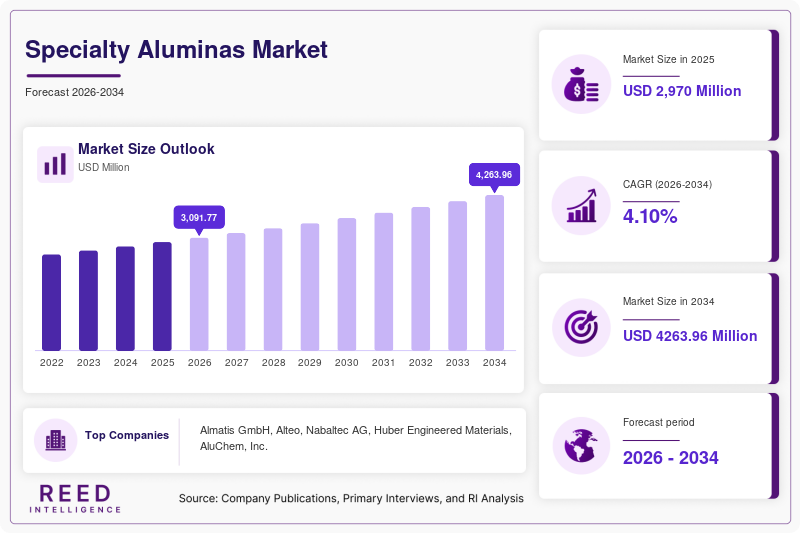
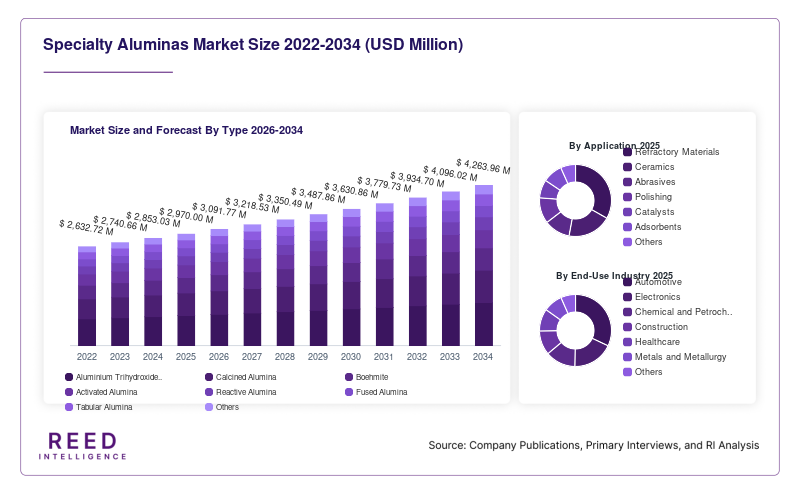
The global specialty aluminas market size was valued at USD 2,970 million in 2025 and is projected to grow from USD 3,091.77 million in 2026 to USD 4,263.96 million by 2034, registering a CAGR of 4.10% during the forecast period from 2026 to 2034.
The specialty aluminas market comprises engineered aluminium oxide materials developed for applications that require specific properties such as high purity, hardness, thermal stability, wear resistance, chemical resistance, and controlled particle size. Major product categories include calcined alumina, activated alumina, tabular alumina, fused alumina, reactive alumina, boehmite, and aluminium trihydroxide (ATH). These materials serve industries including refractories, ceramics, abrasives, polishing, catalysts, automotive, electronics, chemicals, and construction.
Specialty Aluminas Market Drivers
Rising Demand for Refractory Materials
Specialty aluminas are important raw materials for refractory products used in furnaces, kilns, reactors, and other high-temperature industrial equipment. Their hardness, thermal stability, and resistance to wear and chemical attack support applications in steel, cement, glass, and other process industries. Industrial maintenance, replacement of refractory linings, and investment in production capacity contribute to demand for suitable alumina grades.
Growth in Technical Ceramics and Advanced Manufacturing
The use of technical ceramics in electronics, automotive components, industrial machinery, and specialized engineering is supporting demand for engineered alumina materials. These applications can require high hardness, electrical insulation, dimensional stability, thermal performance, and resistance to wear. Producers that offer consistent quality and grades tailored to specific processing requirements can serve manufacturers seeking reliable material performance.
Increasing Use in Catalysts and Environmental Applications
Activated alumina and related materials are used in catalyst support, adsorption, drying, and purification processes. Industrial gas treatment, chemical processing, and emission-control applications create demand for materials with suitable surface area, porosity, and chemical stability. Requirements for more efficient purification and process performance can support the use of specialized alumina grades.
Specialty Aluminas Market Restraints
Energy-Intensive Production and High Processing Costs
Calcination, high-temperature treatment, refining, and specialized processing can require significant energy and capital investment. Production costs may increase with energy prices, raw-material costs, and the need for tighter purity specifications. These factors can affect profitability and make some specialty alumina grades more expensive than alternative materials, particularly in price-sensitive applications.
Raw-Material Price Volatility and Environmental Compliance
Specialty alumina producers can be affected by fluctuations in bauxite, aluminium hydroxide, energy, and transportation costs. Environmental requirements associated with emissions, industrial waste, and energy use can add to operating and compliance expenses. Manufacturers must balance product quality and supply reliability with cost management and changing regulatory expectations.
Specialty Aluminas Market Opportunities
Advanced Electronics, Automotive, and Energy Applications
The development of advanced electronic components, electric vehicles, energy systems, and specialized ceramics creates opportunities for high-purity and engineered aluminas. Depending on grade and formulation, these materials can be used in electrical insulation, thermal management, wear-resistant parts, and specialized ceramic components. Suppliers with the ability to meet stringent technical specifications can expand into higher-value applications.
Sustainable Materials and Specialized Flame-Retardant Formulations
ATH and selected alumina-based materials are used in flame-retardant systems and other applications where thermal behaviour and material safety are important. Demand for halogen-free formulations and improved material performance creates opportunities for product development. Manufacturers can also pursue process improvements that reduce energy consumption, improve yield, and lower waste during specialty alumina production.
Specialty Aluminas Market Segmental Analysis
By Type
Calcined alumina is identified as a leading type in the specialty aluminas market because of its use in refractories, technical ceramics, polishing materials, and other industrial products. Its thermal stability, hardness, and suitability for high-temperature applications support demand from steel, cement, glass, and industrial manufacturing. The segment serves a broad range of uses, with requirements varying by purity, particle size, and processing characteristics.
Aluminium trihydroxide is used in flame-retardant formulations and selected polymer applications. Activated alumina is important in adsorption, drying, purification, and catalyst-support processes. Boehmite and reactive alumina serve specialized ceramic, catalyst, and formulation requirements, while fused and tabular aluminas are used in demanding refractory and abrasive applications. The fastest-growing type can vary according to the market definition and forecast methodology; a sufficiently comparable growth rate for every type could not be independently verified.
By Application
Refractory materials represent the dominant application segment, accounting for more than 35% of the market according to the referenced market estimate. Specialty aluminas are used in refractory bricks, castables, furnace linings, and other high-temperature products because of their thermal stability, mechanical strength, and resistance to demanding operating environments. Demand is associated with steel, cement, glass, foundry, and other energy-intensive industries.
Catalysts and adsorbents are identified as a faster-growing application area in the referenced market analysis. Activated alumina and other suitable alumina materials are used in catalyst support, gas drying, adsorption, and purification. Growth opportunities are associated with chemical processing, industrial gas treatment, and applications that require controlled surface properties and reliable performance. Ceramics, abrasives, and polishing remain important applications, supported by the need for hardness, wear resistance, dimensional consistency, and specialized surface finishes.
By End-Use Industry
Chemical and petrochemical industries use specialty aluminas in catalysts, adsorbents, refractory materials, and process-related applications. Demand depends on plant operating conditions, purification requirements, catalyst performance, and investment in industrial processing infrastructure.
The automotive and electronics industries require selected specialty alumina grades for technical ceramics, electrical insulation, wear-resistant components, polishing, and other specialized uses. Construction and metals-related industries contribute through refractory products, ceramics, and industrial processing. Healthcare applications include selected technical ceramic and polishing uses where the material grade meets the required technical and regulatory specifications. End-use growth differs by alumina type and application, so a single verified fastest-growing industry share was not available.
Specialty Aluminas Market Regional Analysis
North America Specialty Aluminas Market
North America is an established market for specialty aluminas, supported by industrial manufacturing, refractory production, technical ceramics, chemical processing, and advanced materials research. The United States contributes through demand from industrial furnaces, automotive components, electronics, aerospace, and catalyst applications. Canada also supports demand through metals processing, chemicals, and industrial manufacturing. A reliable numerical 2025 global market-share percentage for North America could not be verified for the exact market definition used in this report.
Regional demand is influenced by the need for high-performance materials, industrial equipment maintenance, environmental applications, and specialized ceramic components. Manufacturers are focused on improving product purity, process consistency, and energy efficiency. Investment in advanced manufacturing and high-value industrial applications can support demand, while production costs, energy prices, and environmental compliance remain important considerations.
Europe Specialty Aluminas Market
Europe's specialty aluminas market is supported by established chemical, automotive, refractory, ceramic, and industrial manufacturing sectors. Germany, France, Italy, and the United Kingdom contribute through automotive production, industrial machinery, technical ceramics, and chemical processing. European manufacturers also serve specialized applications that require controlled material characteristics and consistent product quality. A reliable numerical 2025 global market-share percentage for Europe could not be verified for the exact market definition used in this report.
Demand is influenced by industrial modernization, refractory replacement cycles, environmental requirements, and the development of advanced materials. Alumina-based catalysts and adsorbents serve selected chemical and purification applications, while calcined and tabular aluminas support high-temperature processes. Producers face pressure to manage energy-intensive processing, meet environmental requirements, and maintain competitiveness in international markets.
Asia Pacific Specialty Aluminas Market
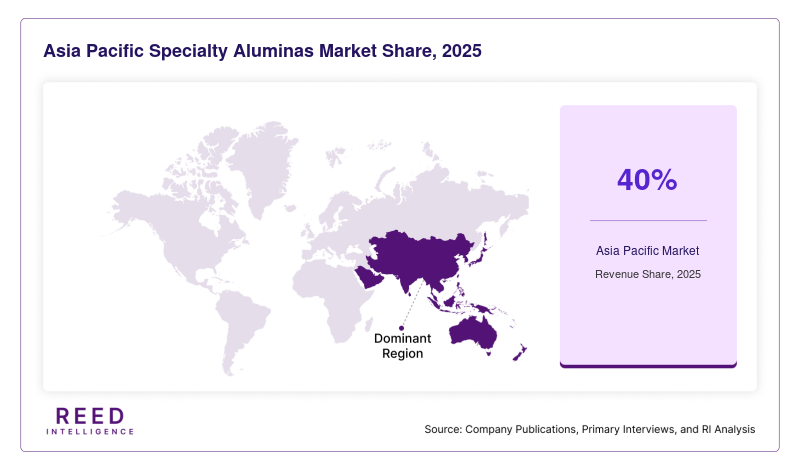
Asia Pacific is the dominant region, accounting for more than 40% of the global specialty aluminas market, according to the referenced market analysis. China, India, and Japan contribute to regional demand through steel production, ceramics, automotive manufacturing, electronics, construction, and chemical processing. Industrialization and infrastructure development support the use of specialty aluminas in refractory materials, technical ceramics, abrasives, and other industrial applications.
Regional growth is supported by manufacturing capacity, expanding industrial production, and demand for high-performance materials. China has a substantial industrial base for alumina consumption, while India contributes through infrastructure, metals, ceramics, and chemical industries. Japan and South Korea support demand for specialized materials used in electronics, precision manufacturing, and advanced ceramics. Energy costs, environmental controls, raw-material availability, and competition among producers influence the regional market.
Latin America Specialty Aluminas Market
Latin America's specialty aluminas market is supported by metals processing, construction, cement, ceramics, chemicals, and other industrial activities. Brazil is an important market because of its manufacturing base, mineral resources, and industrial processing sectors. Mexico and other regional economies contribute through automotive manufacturing, construction materials, and industrial supply chains. A reliable numerical 2025 global market-share percentage for Latin America could not be verified for the exact market definition used in this report.
Regional demand depends on industrial investment, refractory requirements, infrastructure development, and the availability of specialized materials. Opportunities exist in improving refractory performance, expanding technical ceramic applications, and supporting chemical-processing operations. However, economic volatility, transportation costs, imported equipment requirements, and differences in local manufacturing capabilities can affect adoption and supply-chain planning.
Middle East & Africa Specialty Aluminas Market
The Middle East & Africa market is supported by metals and mineral processing, petrochemicals, construction, cement, and industrial infrastructure. Gulf economies contribute through chemical processing, refining, and industrial diversification, while South Africa and other African markets have demand associated with mining, metallurgy, construction, and industrial manufacturing. A reliable numerical 2025 global market-share percentage for this region could not be verified for the exact market definition used in this report.
Demand opportunities include refractory materials for high-temperature operations, alumina-based catalysts and adsorbents for chemical processing, and specialized materials for infrastructure and industrial development. Regional market growth depends on industrial investment, supply-chain access, local processing capabilities, and the development of downstream manufacturing. Energy costs, imported-material dependence, and uneven infrastructure can influence purchasing decisions.
Specialty Aluminas Market Competitive Landscape
The specialty aluminas market includes integrated aluminium producers, specialty chemical companies, engineered-material manufacturers, and suppliers focused on high-purity and application-specific alumina grades. Companies compete through product quality, purity, particle characteristics, technical support, supply reliability, processing capabilities, and the ability to meet customer-specific specifications.
Competition differs by product category. Large producers serve industrial customers requiring consistent supply of calcined and other alumina grades, while specialty manufacturers focus on technical ceramics, refractories, polishing materials, catalysts, and adsorbents. Research and development, process optimization, energy efficiency, and product customization are important factors in maintaining competitiveness.
Key Market Players
- Almatis GmbH
- Alteo
- Nabaltec AG
- Huber Engineered Materials
- AluChem, Inc.
- Rio Tinto
- Alcoa Corporation
- Aluminum Corporation of China Limited (CHALCO)
- Hindalco Industries Limited
- Sumitomo Chemical Co., Ltd.
Specialty Aluminas MarketRecent Market Developments
- August 2026 - Hindalco Industries Limited: Hindalco commissioned India's first superfine precipitated aluminium trihydrate (PPT ATH) manufacturing plant in Belagavi, Karnataka. The greenfield facility has an annual production capacity of 30,000 tonnes and will supply specialty alumina for halogen-free flame-retardant applications, including wires and cables, polymer insulators, thermal insulation, and electric vehicles. Hindalco stated that the facility operates entirely on renewable energy.
- July 2026 - Almatis: Almatis reached a major construction milestone at its new production facility in Qingdao, China, completing the main structure's topping-out ceremony. The project is intended to expand production capabilities for high-purity alumina and specialty ceramic materials, serving demand from semiconductor, electronics, and new-energy applications.
Specialty Aluminas Market Segments
By Type
- Aluminium Trihydroxide (ATH)
- Calcined Alumina
- Boehmite
- Activated Alumina
- Reactive Alumina
- Fused Alumina
- Tabular Alumina
- Others
By Application
- Refractory Materials
- Ceramics
- Abrasives
- Polishing
- Catalysts
- Adsorbents
- Others
By End-Use Industry
- Automotive
- Electronics
- Chemical and Petrochemical
- Construction
- Healthcare
- Metals and Metallurgy
- Others
By Region
- North America
- Europe
- APAC
- Middle East and Africa
- LATAM