Specialty Coffee Shops Market Size, Share & Trends Analysis Report By Shop Type (Independent Specialty Coffee Shops, Specialty Coffee Chains), By Coffee Offering (Espresso-Based Beverages, Brewed & Filter Coffee), By Business Model (Dine-In Cafes, Takeaway-Focused, Drive-Thru Specialty Cafes), By Service Channel (On-Premise Consumption, Takeaway/Pick-Up) and By Region (North America, Europe, APAC, Middle East and Africa, LATAM) Forecasts, 2026-2034
USD 3950
Specialty Coffee Shops Market Size
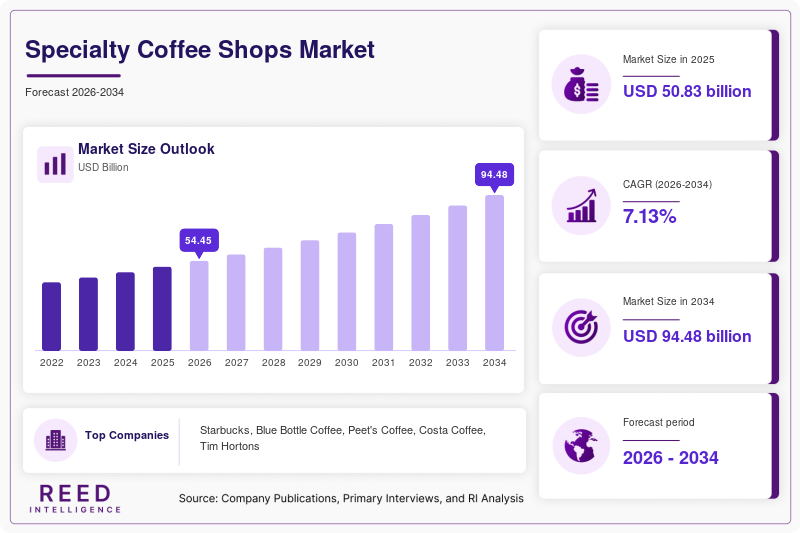
The Specialty Coffee Shops Market was valued at USD 50.83 billion in 2025 and is estimated at USD 54.45 billion in 2026. Based on the supplied forecast, the market is projected to reach USD 94.48 billion by 2034, representing a CAGR of 7.13% during 2026–2034.
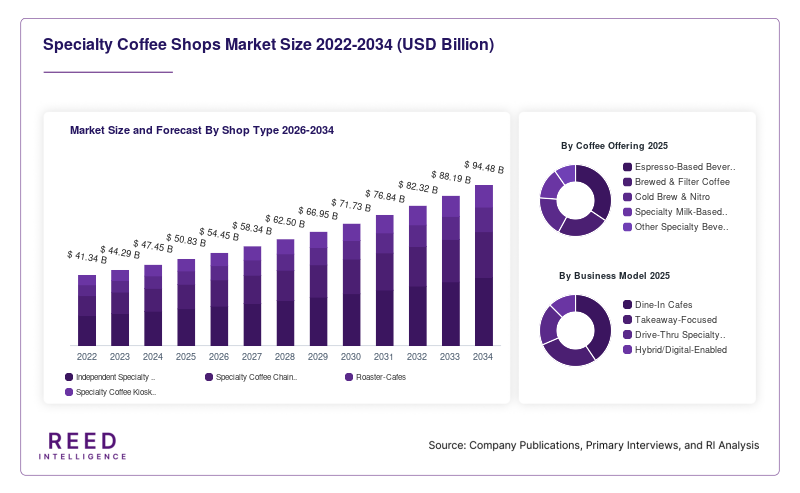
The 2026 market represents approximately 7.13% growth over 2025, consistent with the supplied forecast trajectory. Applying the supplied CAGR backward gives an analytical market size of approximately USD 47.44 billion in 2024, USD 44.28 billion in 2023, and USD 41.29 billion in 2022. These historical values are back-calculated estimates, not independently reported historical market sizes.
The demand environment is favorable because specialty coffee is increasingly becoming an everyday consumption category rather than a niche premium product. In the U.S., 48% of adults reported drinking specialty coffee in the past day in September 2026, exceeding traditional coffee consumption. Out-of-home consumption has also recovered: 38% of past-day coffee drinkers had coffee prepared outside the home in the September 2026 NCDT survey, the highest level since January 2020.
Younger consumers are particularly important. The 2026 NCDT Specialty Coffee Report found that 69% of 25–39-year-olds had consumed specialty coffee during the past week, while 36% of past-day specialty coffee drinkers had their coffee prepared away from home, compared with 23% for traditional coffee drinkers.
The market nevertheless faces a significant input-cost challenge. The International Coffee Organization reported that its Composite Indicator Price averaged 287.29 US cents/lb in August 2026, with prices influenced by weather expectations, Brazilian rainfall and near-term Arabica supply conditions. This creates direct pressure on specialty cafés because higher-quality beans represent a core component of product differentiation.
Specialty Coffee Shops Market Drivers
Specialty Coffee Has Moved Into the Mainstream
The strongest demand signal is the increasing share of consumers choosing specialty coffee.
In September 2026, 48% of U.S. adults had specialty coffee in the previous day, compared with 42% for traditional coffee. Espresso-based beverages also reached a record level, with 47% of adults reporting consumption during the previous week.
The commercial mechanism is important: as specialty beverages move from occasional indulgence to habitual consumption, cafés gain more opportunities to generate recurring traffic rather than relying exclusively on premium discretionary purchases.
Younger Consumers Are Increasing Specialty-Café Demand
Consumers aged 25–39 are a particularly important customer group. The 2026 specialty coffee report found that 69% of this age group consumed specialty coffee during the previous week.
This demographic tends to value beverage customization, coffee quality, café atmosphere, digital convenience and social experiences.
For specialty cafés, the implication is that the addressable customer base is expanding beyond traditional coffee enthusiasts toward consumers who associate specialty coffee with lifestyle, work and social activity.
Out-of-Home Consumption Is Recovering
The U.S. coffee market is experiencing a renewed shift toward out-of-home consumption.
The September 2026 NCDT report found that 38% of past-day coffee drinkers consumed coffee prepared outside the home, the highest level since January 2020. Specialty drinkers are particularly oriented toward out-of-home preparation, with 36% reporting coffee prepared away from home.
This creates direct revenue opportunities for cafés through beverage sales, food attachment, premium customization and repeat visits.
Specialty Coffee Shops Market Restraints
Volatile Green-Coffee Prices
Coffee input prices remain one of the most significant constraints on café margins.
The ICO Composite Indicator Price averaged 287.29 US cents/lb in August 2026, after remaining highly volatile during the preceding period. The organization attributes price movements to changing supply expectations, weather and production conditions.
Cafés cannot always pass higher bean costs through immediately because customers remain sensitive to beverage prices. Operators therefore need to balance menu pricing, portion sizes, sourcing contracts and product mix.
Labor Costs and Barista Availability
Specialty cafés depend more heavily on skilled labor than conventional self-service coffee formats because preparation quality is part of the product proposition.
Training, employee turnover, wage pressures and limited availability of experienced baristas can therefore increase operating costs.
The SCA has highlighted labor and livelihood issues across the coffee value chain, including pressures affecting both farm labor and coffee workers.
High Store-Level Operating Costs
Rent, utilities, equipment, labor and fit-out costs can significantly affect café economics.
Specialty coffee shops generally require espresso machines, grinders, water-filtration systems, refrigeration, display equipment, seating and increasingly digital ordering infrastructure.
Prime urban locations provide traffic but can materially increase occupancy costs, making store productivity a critical factor.
Specialty Coffee Shops Market Opportunities
Expansion of Specialty Café Chains
Specialty chains can scale sourcing, training, technology and marketing while maintaining a differentiated coffee proposition.
The opportunity is particularly strong in markets where specialty coffee consumption is growing from a relatively low base.
Expansion in APAC
APAC provides a strong growth opportunity because of urbanization, younger consumer demographics, expanding middle-class populations and increasing adoption of café culture.
India is particularly notable. The Coffee Board estimates domestic coffee consumption at 96,000 MT in 2024 and identifies rapid café expansion as an important part of the country's evolving coffee market.
Cold Brew and Specialty Beverage Innovation
Cold brew, nitro, flavored espresso drinks and specialty milk-based beverages allow cafés to expand beyond traditional hot coffee.
These products can also increase afternoon and evening demand, reducing dependence on morning traffic.
Segmental Analysis
By Shop Type
Independent Specialty Coffee Shops represent approximately 42% of the 2025 market, equivalent to about USD 21.35 billion under the internal analytical allocation. The segment is modeled at approximately 6.9% CAGR through 2034, producing an indicative USD 38.92 billion by 2034. Independent cafés benefit from local brand identity, neighborhood relationships, flexible menus and the ability to emphasize single-origin or craft coffee.
Specialty Coffee Chains represent approximately 35% of the 2025 market, equivalent to about USD 17.79 billion. The segment is modeled at approximately 7.3% CAGR, reaching around USD 33.54 billion by 2034. Chains benefit from standardized quality, centralized procurement, digital loyalty systems and greater access to prime retail locations.
Roaster-Cafes represent approximately 15% of the 2025 market, or about USD 7.62 billion. The segment is modeled at approximately 7.8% CAGR, reaching approximately USD 14.99 billion by 2034. These businesses control more of the value chain by combining roasting, retail and café operations.
Specialty Coffee Kiosks & Other Formats represent approximately 8% of the 2025 market, equivalent to about USD 4.07 billion. The segment is modeled at approximately 5.8% CAGR, reaching around USD 6.75 billion by 2034. Compact formats benefit from lower space requirements but generally provide a narrower experience proposition.
By Coffee Offering
Espresso-Based Beverages represent approximately 40% of the 2025 market, equivalent to about USD 20.33 billion. The segment is modeled at approximately 6.8% CAGR, reaching around USD 36.76 billion by 2034. Espresso provides the base for lattes, cappuccinos, americanos, macchiatos and other high-frequency specialty beverages.
Brewed & Filter Coffee represents approximately 22% of the 2025 market, equivalent to about USD 11.18 billion. It is modeled at approximately 6.5% CAGR, reaching approximately USD 19.71 billion by 2034. Filter and pour-over methods remain important for consumers interested in origin, flavor profile and brewing technique.
Cold Brew & Nitro represents approximately 16% of the 2025 market, or about USD 8.13 billion. The segment is modeled at approximately 8.5% CAGR, reaching around USD 16.95 billion by 2034. Its higher modeled growth reflects product innovation, younger consumer adoption and stronger relevance outside the traditional morning coffee occasion.
Specialty Milk-Based Beverages represent approximately 14% of the 2025 market, equivalent to about USD 7.12 billion. The segment is modeled at approximately 7.8% CAGR, reaching approximately USD 13.99 billion by 2034. Lattes, cappuccinos and related beverages combine specialty coffee with flavor customization and premium pricing.
Other Specialty Beverages represent approximately 8% of the 2025 market, or about USD 4.07 billion, and are modeled at approximately 6.0% CAGR, reaching around USD 6.87 billion by 2034.
By Business Model
Dine-In Cafes represent approximately 48% of the 2025 market, equivalent to about USD 24.40 billion. The segment is modeled at approximately 6.5% CAGR, reaching approximately USD 43.00 billion by 2034. Dine-in cafés monetize not only coffee but also seating, social interaction, work and customer experience.
Takeaway-Focused formats represent approximately 28% of the 2025 market, or about USD 14.23 billion. The segment is modeled at approximately 7.2% CAGR, reaching around USD 26.61 billion by 2034. Faster service and smaller footprints support expansion in dense urban and commuter locations.
Drive-Thru Specialty Cafes represent approximately 12% of the 2025 market, equivalent to about USD 6.10 billion. The segment is modeled at approximately 8.0% CAGR, reaching around USD 12.19 billion by 2034. The model benefits from convenience and high transaction throughput.
Hybrid/Digital-Enabled cafés represent approximately 12% of the 2025 market, or about USD 6.10 billion. The segment is modeled at approximately 8.5% CAGR, reaching approximately USD 12.71 billion by 2034. Mobile ordering, loyalty, delivery integration and digital personalization support higher repeat-purchase potential.
By Service Channel
On-Premise Consumption represents approximately 46% of the 2025 market, equivalent to about USD 23.38 billion. It is modeled at approximately 6.3% CAGR, reaching approximately USD 40.52 billion by 2034.
Takeaway/Pick-Up represents approximately 30% of the 2025 market, or about USD 15.25 billion, and is modeled at approximately 7.0% CAGR, reaching approximately USD 28.03 billion by 2034.
Delivery represents approximately 14% of the 2025 market, equivalent to about USD 7.12 billion. It is modeled at approximately 9.0% CAGR, reaching approximately USD 15.46 billion by 2034. Delivery has the highest modeled channel growth because digital ordering expands café reach beyond the immediate store catchment.
Retail Beans & Merchandise represent approximately 10% of the 2025 market, equivalent to about USD 5.08 billion. The segment is modeled at approximately 8.0% CAGR, reaching around USD 10.16 billion by 2034. Retail products create recurring revenue beyond individual café visits.
Regional Analysis
North America Specialty Coffee Shops Market
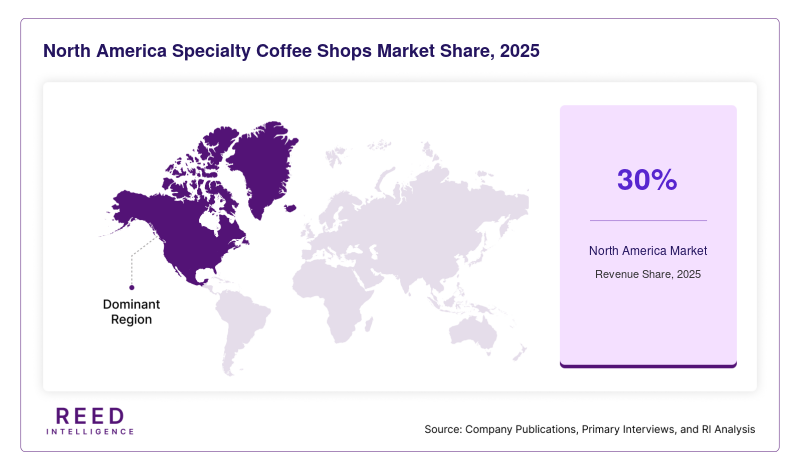
North America represents approximately 30% of the 2025 market, equivalent to about USD 15.25 billion under the internal analytical allocation. It is modeled at approximately 6.5% CAGR, reaching around USD 26.88 billion by 2034.
The region has a mature specialty coffee culture and strong consumer awareness of espresso-based beverages, cold brew, single-origin coffee and premium café concepts.
The U.S. is particularly important. Specialty coffee consumption reached a record 48% of adults in September 2026, while out-of-home consumption also recovered toward pre-pandemic levels.
Large chains are simultaneously investing in store experience and productivity. Starbucks reported 7.9% global comparable-store sales growth in Q3 FY2026, driven by transaction and average-ticket growth, while its Back to Starbucks strategy emphasizes customer service, menu innovation and coffeehouse experience.
Europe Specialty Coffee Shops Market
Europe represents approximately 25% of the 2025 market, equivalent to about USD 12.71 billion. It is modeled at approximately 6.4% CAGR, reaching approximately USD 22.21 billion by 2034.
Europe has a deep café culture and strong espresso traditions, while specialty coffee continues to expand through independent cafés, micro-roasters and premium chains.
Sustainability and traceability are particularly important. The EU Deforestation Regulation covers coffee and requires relevant businesses to demonstrate that covered products are deforestation-free and legally produced. Large and medium operators face an application date of December 30, 2026.
APAC Specialty Coffee Shops Market
APAC represents approximately 27% of the 2025 market, equivalent to about USD 13.72 billion. It is modeled at approximately 9.0% CAGR, the highest regional growth rate, reaching approximately USD 29.81 billion by 2034.
The region benefits from urbanization, younger consumers, rising disposable incomes and increasing adoption of Western and specialty café formats.
India is a particularly important growth market. The Coffee Board reports that domestic consumption increased substantially over the long term and reached an estimated 96,000 MT in 2024. It also identifies rapid expansion of coffee bars and cafés in urban centers.
The region also has strong domestic specialty operators. The Coffee Board's consumption research identifies brands including Blue Tokai, Araku and Subko within India's specialty café and roaster ecosystem.
Middle East and Africa Specialty Coffee Shops Market
Middle East and Africa represent approximately 7% of the 2025 market, equivalent to about USD 3.56 billion. The segment is modeled at approximately 7.0% CAGR, reaching around USD 6.54 billion by 2034.
Urban development, tourism, premium hospitality and younger consumers support specialty café adoption. Gulf markets are particularly relevant for premium café concepts because coffee consumption is increasingly integrated with retail, hospitality and lifestyle destinations.
However, import dependence, rental costs and differences in consumer purchasing power can produce substantial variation across countries.
LATAM Specialty Coffee Shops Market
LATAM represents approximately 11% of the 2025 market, equivalent to about USD 5.59 billion. It is modeled at approximately 7.5% CAGR, reaching approximately USD 10.72 billion by 2034.
The region combines major coffee-producing countries with growing domestic specialty consumption. Local origin access can provide cafés with an advantage in storytelling, freshness and differentiated single-origin offerings.
Brazil, Colombia and other coffee-producing countries also provide opportunities for specialty cafés to integrate producer relationships and origin-focused experiences into the retail proposition.
Competitive Landscape
The Specialty Coffee Shops Market is highly fragmented, with competition between global chains, regional specialty chains, independent cafés and vertically integrated roaster-café businesses.
Competition is increasingly based on coffee quality, store experience, beverage innovation, convenience, digital loyalty, sourcing transparency and location economics.
Global chains have substantial advantages in procurement, technology, marketing and store networks. Starbucks, for example, has been investing heavily in its coffeehouse experience under the Back to Starbucks strategy. In April 2026, the company said it had invested more than USD 500 million in its coffeehouse partners and linked the investments to service and operational improvements.
Independent specialty operators compete through local identity, specialty beans, direct relationships with roasters and differentiated café experiences.
Roaster-cafés have another advantage: vertical integration allows them to control roasting and café presentation, potentially improving product consistency and brand differentiation.
The competitive environment is therefore moving toward a combination of specialty product expertise and operational scalability.
Key Market Players
- Starbucks
- Blue Bottle Coffee
- Peet's Coffee
- Costa Coffee
- Tim Hortons
- Dutch Bros
- Caribou Coffee
- The Coffee Bean & Tea Leaf
- Gloria Jean's Coffees
- Blue Tokai Coffee Roasters
- Third Wave Coffee
- % Arabica
- Pret A Manger
- Blank Street Coffee
Recent Market Developments
September 2026 — U.S. Specialty Coffee Consumption Reaches New Record
The National Coffee Association reported that 48% of U.S. adults consumed specialty coffee in the past day, while out-of-home coffee consumption reached 38% among past-day coffee drinkers.
July 2026 — Specialty Coffee Consumption Remains at Record High
The Specialty Coffee Association reported that 47% of American adults consumed specialty coffee in the past day, with 69% of consumers aged 25–39 consuming specialty coffee during the previous week.
Specialty Coffee Shops Market Segments
By Shop Type
- Independent Specialty Coffee Shops
- Specialty Coffee Chains
- Roaster-Cafes
- Specialty Coffee Kiosks & Other Formats
By Coffee Offering
- Espresso-Based Beverages
- Brewed & Filter Coffee
- Cold Brew & Nitro
- Specialty Milk-Based Beverages
- Other Specialty Beverages
By Business Model
- Dine-In Cafes
- Takeaway-Focused
- Drive-Thru Specialty Cafes
- Hybrid/Digital-Enabled
By Service Channel
- On-Premise Consumption
- Takeaway/Pick-Up
- Delivery
- Retail Beans & Merchandise
By Region
- North America
- Europe
- APAC
- Middle East and Africa
- LATAM