Specialty Synthetic Glass Fiber Market Size, Share & Demand Report By Product Type (E-Glass Fiber, S-Glass Fiber, C-Glass Fiber), By Application (Composites and Reinforcement, Electrical and Electronics), By End-Use Industry (Construction and Infrastructure, Automotive and Transportation), By Manufacturing Process (Continuous Filament Process), By Distribution Channel (Direct Industrial Sales, Specialty Material Distributors, Online B2B Platforms), By Region & Segment Forecasts, 2026–2034
USD 3950
Market Overview
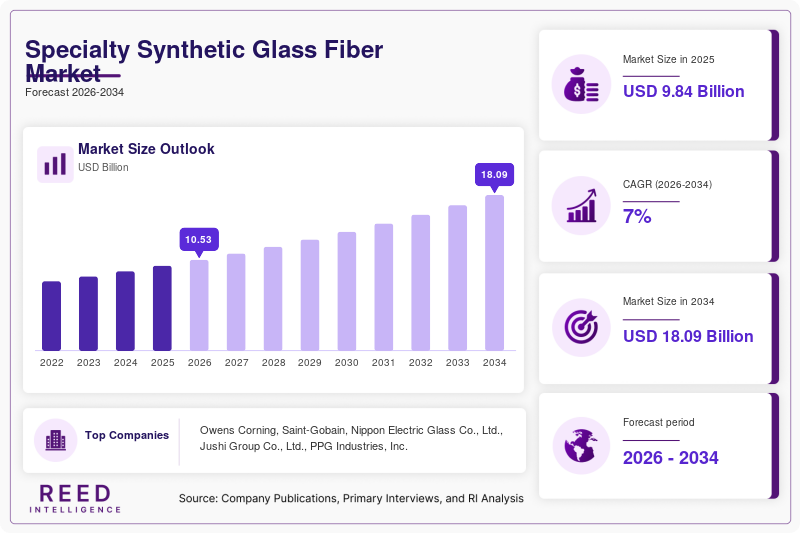
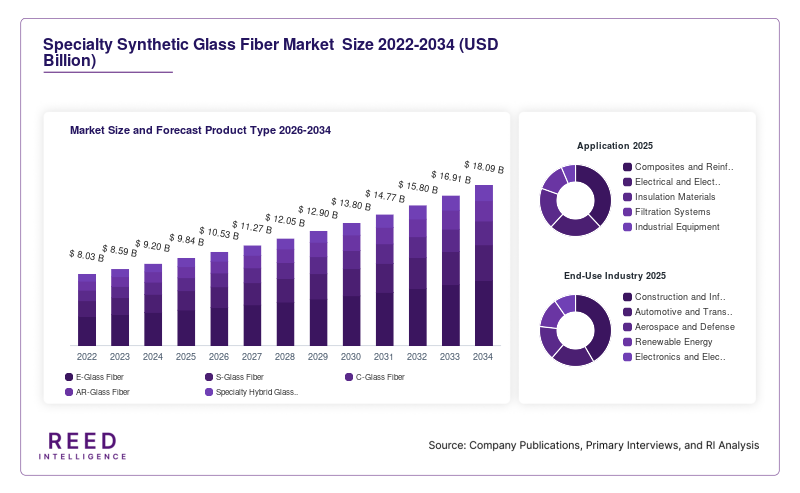
The global Specialty Synthetic Glass Fiber Market size was valued at USD 9.84 billion in 2026 and is projected to reach USD 16.92 billion by 2034, expanding at a CAGR of 7.0% during the forecast period (2026–2034). The market growth has been supported by rising global demand for lightweight, high-strength composite materials across aerospace, automotive, electronics, renewable energy, and construction industries. Increasing industrial preference for advanced reinforcement materials with enhanced thermal resistance and durability has accelerated the adoption of specialty synthetic glass fibers in high-performance applications.
Specialty synthetic glass fibers are engineered materials widely utilized for insulation, structural reinforcement, filtration, and composite manufacturing. These fibers offer favorable mechanical properties, corrosion resistance, and electrical insulation performance, making them suitable for demanding industrial environments. The expansion of advanced manufacturing activities and growing investments in infrastructure modernization have contributed to rising market penetration globally.
Key Highlights
- Asia Pacific accounted for 39.2% of the global Specialty Synthetic Glass Fiber Market share in 2025, while the Middle East & Africa is projected to register the fastest CAGR of 8.1% during the forecast period.
- By product type, E-glass fiber dominated with a 48.7% market share in 2025, whereas S-glass fiber is anticipated to grow at a CAGR of 8.4% through 2034.
- By application, composites and reinforcement held the largest market share of 44.1% in 2025, while electrical and electronics applications are expected to expand at a CAGR of 8.3%.
- By end-use industry, construction and infrastructure captured 31.6% of the market in 2025, whereas renewable energy is forecast to grow at a CAGR of 8.8%.
- China remained the dominant country market, valued at USD 1.82 billion in 2024 and USD 1.95 billion in 2025.
Market Trends
Increasing Integration of Lightweight Composite Materials
The growing use of lightweight composite materials in transportation and industrial manufacturing has become a notable trend shaping the Specialty Synthetic Glass Fiber Market. Automotive and aerospace manufacturers are increasingly replacing traditional metal components with reinforced composite materials to improve fuel efficiency and structural performance. Specialty synthetic glass fibers are gaining traction because they provide durability, dimensional stability, and reduced material weight in critical engineering applications.
Expansion of High-Performance Electrical Insulation Applications
The rapid development of advanced electronics and electrical systems is driving demand for specialty glass fiber insulation materials. Manufacturers are utilizing engineered glass fibers in circuit boards, insulation panels, battery systems, and industrial electrical components due to their thermal resistance and dielectric properties. The increasing adoption of electric vehicles and smart industrial systems continues to support this market trend.
Market Drivers
Rising Demand from Wind Energy Sector
The expansion of global wind energy infrastructure has significantly supported the Specialty Synthetic Glass Fiber Market. Wind turbine manufacturers increasingly rely on reinforced glass fiber composites for blade production because of their strength-to-weight advantages and corrosion resistance. Governments and energy companies are investing in renewable energy projects, creating sustained demand for advanced composite materials in large-scale turbine manufacturing.
Growth in Advanced Construction Materials
The increasing use of durable and lightweight materials in modern construction projects has accelerated market demand. Specialty synthetic glass fibers are widely used in reinforced concrete, insulation systems, roofing materials, and structural panels. Infrastructure developers are adopting advanced composite materials to improve longevity, thermal performance, and design flexibility in commercial and industrial construction applications.
Market Restraint
High Energy Consumption in Manufacturing
The production of specialty synthetic glass fibers requires energy-intensive manufacturing processes involving high-temperature melting and precision processing technologies. Rising industrial energy costs and environmental regulations can increase operational expenses for manufacturers. These factors may limit profit margins and create pricing challenges across the market.
Market Opportunities
Expansion of Electric Vehicle Manufacturing
The rapid growth of electric vehicle production is creating new opportunities for specialty synthetic glass fiber manufacturers. Automotive companies are increasingly utilizing lightweight composite materials to improve battery efficiency and vehicle performance. Specialty glass fibers are expected to witness growing adoption in battery enclosures, interior structures, and insulation systems.
Increasing Demand for Industrial Filtration Solutions
The expansion of industrial filtration systems is generating growth opportunities for the Specialty Synthetic Glass Fiber Market. Manufacturers are developing advanced fiber-based filtration materials for chemical processing, water treatment, and air purification applications. Rising environmental standards and industrial safety requirements are expected to support long-term segment demand.
Segmental Analysis
By Product Type
E-Glass Fiber Dominated the Market
E-glass fiber accounted for 48.7% of the Specialty Synthetic Glass Fiber Market share in 2025. The segment maintained dominance because of its cost-effectiveness, strong electrical insulation properties, and broad industrial applicability. Manufacturers widely utilized E-glass fibers in reinforced plastics, insulation materials, and structural composites across multiple industries.
S-Glass Fiber to Witness Fastest Growth
S-glass fiber is projected to expand at a CAGR of 8.4% during the forecast period. The segment will gain traction due to its superior tensile strength and impact resistance compared to conventional glass fiber materials. Increasing utilization in aerospace structures and high-performance automotive components is expected to support segment growth.
By Application
Composites and Reinforcement Held the Largest Share
Composites and reinforcement represented 44.1% of the global Specialty Synthetic Glass Fiber Market share in 2025. The segment dominated because specialty glass fibers are extensively used in structural reinforcement applications for industrial equipment, transportation systems, and construction materials. Rising demand for lightweight composite products supported segment expansion.
Electrical and Electronics Applications Expected to Grow Rapidly
Electrical and electronics applications are anticipated to register a CAGR of 8.3% during the forecast period. Increasing demand for thermal insulation materials and advanced electrical components will support segment growth. Manufacturers are expected to develop specialty fibers with improved dielectric and heat-resistant properties for electronics applications.
By End-Use Industry
Construction and Infrastructure Dominated the Market
Construction and infrastructure held 31.6% of the Specialty Synthetic Glass Fiber Market share in 2025. The segment maintained dominance because specialty glass fibers are increasingly utilized in reinforced concrete systems, insulation products, and architectural panels. Growing investments in urban infrastructure modernization supported market demand.
Renewable Energy to Register Highest Growth
Renewable energy is projected to grow at a CAGR of 8.8% through 2034. Increasing installation of wind energy systems and advanced energy infrastructure will drive segment expansion. Manufacturers are expected to supply high-performance glass fiber composites for turbine blades and energy storage systems.
By Manufacturing Process
Continuous Filament Process Led the Market
The continuous filament process accounted for 57.9% of the global Specialty Synthetic Glass Fiber Market share in 2025. The segment benefited from high production efficiency and product consistency in industrial manufacturing applications. Continuous filament materials remained preferred for structural reinforcement and composite fabrication.
Melt-Blown Process to Expand Significantly
The melt-blown process is expected to grow at a CAGR of 8.2% during the forecast period. Increasing utilization in filtration and insulation applications will support segment demand. Manufacturers are anticipated to invest in advanced processing technologies to improve fiber uniformity and filtration efficiency.
Regional Analysis
North America
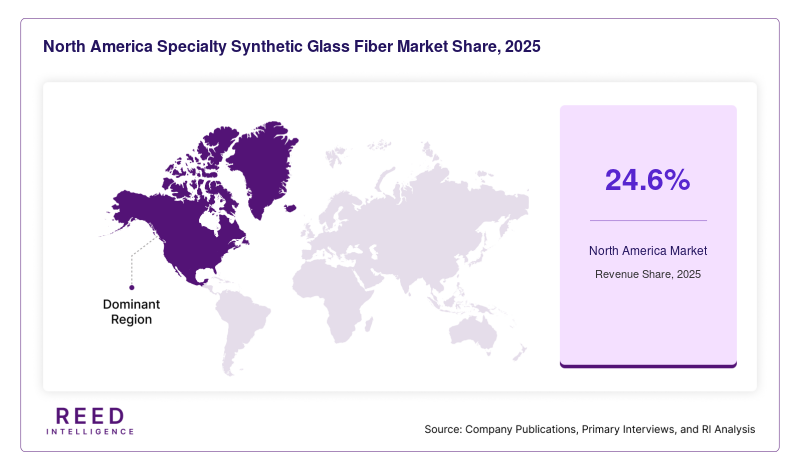
North America accounted for 24.6% of the global Specialty Synthetic Glass Fiber Market share in 2025 and is projected to grow at a CAGR of 6.7% during the forecast period. The regional market benefited from strong demand for aerospace composites and advanced construction materials. The United States dominated the regional market due to increasing investments in electric vehicle manufacturing and industrial automation technologies. Rising utilization of lightweight materials in transportation applications supported regional market growth.
Europe
Europe held 27.3% of the global Specialty Synthetic Glass Fiber Market share in 2025 and is anticipated to expand at a CAGR of 6.9% through 2034. The regional market was supported by growing renewable energy investments and advanced automotive manufacturing activities. Germany emerged as the leading country market due to the strong presence of industrial engineering companies and composite material manufacturers. Increasing adoption of sustainable construction materials is expected to contribute to regional market expansion.
Asia Pacific
Asia Pacific represented 39.2% of the global Specialty Synthetic Glass Fiber Market share in 2025 and is forecast to register a CAGR of 7.8% during the forecast period. China dominated the regional market due to expanding electronics manufacturing and large-scale infrastructure development projects. Increasing industrial production and rapid urbanization are expected to strengthen demand for advanced reinforcement materials across the region.
Middle East & Africa
The Middle East & Africa accounted for 4.9% of the global Specialty Synthetic Glass Fiber Market share in 2025 and is projected to grow at the fastest CAGR of 8.1% between 2026 and 2034. Saudi Arabia led the regional market owing to rising investments in industrial infrastructure and energy diversification projects. Expanding construction modernization activities are expected to support market growth across the region.
Latin America
Latin America captured 4.0% of the global Specialty Synthetic Glass Fiber Market share in 2025 and is expected to grow at a CAGR of 6.5% during the forecast period. Brazil dominated the regional market due to increasing industrial manufacturing activities and growing use of reinforced materials in commercial construction projects. Expanding renewable energy installations are anticipated to contribute to regional market development.
Competitive Landscape
The Specialty Synthetic Glass Fiber Market remains moderately consolidated with the presence of global material manufacturers, composite solution providers, and industrial fiber producers. Market participants are focusing on production capacity expansion, lightweight material innovation, sustainability initiatives, and strategic partnerships to strengthen their competitive position.
Owens Corning emerged as a leading market participant due to its extensive composite materials portfolio and advanced fiber manufacturing capabilities. The company recently expanded its specialty glass fiber production operations to address increasing demand from renewable energy and industrial composite applications.
Saint-Gobain strengthened its advanced materials division through investments in high-performance reinforcement technologies.
Nippon Electric Glass Co., Ltd. focused on specialty glass fiber solutions for electronics and insulation applications.
Jushi Group Co., Ltd. expanded its industrial composite manufacturing capabilities for infrastructure and transportation applications.
PPG Industries, Inc. invested in lightweight material technologies targeting automotive and aerospace industries.
Key Players List
- Owens Corning
- Saint-Gobain
- Nippon Electric Glass Co., Ltd.
- Jushi Group Co., Ltd.
- PPG Industries, Inc.
- China Beihai Fiberglass Co., Ltd.
- Johns Manville
- AGY Holding Corp.
- Taishan Fiberglass Inc.
- Binani Industries Ltd.
- 3B-the fibreglass company
- Chongqing Polycomp International Corp.
- Knauf Insulation
- CertainTeed Corporation
- Hexcel Corporation
Recent Developments
- In 2025, Owens Corning expanded its specialty glass fiber production capacity for renewable energy applications.
- In 2024, Saint-Gobain introduced advanced reinforcement materials for industrial composite systems.
- In 2025, Jushi Group Co., Ltd. strengthened its global distribution network for engineered fiberglass products.
- In 2024, Nippon Electric Glass Co., Ltd. launched specialty insulation glass fibers targeting electronics manufacturing applications.
- In 2025, PPG Industries, Inc. invested in lightweight composite material technologies for transportation applications.
Specialty Synthetic Glass Fiber Market Segments
Product Type
- E-Glass Fiber
- S-Glass Fiber
- C-Glass Fiber
- AR-Glass Fiber
- Specialty Hybrid Glass Fiber
Application
- Composites and Reinforcement
- Electrical and Electronics
- Insulation Materials
- Filtration Systems
- Industrial Equipment
End-Use Industry
- Construction and Infrastructure
- Automotive and Transportation
- Aerospace and Defense
- Renewable Energy
- Electronics and Electrical
Manufacturing Process
- Continuous Filament Process
- Melt-Blown Process
- Staple Fiber Process
Distribution Channel
- Direct Industrial Sales
- Specialty Material Distributors
- Online B2B Platforms
- Composite Material Suppliers
- Regional Industrial Dealers
By Region
- North America
- Europe
- APAC
- Middle East and Africa
- LATAM