Specimen Retrieval Bag Market Size, Share & Demand Report By Product Type (Detachable Specimen Retrieval Bags, Non-Detachable Specimen Retrieval Bags), By Application (Laparoscopic Surgeries, Endoscopic Procedures), By End-Use (Hospitals, Ambulatory Surgical Centers, Specialty Clinics) By Region & Segment Forecasts, 2026–2034
USD 3950
Market Overview
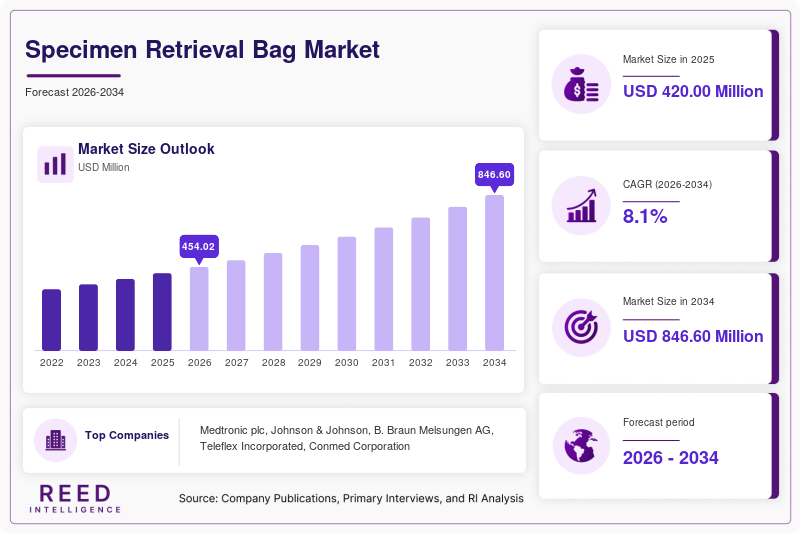
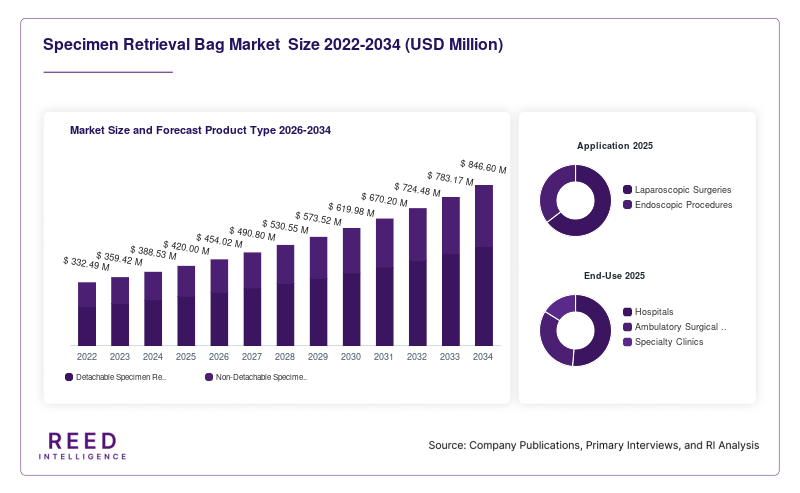
The Specimen Retrieval Bag Market was valued at approximately USD 420 million in 2026 and is projected to reach USD 785 million by 2034, expanding at a CAGR of 8.1% during 2026–2034. The market is experiencing steady growth due to the increasing adoption of minimally invasive surgical procedures worldwide. Specimen retrieval bags are widely used in laparoscopic and endoscopic surgeries to safely extract tissues, organs, or foreign objects while minimizing contamination risks. The rising prevalence of chronic diseases such as cancer, gastrointestinal disorders, and gynecological conditions has contributed significantly to the growing number of surgical procedures, thereby driving demand for these products.
A key global factor supporting market growth is the rapid advancement in surgical technologies, particularly minimally invasive and robotic-assisted surgeries. These innovations have improved patient outcomes by reducing hospital stays, minimizing postoperative complications, and enhancing recovery time. As healthcare systems globally continue to emphasize cost efficiency and patient safety, the adoption of specimen retrieval bags has become essential in modern surgical settings.
Key Highlights
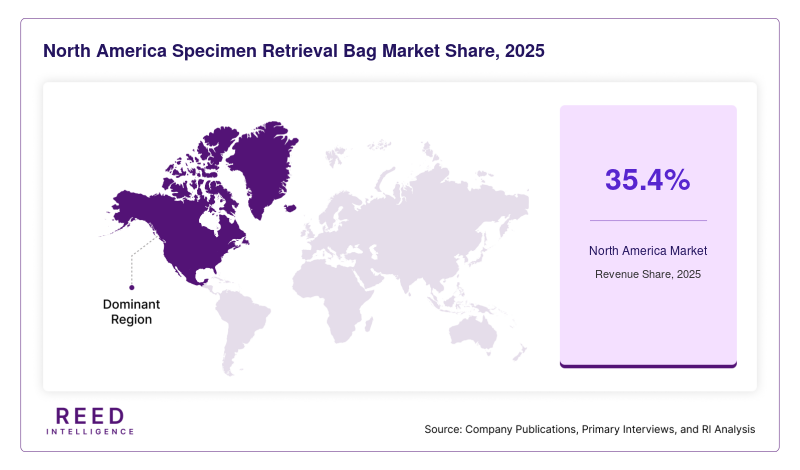
- North America dominated the market with a 35.4% share in 2025.
- Asia Pacific is expected to grow at the fastest CAGR of 9.6% during 2026–2034.
- By product type, detachable specimen bags accounted for the largest share of 42.8%, while non-detachable bags are projected to grow at a CAGR of 8.9%.
- By application, laparoscopic surgeries led with a 46.2% share, whereas endoscopic procedures are expected to expand at a CAGR of 9.2%.
- The United States remained the dominant country, with market values of USD 160 million in 2024 and USD 175 million in 2025.
Market Trends
Rising Preference for Minimally Invasive Surgical Procedures
The increasing shift toward minimally invasive surgical techniques is a major trend shaping the specimen retrieval bag market. Healthcare providers are adopting laparoscopic and endoscopic procedures due to their benefits, including reduced pain, smaller incisions, and faster recovery times. This shift has increased the demand for specialized surgical tools such as specimen retrieval bags that ensure safe and contamination-free extraction of tissues. Hospitals and surgical centers are also investing in advanced surgical equipment to improve efficiency and patient outcomes. Additionally, the aging global population is more susceptible to conditions requiring surgery, further boosting procedural volumes. This trend is expected to continue as technological advancements make minimally invasive surgeries more accessible across emerging economies.
Development of Advanced and Biocompatible Materials
Manufacturers are increasingly focusing on the development of specimen retrieval bags made from advanced, durable, and biocompatible materials. These materials enhance product strength, reduce the risk of rupture, and improve safety during complex surgical procedures. Innovations such as reinforced seams, leak-proof designs, and eco-friendly materials are gaining traction. Furthermore, regulatory requirements for surgical safety are encouraging companies to adopt higher-quality manufacturing standards. The integration of antimicrobial coatings and improved deployment mechanisms has also contributed to product differentiation. This trend reflects a broader industry focus on improving surgical safety and reducing infection risks, which is likely to drive continuous product innovation in the coming years.
Market Drivers
Increasing Surgical Procedures Due to Chronic Diseases
The growing prevalence of chronic diseases such as cancer, obesity, and gastrointestinal disorders has led to a rise in surgical interventions globally. Many of these conditions require minimally invasive procedures, where specimen retrieval bags play a critical role in ensuring safe extraction of tissues. As healthcare systems expand access to surgical care, particularly in developing regions, the volume of procedures continues to rise. Additionally, early diagnosis and improved screening programs have increased the number of elective surgeries. This surge in surgical demand directly contributes to the growth of the specimen retrieval bag market, as hospitals and clinics seek reliable tools to enhance procedural safety and efficiency.
Advancements in Surgical Technologies and Equipment
Technological advancements in surgical equipment, including robotic-assisted systems and high-definition imaging, are driving the adoption of specimen retrieval bags. These technologies enable surgeons to perform complex procedures with greater precision, increasing the need for high-quality retrieval solutions. The integration of specimen bags with advanced surgical instruments has improved workflow efficiency and reduced procedural risks. Moreover, continuous innovation by manufacturers in terms of product design and functionality has enhanced usability. As hospitals upgrade their infrastructure to incorporate modern surgical technologies, the demand for compatible and efficient specimen retrieval devices is expected to increase significantly.
Market Restraint
High Cost of Advanced Surgical Devices
One of the primary restraints affecting the specimen retrieval bag market is the high cost associated with advanced surgical devices and related equipment. While specimen retrieval bags themselves are relatively low-cost items, their usage is closely tied to minimally invasive surgical procedures, which require expensive equipment such as laparoscopic systems and robotic platforms. In developing regions, limited healthcare budgets and inadequate infrastructure can restrict the adoption of such advanced procedures, thereby limiting market growth. Smaller hospitals and clinics may opt for traditional surgical methods due to cost constraints, reducing the demand for specimen retrieval bags. Additionally, reimbursement challenges in certain healthcare systems can further impact adoption rates. For example, in low- and middle-income countries, healthcare providers often face financial limitations that hinder investment in advanced surgical technologies. This creates a disparity in market penetration, with developed regions dominating while emerging markets experience slower growth.
Market Opportunities
Expansion in Emerging Healthcare Markets
Emerging economies present significant growth opportunities for the specimen retrieval bag market. Countries in Asia Pacific, Latin America, and Africa are investing heavily in healthcare infrastructure and expanding access to surgical care. Government initiatives aimed at improving healthcare services and increasing insurance coverage are contributing to higher surgical volumes. As hospitals in these regions adopt minimally invasive techniques, the demand for specimen retrieval bags is expected to rise. Additionally, the presence of a large patient population and increasing awareness about advanced medical treatments further support market expansion. Manufacturers can capitalize on this opportunity by offering cost-effective products tailored to regional needs.
Increasing Adoption of Single-Use Surgical Devices
The growing emphasis on infection control and patient safety is driving the adoption of single-use surgical devices, including specimen retrieval bags. Single-use products reduce the risk of cross-contamination and eliminate the need for sterilization, making them highly preferred in modern healthcare settings. Regulatory bodies are also promoting the use of disposable medical devices to improve hygiene standards. This trend is particularly prominent in developed countries, where strict healthcare regulations are enforced. As hospitals prioritize safety and efficiency, the demand for disposable specimen retrieval bags is expected to increase. This creates opportunities for manufacturers to innovate and expand their product portfolios.
Segmental Analysis
By Product Type
Detachable specimen retrieval bags dominated the market in 2024, accounting for a share of 42.8%. These bags are widely preferred due to their flexibility and ease of use during surgical procedures. Surgeons can detach the bag from the insertion device, allowing for better maneuverability and efficient specimen removal. This feature is particularly useful in complex laparoscopic surgeries where precision is critical. Additionally, detachable bags are designed to minimize contamination risks, making them suitable for procedures involving potentially hazardous tissues. Their compatibility with various surgical instruments further enhances their adoption across hospitals and ambulatory surgical centers.
Non-detachable specimen retrieval bags are expected to be the fastest-growing subsegment, with a CAGR of 8.9% during the forecast period. These bags offer advantages such as cost-effectiveness and simplicity in design, making them suitable for routine surgical procedures. The growing demand for affordable medical devices in emerging markets is driving the adoption of non-detachable bags. Furthermore, advancements in material quality and design have improved their durability and performance. As healthcare providers seek cost-efficient solutions without compromising safety, the demand for non-detachable specimen retrieval bags is expected to increase steadily.
By Application
Laparoscopic surgeries accounted for the largest share of 46.2% in 2024, driven by the widespread adoption of minimally invasive techniques. These procedures require specialized tools for specimen extraction, making specimen retrieval bags an essential component. The increasing prevalence of conditions such as gallbladder diseases, appendicitis, and cancer has contributed to the high volume of laparoscopic surgeries. Additionally, the benefits of reduced hospital stays and faster recovery times have encouraged both patients and healthcare providers to opt for these procedures. This has significantly boosted the demand for specimen retrieval bags in laparoscopic applications.
Endoscopic procedures are projected to be the fastest-growing subsegment, with a CAGR of 9.2% during the forecast period. The growth of this segment is driven by advancements in endoscopic technologies and increasing diagnostic procedures. Endoscopy is widely used for both diagnostic and therapeutic purposes, leading to a higher demand for specimen retrieval solutions. Additionally, the rising focus on early disease detection has increased the number of endoscopic procedures globally. As healthcare providers continue to adopt advanced endoscopic techniques, the demand for specimen retrieval bags is expected to grow rapidly.
By End-Use
Hospitals dominated the market in 2024, accounting for a significant share due to the high volume of surgical procedures performed in these settings. Hospitals are equipped with advanced surgical infrastructure and skilled healthcare professionals, making them the primary users of specimen retrieval bags. The increasing number of inpatient and outpatient surgeries, along with the availability of specialized surgical departments, has contributed to this dominance. Additionally, hospitals are more likely to adopt advanced medical devices to improve patient outcomes and maintain high standards of care.
Ambulatory surgical centers (ASCs) are expected to be the fastest-growing subsegment, with a CAGR of 9.4% during the forecast period. The growth of ASCs is driven by the increasing preference for outpatient procedures and cost-effective treatment options. These centers offer shorter procedure times and reduced hospital stays, making them attractive to patients. As the number of minimally invasive procedures performed in ASCs increases, the demand for specimen retrieval bags is also expected to rise. Furthermore, advancements in surgical techniques and equipment are enabling ASCs to perform more complex procedures, further supporting market growth.
Regional Analysis
North America
North America held a dominant share of 35.4% in 2025 and is expected to grow at a CAGR of 7.8% during the forecast period. The region benefits from a well-established healthcare infrastructure, high adoption of advanced surgical technologies, and a strong presence of leading medical device manufacturers. The increasing prevalence of chronic diseases and a growing geriatric population are driving surgical volumes, thereby supporting market growth. Additionally, favorable reimbursement policies and high healthcare spending contribute to the widespread adoption of specimen retrieval bags.
The United States is the dominant country in this region, driven by advanced healthcare facilities and a high rate of minimally invasive surgeries. A unique growth factor is the rapid adoption of robotic-assisted surgical systems, which require specialized tools for specimen extraction. This has increased the demand for high-quality retrieval bags. Furthermore, continuous innovation by domestic manufacturers and strong regulatory standards ensure consistent product quality and safety.
Europe
Europe accounted for approximately 27.6% of the market share in 2025 and is projected to grow at a CAGR of 7.5% through 2034. The region's growth is supported by increasing healthcare expenditure and the rising adoption of minimally invasive procedures. Countries across Europe are focusing on improving surgical outcomes and reducing hospital stays, which has boosted demand for specimen retrieval bags. Additionally, the presence of established healthcare systems and strong regulatory frameworks supports market expansion.
Germany is the leading country in Europe, driven by its advanced healthcare infrastructure and high surgical procedure rates. A unique growth factor in Germany is the strong emphasis on medical innovation and research. Hospitals and research institutions actively collaborate to develop and adopt advanced surgical tools, including specimen retrieval bags. This focus on innovation enhances the overall efficiency and safety of surgical procedures.
Asia Pacific
Asia Pacific is expected to grow at the fastest CAGR of 9.6% during the forecast period, with a market share of 22.3% in 2025. The region is witnessing rapid growth due to increasing healthcare investments, a large patient population, and rising awareness about minimally invasive surgeries. Governments in countries such as China and India are investing in healthcare infrastructure, which is driving the adoption of advanced surgical technologies.
China is the dominant country in this region, supported by its expanding healthcare system and increasing surgical volumes. A unique growth factor is the government's focus on improving access to healthcare services in rural areas. This has led to the establishment of new hospitals and surgical centers, increasing the demand for medical devices such as specimen retrieval bags. Additionally, the growing middle-class population is driving demand for quality healthcare services.
Middle East & Africa
The Middle East & Africa region held a market share of 7.2% in 2025 and is expected to grow at a CAGR of 7.1% during the forecast period. The market is driven by improving healthcare infrastructure and increasing government investments in the healthcare sector. Countries in the Middle East are adopting advanced medical technologies, while African nations are gradually expanding access to surgical care.
Saudi Arabia is the dominant country in this region, supported by significant investments in healthcare modernization. A unique growth factor is the government's focus on diversifying the economy and enhancing healthcare services. This includes the development of new hospitals and the adoption of advanced surgical equipment. As a result, the demand for specimen retrieval bags is expected to increase steadily.
Latin America
Latin America accounted for 7.5% of the market share in 2025 and is projected to grow at a CAGR of 7.3% during the forecast period. The region is experiencing growth due to increasing healthcare awareness and rising surgical procedures. Governments are focusing on improving healthcare access, which is driving the adoption of advanced medical devices.
Brazil is the dominant country in Latin America, driven by its large population and expanding healthcare sector. A unique growth factor is the increasing number of private healthcare providers offering advanced surgical procedures. This has led to higher demand for specimen retrieval bags, as private hospitals invest in modern equipment to attract patients and improve outcomes.
Competitive Landscape
The specimen retrieval bag market is moderately competitive, with several global and regional players focusing on product innovation and strategic partnerships. Leading companies are investing in research and development to enhance product quality and introduce advanced features such as improved durability and ease of use. The market is characterized by the presence of established medical device manufacturers with strong distribution networks.
Medtronic plc is a leading player in the market, known for its extensive product portfolio and global presence. The company focuses on continuous innovation and has recently introduced advanced specimen retrieval solutions designed for minimally invasive procedures. Other key players are also expanding their product offerings and entering emerging markets to strengthen their market position. Strategic collaborations and acquisitions are common strategies adopted by companies to enhance their capabilities and expand their geographic reach.
Key Players
- Medtronic plc
- Johnson & Johnson
- B. Braun Melsungen AG
- Teleflex Incorporated
- Conmed Corporation
- Purple Surgical
- LaproSurge
- Applied Medical Resources Corporation
- Grena Ltd
- Welfare Medical Ltd
- Ackermann Instrumente GmbH
- Unimax Medical Systems Inc.
- Zhejiang Geyi Medical Instrument Co., Ltd
- Genicon Inc.
- Changzhou Ankang Medical Instruments Co., Ltd
Recent Developments
- In 2025, Medtronic launched an advanced specimen retrieval bag with enhanced durability and improved deployment mechanisms for laparoscopic procedures.
- In 2024, Teleflex Incorporated expanded its product portfolio by introducing cost-effective specimen retrieval solutions targeting emerging markets.
- In 2025, B. Braun Melsungen AG entered a strategic partnership with regional distributors to strengthen its presence in Asia Pacific.
Specimen Retrieval Bag Market Segments
Product Type
- Detachable Specimen Retrieval Bags
- Non-Detachable Specimen Retrieval Bags
Application
- Laparoscopic Surgeries
- Endoscopic Procedures
End-Use
- Hospitals
- Ambulatory Surgical Centers
- Specialty Clinics
By Region
- North America
- Europe
- APAC
- Middle East and Africa
- LATAM