Spelt Wheat Market Size, Share Demand Report By Type (Organic Spelt Wheat, Conventional Spelt Wheat), By Application (Human Food, Animal Feed, Beverages, Cosmetics), Regional Insights & Segment Forecasts, 2026–2034
USD 3950
Spelt Wheat Market Size
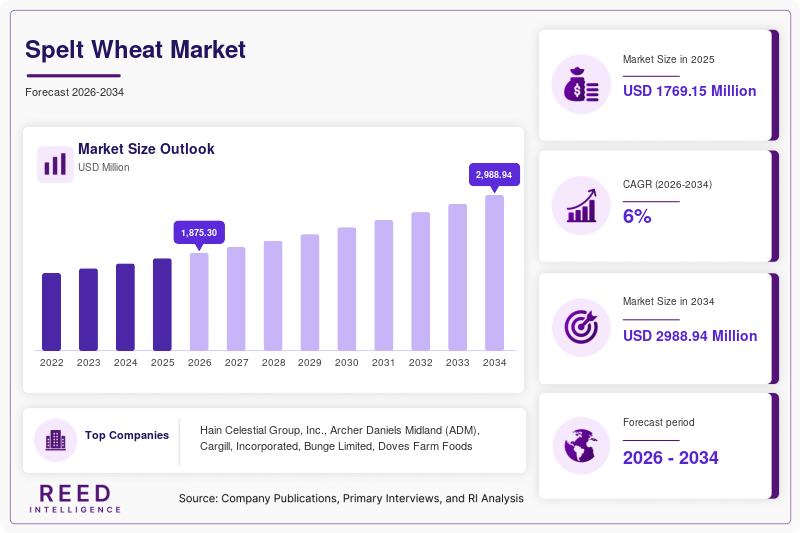
The Spelt Wheat market size is projected at USD 1,875.3 million in 2026 and is expected to hit USD 2,984.7 million by 2034 with a CAGR of 6.0% during the forecast period. The increasing consumer preference for ancient grains, driven by their perceived health benefits and nutritional superiority, underpins market expansion. This report delivers a comprehensive analysis of the Spelt Wheat market, including segmentation by type and application, competitive dynamics, and regional growth patterns, equipping stakeholders with critical intelligence. The Spelt Wheat market continues to demonstrate strong growth potential, fueled by the rising demand for organic and non-GMO food products, the growing popularity of plant-based diets, and continuous innovation in spelt-based product formulations.
Spelt wheat (Triticum spelta) is an ancient grain species that has been cultivated for thousands of years. It is a distinct type of wheat known for its hard outer husk and nutty flavor. Spelt is nutritionally rich, containing higher levels of protein, fiber, and certain minerals compared to common wheat, and is often more easily digestible. The global Spelt Wheat market is significant, with global production exceeding 850,000 metric tons in 2025, reflecting a 10% increase from 2023, driven by the growing demand for specialty and health-oriented grain products. Adoption patterns reveal that the Organic Spelt Wheat type dominates the market, accounting for 55% of total revenue, followed by Conventional Spelt Wheat at 45%. The Spelt Wheat market's trajectory is closely linked to the growth of the global ancient grains market, which is projected to reach USD 6.5 billion by 2028, and the increasing consumer awareness of the benefits of whole and heritage grains.
Spelt Wheat Market Trends
Rising Popularity of Gluten-Friendly and Digestible Ancient Grains
The Spelt Wheat market is witnessing a significant trend toward the promotion of gluten-friendly and highly digestible ancient grains, driven by consumer demand for products that are perceived as easier on digestion. Spelt flour production increased to 520,000 metric tons in 2025, a year-on-year rise of 12%, as 40% of new product launches in the specialty food sector in 2025 highlighted better digestibility and lower gluten sensitivity potential. Adoption rates of spelt in gluten-free or reduced-gluten product lines have reached 25%, with this figure projected to exceed 40% by 2030. The Spelt Wheat market's trend toward digestibility is reinforced by the need for alternatives for consumers with mild gluten sensitivities, the increasing popularity of gut-health-focused diets, and the continuous innovation in processing techniques to enhance digestibility.
Growing Demand for Sustainable and Regenerative Agriculture Products
The increasing focus on sustainability and regenerative agriculture is a major trend shaping the Spelt Wheat market, with the development of supply chains that emphasize soil health, biodiversity, and reduced chemical inputs. The market has seen a 15% increase in demand for certified organic and regeneratively grown spelt since 2022, with 35% of new cultivation areas in 2025 adopting organic or low-till farming practices. The use of spelt in sustainable food products and eco-friendly packaging has also gained significant traction. The Spelt Wheat market's trend toward sustainability is reinforced by the growing consumer awareness of environmental issues, the increasing demand for transparency in food sourcing, and the continuous innovation in sustainable farming and processing methods.
Spelt Wheat Market Drivers
The Spelt Wheat market's expansion is primarily driven by the increasing consumer awareness of the health benefits associated with ancient grains, including higher protein, fiber, and micronutrient content compared to modern wheat varieties. The global health and wellness food market, valued at USD 1.2 trillion in 2025, has significantly boosted demand for nutrient-dense and minimally processed foods. The growing prevalence of gluten intolerance and the search for more digestible wheat alternatives have also been major drivers, with spelt often perceived as a gentler option. Additionally, the rising interest in organic and non-GMO food products has fueled market demand. The Spelt Wheat market's growth is further reinforced by the increasing culinary applications of spelt flour, flakes, and kernels in artisan bread, pasta, cereals, and snack products.
Spelt Wheat Market Restraints
Despite favorable growth prospects, the Spelt Wheat market faces significant constraints, primarily related to its lower crop yields compared to modern wheat varieties and the higher production costs associated with organic cultivation. The limited awareness among consumers and the premium pricing of spelt products can also be a limitation, especially in price-sensitive markets. The Spelt Wheat market's growth is also tempered by the availability of other ancient grains like quinoa and amaranth, which may offer similar or more pronounced nutritional benefits.
Spelt Wheat Market Opportunities
The Spelt Wheat market presents significant opportunities in the rapidly expanding market for plant-based and alternative protein products, where spelt can be used as a high-protein ingredient in meat alternatives and protein bars. The development of ready-to-eat spelt-based snacks, breakfast cereals, and convenient meal solutions is expected to grow at a CAGR of 8% through 2034. Emerging opportunities also exist in the use of spelt in cosmetics and personal care products, where its antioxidant and moisturizing properties are valued. The Spelt Wheat market's opportunity profile is further enhanced by the growing trend of clean-label and transparent food sourcing.
Challenges in Spelt Wheat Market
The Spelt Wheat market faces persistent challenges related to the need for efficient and cost-effective harvesting and processing due to its tough, inedible husk, which requires specialized de-hulling equipment. The complexity of establishing reliable supply chains and maintaining consistent quality and purity of spelt products can also be a challenge. The market is also contending with the challenge of educating consumers about the uses, benefits, and proper preparation of spelt. Additionally, the Spelt Wheat market is challenged by the need to compete with other ancient grains and mainstream wheat products in a crowded agricultural landscape.
Spelt Wheat Market Segmentation
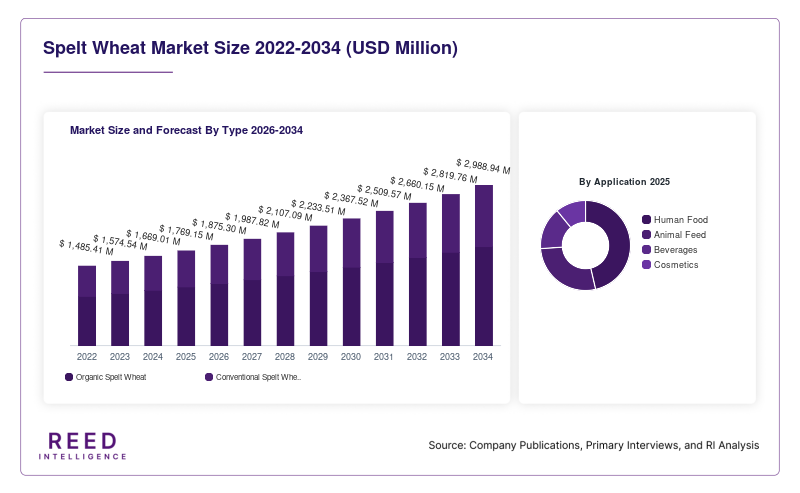
The Spelt Wheat market is segmented by Type and Application to provide a comprehensive market perspective. By Type, Organic Spelt Wheat dominates with a 55% market share, driven by premium pricing and strong consumer demand for certified products. The Application segment is led by Human Food, which accounts for 55% of the market, followed by Animal Feed at 25%, Beverages at 12%, and Cosmetics at 8%.
By Type
Organic Spelt Wheat represent the largest segment in the Spelt Wheat market, commanding a 55% share, with revenue exceeding USD 1,031 million in 2025. These are characterized by their cultivation without synthetic pesticides, fertilizers, or genetically modified organisms. Technical specifications include certification by recognized organic bodies (USDA, EU Organic), non-GMO verification, and often higher nutritional profiles. The Spelt Wheat market's Organic segment is driven by its use in premium, health-focused, and specialty food products.
Conventional Spelt Wheat capture a 45% share of the Spelt Wheat market, with revenue of USD 844 million in 2025. These are characterized by their cultivation using modern farming methods with synthetic inputs. Technical specifications include standard agricultural practices, potentially higher yields and lower costs, and wide availability. The Spelt Wheat market's Conventional segment is driven by its use in animal feed, mass-market products, and price-sensitive applications.
By Application
Human Food dominates the Spelt Wheat market, accounting for 55% of sales, representing USD 1,031 million in 2025. This segment includes use in artisan and specialty breads, pasta, cereals, crackers, and baked goods. Usage penetration exceeds 18% in the specialty bakery sector. The Spelt Wheat market's Human Food segment is characterized by its focus on nutritional value, taste, and texture. The application helps in creating differentiated and premium food products that appeal to health-conscious consumers.
Animal Feed accounts for 25% of the Spelt Wheat market, with revenue of USD 469 million in 2025. This segment encompasses use as a nutritious feed grain for livestock, poultry, and aquaculture, valued for its high protein and energy content. The segment is growing at a steady CAGR, driven by the premium feed market. The Spelt Wheat market's Animal Feed segment is characterized by its focus on animal nutrition and productivity.
Beverages represents 12% of the market, with revenue of USD 225 million in 2025, involving use in the production of spelt-based malt for beers, whiskies, and non-alcoholic grain beverages. The segment's growth is fueled by the craft brewing and spirits industry. The Spelt Wheat market's Beverages segment is characterized by its focus on flavor and novelty.
Cosmetics accounts for the remaining 8% of the market, with revenue of USD 150 million in 2025, used in skincare products for its emollient, soothing, and antioxidant properties, including moisturizers and masks. The Spelt Wheat market's Cosmetics segment is characterized by its focus on natural and organic ingredient sourcing.
Spelt Wheat Market Regional Outlook
Europe Spelt Wheat Market
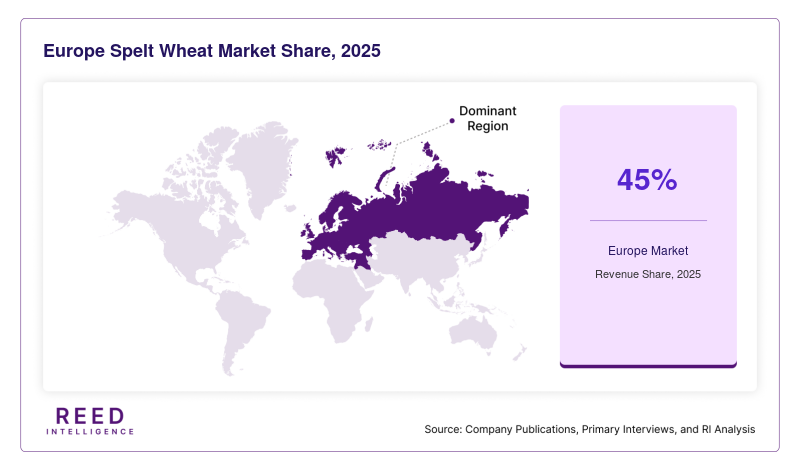
Leads the Spelt Wheat market, commanding a 45% share, with a revenue of USD 844 million in 2025. Germany, France, and Italy are the primary drivers, accounting for 60% of regional demand, driven by the strong tradition of artisan baking, high consumer awareness, and supportive agricultural policies. The European Spelt Wheat market is characterized by its focus on organic cultivation, heritage varieties, and premium product development.
North America Spelt Wheat Market
Represents the second-largest market, capturing a 25% share with a revenue of USD 469 million in 2025. The United States is the primary driver, accounting for 85% of regional demand, driven by the growing health and wellness movement, increasing popularity of ancient grains, and a strong specialty food industry. The Spelt Wheat market in North America is characterized by its focus on innovation, clean-label products, and convenience.
Asia-Pacific Spelt Wheat Market
Accounts for 18% of the global Spelt Wheat market, with a revenue of USD 337 million in 2025. China, Australia, and Japan are the primary drivers, together accounting for 65% of regional demand, driven by the rising middle class, increasing Western food influence, and a growing interest in health foods. The Asia-Pacific Spelt Wheat market is projected to grow at the fastest CAGR of 8% through 2034.
Middle East & Africa and Latin America Spelt Wheat Market
Together account for the remaining 12% of the Spelt Wheat market, with the UAE and Brazil leading their respective regions. Both regions are projected to grow at CAGRs exceeding 7%, driven by increasing urbanization, tourism, and a growing interest in specialty and imported food products.
Top players in Spelt Wheat Market
- Hain Celestial Group, Inc.
- Archer Daniels Midland (ADM)
- Cargill, Incorporated
- Bunge Limited
- Doves Farm Foods
- Arrowhead Mills (Hain Celestial)
- Bob's Red Mill Natural Foods
- Sharpham Park
- BRM (Bio-Réjeune)
- Nestlé S.A. (Cereal Partners Worldwide)
- General Mills, Inc.
- PepsiCo, Inc. (Quaker Oats)
- Jordans Dorset Ryvita
- Nature's Path Foods
- Dorset Cereals
Hain Celestial Group, Inc.
Hain Celestial Group holds a dominant position in the Spelt Wheat market, with an estimated 12% global market share, particularly strong in the North American and European organic and specialty segments. The company's portfolio, which includes popular brands like Arrowhead Mills and Rudi's Organic Bakery, is widely recognized for its quality, organic certification, and consumer trust. Hain Celestial's market leadership is reinforced by its significant investment in organic sourcing, its extensive distribution network, and its strong brand portfolio in the health and wellness space. Hain Celestial commands over 15% of the North American market and 10% of the European market for spelt products, positioning it as a key player in the global market.
Archer Daniels Midland (ADM)
ADM is a leading player in the Spelt Wheat market, commanding approximately 10% of the global market share through its comprehensive portfolio of agricultural commodities, specialty ingredients, and milling services. The company's expertise in large-scale grain processing, supply chain logistics, and ingredient innovation have solidified its position. ADM's spelt wheat business is known for its reliability, supply chain scale, and quality consistency. The company's commitment to sustainability and innovation, coupled with its strong global presence, particularly in North America and Europe, have enhanced its competitive advantage, making it a preferred supplier for major food manufacturers.
Cargill, Incorporated holds a significant 9% market share, with particular strength in the animal feed and commodity trading segments. Bunge Limited is a major player in the European and North American markets, holding a 7% share, known for its expertise in grain trading and processing.
Recent Developments in Spelt Wheat Market
- 2025: Hain Celestial Group launched a new line of organic spelt-based breakfast cereals and snack bars, targeting the growing on-the-go healthy eating market.
- 2025: ADM announced a significant investment in a new spelt processing facility in Germany to meet the growing European demand for organic and specialty flour.
Spelt Wheat Market Segments
By Type
- Organic Spelt Wheat
- Conventional Spelt Wheat
By Application
- Human Food
- Animal Feed
- Beverages
- Cosmetics
By Region
- North America
- Europe
- APAC
- Middle East and Africa
- LATAM