Spider Lift Market Size, Share & Trends Analysis Report By Type, By Lift Height, By Application, and By Region (North America, Europe, Asia Pacific, Latin America, Middle East & Africa) Forecasts, 2026–2034
USD 3950
Spider Lift Market Size
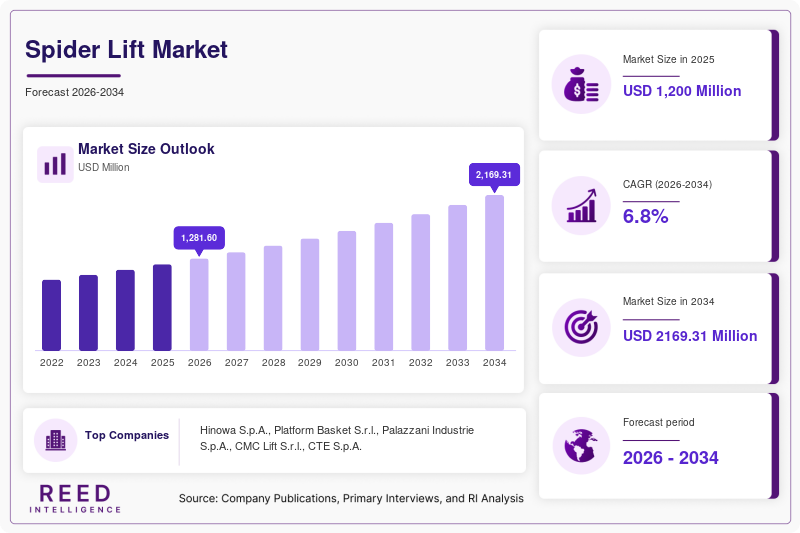
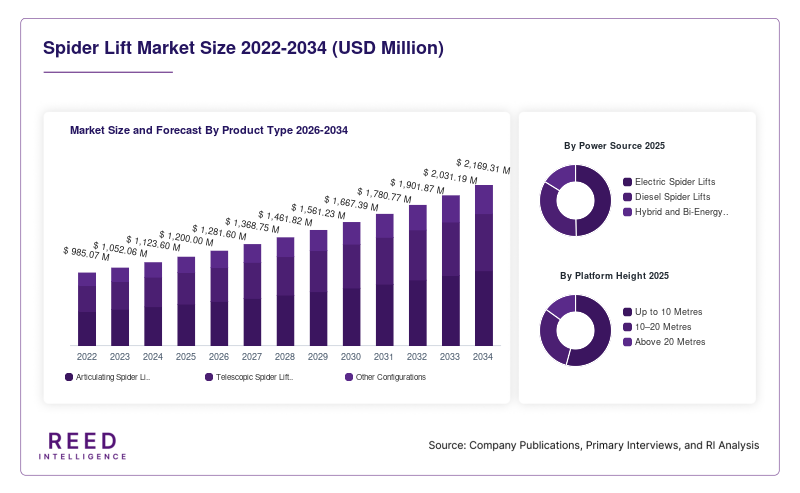
The global spider lift market size was valued at USD 1,200 million in 2025 and is projected to grow from USD 1,281.60 million in 2026 to USD 2,169.31 million by 2034, registering a CAGR of 6.8% during the forecast period from 2026 to 2034.
The spider lift market covers compact, tracked aerial work platforms designed to provide elevated access in locations where conventional boom lifts, scissor lifts, or larger mobile elevating work platforms may be difficult to position. Spider lifts typically use a compact chassis, extendable stabilizing outriggers, and a telescopic or articulated boom to reach elevated work areas. Their tracked undercarriages and relatively narrow transport dimensions make them suitable for confined access routes, uneven terrain, landscaped areas, and selected indoor environments.
Spider Lift Market Drivers
Growth in Construction, Building Maintenance, and Infrastructure Projects
Construction, renovation, and infrastructure maintenance create demand for safe and flexible elevated access equipment. Spider lifts can be used for façade repairs, glazing, painting, electrical work, roofing, and maintenance in areas that are difficult to reach with conventional equipment. Their compact design can be valuable in urban construction sites, historic buildings, and sites with restricted access. Ongoing maintenance requirements for commercial properties and public infrastructure provide demand beyond new construction activity.
Increasing Focus on Work-at-Height Safety
Employers and contractors require access equipment that supports controlled positioning, platform stability, and safer work practices at height. Spider lifts provide a dedicated work platform and stabilizing outriggers for tasks that might otherwise involve ladders or more complex scaffolding arrangements. Adoption is influenced by workplace safety rules, operator training, equipment inspection, and the suitability of the selected machine for each task. Safety systems and user-friendly controls are therefore important considerations in purchasing and rental decisions.
Rising Demand for Compact and Versatile Aerial Access Equipment
Spider lifts are designed for applications where equipment footprint, transportability, outreach, and ground conditions limit the use of conventional boom lifts. Their tracked undercarriages can assist movement over selected uneven surfaces, while compact dimensions can facilitate access through narrow entrances. These characteristics support use in landscaping, arboriculture, industrial maintenance, facilities management, and specialized construction. Rental availability further broadens access to equipment for small contractors and businesses with intermittent requirements.
Spider Lift Market Restraints
High Acquisition and Maintenance Costs
Spider lifts can require substantial investment because of their specialized boom systems, stabilization mechanisms, controls, and compact engineering. Costs can also arise from routine servicing, replacement parts, battery systems, transport, and operator training. Smaller contractors may find purchase costs difficult to justify when usage is intermittent. Rental can reduce the initial capital burden but introduces availability, transport, and utilization considerations.
Operational Complexity and Site Constraints
Spider lifts must be selected and positioned according to working height, outreach, platform load, ground conditions, access dimensions, and setup requirements. Incorrect positioning or unsuitable ground conditions can compromise safe operation. Operators also need training in setup, stabilization, controls, and emergency procedures. Limited site access, overhead obstructions, restricted working areas, and the need to transport equipment between jobs can reduce suitability for some projects.
Spider Lift Market Opportunities
Electrification and Low-Emission Product Development
Battery-powered spider lifts provide opportunities in indoor maintenance, commercial buildings, public facilities, and locations where noise or local emissions are restricted. Improvements in battery performance, charging systems, energy management, and electric drive components may broaden the range of applications for electric machines. Manufacturers can differentiate products through charging flexibility, operating duration, reduced maintenance requirements, and compatibility with users' environmental objectives. Adoption will depend on duty cycle, access to charging, purchase price, and machine performance under actual site conditions.
Expansion of Rental Fleets and Specialized Access Services
Rental providers can make spider lifts available to contractors, arborists, facilities managers, and industrial maintenance teams without requiring each user to own specialist equipment. Fleet expansion and improved geographic coverage can increase access to machines with different working heights and power configurations. Digital booking, fleet tracking, preventive maintenance, and operator support also offer opportunities to improve utilization. Manufacturers and distributors can serve this demand through dealer partnerships, parts availability, training, and after-sales service.
Spider Lift Market Segmental Analysis
By Product Type
Articulating spider lifts accounted for approximately 51% of the market in 2024, according to Global Market Insights. Their articulated boom design enables operators to navigate around obstacles and reach elevated work areas with restricted access. These machines are used in building maintenance, construction, tree care, telecommunications, and specialist industrial work. Their compact chassis and flexible positioning capabilities make them useful where conventional lifting equipment cannot easily approach the work area. Product development focuses on reach, stability, control precision, transportability, and operator safety.
Telescopic spider lifts use extending boom sections to provide direct reach to elevated or laterally positioned work areas. They can be useful for applications that require access over obstacles, greater horizontal outreach, or a relatively direct working path. Demand depends on the required working envelope, platform capacity, machine dimensions, and site conditions. Telescopic designs compete with articulated configurations based on the needs of each job rather than on boom arrangement alone. The exact global share and CAGR for this segment are not verifiable from the available sources.
Other configurations include specialized spider-lift designs that combine different boom arrangements, chassis formats, stabilization systems, or application-specific features. Their use depends on working height, access restrictions, transport requirements, platform load, and terrain. Manufacturers may develop specialized variants for sensitive flooring, confined interiors, industrial environments, or difficult outdoor locations. The size and growth rate of this category depend on the classification system used by individual market research providers.
By Power Source
Electric spider lifts are designed for applications where low local emissions and reduced operating noise are important. They are suitable for selected indoor maintenance jobs, commercial facilities, public buildings, and noise-sensitive urban locations. Battery-powered models can reduce dependence on onboard combustion engines during operation, although their practical range depends on battery capacity, charging availability, workload, and operating conditions. Product differentiation includes charging time, battery life, platform performance, weight, and the ability to complete a work shift between charges.
Diesel-powered spider lifts remain relevant for outdoor applications where fuel availability, operating duration, and worksite conditions influence equipment selection. They can support demanding maintenance and construction tasks at locations where regular battery charging is inconvenient. Their suitability depends on emissions requirements, noise restrictions, engine performance, maintenance needs, and the type of terrain encountered. Indoor use may be restricted or unsuitable in some environments because of exhaust emissions and ventilation requirements.
Hybrid and bi-energy spider lifts combine different power options, often enabling users to select between an onboard engine and an electrical supply or battery-powered operation. These configurations can provide flexibility across indoor and outdoor tasks, particularly for contractors working at multiple sites. Their value depends on the available power sources, charging or refuelling arrangements, machine weight, maintenance requirements, and purchase cost. Manufacturers use such configurations to address customers who require a broader range of operating conditions from a single machine.
By Platform Height
Spider lifts in the up-to-10-metre category address lower-level access work in confined interiors, smaller commercial buildings, and selected maintenance applications. Compact dimensions can be particularly important when machines must pass through narrow doorways or operate around obstacles. Buyers evaluate platform capacity, setup time, transportability, and the ability to work safely within limited spaces. Competition from ladders, small scissor lifts, and other compact access equipment influences demand in this category.
10–20 Metres
The 10–20-metre category accounted for approximately 47% of the market in 2024, according to Global Market Insights. This height range serves many routine building-maintenance, landscaping, construction, and repair tasks without requiring the largest spider-lift models. It provides a balance between reach, machine size, and transport requirements. Demand is influenced by building height, contractor requirements, rental-fleet composition, and the need to access elevated work areas with limited ground-level space.
Spider lifts above 20 metres serve specialized applications requiring greater working height or outreach. They may be used for high-rise façade maintenance, large industrial facilities, infrastructure inspection, tree care, and complex access operations. Higher-reach equipment requires careful consideration of stabilization, ground conditions, platform capacity, wind limits, and the working envelope. Acquisition and transport costs can be significant, so rental and specialist access-service providers are important potential users. The segment's exact share and CAGR are not verifiable from the available sources.
By Application
Construction is a major application for spider lifts because projects often require elevated access in restricted or irregularly shaped work areas. Machines can support façade installation, glazing, finishing, painting, repair, and other work-at-height tasks. Their compact dimensions may be useful in urban developments and renovation projects where larger lifting equipment is difficult to position. Demand depends on construction activity, site-access requirements, equipment availability, and the cost of alternative access methods.
Building maintenance and repair applications include exterior cleaning, roof inspection, lighting replacement, painting, façade repairs, and work on commercial or public facilities. Spider lifts can provide temporary access without requiring permanent access infrastructure. Demand is influenced by the age and condition of buildings, maintenance budgets, safety requirements, and the need to minimize disruption to occupants or business operations. Rental availability allows maintenance contractors to select equipment according to the height and geometry of each job.
Arboriculture and landscaping applications include tree pruning, canopy maintenance, removal of damaged branches, and work in landscaped areas. Tracked spider lifts can be useful where ground conditions, access width, or surrounding vegetation constrain larger equipment. Buyers assess machine weight, track design, ground pressure, working reach, and setup requirements to limit disturbance to the site. Demand depends on tree-care activity, municipal maintenance programmes, weather-related work, and contractor investment in specialized equipment.
Spider Lift Market Regional Analysis
North America Spider Lift Market
North America accounted for approximately 21.8% of the global spider lift market in 2025, according to Market Intelo's regional assessment. Demand is supported by construction, commercial property maintenance, arboriculture, infrastructure upgrades, and the use of specialist access equipment by rental companies. The United States is a significant market within the region, with demand shaped by building maintenance requirements, industrial activity, and the availability of established aerial-platform distribution and service networks. Canada also has applications in construction, facilities maintenance, utilities, and tree care.
Market development depends on construction spending, workplace safety practices, equipment rental utilization, financing conditions, and the availability of trained operators. Electric and hybrid models may attract users working indoors or in noise-sensitive areas, while diesel-powered equipment remains relevant for selected outdoor applications. Rental companies and specialist contractors consider transport costs, equipment reliability, service coverage, and resale value when expanding their fleets. A region-wide CAGR matching the supplied global market definition is not independently verified.
Europe Spider Lift Market
Europe accounted for approximately 31.5% of the global spider lift market in 2025, according to Market Intelo's regional assessment. The region has established manufacturers and distributors of compact aerial access equipment, including companies based in Italy, Germany, Denmark, and other European markets. Spider lifts are used in building renovation, façade maintenance, industrial facilities, tree care, and specialist construction. Compact tracked equipment can be useful in historic urban areas and sites with narrow access routes or sensitive surfaces.
European demand is influenced by renovation activity, occupational safety requirements, environmental considerations, and the availability of rental fleets. Electric and bi-energy products are relevant to users working in indoor environments or locations where noise and local emissions must be limited. Manufacturers also compete on working height, outreach, machine weight, setup efficiency, and after-sales support. Regional demand varies by country according to construction investment, rental-market maturity, industrial activity, and local purchasing conditions. A consistent regional CAGR for the exact market definition used here is not independently verified.
Asia Pacific Spider Lift Market
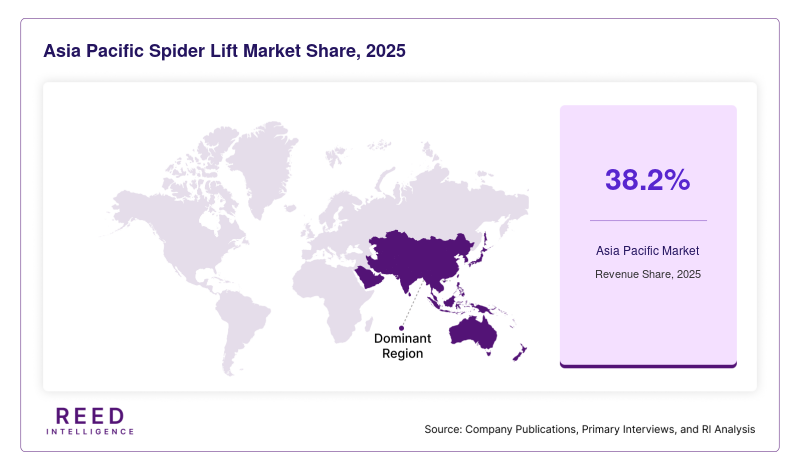
Asia Pacific held approximately 38.2% of the global spider lift market in 2025, according to Market Intelo's regional assessment, making it the leading region in that source. Demand is associated with urban construction, commercial property development, infrastructure maintenance, industrial facilities, and increasing use of mechanized access equipment. China, India, Japan, South Korea, and Australia represent distinct demand environments, with differences in construction activity, industrial development, local manufacturing, and access-equipment rental practices.
The regional market is shaped by infrastructure investment, urbanization, contractor purchasing power, equipment availability, and the expansion of local distribution and service networks. China has an established equipment-manufacturing base, while other regional markets offer applications in building maintenance, utilities, industrial facilities, and landscaping. The use of compact aerial platforms depends on site conditions, operator training, safety requirements, and the availability of machines suited to local applications. Market Intelo estimates Asia Pacific's regional CAGR at 7.4%, but this figure is source-specific and is not independently verified against the supplied global forecast.
Latin America Spider Lift Market
Latin America is estimated to account for approximately 5.2% of the global spider lift market in 2025, according to Market Intelo's regional assessment. Demand is linked to construction, commercial building maintenance, industrial activity, tree care, and infrastructure development. Brazil and Mexico are relevant markets because of their construction and industrial bases, while demand in other countries depends on project investment, equipment availability, and the reach of distribution and rental networks.
Market development is affected by financing costs, currency fluctuations, import expenses, construction cycles, and access to trained operators and service technicians. Rental can help contractors obtain specialized equipment without making a large capital investment, although fleet availability and transport logistics influence the total cost of use. Manufacturers and distributors may expand through dealer partnerships, technical support, and parts availability. The precise regional CAGR for the same market definition and forecast period is not independently verified.
Middle East & Africa Spider Lift Market
The Middle East & Africa region accounted for approximately 3.3% of the global spider lift market in 2025, according to Market Intelo's regional assessment. Potential applications include commercial construction, facility maintenance, industrial installations, infrastructure projects, and elevated maintenance work at large properties. Gulf countries have demand linked to commercial and infrastructure development, while selected African markets use aerial access equipment for construction, utilities, and industrial maintenance.
Regional growth depends on project schedules, capital expenditure, rental-fleet development, import arrangements, and the availability of service support. High temperatures, dusty operating environments, transport distances, and site conditions can affect equipment selection and maintenance requirements. Distribution partners and rental providers can support market access by supplying suitable machines, replacement parts, operator training, and technical assistance. The exact regional CAGR is not independently verified for the market definition used in this report.
Spider Lift Market Competitive Landscape
The spider lift market includes specialist aerial-platform manufacturers, broader access-equipment companies, regional equipment producers, distributors, and rental providers. Competition is shaped by working height, horizontal outreach, platform capacity, machine weight, transport dimensions, boom configuration, stability systems, power options, and maintenance requirements. Companies also compete through dealer coverage, replacement-parts availability, operator training, warranty terms, and the ability to support rental fleets.
Product innovation is increasingly focused on combining high reach with compact dimensions and straightforward setup. Electric and bi-energy models address selected indoor and noise-sensitive applications, while diesel configurations serve jobs requiring sustained outdoor operation. Digital displays, remote controls, diagnostics, and telematics can help operators monitor equipment and allow fleet managers to plan maintenance.
Key Market Players
- Hinowa S.p.A.
- Platform Basket S.r.l.
- Palazzani Industrie S.p.A.
- CMC Lift S.r.l.
- CTE S.p.A.
- Niftylift Limited
- Ommelift A/S
- Dinolift Oy
- Teupen Maschinenbau GmbH
- Easy Lift S.r.l.
Spider Lift Market Recent Developments
June 24, 2026 - Sinoboom introduced the SPA27J and SPA27EJ spider lifts. The company announced new diesel and electric variants with a maximum working height of 27 metres, horizontal outreach of 14.2 metres, and a 230 kg platform capacity for the diesel variant. The design features a double-telescopic boom, adjustable crawler tracks, and real-time fault diagnosis. Sinoboom stated that the models were available to order in global markets, excluding the United States and mainland Europe.
July 7, 2026 - Palazzani highlighted the XTJ 52+ ECO electric spider lift. The manufacturer presented the fully electric model for the Movicarga awards in the tracked-platform category. The machine offers a maximum working height of 52 metres and horizontal outreach of up to 19.5 metres, targeting demanding industrial, infrastructure, energy, and urban-maintenance applications.
Spider Lift Market Segments
By Product Type
- Articulating Spider Lifts
- Telescopic Spider Lifts
- Other Configurations
By Power Source
- Electric Spider Lifts
- Diesel Spider Lifts
- Hybrid and Bi-Energy Spider Lifts
By Platform Height
- Up to 10 Metres
- 10–20 Metres
- Above 20 Metres
By Application
- Construction
- Building Maintenance and Repair
- Arboriculture and Landscaping
- Industrial and Utility Maintenance
- Others
By Region
- North America
- Europe
- APAC
- Middle East and Africa
- LATAM