Sports Market Size, Share Demand Report By Type (Sports Equipment, Sports Apparel, Sports Footwear), By Application (Professional Sports, Recreational Sports, Fitness and Wellness) By Region & Segment Forecasts, 2026–2034
USD 3950
Sports Market Size
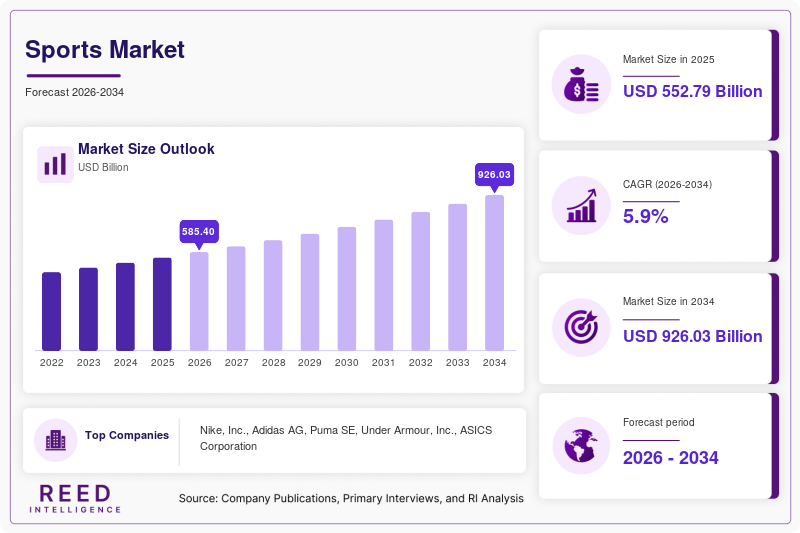
Global sports market size is projected at USD 585.4 billion in 2026 and is expected to hit USD 926.2 billion by 2034 with a CAGR of 5.9%.” The market encompasses sporting goods, apparel, footwear, equipment, accessories, and related products purchased by professional athletes, recreational participants, fitness consumers, institutions, and sports organizations. Detailed data across product categories, applications, countries, distribution channels, and competitive positioning is increasingly important for understanding consumer participation, product innovation, and changing purchasing patterns.
Key takeaways
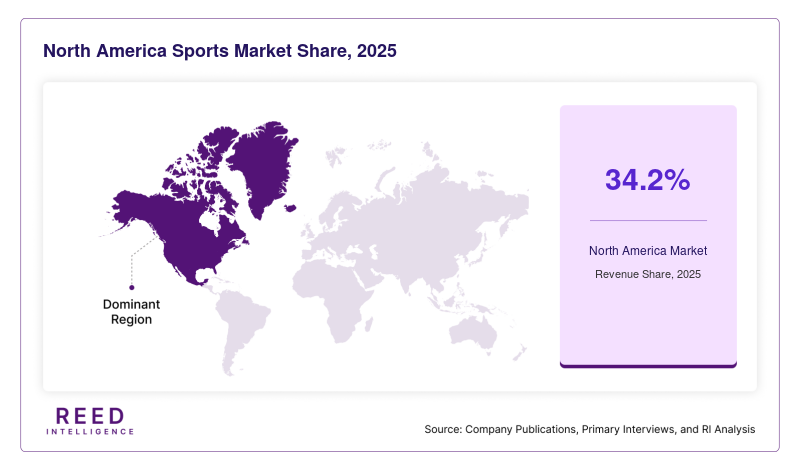
- North America dominated the global sports market with approximately 34.2% share in 2026, while Asia Pacific is the fastest-growing region with a CAGR of 7.1% through 2034.
- Sports equipment represented approximately 42.8% of global revenue in 2026, while sports footwear is the fastest-growing type with an estimated CAGR of 6.5%.
- Professional sports contributed approximately 31.6% of revenue, supported by organized leagues, athletic programs, clubs, sponsorships, and institutional procurement.
- Recreational sports accounted for approximately 40.5% share, driven by rising participation in running, cycling, outdoor activities, team sports, and individual fitness.
- India represents an emerging country market and is projected to reach approximately USD 27.8 billion by 2034, expanding at a CAGR of 9.3% during 2026–2034.
The global sports market includes equipment, apparel, footwear, protective products, accessories, and performance-oriented sporting goods used across professional, recreational, educational, and fitness environments. Global sports-product manufacturing exceeds 20 billion individual units annually, including footwear, garments, balls, protective equipment, fitness accessories, and specialized gear. Sports equipment contributes approximately 42.8% of revenue, apparel 32.5%, and footwear 24.7%. Digital commerce, wearable technologies, connected equipment, and personalized products are increasing consumer adoption, while sports participation, health awareness, organized competitions, and recreational activities continue to expand the addressable customer base.
Sports Market Trends
Connected Equipment, Athleisure and Personalized Performance Products
Technology integration is transforming sports products through sensors, connected equipment, GPS tracking, performance analytics, smart fabrics, and mobile applications. Smart watches, connected fitness equipment, sensor-enabled footwear, and digitally monitored training products are increasingly integrated into consumer routines. Manufacturers are also using data analytics and digital design tools to develop lighter, more durable, and application-specific products for running, cycling, football, basketball, tennis, and outdoor activities.
Demand is simultaneously shifting toward products that combine athletic functionality with everyday lifestyle use. Athleisure apparel, lightweight footwear, recovery products, technical outerwear, and versatile training equipment are gaining relevance among consumers who participate in multiple activities. Professional teams continue to demand specialized performance products, while recreational users increasingly purchase premium equipment based on comfort, durability, injury prevention, sustainability, and measurable performance improvements.
Sports Market Drivers
Rising Sports Participation and Health Awareness
Growing participation in organized and recreational sports is a major driver of demand for sporting goods. Increased awareness of physical activity, weight management, cardiovascular health, and active lifestyles encourages consumers to purchase footwear, apparel, equipment, protective products, and fitness accessories. Schools, sports clubs, gyms, professional organizations, and community programs also contribute to recurring institutional demand, while urbanization is supporting participation in accessible sports and fitness activities.
Sports Market Restraints
Premium Product Prices and Supply Chain Volatility
High prices for technologically advanced footwear, connected equipment, technical apparel, and specialized sporting goods can restrict adoption among price-sensitive consumers. Raw-material costs, transportation expenses, currency fluctuations, and international sourcing also influence product pricing. Manufacturers dependent on synthetic fibers, rubber, metals, composites, and specialized electronic components may experience cost volatility. Counterfeit sporting goods further affect brand value and can divert sales from established manufacturers.
Sports Market Opportunities
Expansion of Smart and Sustainable Sporting Goods
Smart products and sustainable materials are creating new opportunities across equipment, apparel, and footwear categories. Recycled polyester, bio-based materials, low-impact manufacturing, repair programs, and recyclable product designs are gaining attention from environmentally conscious consumers. Connected equipment can generate recurring digital-service opportunities through performance monitoring and training platforms. Emerging participation in running, cycling, cricket, football, racket sports, and outdoor recreation also provides opportunities for category expansion in developing economies.
Challenges in Sports Market
Rapid Product Cycles and Intense Brand Competition
Sports-product manufacturers face rapid changes in consumer preferences, technology, fashion, and athlete-driven product trends. Companies must continuously invest in research, product development, marketing, sponsorships, and digital channels. Inventory management is challenging because seasonal products and rapidly changing designs can create excess stock. Strong competition among global brands, private labels, specialist manufacturers, and direct-to-consumer businesses further increases pressure on pricing, differentiation, and customer retention.
Sports Market Segmentation Analysis
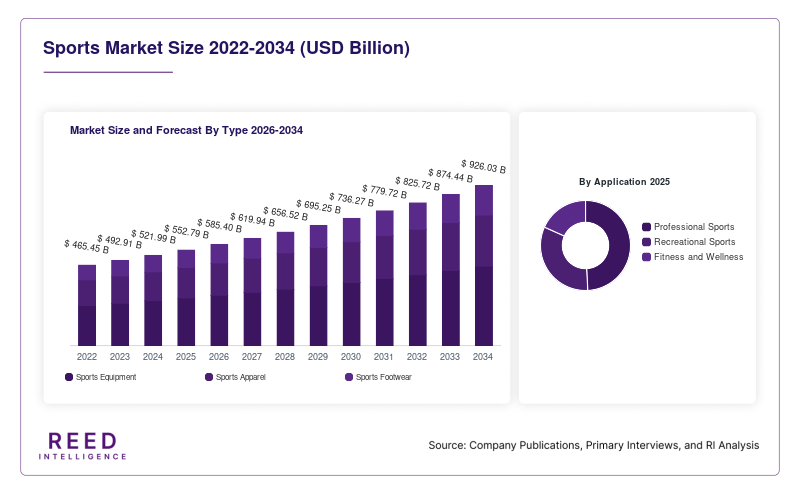
Sports equipment represented the largest product category with approximately 42.8% of global revenue in 2026, followed by sports apparel at 32.5% and sports footwear at 24.7%. By application, recreational sports held approximately 40.5%, professional sports 31.6%, and fitness and wellness 27.9%. Increasing participation and premiumization are encouraging consumers to purchase specialized products with improved durability, ergonomics, performance characteristics, and digital functionality.
By Type
Sports equipment accounted for approximately 42.8% of global revenue in 2026, representing more than 8.6 billion units produced annually across balls, bats, rackets, protective equipment, training devices, bicycles, boards, and other sporting products. Equipment specifications vary substantially by sport, with products increasingly using carbon fiber, engineered polymers, aluminum alloys, composite materials, and impact-resistant foams. Professional-grade products generally emphasize low weight, structural stiffness, aerodynamic performance, durability, and sport-specific ergonomics.
Sports apparel represented approximately 32.5% of global revenue, with annual production exceeding 9.2 billion garments. The category includes jerseys, shorts, leggings, jackets, base layers, training tops, socks, and technical outerwear. Polyester remains a major material, while nylon, elastane, recycled fibers, and moisture-management blends are increasingly used. Technical garments typically incorporate 120–220 gsm fabrics, four-way stretch construction, moisture-wicking finishes, ventilation zones, UV protection, and temperature-management features.
Sports footwear contributed approximately 24.7% of revenue and represents more than 2.7 billion pairs produced annually. Running, football, basketball, tennis, training, hiking, and specialized athletic footwear account for major volumes. Modern designs use engineered mesh, synthetic uppers, thermoplastic components, EVA or expanded foam midsoles, rubber outsoles, carbon plates, and structured heel systems. Lightweight construction, energy return, cushioning, traction, stability, and biomechanical support remain key product specifications.
By Application
Professional sports accounted for approximately 31.6% of global revenue and represents demand from professional teams, leagues, athletes, clubs, federations, and training academies. More than 5 billion units of apparel, equipment, footwear, and accessories are estimated to support professional and organized competitive activities annually. Customers prioritize technical specifications, durability, athlete customization, regulatory compliance, and performance optimization. Team uniforms, specialized footwear, protective equipment, training devices, and competition-standard equipment are major product categories.
Recreational sports represented approximately 40.5% of revenue and form the largest application category. More than 8 billion product units are consumed annually across running, cycling, swimming, football, basketball, tennis, badminton, hiking, camping, and outdoor recreation. Consumers increasingly seek products balancing price, comfort, durability, and performance. Growth in community sports, amateur competitions, outdoor recreation, and family participation is supporting recurring purchases of apparel, footwear, equipment, protective products, and accessories.
Fitness and wellness applications generated approximately 27.9% of revenue and account for more than 5 billion annual product units. Demand includes training footwear, gym apparel, resistance equipment, yoga products, exercise accessories, fitness trackers, mats, weights, and home-training equipment. Products increasingly incorporate ergonomic designs, connected sensors, adjustable resistance, breathable fabrics, impact absorption, and digital performance monitoring. Growth in gyms, boutique fitness studios, home workouts, and corporate wellness programs supports category expansion.
Sports Market Regional Analysis
North America Sports Market
North America held approximately 34.2% of global revenue in 2026, making it the largest regional market. The United States contributes the majority of regional demand, followed by Canada and Mexico. Recreational sports represent approximately 39% of regional revenue, while professional sports and fitness contribute about 32% and 29%, respectively. High consumer spending, professional leagues, extensive sports infrastructure, and strong e-commerce penetration support regional sales.
Europe Sports Market
Europe accounted for approximately 28.1% of global revenue in 2026, with Germany, the United Kingdom, France, Italy, Spain, and the Netherlands serving as significant contributors. Recreational and professional sports together represent approximately 70% of regional demand, while fitness and wellness contributes nearly 30%. Football, cycling, running, tennis, winter sports, and outdoor recreation remain important product categories. Sustainability and recycled materials are increasingly incorporated into product development and procurement.
Asia Pacific Sports Market
Asia Pacific represented approximately 25.7% of revenue and is expected to record the fastest regional CAGR of 7.1% through 2034. China, Japan, India, South Korea, and Australia are leading contributors. Recreational sports account for approximately 42%, professional sports 29%, and fitness and wellness 29% of regional revenue. Expanding middle-class populations, youth participation, digital commerce, international sporting events, fitness awareness, and local sports ecosystems are supporting strong category growth.
Latin America Sports Market
Latin America contributed approximately 7.0% of global revenue in 2026, with Brazil, Mexico, Argentina, Chile, and Colombia representing major markets. Professional and recreational sports together account for approximately 73% of regional demand, with football remaining a major category. Growing participation in running, cycling, fitness, and outdoor activities is expanding demand for affordable and mid-range footwear, apparel, equipment, and accessories through specialist retailers and online channels.
Middle East & Africa Sports Market
Middle East & Africa represented approximately 5.0% of global revenue. The United Arab Emirates, Saudi Arabia, South Africa, Qatar, and Israel are major contributors. Fitness and wellness represents nearly 32% of regional demand, while recreational and professional sports account for approximately 41% and 27%, respectively. Investment in sports facilities, tourism, international sporting events, youth programs, gyms, and outdoor recreation is increasing demand for technical and lifestyle-oriented sporting goods.
Top players in Sports Market
- Nike, Inc.
- Adidas AG
- Puma SE
- Under Armour, Inc.
- ASICS Corporation
- New Balance Athletics, Inc.
- Anta Sports Products Limited
- Amer Sports Corporation
- Decathlon SE
- Lululemon Athletica Inc.
- VF Corporation
- Yonex Co., Ltd.
Recent Developments in Sports Market
- 2026, January: Leading sporting-goods manufacturers expanded connected product portfolios incorporating sensors, mobile applications, performance tracking, and personalized training features.
- 2025, November: Major sportswear brands increased the use of recycled and lower-impact materials across footwear, apparel, and accessories collections.
- 2025, August: Sports-equipment companies expanded lightweight composite and advanced polymer product lines targeting professional and high-performance recreational users.
- 2025, May: Global sporting-goods companies strengthened direct-to-consumer digital channels and personalized product experiences across footwear, apparel, and equipment categories.
- 2024, October: Leading manufacturers introduced expanded performance-focused product ranges incorporating energy-return foams, breathable technical fabrics, improved cushioning, and sport-specific ergonomic designs.
Sports Market Segments
By Type
- Sports Equipment
- Sports Apparel
- Sports Footwear
By Application
- Professional Sports
- Recreational Sports
- Fitness and Wellness
By Region
- North America
- Europe
- APAC
- Middle East and Africa
- LATAM