Sports Turf Seed Market Size, Share & Demand Report By Seed Type (Kentucky Bluegrass, Perennial Ryegrass, Tall Fescue, Bermuda Grass, Zoysia Grass, Others), By Application (Sports Fields, Golf Courses, Recreational Parks, Training Grounds, Others), By End Use (Professional Sports Stadiums, Educational Institutions, Municipal Sports Facilities, Private Sports Clubs, Others), By Region & Segment Forecasts, 2026–2034
USD 3950
Market Overview
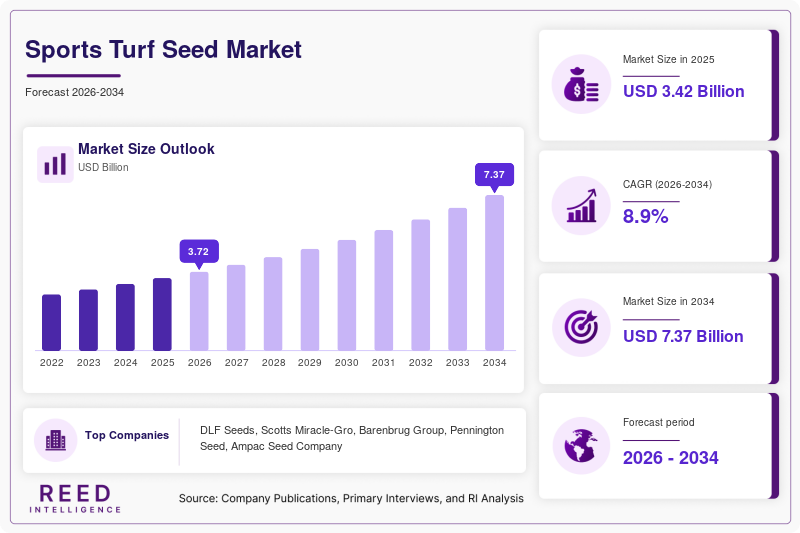
The global Sports Turf Seed Market size was valued at USD 3.42 billion in 2026 and is projected to reach USD 6.78 billion by 2034, expanding at a CAGR of 8.9% during the forecast period from 2026 to 2034. The market is experiencing stable growth due to rising investments in professional sports infrastructure, increasing demand for durable turf surfaces, and the growing adoption of advanced grass seed varieties for stadiums, golf courses, athletic fields, and recreational parks. Governments and private sports organizations are allocating higher budgets toward landscape enhancement and sustainable turf management, which continues to support industry expansion across developed and emerging economies.
A major global factor supporting market growth is the increasing number of international sporting events and urban recreational developments. Countries are modernizing sports facilities to meet international standards, which has increased demand for high-performance turf seed blends capable of withstanding heavy foot traffic, climate stress, and intensive maintenance cycles. In addition, growing awareness regarding environmental sustainability has encouraged the use of drought-resistant and low-maintenance turf seed varieties. Manufacturers are also investing in biotechnology and hybrid breeding programs to improve seed quality, disease resistance, and recovery performance.
Key Highlights
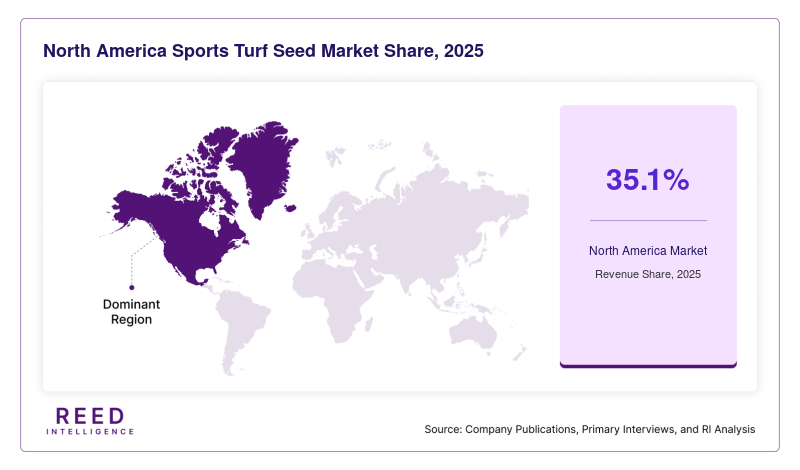
- North America dominated the market with a 35.1% share in 2025, while Asia Pacific is expected to grow at the fastest CAGR of 10.8% during 2026–2034.
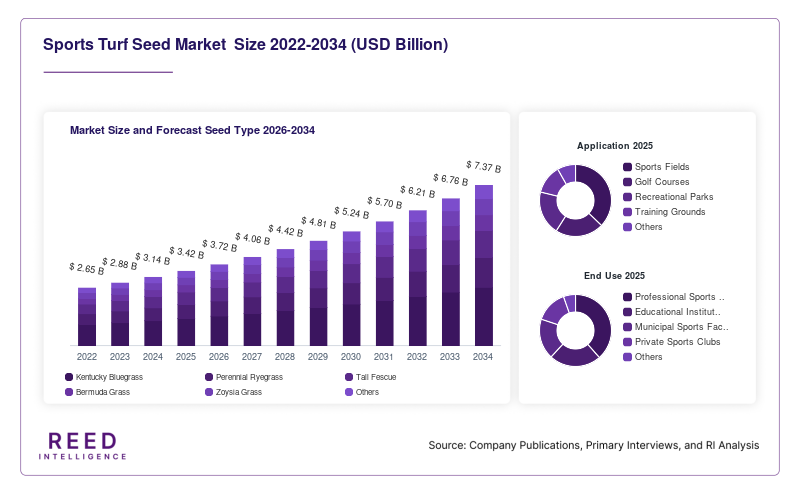
- By seed type, Kentucky bluegrass accounted for the largest share of 31.8%, while perennial ryegrass is projected to grow at a CAGR of 10.9%.
- By application, sports fields led with a 42.6% share, whereas golf courses are expected to expand at a CAGR of 10.4%.
- By end use, professional sports stadiums dominated with a 39.7% share, while educational institutions are projected to grow at a CAGR of 10.6%.
- The United States remained the dominant country, with market values of USD 710 million in 2024 and USD 775 million in 2025.
Market Trends
Rising Adoption of Climate-Resilient Turf Seed Varieties
Sports facility operators are increasingly adopting climate-resilient turf seed varieties to address changing weather conditions and water availability concerns. Turf managers across football fields, golf courses, baseball grounds, and public recreational spaces are shifting toward drought-tolerant seed blends that require lower irrigation levels while maintaining turf density and visual quality. This trend has become more visible in regions experiencing prolonged dry seasons and stricter water conservation regulations. Seed producers are developing advanced cultivars with improved heat tolerance, faster germination, and resistance to diseases caused by humidity fluctuations. The integration of biotechnology into seed development has further strengthened product performance. In addition, sports authorities are demanding surfaces that can sustain year-round use with limited downtime for maintenance. As sustainability standards continue to influence procurement decisions, climate-adaptive turf seed solutions are expected to become a central focus of the Sports Turf Seed Market over the coming years.
Increasing Investments in Multi-Purpose Sports Infrastructure
The expansion of multi-purpose sports infrastructure is creating strong demand for premium turf seed products worldwide. Municipal governments, educational institutions, and private sports clubs are investing in facilities capable of hosting multiple sporting activities on a single turf surface. This has accelerated the requirement for high-durability grass species that can tolerate intensive wear and recover quickly after usage. Emerging economies are also witnessing increased spending on community sports complexes and urban recreational parks to support public fitness initiatives and sports tourism. Modern stadium operators are emphasizing aesthetic turf appearance along with playing consistency, leading to higher adoption of customized seed mixtures. The growth of women’s sports leagues and youth sports programs has additionally increased field utilization rates, creating a need for continuous turf renovation and reseeding activities. These developments are expected to sustain long-term demand growth within the Sports Turf Seed Market.
Market Drivers
Expansion of Professional and Recreational Sports Activities
The growing popularity of professional and recreational sports activities is a major factor driving the Sports Turf Seed Market. Governments and sports organizations are investing heavily in stadium modernization projects, athletic grounds, and training facilities to accommodate increasing participation in sports such as football, cricket, rugby, baseball, and golf. Recreational sports programs in schools, colleges, and local communities are also expanding rapidly, increasing the need for high-quality turf surfaces that can withstand intensive usage. Turf seed manufacturers are benefiting from repeated reseeding requirements caused by seasonal wear and weather-related damage. Furthermore, international sporting tournaments often require upgraded playing surfaces that comply with global performance standards. The increasing focus on player safety and field consistency has encouraged facility managers to select premium turf seed varieties with improved root strength and durability. These factors continue to contribute significantly to overall market growth.
Growing Demand for Sustainable Landscaping Solutions
The rising demand for sustainable landscaping solutions is accelerating innovation and product adoption within the Sports Turf Seed Market. Sports facility operators are increasingly seeking environmentally responsible turf systems that reduce water consumption, fertilizer use, and maintenance costs. This trend has encouraged seed producers to develop grass varieties with improved nutrient efficiency and natural disease resistance. Sustainable turf management practices are becoming particularly important in urban regions facing resource constraints and environmental regulations. Many municipalities are implementing green infrastructure programs that prioritize eco-friendly sports grounds and recreational spaces. Additionally, advancements in seed coating technologies and organic treatment methods are improving germination efficiency while minimizing chemical dependency. The market is also benefiting from the integration of smart irrigation systems that optimize water usage on turf surfaces. As environmental sustainability becomes a key purchasing consideration, demand for innovative turf seed solutions is expected to strengthen steadily during the forecast period.
Market Restraint
High Maintenance Costs and Competition from Artificial Turf
One of the primary restraints affecting the Sports Turf Seed Market is the high maintenance cost associated with natural grass surfaces. Sports turf areas require continuous irrigation, fertilization, mowing, pest management, and seasonal reseeding to maintain optimal playing conditions. These recurring expenses can become financially challenging for municipalities, schools, and smaller sports organizations operating under limited budgets. In regions experiencing water scarcity, maintaining natural turf surfaces also becomes more difficult due to increasing utility costs and environmental restrictions. Additionally, artificial turf alternatives continue to gain popularity because of their lower maintenance requirements and longer operational lifespan. Synthetic surfaces are particularly attractive for multi-use facilities where heavy usage reduces the recovery time available for natural grass. Several stadium operators are adopting hybrid turf systems or synthetic fields to reduce downtime and operational expenses. This growing competition from alternative playing surfaces may limit the expansion potential of natural sports turf seed products in certain regional markets.
Market Opportunities
Growth of Sports Infrastructure in Emerging Economies
Emerging economies are creating substantial growth opportunities for the Sports Turf Seed Market through large-scale investments in sports infrastructure development. Countries across Asia Pacific, Latin America, and the Middle East are constructing new stadiums, golf resorts, athletic complexes, and recreational parks to support economic diversification and tourism growth. Government initiatives aimed at encouraging youth participation in sports are also increasing demand for community sports grounds and school athletic facilities. These projects require high-performance turf systems capable of adapting to regional climate conditions and intensive usage patterns. International sporting events hosted by developing nations are further accelerating infrastructure upgrades and turf modernization programs. Turf seed suppliers are expanding their regional distribution networks and launching climate-specific seed varieties to capitalize on this demand. The growing middle-class population and rising consumer interest in fitness and outdoor activities are expected to strengthen market opportunities significantly during the forecast period.
Technological Advancements in Seed Breeding and Turf Management
Technological advancements in seed breeding and turf management practices are opening new opportunities for market participants. Seed manufacturers are increasingly investing in research programs focused on genetic improvement, disease resistance, rapid establishment, and stress tolerance. These innovations are helping sports facility managers reduce maintenance costs while improving field durability and visual appearance. Precision turf management technologies, including moisture sensors and automated irrigation systems, are also supporting efficient turf maintenance operations. The adoption of data-driven turf monitoring tools is enabling facility operators to optimize seeding schedules and nutrient management practices. Furthermore, advancements in seed coating technologies are improving germination rates and enhancing turf establishment under difficult environmental conditions. Companies introducing premium hybrid seed blends tailored for specific sports applications are expected to gain competitive advantages. As sports organizations continue prioritizing field quality and sustainability, technology-driven turf seed solutions are likely to generate substantial long-term market growth opportunities.
Segmental Analysis
By Seed Type
Kentucky bluegrass dominated the Sports Turf Seed Market in 2024, accounting for approximately 31.8% of the overall market share. The segment maintains strong demand due to its dense texture, excellent visual appearance, and superior recovery performance under heavy foot traffic conditions. Professional sports stadiums, golf courses, and recreational parks widely utilize Kentucky bluegrass because it creates a uniform and resilient playing surface suitable for multiple sporting activities. The grass variety is particularly preferred in cooler climatic regions where consistent turf quality is essential for year-round sports operations. Its ability to recover rapidly from wear damage has increased adoption across football and baseball facilities. Turf managers also favor this seed type due to its compatibility with blended turf systems designed for enhanced durability. Continued investments in premium sports infrastructure and stadium renovation projects are expected to support sustained demand for Kentucky bluegrass products globally.
Perennial ryegrass is projected to emerge as the fastest-growing subsegment, expanding at a CAGR of 10.9% during the forecast period. The segment is gaining popularity because of its rapid germination capability, strong wear tolerance, and suitability for overseeding applications. Sports facility operators increasingly prefer perennial ryegrass for maintaining turf density during seasonal transitions and intensive sports schedules. The grass variety is widely adopted in stadiums requiring quick turf establishment before major sporting events. Additionally, advancements in seed breeding technologies have improved disease resistance and climate adaptability, further supporting product adoption. Growing investments in community sports infrastructure and educational athletic fields are also contributing to segment growth. The increasing focus on low-maintenance and high-performance turf systems is expected to strengthen demand for perennial ryegrass across both developed and emerging markets during the coming years.
By Application
Sports fields represented the dominant application segment in 2024 and accounted for approximately 42.6% of the total Sports Turf Seed Market share. The segment benefits from increasing investments in football stadiums, baseball grounds, rugby fields, and cricket facilities across multiple regions. Governments, educational institutions, and private sports organizations are continuously upgrading sports surfaces to improve athlete safety and playing consistency. Sports fields require frequent reseeding and turf maintenance due to heavy usage and changing weather conditions, creating recurring demand for premium turf seed products. Additionally, the growing popularity of youth sports leagues and amateur athletic programs has increased the number of sports grounds requiring high-quality natural turf systems. Sports facility managers are also adopting customized seed mixtures designed to improve turf resilience and reduce recovery time after sporting events. These factors continue to support the long-term growth of the sports fields application segment.
Golf courses are anticipated to witness the fastest growth, registering a CAGR of 10.4% during the forecast period. The segment is expanding due to increasing golf tourism, rising disposable incomes, and growing interest in recreational outdoor activities. Luxury resort developments and private golf clubs are investing heavily in high-performance turf systems capable of maintaining premium visual appeal and playing quality. Turf seed suppliers are introducing specialized grass varieties designed for fairways, greens, and rough areas with improved disease resistance and water efficiency. The expansion of golf infrastructure in Asia Pacific and the Middle East is also creating significant growth opportunities for the segment. Furthermore, golf course operators are increasingly focusing on sustainable landscape management practices, encouraging the adoption of drought-tolerant turf seed varieties. Continued growth in sports tourism and recreational infrastructure investments is expected to drive segment expansion over the coming years.
By End Use
Professional sports stadiums accounted for the largest share of the Sports Turf Seed Market in 2024, representing nearly 39.7% of total revenue. The segment benefits from continuous investments in stadium modernization, international sporting tournaments, and advanced turf management technologies. Professional sports organizations prioritize premium natural playing surfaces that ensure athlete safety, ball performance consistency, and aesthetic quality. Stadium operators frequently conduct reseeding and turf renovation activities to maintain field performance throughout competitive seasons. The increasing number of global football, cricket, baseball, and rugby tournaments has further strengthened demand for durable and fast-recovering turf seed varieties. In addition, hybrid turf systems combining natural grass with reinforcement technologies are gaining popularity among major stadium operators. The rising focus on fan experience and broadcasting standards is also encouraging investments in visually appealing and high-quality turf surfaces across professional sports venues worldwide.
Educational institutions are projected to emerge as the fastest-growing end-use segment, expanding at a CAGR of 10.6% during the forecast period. Schools, colleges, and universities are increasingly investing in athletic infrastructure to support student participation in sports and recreational activities. Governments across multiple countries are allocating higher budgets toward the development of school sports grounds and training facilities. Educational institutions typically require durable and cost-effective turf systems capable of handling frequent usage across multiple sports activities. The growing emphasis on student wellness, outdoor fitness programs, and competitive athletics is creating strong demand for sports turf seed products within this segment. In addition, universities hosting regional and national sporting events are upgrading field quality to meet professional standards. Manufacturers offering low-maintenance and climate-resistant turf seed blends are expected to benefit significantly from the expanding educational infrastructure sector.
Regional Analysis
North America
North America accounted for 35.1% of the global Sports Turf Seed Market share in 2025 and continues to maintain a strong position due to the presence of advanced sports infrastructure and established turf management practices. The region is projected to expand at a CAGR of 8.3% during the forecast period. High participation in sports such as football, baseball, golf, and soccer has created sustained demand for premium turf seed varieties across professional and recreational facilities. In addition, the region benefits from strong investments in golf course renovation and stadium modernization projects.
The United States remains the dominant country within North America due to its extensive network of professional sports leagues, educational athletic programs, and municipal sports facilities. A unique growth factor supporting the national market is the increasing adoption of drought-resistant turf grass in response to changing climate conditions and water conservation policies. Sports facility operators are investing in advanced turf management systems to improve playing quality while reducing maintenance expenses. Canada is also witnessing steady demand growth from recreational parks and community sports developments.
Europe
Europe held a significant share of the Sports Turf Seed Market in 2025 and is expected to register a CAGR of 7.9% between 2026 and 2034. The region benefits from strong football culture, widespread golf course infrastructure, and increasing investments in public recreational spaces. Sports authorities across Europe continue to emphasize high-quality natural playing surfaces that comply with professional league standards. The demand for environmentally sustainable turf seed varieties is also increasing due to stricter environmental regulations and sustainability targets implemented across several European countries.
Germany emerged as the leading country in the European market owing to its advanced sports infrastructure and large number of football training facilities. A unique growth factor driving the German market is the integration of sustainable landscape management practices within municipal sports grounds and public recreational parks. The country is also witnessing rising demand for premium turf renovation services in stadiums hosting international competitions. The United Kingdom and France continue to contribute significantly through golf course maintenance and sports academy development projects.
Asia Pacific
Asia Pacific is projected to witness the fastest growth in the Sports Turf Seed Market, expanding at a CAGR of 10.8% during the forecast period. The region is benefiting from rapid urbanization, increasing sports participation, and substantial government spending on athletic infrastructure development. Countries across Asia Pacific are investing heavily in stadium construction, school sports facilities, and public recreational parks to support fitness initiatives and tourism growth. Rising disposable incomes and growing interest in outdoor recreational activities are also supporting market expansion across both developed and emerging economies.
China represents the dominant country in the regional market due to extensive investments in sports infrastructure and urban landscaping projects. A unique growth factor driving market growth in China is the government’s long-term strategy to strengthen domestic sports participation and international sporting competitiveness. The country has accelerated the construction of football training centers, multi-purpose stadiums, and community sports grounds. India and Australia are also contributing significantly through cricket infrastructure modernization and golf tourism development activities.
Middle East & Africa
The Middle East & Africa region is gradually emerging as a promising market for sports turf seed products and is expected to grow at a CAGR of 8.1% from 2026 to 2034. Investments in sports tourism, luxury golf resorts, and international sporting events are supporting market development across the region. Countries are increasingly focusing on building climate-resilient sports facilities capable of withstanding harsh environmental conditions. Demand for heat-tolerant turf seed varieties has increased substantially due to extreme temperatures and limited water availability in several regional markets.
Saudi Arabia remains the dominant country in the Middle East & Africa market owing to ongoing investments in sports infrastructure and tourism diversification initiatives. A unique growth factor supporting the national market is the expansion of mega sporting and entertainment projects under long-term economic transformation programs. The country is developing world-class stadiums, golf courses, and recreational complexes to attract international tourism and sporting events. South Africa also contributes steadily through rugby and cricket infrastructure development activities.
Latin America
Latin America accounted for a moderate share of the Sports Turf Seed Market in 2025 and is anticipated to grow at a CAGR of 7.6% during the forecast period. The region benefits from strong football culture, increasing recreational sports participation, and rising investments in public sports infrastructure. Governments and private sports clubs are focusing on upgrading stadium turf quality to meet international tournament requirements. The expansion of urban recreational spaces and community sports grounds is also creating stable demand for durable and low-maintenance turf seed varieties.
Brazil dominates the Latin American market due to its extensive football infrastructure and growing number of recreational sports facilities. A unique growth factor supporting the Brazilian market is the continuous renovation of stadiums and training grounds used for domestic and international sporting events. The country’s favorable climate conditions also support year-round turf cultivation and maintenance activities. Mexico and Argentina continue to contribute to regional market growth through increasing investments in golf courses and municipal sports complexes.
Competitive Landscape
The Sports Turf Seed Market is moderately fragmented, with leading companies focusing on product innovation, regional expansion, and strategic partnerships to strengthen their market presence. Major participants are investing in research and development activities to introduce advanced turf seed varieties with improved disease resistance, drought tolerance, and wear recovery performance. Companies are also expanding their distribution networks to capture opportunities in emerging sports infrastructure markets across Asia Pacific and the Middle East.
DLF Seeds remains one of the leading companies in the market due to its broad turf seed portfolio and strong international presence. The company recently introduced advanced climate-resistant turf seed blends designed for professional sports stadiums and golf course applications. Other major companies are emphasizing sustainable seed technologies and customized turf solutions tailored to regional environmental conditions. Market competition is expected to intensify further as sports organizations increasingly demand premium-quality turf systems capable of delivering high performance with lower maintenance requirements.
Key Players
- DLF Seeds
- Scotts Miracle-Gro
- Barenbrug Group
- Pennington Seed
- Ampac Seed Company
- Columbia Seeds
- Graham Turf Seeds
- BrettYoung
- Seed Research of Oregon
- Royal Barenbrug Group
- Turf Merchants
- Mountain View Seeds
- Jacklin Seed
- Hancock Seed Company
- Allied Seed
Recent Developments
- In February 2026, Barenbrug Group launched a new drought-tolerant turf seed blend designed for football stadiums and municipal sports facilities in water-stressed regions.
- In July 2025, DLF Seeds expanded its turf research center operations to accelerate the development of climate-resilient sports turf seed varieties.
- In October 2025, Scotts Miracle-Gro introduced advanced seed coating technology aimed at improving germination rates and turf establishment in high-traffic sports grounds.
- In March 2026, Pennington Seed partnered with regional sports facility operators to supply customized turf seed solutions for multi-purpose athletic complexes.
Sports Turf Seed Market Segments
Seed Type
- Kentucky Bluegrass
- Perennial Ryegrass
- Tall Fescue
- Bermuda Grass
- Zoysia Grass
- Others
Application
- Sports Fields
- Golf Courses
- Recreational Parks
- Training Grounds
- Others
End Use
- Professional Sports Stadiums
- Educational Institutions
- Municipal Sports Facilities
- Private Sports Clubs
- Others
By Region
- North America
- Europe
- APAC
- Middle East and Africa
- LATAM