Spray On Solar Cell Market Size, Share & Demand Report By Material Type (Perovskite Spray Cells, Organic Photovoltaic Spray Cells, Quantum Dot Spray Cells, Dye-Sensitized Spray Cells), By Application (Building Integrated Photovoltaics, Wearable Electronics, Portable Energy Devices, Industrial Power Systems, Smart Transportation Systems), By End-Use (Residential, Commercial Infrastructure, Industrial, Transportation, Defense and Aerospace), By Region & Segment Forecasts, 2026–2034
USD 3950
Market Overview
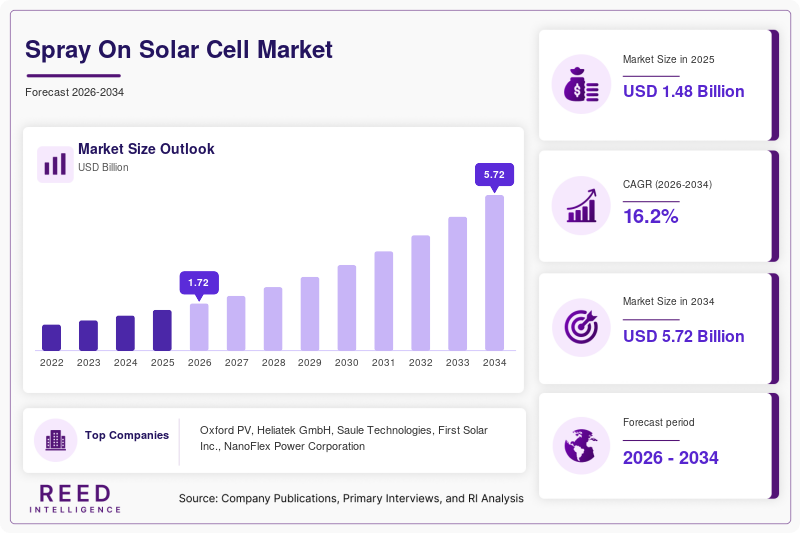
The global Spray On Solar Cell Market size was valued at USD 1.48 billion in 2026 and is projected to reach USD 4.92 billion by 2034, expanding at a CAGR of 16.2% during the forecast period from 2026 to 2034. The market is gaining momentum as governments, manufacturers, and energy developers continue to invest in flexible photovoltaic technologies that can support lightweight, portable, and low-cost solar power generation. Spray on solar cells, often developed using perovskite materials, organic photovoltaics, and nanomaterial coatings, are emerging as an alternative to conventional silicon-based panels in applications where flexibility and integration are essential.
Growing global emphasis on decarbonization and renewable energy adoption has supported the expansion of the market. Several countries are implementing clean energy targets, carbon neutrality frameworks, and building efficiency standards that encourage the use of advanced solar technologies. Spray on solar cells are increasingly integrated into transportation, smart buildings, industrial roofing systems, and consumer electronics because of their ability to be applied to curved and lightweight surfaces. In addition, advancements in printable electronics and thin-film deposition methods are improving efficiency rates and reducing production costs across commercial-scale manufacturing operations.
Key Highlights
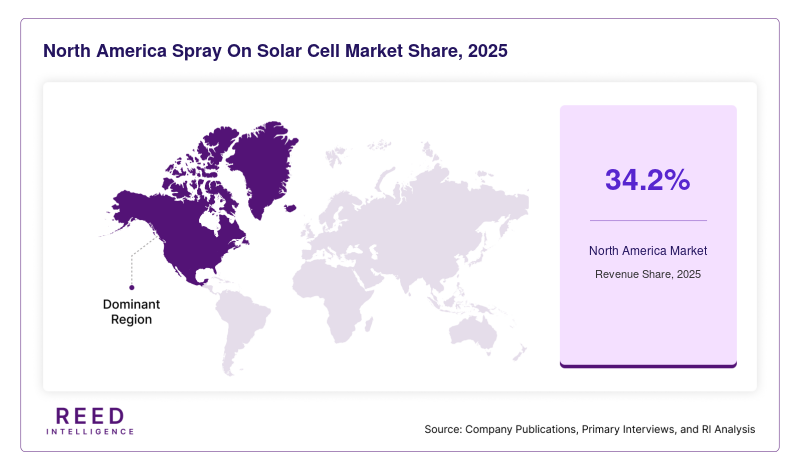
- North America dominated the market with a 34.2% share in 2025, while Asia Pacific is expected to grow at the fastest CAGR of 18.4% during 2026–2034.
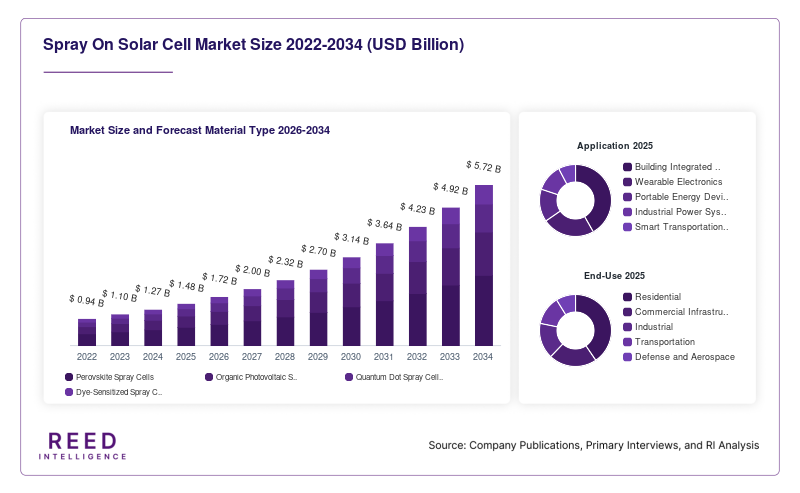
- By material type, perovskite spray cells accounted for the largest share of 42.7%, while organic photovoltaic spray cells are projected to grow at a CAGR of 19.1%.
- By application, building integrated photovoltaics led with a 39.6% share, whereas wearable electronics are expected to expand at a CAGR of 20.3%.
- By end-use, commercial infrastructure accounted for the dominant share of 37.9%, while transportation applications are projected to grow at a CAGR of 18.8%.
- The United States remained the dominant country, with market values of USD 420 million in 2024 and USD 485 million in 2025.
Market Trends
Expansion of Building Integrated Photovoltaic Solutions
The integration of spray on solar technologies into building materials is becoming a major trend across the global energy industry. Construction companies and urban infrastructure developers are adopting building integrated photovoltaics to improve energy efficiency while reducing dependency on traditional electricity grids. Spray on solar cells are being applied to glass surfaces, facades, rooftops, and lightweight construction materials because they can conform to irregular surfaces without increasing structural load. This trend is particularly visible in smart city projects and green commercial buildings where developers seek multifunctional materials that combine architectural flexibility with renewable energy generation.
The growing focus on net-zero commercial buildings is accelerating research into transparent and semi-transparent spray on photovoltaic coatings. Governments in North America and Europe are introducing energy efficiency regulations that support on-site renewable power generation within commercial and residential infrastructure. In addition, real estate developers are investing in energy-generating windows and solar-enabled coatings to improve sustainability ratings. As energy costs continue to rise globally, the demand for integrated photovoltaic technologies is expected to strengthen further during the forecast period.
Rising Adoption of Flexible Solar Technology in Consumer Electronics
Consumer electronics manufacturers are increasingly exploring spray on solar cell technologies for wearable devices, portable chargers, smart textiles, and connected electronics. Traditional rigid solar panels limit design flexibility, while spray-based photovoltaic coatings can be applied directly to fabrics, polymer surfaces, and lightweight portable devices. This trend is encouraging electronics companies to collaborate with material science firms and renewable energy startups to commercialize compact and efficient self-charging devices.
The growing use of Internet of Things devices and portable electronics is creating demand for decentralized power generation solutions that improve battery efficiency and reduce charging frequency. Spray on solar coatings are being evaluated for integration into smartphones, backpacks, smartwatches, and electric mobility accessories. The market is also benefiting from advancements in conductive inks, printable nanomaterials, and scalable roll-to-roll manufacturing technologies that support cost-efficient production. As consumers increasingly prioritize sustainable electronics, the adoption of spray on photovoltaic systems in consumer applications is expected to expand steadily.
Market Drivers
Increasing Investments in Renewable Energy Infrastructure
Rapid global investment in renewable energy infrastructure is one of the primary factors supporting the growth of the Spray On Solar Cell Market. Governments across developed and developing economies are allocating substantial funding toward clean energy deployment, energy transition programs, and carbon emission reduction initiatives. Spray on solar cells are gaining attention because they offer a lightweight and adaptable renewable energy solution for applications where conventional solar panels are difficult to install. The technology is especially useful in urban infrastructure, transportation systems, portable energy units, and temporary installations.
Public and private investments in advanced photovoltaic technologies are also improving manufacturing capabilities and commercial scalability. Research institutions and technology firms are developing spray deposition methods that enhance energy conversion efficiency and environmental stability. Several energy developers are testing spray on solar systems for industrial roofing, warehouse structures, and mobile energy applications. The increasing adoption of sustainable energy frameworks by corporations is further contributing to market expansion, particularly in regions focused on reducing fossil fuel dependency and increasing renewable electricity generation.
Technological Advancements in Thin-Film and Nanomaterial Coatings
Continuous advancements in thin-film photovoltaic materials and nanotechnology are significantly driving the development of spray on solar cells. Innovations in perovskite materials, organic semiconductors, conductive polymers, and nanoparticle coatings are improving the performance and durability of spray-based photovoltaic systems. Manufacturers are focusing on enhancing efficiency rates while lowering manufacturing complexity and production costs through scalable printing technologies.
The development of roll-to-roll production techniques and high-speed deposition systems is enabling faster commercialization of flexible photovoltaic coatings. Improved resistance to moisture, ultraviolet radiation, and temperature fluctuations is also increasing the viability of spray on solar cells in outdoor and industrial applications. Research collaborations between universities, renewable energy companies, and electronics manufacturers are accelerating innovation in multifunctional solar coatings. As production processes become more standardized and material performance improves, spray on solar technologies are expected to gain broader commercial acceptance across residential, industrial, and consumer electronics sectors.
Market Restraint
Limited Long-Term Durability and Commercial Standardization
One of the primary challenges restricting the growth of the Spray On Solar Cell Market is the limited long-term durability of spray-based photovoltaic materials compared to traditional silicon solar panels. Many spray on solar technologies, especially perovskite-based systems, remain vulnerable to moisture exposure, temperature fluctuations, and ultraviolet degradation over extended operating periods. These durability concerns create hesitation among commercial buyers and infrastructure developers who require reliable energy systems with long operational lifespans.
The lack of universal manufacturing standards and certification frameworks also affects market adoption. Several spray on photovoltaic products are still in the pilot or early commercialization stage, which limits large-scale deployment in regulated industries such as construction, transportation, and utility energy generation. Financial institutions and investors often prefer proven photovoltaic technologies with established performance records, making funding more difficult for emerging spray on solar companies. In addition, inconsistent efficiency rates across different environmental conditions can impact project economics and customer confidence. Although research efforts are improving material stability and performance, the industry still faces commercialization barriers related to reliability, scalability, and quality assurance.
Market Opportunities
Growth Potential in Electric Vehicle and Transportation Integration
The integration of spray on solar cells into transportation systems presents a major opportunity for market participants. Automotive manufacturers, public transportation operators, and electric mobility companies are increasingly evaluating lightweight photovoltaic coatings to improve energy efficiency and extend battery performance. Spray on solar materials can be applied to vehicle roofs, body panels, cargo containers, and public transportation infrastructure without significantly increasing weight.
Electric vehicle manufacturers are exploring the use of flexible solar coatings to support auxiliary systems, reduce charging frequency, and enhance sustainability credentials. In addition, aerospace and marine transportation sectors are investigating lightweight solar technologies for energy generation in remote and mobile environments. As governments continue to support electric mobility adoption through incentives and environmental regulations, the demand for integrated renewable energy technologies is expected to increase. The ability of spray on solar cells to adapt to curved and unconventional surfaces creates substantial commercial potential within next-generation transportation applications.
Emerging Demand Across Remote and Off-Grid Energy Systems
Growing demand for decentralized power generation in remote and off-grid locations is creating strong opportunities for spray on solar cell manufacturers. Rural electrification programs, disaster recovery systems, military operations, and remote industrial sites increasingly require portable and lightweight renewable energy technologies that can be deployed rapidly. Spray on photovoltaic coatings offer advantages in these applications because they can be applied to temporary shelters, mobile equipment, and flexible materials.
Humanitarian organizations and defense agencies are investing in portable solar technologies to reduce dependency on fuel logistics and conventional power systems in isolated environments. In addition, developing countries across Asia Pacific, Africa, and Latin America are implementing renewable energy programs aimed at improving electricity access in underserved communities. Spray on solar cells provide a cost-efficient solution for lightweight power generation where grid infrastructure remains limited. Continued advancements in flexible battery storage systems and portable electronics are expected to strengthen the role of spray on photovoltaic technologies in remote energy applications during the forecast period.
Segmental Analysis
By Material Type
Perovskite spray cells dominated the Spray On Solar Cell Market and accounted for 42.7% of the global market share in 2024. The dominance of this subsegment is attributed to its strong energy conversion efficiency, lower production costs, and compatibility with flexible photovoltaic manufacturing processes. Perovskite materials can be deposited using spray coating techniques on lightweight substrates, making them suitable for portable electronics, smart building surfaces, and wearable devices. Several research institutions and manufacturers are prioritizing perovskite technology because it offers a balance between efficiency performance and manufacturing scalability. The increasing number of pilot commercialization projects in Europe, North America, and Asia Pacific has further strengthened demand for perovskite spray cells. In addition, the material supports semi-transparent solar applications, which expands its usage in architectural glass systems and energy-generating windows.
Organic photovoltaic spray cells are expected to register the fastest CAGR of 19.1% during the forecast period due to increasing demand for lightweight and flexible renewable energy technologies. Organic photovoltaic materials offer advantages such as mechanical flexibility, low-temperature manufacturing, and compatibility with printable electronics. These characteristics make them highly suitable for consumer electronics, smart textiles, and portable charging systems. Companies operating in the wearable electronics industry are investing in organic photovoltaic coatings to improve device energy efficiency and reduce dependence on conventional battery charging methods. In addition, ongoing advancements in conductive polymers and nanomaterial formulations are improving energy conversion rates and operational stability. The growing interest in sustainable consumer electronics and flexible energy harvesting systems is expected to support rapid growth in this segment over the coming years.
By Application
Building integrated photovoltaics accounted for the largest market share of 39.6% in 2024 due to increasing demand for sustainable and energy-efficient construction solutions. Spray on solar technologies are increasingly used in commercial buildings, residential complexes, and smart urban infrastructure because they can be integrated into roofs, windows, facades, and lightweight structural materials. The ability to generate electricity without altering architectural aesthetics has made these systems attractive to real estate developers and infrastructure planners. Governments across Europe and North America are implementing energy efficiency regulations that encourage the integration of renewable energy systems within building designs. In addition, rising electricity prices and growing corporate sustainability targets are accelerating the adoption of building integrated photovoltaic technologies. Continuous advancements in transparent solar coatings and flexible photovoltaic materials are also supporting segment expansion.
Wearable electronics is projected to witness the fastest CAGR of 20.3% during the forecast period owing to the increasing demand for portable and self-powered electronic devices. Spray on solar cells can be applied to fabrics, polymer surfaces, and lightweight accessories, enabling continuous power generation for smartwatches, fitness trackers, smart clothing, and portable communication devices. Consumer demand for sustainable and energy-efficient electronics is encouraging manufacturers to explore innovative photovoltaic integration methods. The rapid growth of Internet of Things devices and connected consumer technologies is further contributing to segment development. Research collaborations between electronics companies and renewable energy firms are improving the efficiency and durability of flexible solar coatings used in wearable applications. As battery optimization becomes a priority across the electronics industry, the demand for spray-based photovoltaic systems in wearable technology is expected to increase significantly.
By End-Use
Commercial infrastructure emerged as the dominant end-use segment and held 37.9% of the global market share in 2024. Commercial facilities are increasingly adopting spray on solar technologies to improve sustainability performance and reduce long-term operational energy costs. Shopping centers, office buildings, logistics warehouses, and hospitality facilities are integrating lightweight photovoltaic coatings into roofing systems, exterior surfaces, and smart building components. The segment is also benefiting from rising environmental regulations and corporate commitments toward carbon neutrality. Spray on solar cells provide an attractive alternative for commercial projects that require adaptable and aesthetically integrated renewable energy solutions. In addition, the growing trend of green building certifications and energy-efficient commercial developments is encouraging property developers to invest in advanced photovoltaic technologies. Increasing awareness regarding decentralized energy generation further supports segment growth.
Transportation applications are expected to expand at the fastest CAGR of 18.8% during the forecast period because of the increasing focus on electric mobility and lightweight renewable energy integration. Automotive manufacturers are evaluating spray on solar coatings for use in electric vehicles, buses, rail systems, and marine transportation. These coatings can provide supplementary power for auxiliary systems while reducing battery load and improving operational efficiency. The aviation and logistics industries are also exploring lightweight photovoltaic materials for portable energy generation and sustainability improvements. Government incentives supporting electric vehicle adoption and low-emission transportation systems are accelerating innovation in integrated solar technologies. Furthermore, advancements in flexible thin-film materials and lightweight conductive coatings are improving the feasibility of applying spray on solar cells across various transportation surfaces and mobility platforms.
Regional Analysis
North America
North America accounted for 34.2% of the global Spray On Solar Cell Market in 2025 and is expected to maintain a stable growth trajectory with a CAGR of 15.1% during the forecast period. The region benefits from strong renewable energy investments, advanced research infrastructure, and increasing demand for flexible photovoltaic technologies across commercial and industrial sectors. Government funding programs supporting clean energy innovation have accelerated research into printable solar materials and advanced thin-film technologies. The presence of established renewable energy companies and venture capital investments also contributes to regional market expansion.
The United States remains the dominant country within North America due to its advanced renewable energy ecosystem and strong focus on next-generation photovoltaic development. The country continues to witness rising adoption of building integrated photovoltaic systems and portable solar applications across military and commercial sectors. Universities and private research institutions are actively developing high-efficiency spray on solar coatings with improved environmental stability. Federal tax incentives and state-level renewable energy mandates continue to encourage investments in flexible solar technologies throughout the country.
Europe
Europe represented 26.8% of the global market in 2025 and is projected to grow at a CAGR of 14.8% between 2026 and 2034. The region is characterized by strict carbon reduction targets, strong environmental policies, and increasing adoption of sustainable building technologies. European countries are actively investing in energy-efficient infrastructure and renewable power integration to support climate neutrality objectives. Spray on solar cells are gaining popularity in green construction projects and smart urban developments because they provide lightweight and adaptable photovoltaic solutions.
Germany emerged as the dominant country in the European market owing to its established solar manufacturing industry and extensive clean energy transition initiatives. The country is focusing on integrating renewable energy technologies into industrial facilities, transportation systems, and residential infrastructure. German manufacturers are also collaborating with research organizations to improve perovskite solar efficiency and large-scale production techniques. Growing investments in sustainable mobility and energy-efficient commercial buildings continue to support demand for spray on solar technologies across the country.
Asia Pacific
Asia Pacific accounted for 23.5% of the Spray On Solar Cell Market in 2025 and is expected to register the fastest CAGR of 18.4% during the forecast period. Rapid industrialization, urban infrastructure expansion, and rising renewable energy adoption are driving regional market growth. Governments across the region are implementing ambitious solar energy programs to reduce fossil fuel dependence and improve energy security. The growing electronics manufacturing industry is also contributing to demand for flexible and lightweight photovoltaic materials.
China dominates the Asia Pacific market because of its strong photovoltaic manufacturing capabilities and extensive investments in renewable energy technologies. The country is expanding production capacity for thin-film solar materials and supporting commercialization through government incentives and industrial partnerships. Chinese electronics and automotive manufacturers are increasingly evaluating spray on solar coatings for wearable devices and electric mobility applications. Rapid expansion of smart cities and energy-efficient construction projects is further strengthening market demand across the country.
Middle East & Africa
The Middle East & Africa region held 8.1% of the global market in 2025 and is anticipated to grow at a CAGR of 13.7% through 2034. Rising investments in renewable energy diversification and increasing focus on sustainable infrastructure are supporting market development. Several countries in the region are exploring advanced solar technologies to address energy security concerns and reduce dependence on fossil fuel exports. Spray on solar cells are being considered for lightweight construction materials, remote energy systems, and portable power applications in desert environments.
The United Arab Emirates represents the leading country within the regional market due to its large-scale renewable energy initiatives and smart city development programs. The country is investing heavily in clean energy technologies and sustainable urban infrastructure as part of its economic diversification strategy. Spray on photovoltaic coatings are attracting interest for integration into modern architectural projects and transportation systems. Growing research partnerships between regional universities and international energy firms are expected to accelerate technology adoption in the coming years.
Latin America
Latin America captured 7.4% of the global Spray On Solar Cell Market in 2025 and is forecast to grow at a CAGR of 14.2% during the study period. Increasing electricity demand, rising renewable energy investments, and supportive government policies are contributing to regional growth. Countries across the region are seeking affordable and scalable renewable energy technologies to improve energy access and reduce carbon emissions. Spray on solar systems are gaining attention for use in remote communities, agricultural infrastructure, and lightweight energy installations.
Brazil remains the dominant country in the Latin American market because of its expanding renewable energy sector and growing investments in distributed solar generation. The country is witnessing increasing adoption of sustainable construction materials and off-grid solar solutions in rural areas. Brazilian research institutions are also evaluating advanced photovoltaic coatings for industrial and agricultural applications. Supportive clean energy financing programs and increasing awareness of sustainable energy technologies continue to strengthen market opportunities across the country.
Competitive Landscape
The Spray On Solar Cell Market is characterized by strong research activity, strategic partnerships, and increasing investments in advanced photovoltaic technologies. Companies are focusing on improving efficiency levels, production scalability, and material durability to strengthen their competitive positions. The market includes established solar manufacturers, nanotechnology firms, material science companies, and renewable energy startups competing to commercialize next-generation spray-based photovoltaic solutions.
Oxford PV remains one of the leading companies in the market due to its extensive expertise in perovskite solar technologies and strategic collaborations with global energy firms. The company has continued to invest in high-efficiency perovskite photovoltaic systems aimed at accelerating commercial adoption. Heliatek, Saule Technologies, and First Solar are also expanding research efforts related to flexible and printable solar technologies for commercial infrastructure and electronics applications.
Key Players
- Oxford PV
- Heliatek GmbH
- Saule Technologies
- First Solar Inc.
- NanoFlex Power Corporation
- SolarWindow Technologies Inc.
- Konarka Technologies
- Greatcell Energy
- Panasonic Holdings Corporation
- Hanergy Thin Film Power Group
- Sharp Corporation
- Toshiba Corporation
- Mitsubishi Chemical Group
- Ascent Solar Technologies
- Sun Harmonics
Recent Developments
- In March 2025, Oxford PV expanded its perovskite solar manufacturing operations to increase production capacity for flexible photovoltaic applications.
- In January 2025, Saule Technologies introduced a next-generation printable solar coating solution designed for smart building infrastructure and energy-efficient commercial projects.
- In September 2024, Heliatek GmbH entered a strategic partnership with a European automotive manufacturer to develop lightweight photovoltaic coatings for electric vehicle integration.
- In June 2024, First Solar Inc. increased investments in advanced thin-film photovoltaic research programs focused on flexible solar deployment and high-efficiency coating technologies.
Spray On Solar Cell Market Segments
Material Type
- Perovskite Spray Cells
- Organic Photovoltaic Spray Cells
- Quantum Dot Spray Cells
- Dye-Sensitized Spray Cells
Application
- Building Integrated Photovoltaics
- Wearable Electronics
- Portable Energy Devices
- Industrial Power Systems
- Smart Transportation Systems
End-Use
- Residential
- Commercial Infrastructure
- Industrial
- Transportation
- Defense and Aerospace
By Region
- North America
- Europe
- APAC
- Middle East and Africa
- LATAM