Spray Tanning Market Size, Share & Trends Analysis Report By Product Type (Bronzing Spray, Tanning Mousse, Tanning Lotion, Tanning Oil), By Application (Salon & Spa, Home Use, Professional Tanning Studios), By Distribution Channel (Direct Sales, Specialty Stores, Supermarkets & Hypermarkets, Online Channels) and By Region (North America, Europe, APAC, Middle East and Africa, LATAM) Forecasts, 2026–2034
USD 3950
Spray Tanning Market Size
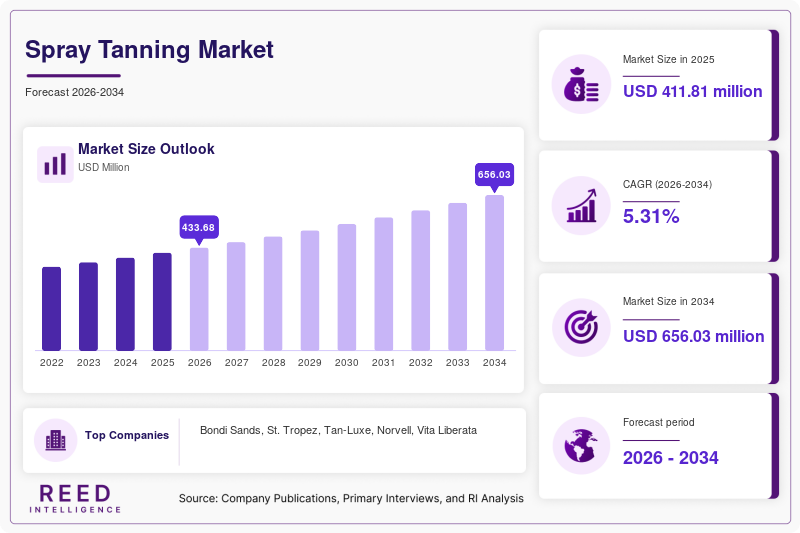
The global Spray Tanning Market was valued at USD 411.81 million in 2025 and is projected to grow from USD 433.68 million in 2026 to USD 656.03 million by 2034, registering a CAGR of 5.31% during 2026–2034.
Spray tanning occupies the intersection of sunless tanning, skincare and professional beauty services, with products generally using tanning-active ingredients to create temporary skin coloration without deliberate ultraviolet exposure. The category spans professional spray systems used in salons and tanning studios as well as consumer-oriented sprays, mousses, lotions and related formulations.
The demand structure is increasingly divided between professional services and at-home applications. Professional operators provide controlled application and personalized results, while home-use products compete through convenience, lower per-application costs and broader availability through beauty retailers and online channels.
Spray Tanning Market Drivers
Rising Preference for Sunless Tanning Creates Demand for Controlled Coloration
Sunless tanning provides consumers with a way to obtain temporary skin coloration without intentional exposure to tanning ultraviolet radiation. The FDA identifies DHA as the active color additive used in many sunless tanning products and permits its use in cosmetics when applied according to applicable requirements.
This creates a direct market mechanism: consumers seeking a tanned appearance can substitute topical products or professional spray services for intentional UV tanning. The effect is particularly relevant to consumers who prioritize appearance while seeking alternatives to conventional tanning practices.
Professional salons benefit through service-based applications, while consumer brands benefit through home-use formulations. The counterbalance is that sunless tanning products do not provide inherent UV protection unless a separate sunscreen product is used.
Product Innovation Improves the Economics of At-Home Tanning
The consumer proposition increasingly depends on application experience rather than simply the ability to produce a darker skin tone. Brands compete through formulations designed around ease of application, shade development, drying speed, transfer resistance, odor management and skin-conditioning characteristics.
The commercial mechanism is straightforward: improvements that reduce application errors can increase repeat purchasing and broaden the addressable consumer base beyond experienced self-tanners. Mousse, spray, lotion and gradual-tan formats allow companies to target different levels of convenience and tanning intensity.
The FDA's regulatory treatment of DHA also reinforces the importance of formulation and application conditions because cosmetic use must remain within applicable requirements.
Professional Beauty Services Support Recurring Spray-Tanning Demand
Professional spray tanning creates a recurring service model rather than a single product transaction. Customers can purchase treatments for events, holidays, photography, weddings and routine appearance maintenance, creating repeated consumption opportunities for salons and tanning studios.
The mechanism differs from home-use products: the customer pays for application expertise, equipment, preparation and consistency, while the operator purchases tanning formulations and replenishes consumables.
This structure supports demand for professional-grade spray systems and formulations, particularly where salons differentiate through customized shades or application techniques. However, professional services face competition from lower-cost home products and require trained personnel, equipment and adequate customer throughput.
Spray Tanning Market Restraints
Uneven Application and Shade Variability Can Reduce Repeat Purchases
The effectiveness of a spray-tanning product depends not only on formulation but also on preparation, application technique, skin characteristics and development time. Uneven coloration, streaking or an unwanted shade can negatively affect consumer satisfaction.
This creates a commercial constraint because consumers can switch between brands or formats relatively easily. Product manufacturers therefore need to address application consistency through spray mechanics, formulation viscosity, drying characteristics and consumer instructions.
Professional services can reduce some application-related problems through trained operators, but they introduce additional cost compared with at-home products. Consequently, manufacturers must balance product sophistication against the price sensitivity of mass-market consumers.
Regulatory and Ingredient-Use Requirements Constrain Formulation Choices
Sunless-tanning products are subject to cosmetic regulatory requirements that vary by jurisdiction. In the United States, FDA identifies DHA as the principal color additive used in sunless tanning products and specifies conditions governing its cosmetic use.
The regulatory mechanism affects formulation, labeling, manufacturing controls and claims. Companies seeking international distribution must also account for differences between regulatory systems.
The constraint is particularly relevant for brands developing multifunctional products that combine tanning with skincare or other cosmetic claims. Additional ingredients can expand the consumer proposition but also increase formulation and compliance requirements.
Spray Tanning Market Opportunities
Multi-Functional Tanning Formulations Can Increase Product Value
A significant product-development opportunity lies in combining tanning functionality with skincare-oriented characteristics, such as moisturizing, conditioning and antioxidant positioning.
The commercial mechanism is to shift the purchase decision from a single-purpose tanning product toward a broader beauty routine. This can increase differentiation in an increasingly crowded category and provide brands with additional reasons for consumers to select premium formulations.
The opportunity is strongest in home-use products, where consumers directly evaluate texture, scent, application experience and skin feel. However, companies must ensure that additional cosmetic ingredients do not compromise tanning performance, shade consistency or product stability.
Online Distribution Expands Access to Specialized Tanning Products
E-commerce allows consumers to compare tanning formats, shades, application accessories and reviews without relying exclusively on physical beauty stores or salons.
This creates a market mechanism for niche brands and specialized formulations to reach consumers outside their traditional geographic distribution networks. Online channels can also support repeat purchasing because customers who identify a preferred tanning product can reorder without visiting a physical store.
The opportunity is particularly relevant to specialized products targeting specific skin tones, tanning intensity or application requirements. The counterbalance is intense online competition and the difficulty of communicating actual shade outcomes through digital product pages.
Product Type Segment Analysis
Bronzing Spray Represents the Largest Product Type
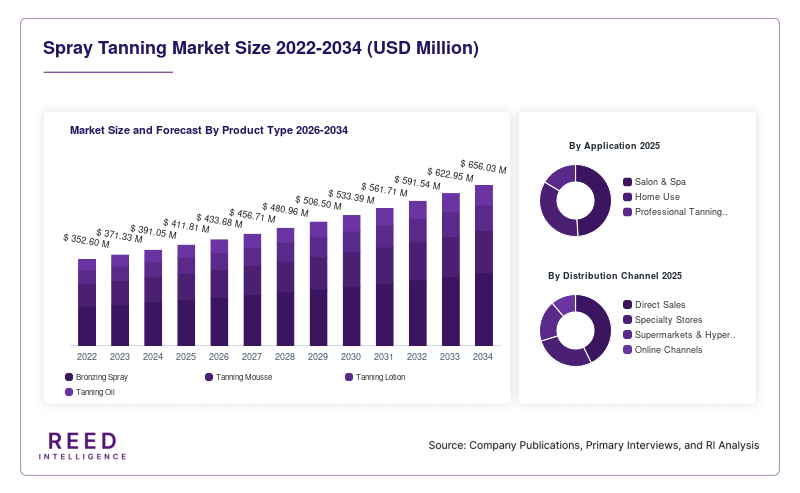
Bronzing Spray represents the largest product-type segment in the internal 2025 allocation, accounting for approximately 34% of global revenue, equivalent to approximately USD 140.02 million. Its position reflects the direct relationship between spray delivery and the category's core consumer proposition: rapid and relatively uniform topical color application.
Spray formats are also relevant to professional services because application equipment can distribute tanning formulations across larger skin surfaces. The format can therefore serve both consumer and professional channels.
Its future position depends on improvements in spray dispersion, drying performance, shade control and transfer resistance. Competition from mousse and lotion products remains significant because consumers differ in preferred application methods and perceived ease of use.
Tanning Mousse Is Expanding Faster Through At-Home Application
Tanning Mousse accounts for approximately 29% of the 2025 market, equivalent to about USD 119.42 million, and is internally modeled at approximately 6.2% CAGR through 2034.
Its expansion is connected to the growth of self-application routines. Mousse formulations can be paired with applicator mitts and staged tanning routines, allowing consumers to control intensity and repeat applications.
The commercial advantage is convenience and consumer familiarity with skincare-like application. The principal limitation remains application consistency, particularly for inexperienced users. Brands that reduce streaking, improve drying and provide predictable color development can therefore increase repeat purchasing.
Application Segment Analysis
Salon & Spa represents approximately 40% of the 2025 market, equivalent to USD 164.72 million in the internal allocation. Demand is generated through professional application, appointment-based purchasing and recurring treatments. The segment benefits from consumers who prioritize convenience and professionally controlled results.
Home Use accounts for approximately 37%, corresponding to USD 152.37 million. The segment is supported by lower per-application costs, product availability and consumers' ability to control application frequency. Online retail and beauty-specialty distribution reinforce access to a broad range of tanning formats.
Professional Tanning Studios represent approximately 23%, or USD 94.72 million. Demand depends on treatment frequency, customer retention and the availability of specialized tanning equipment and formulations. The segment is more exposed to competition from home-use products because consumers can substitute professional applications with increasingly sophisticated consumer formulations.
Distribution Channel Analysis
Specialty Stores account for approximately 31% of 2025 revenue, equivalent to USD 127.66 million, benefiting from consumers seeking product comparison and beauty-oriented purchasing environments.
Online Channels represent approximately 29%, or USD 119.42 million, and are internally modeled at approximately 6.4% CAGR, supported by product variety, consumer reviews, shade information and repeat ordering.
Direct Sales account for approximately 23%, equivalent to USD 94.72 million, particularly relevant to professional operators and business-to-business supply.
Supermarkets & Hypermarkets account for approximately 17%, or USD 69.01 million, providing mass-market access but generally competing on convenience and price.
Regional Analysis
North America Represents the Largest Regional Market Through Established Sunless-Tanning Adoption
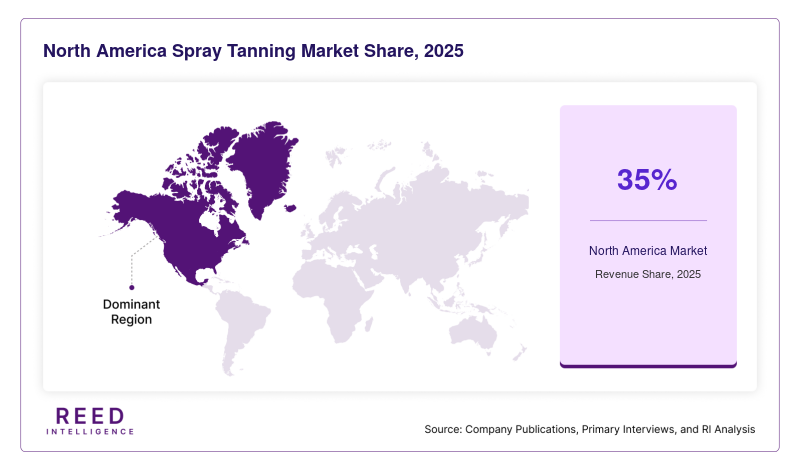
North America accounts for approximately 35% of the 2025 global market, equivalent to USD 144.13 million, in the internal allocation and is modeled at approximately 5.6% CAGR through 2034.
The United States provides the principal demand base, supported by established cosmetic and professional tanning channels. The regulatory environment is also relatively clearly defined around DHA. FDA identifies DHA as a color additive used in sunless tanning products and provides specific requirements for its cosmetic application.
Demand is distributed across professional tanning services, beauty retailers and direct-to-consumer brands. Online distribution has further expanded consumer access to specialized formulations.
The region's future mechanism is primarily product replacement, premiumization and penetration of home-use formats rather than the creation of an entirely new product category.
The major constraints are market maturity, brand competition and substitution between professional services and at-home products.
Europe Maintains Strong Demand Through Beauty Retail and Sunless-Tanning Positioning
Europe represents approximately 29% of the 2025 market, corresponding to USD 119.42 million, and is modeled at approximately 5.2% CAGR.
The regional market combines professional beauty services with consumer self-tanning products distributed through specialty beauty stores, pharmacies, department stores and digital channels.
Product differentiation increasingly centers on formulation characteristics such as natural-looking color, skin conditioning, fragrance and application convenience. European consumers also have access to a broad range of premium beauty brands, creating a competitive environment where formulation and brand positioning can affect purchasing decisions.
The principal countries include the United Kingdom, Germany, France, Italy and Spain.
Regulatory compliance, ingredient restrictions and differing national consumer preferences remain important considerations for suppliers.
Asia-Pacific Provides the Largest Expansion Potential Through Beauty-Product Penetration
Asia-Pacific represents approximately 20% of the 2025 market, or USD 82.36 million, and is internally modeled at approximately 6.4% CAGR, making it the fastest-growing regional allocation.
The commercial opportunity is associated with expanding beauty-product distribution, e-commerce penetration and the introduction of sunless-tanning products to consumers who may have lower historical adoption than established Western markets.
China, Japan, South Korea, Australia and India represent important commercial markets with substantially different beauty preferences and purchasing behaviors.
Online channels can reduce geographic distribution barriers and enable international tanning brands to reach consumers directly. However, cultural preferences surrounding skin tone, regulatory differences and lower category familiarity in some countries can constrain adoption.
Latin America Develops Through Professional Beauty and Consumer Cosmetics Channels
Latin America accounts for approximately 9% of the 2025 market, equivalent to USD 37.06 million, and is modeled at approximately 5.5% CAGR.
Professional beauty services provide an important route because spray tanning can be sold as an appointment-based cosmetic service. Consumer products are distributed through beauty retailers, specialty stores and digital platforms.
Brazil and Mexico provide the largest commercial opportunities within the internal regional structure, supported by developed beauty and personal-care markets.
Future expansion depends on broader awareness of sunless tanning, availability of affordable formulations and greater online distribution. Economic volatility and differences in consumer purchasing power can limit premium-product penetration.
Middle East and Africa Represents a Smaller but Diversifying Demand Base
Middle East and Africa account for approximately 7% of the 2025 market, equivalent to USD 28.83 million, and are modeled at approximately 5.8% CAGR.
Demand is concentrated in urban beauty markets, professional salons, hospitality environments and premium personal-care retail. Professional services can be particularly relevant where consumers prefer controlled application rather than purchasing specialized equipment or products for home use.
The regional market is fragmented across countries with different cosmetic regulations, income levels and beauty preferences. Gulf markets provide opportunities for premium beauty services and imported cosmetic brands, while other markets remain more price-sensitive.
The principal commercial constraint is uneven retail and professional-service infrastructure.
Competitive Landscape
The competitive structure combines cosmetic brands, professional tanning specialists, beauty retailers and specialized sunless-tanning manufacturers. Competition is influenced by formulation technology, shade range, application experience, professional distribution, brand recognition and online reach.
Bondi Sands competes through a dedicated self-tanning portfolio spanning foams, lotions, sprays and related products, giving the company exposure across multiple consumer application formats.
St. Tropez operates across professional and consumer sunless-tanning categories, providing a brand structure that connects salon expertise with at-home products.
Key Market Players
- Bondi Sands
- St. Tropez
- Tan-Luxe
- Norvell
- Vita Liberata
- Fake Bake
- MineTan
- Isle of Paradise
- Loving Tan
- Soleil Toujours
Recent Developments
- August 2026 – Dolce Glow raised USD 11 million in Series A funding led by CAVU Consumer Partners. The financing represents Dolce Glow’s first institutional funding round, with the company stating that the capital will support inventory expansion, retail distribution, product innovation, and team development. The round also included participation from investors such as Miley Cyrus, Sofia Richie Grainge, Olivia Culpo, Jaclyn Hill, Brianna LaPaglia, and Ash Holm. The funding strengthens Dolce Glow’s ability to expand its premium self-tanning portfolio and increase penetration across retail and professional spray-tanning channels.
- May 2025 – Mystic, part of INNOVÉ Beauty & Wellness, introduced an upgraded Mystic + UNITY luxury skincare spray booth. The new system added greater customization, WellFit skincare treatments, natural essential-oil fragrances, enhanced heat features, and upgraded MagneTan technology for more even coverage. INNOVÉ positioned the system as its first major Mystic innovation in more than a decade, combining automated spray tanning with skincare services to give salons additional premium treatment options and revenue opportunities.
Spray Tanning Market Segments
By Product Type
- Bronzing Spray
- Tanning Mousse
- Tanning Lotion
- Tanning Oil
By Application
- Salon & Spa
- Home Use
- Professional Tanning Studios
By Distribution Channel
- Direct Sales
- Specialty Stores
- Supermarkets & Hypermarkets
- Online Channels
By Region
- North America
- Europe
- APAC
- Middle East and Africa
- LATAM