Spraying Plastering Machine Market Size, Share & Demand Report By Product Type (Semi-Automatic Spraying Plastering Machines, Robotic Plaster Spraying Systems), By Application (Commercial Construction, Industrial Construction, Infrastructure Construction, Renovation and Remodeling), By End Use ( Equipment Rental Providers, Infrastructure Developers, Industrial Facility Builders, Government Construction Agencies), By Region & Segment Forecasts, 2026–2034
USD 3950
Market Overview
The global Spraying Plastering Machine Market size was valued at USD 1.42 billion in 2026 and is projected to reach USD 2.68 billion by 2034, expanding at a CAGR of 8.3% during the forecast period. The market continues to gain momentum due to rising investments in commercial and residential infrastructure projects across developing and developed economies. Construction companies are increasingly adopting automated wall finishing and mortar application systems to improve labor efficiency, reduce project completion time, and maintain consistent surface quality. Growing labor shortages in the construction sector have also encouraged contractors to deploy advanced plaster spraying equipment capable of handling high-volume applications with lower operational dependency.
The expansion of urban housing programs and transportation infrastructure development has further strengthened market demand. Manufacturers are focusing on compact and energy-efficient systems integrated with digital pressure controls and automated mixing technology to support continuous construction operations. Demand from renovation activities in aging buildings across Europe and North America is also contributing to industry expansion. In addition, increasing awareness regarding material wastage reduction and workplace productivity has accelerated the adoption of spraying plastering machines in industrial and institutional construction applications.
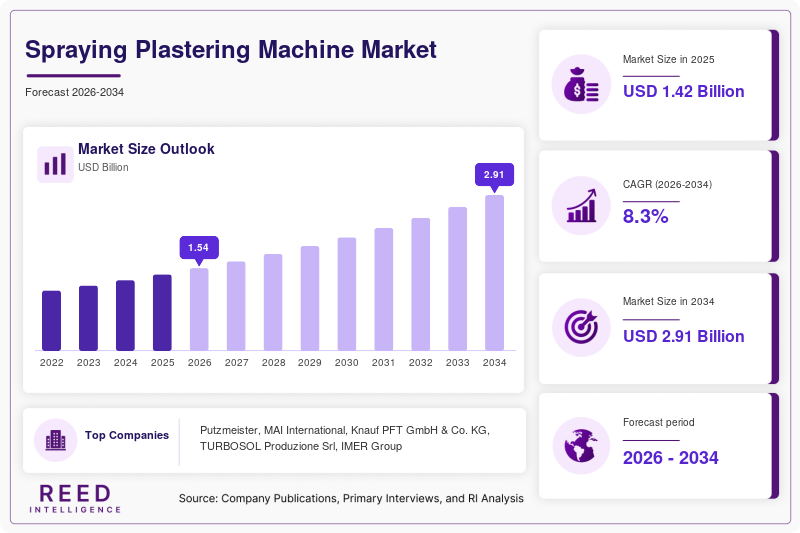
Key Highlights
- North America dominated the market with a 35.1% share in 2025.
- Asia Pacific is expected to grow at the fastest CAGR of 9.8% during 2026–2034.
- By product type, automatic spraying plastering machines accounted for the largest share of 44.6%.
- while robotic plaster spraying systems are projected to grow at a CAGR of 10.7%.
- By application, residential construction led with a 39.4% share.
- whereas infrastructure construction is expected to expand at a CAGR of 9.9%.
- The United States remained the dominant country, with market values of USD 438 million in 2024 and USD 472 million in 2025.
Market Trends
Automation Integration Across Construction Equipment
The Spraying Plastering Machine Market is witnessing strong adoption of automated and digitally controlled equipment across large construction projects. Contractors are increasingly investing in spraying systems equipped with automatic mortar feeding, pressure adjustment, and programmable spray settings to improve surface consistency and reduce manual errors. The integration of smart sensors and touchscreen interfaces has enabled operators to monitor material flow and spraying performance in real time. These systems support faster wall coating processes and lower material wastage, making them suitable for large-scale residential towers and commercial buildings. Equipment manufacturers are also introducing compact automated units that can be transported easily across construction sites, which is improving product penetration among mid-sized contractors.
Rising Preference for Lightweight and Mobile Machines
Demand for lightweight and mobile plaster spraying machines is increasing as contractors prioritize operational flexibility and lower transportation costs. Portable machines with foldable designs and compact compressors are becoming popular in urban renovation projects where space availability is limited. Manufacturers are focusing on machines that can handle multiple plaster materials, including gypsum, cement mortar, and thermal insulation coatings, without requiring extensive maintenance. Battery-assisted and fuel-efficient models are also attracting demand in regions with rising energy efficiency regulations. The trend toward modular construction and rapid urban redevelopment projects is encouraging builders to use mobile plaster spraying equipment that can accelerate finishing work while maintaining consistent output quality across multiple project locations.
Market Drivers
Expansion of Global Infrastructure Development Projects
The continuous expansion of infrastructure construction projects is one of the primary growth drivers for the Spraying Plastering Machine Market. Governments across Asia Pacific, the Middle East, and Latin America are increasing investments in transportation networks, airports, metro systems, and affordable housing developments. These projects require faster construction timelines and standardized wall finishing solutions, which are supporting the use of automated plaster spraying systems. Compared with manual plastering methods, spraying machines reduce labor intensity and improve project productivity. Large infrastructure contractors are increasingly deploying high-capacity machines capable of handling extensive wall and ceiling applications. Rising urban migration and industrial expansion are expected to maintain strong construction activity, thereby supporting long-term market growth.
Increasing Focus on Labor Efficiency and Cost Reduction
The shortage of skilled construction labor in several countries has accelerated demand for mechanized plastering equipment. Construction firms are under pressure to complete projects within strict deadlines while controlling labor costs and reducing material wastage. Spraying plastering machines provide uniform coating application and enable contractors to complete wall finishing tasks more efficiently than traditional methods. Advanced equipment also minimizes rework requirements, which improves operational profitability for builders and developers. In developed economies, contractors are increasingly using automated spraying systems to comply with workplace safety and productivity standards. The growing preference for efficient construction practices among commercial developers and real estate companies is expected to strengthen demand for technologically advanced plaster spraying machines over the forecast period.
Market Restraint
High Initial Equipment Costs and Maintenance Complexity
The relatively high acquisition cost of advanced spraying plastering machines remains a major challenge for market expansion, particularly among small and medium-sized contractors. Automated and robotic plaster spraying systems require significant upfront investment in compressors, pumps, mixers, and control systems. In addition, maintenance requirements associated with pressure nozzles, motor assemblies, and material flow mechanisms increase operational expenses over time. Contractors operating in cost-sensitive markets often continue to rely on manual plastering methods due to lower equipment investment requirements. The lack of trained operators in emerging economies further restricts efficient equipment utilization and may result in inconsistent performance or machine downtime.
The restraint is particularly visible in rural construction projects where limited infrastructure budgets discourage adoption of advanced construction equipment. Some contractors also face difficulties in sourcing replacement parts and technical support for imported machines. As a result, market penetration in developing regions may remain slower than expected despite rising construction activities. Manufacturers are attempting to address this challenge by introducing rental services and compact entry-level equipment, although price sensitivity continues to affect purchasing decisions across several regional markets.
Market Opportunities
Growing Demand for Sustainable Construction Practices
The increasing focus on sustainable construction methods is creating significant opportunities for the Spraying Plastering Machine Market. Builders are adopting spraying systems that optimize plaster utilization and reduce raw material waste during wall coating applications. Modern machines are designed to provide uniform spray distribution, which lowers excess mortar consumption and improves energy efficiency during construction processes. Environmental regulations related to dust reduction and workplace emissions are also encouraging contractors to replace traditional manual plastering practices with mechanized systems. Manufacturers are developing electric-powered and low-noise equipment to meet sustainability requirements in commercial and residential construction projects.
The adoption of eco-friendly building materials such as lightweight gypsum compounds and thermal insulation coatings is further expanding equipment applications. Contractors involved in green building certification projects are increasingly using spraying plastering machines to improve construction efficiency and reduce environmental impact. Demand for sustainable urban infrastructure in Europe and Asia Pacific is expected to create favorable opportunities for manufacturers offering energy-efficient and recyclable equipment components.
Increasing Penetration in Renovation and Interior Finishing Projects
Renovation and refurbishment activities across aging residential and commercial buildings are creating new growth avenues for equipment manufacturers. Urban redevelopment initiatives in North America and Europe are driving demand for compact plaster spraying systems capable of operating in limited indoor spaces. Property owners are investing in interior modernization projects to improve building aesthetics and energy performance, which is supporting the use of precision wall finishing equipment. Portable spraying machines allow contractors to complete renovation work more quickly while maintaining consistent surface quality.
The growth of hospitality, retail, and office renovation projects is also contributing to rising equipment adoption. Contractors increasingly prefer spraying systems for decorative plaster applications, textured wall coatings, and ceiling restoration activities. Manufacturers are introducing multifunctional machines compatible with a wide range of finishing materials to attract renovation-focused contractors. The expansion of smart city redevelopment projects and urban housing refurbishment programs is expected to strengthen long-term demand for advanced plaster spraying equipment.
Segmental Analysis
By Product Type
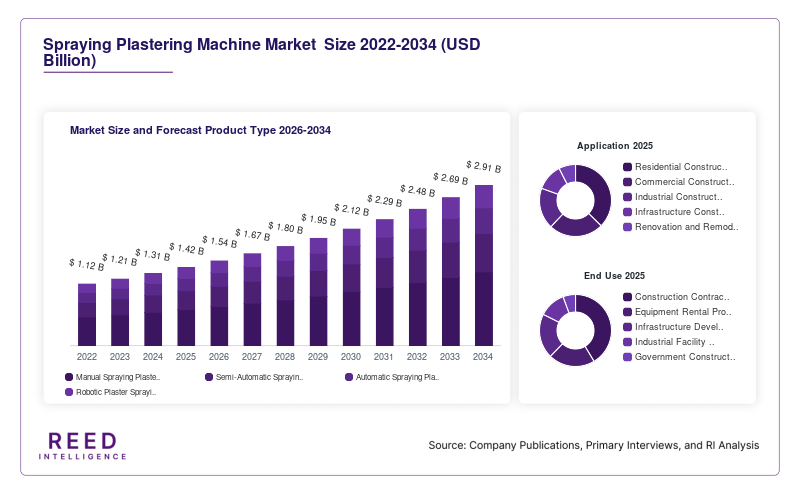
Automatic spraying plastering machines accounted for the largest share of the market in 2024, representing approximately 44.6% of global revenue. These systems are widely preferred due to their ability to provide continuous plaster flow, consistent coating thickness, and reduced manual intervention during construction activities. Large commercial contractors increasingly use automatic equipment for high-rise residential buildings, shopping complexes, and industrial structures where productivity and finishing quality are critical. The machines are compatible with multiple plaster materials, including gypsum, cement mortar, and insulation compounds, which increases their adoption across diverse applications. Their operational efficiency and lower material wastage have strengthened demand among contractors seeking cost-effective construction solutions.
Robotic plaster spraying systems are projected to witness the fastest CAGR of 10.7% during the forecast period. Growth is driven by increasing investments in construction automation and digital building technologies. Robotic systems improve accuracy in wall finishing applications and support remote operation capabilities that reduce dependency on skilled labor. Construction firms involved in large infrastructure and smart building projects are adopting robotic spraying equipment to improve workflow efficiency and worker safety. Manufacturers are also integrating artificial intelligence and sensor-based monitoring systems into robotic machines to optimize material usage and reduce downtime. The adoption of advanced robotics in developed construction markets is expected to significantly enhance demand over the coming years.
By Application
Residential construction emerged as the dominant application segment in 2024, accounting for 39.4% of the global Spraying Plastering Machine Market. Rapid urbanization and the expansion of apartment construction projects have increased the need for faster wall finishing solutions. Developers are increasingly deploying spraying plastering machines to improve construction speed and maintain consistent surface quality across large housing complexes. The demand for affordable housing projects in emerging economies has further supported segment growth. Contractors also prefer spraying systems for interior wall coatings and ceiling finishing because they minimize labor requirements and improve operational efficiency compared with conventional manual plastering methods.
Infrastructure construction is anticipated to register the fastest CAGR of 9.9% between 2026 and 2034. Rising investments in airports, railway stations, metro systems, tunnels, and public utility buildings are driving demand for advanced plaster application technologies. Infrastructure contractors require high-capacity equipment capable of supporting large-scale operations under demanding construction environments. Spraying plastering machines provide faster application rates and help maintain standardized finishing quality across extensive surfaces. Governments across Asia Pacific and the Middle East are increasing investments in transportation and urban development projects, which is expected to strengthen segment growth. The adoption of automated construction technologies in public infrastructure projects is also contributing to increased equipment demand.
By End Use
Construction contractors represented the leading end-use segment in 2024, holding nearly 48.2% of the overall market share. These companies are the primary adopters of spraying plastering machines due to the need for efficient wall finishing systems across commercial, residential, and industrial construction projects. Contractors increasingly prefer mechanized plastering equipment because it shortens project timelines and lowers dependence on skilled labor. Large contracting firms are investing in multifunctional spraying systems capable of handling different plaster materials and coating applications. The expansion of urban infrastructure and real estate development activities has further strengthened demand among contractors operating in both developed and emerging economies.
Rental service providers are projected to expand at the fastest CAGR of 9.4% during the forecast period. The growing preference for equipment rental solutions among small and medium-sized contractors is supporting segment growth. Renting spraying plastering machines allows contractors to reduce upfront investment costs and access technologically advanced equipment for short-term projects. Equipment rental companies are expanding their fleets with portable and automated spraying systems to meet increasing demand from renovation and infrastructure projects. The rising trend of flexible equipment procurement and the expansion of organized construction equipment rental networks in Asia Pacific and North America are expected to accelerate market penetration for this segment.
Regional Analysis
North America
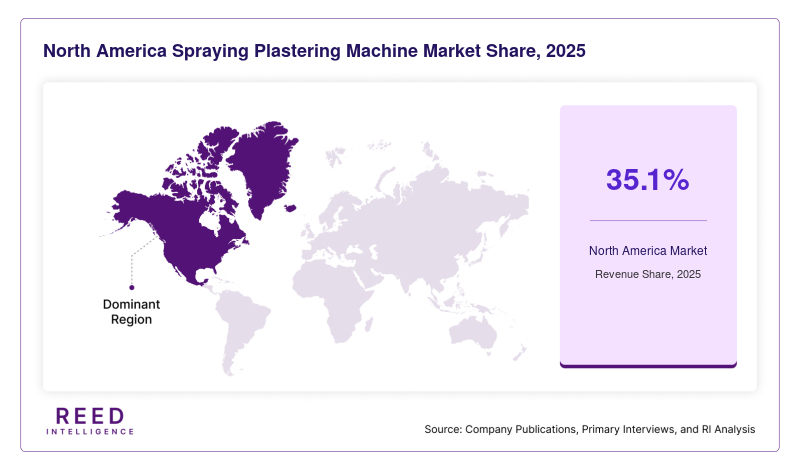
North America accounted for 35.1% of the global Spraying Plastering Machine Market in 2025 and continues to maintain a strong position due to high construction automation adoption across the United States and Canada. The regional market is projected to expand at a CAGR of 7.5% during the forecast period. Commercial infrastructure upgrades and residential renovation projects are supporting equipment demand across major metropolitan areas. Construction companies are increasingly deploying automated spraying systems to address labor shortages and improve productivity in large-scale building projects. Rising demand for energy-efficient building construction is also contributing to market growth.
The United States remains the dominant country within the region due to large-scale investments in residential housing, institutional buildings, and transportation infrastructure. One unique growth factor is the increasing adoption of modular construction practices, which require faster and more standardized wall finishing methods. Contractors are using portable spraying plastering machines to accelerate project completion while maintaining consistent coating quality. The growing presence of rental construction equipment providers has also improved product accessibility for medium-sized contractors operating in regional markets.
Europe
Europe represented 27.4% of the global Spraying Plastering Machine Market in 2025 and is expected to register a CAGR of 7.8% between 2026 and 2034. Demand for advanced plaster spraying systems is supported by stringent building efficiency regulations and the modernization of aging infrastructure across Germany, France, Italy, and the United Kingdom. Renovation activities in historical and commercial buildings are increasing the adoption of precision plaster application equipment. Contractors are focusing on machinery capable of reducing construction waste and improving finishing accuracy in interior wall applications.
Germany continues to lead the European market due to its advanced construction equipment manufacturing sector and strong emphasis on industrial automation. A key growth factor in the country is the increasing adoption of sustainable construction materials that require specialized spraying systems for effective application. German contractors are investing in electrically powered plastering machines to align with environmental standards and energy-efficient building initiatives. The region is also benefiting from rising investments in public infrastructure modernization and residential redevelopment projects.
Asia Pacific
Asia Pacific held 22.8% of the global Spraying Plastering Machine Market in 2025 and is anticipated to witness the fastest CAGR of 9.8% through 2034. Rapid urbanization and large-scale housing developments across China, India, Indonesia, and Vietnam are accelerating equipment demand. Government investments in smart city projects and transportation infrastructure are encouraging contractors to adopt automated construction technologies. Construction firms are increasingly shifting toward spraying plastering machines to reduce dependence on manual labor and improve project efficiency in high-density urban developments.
China remains the leading country in the regional market due to extensive infrastructure spending and continuous residential construction activity. One unique growth factor is the rapid expansion of prefabricated building construction, which requires uniform and fast wall finishing processes. Chinese contractors are investing in high-capacity plaster spraying equipment integrated with automated material feeding systems. In India, increasing urban housing programs and industrial corridor development are also supporting equipment demand, particularly among medium-scale construction contractors seeking productivity improvements.
Middle East & Africa
The Middle East & Africa region accounted for 8.1% of the global Spraying Plastering Machine Market in 2025 and is forecast to grow at a CAGR of 8.4% during the assessment period. The market is benefiting from expanding tourism infrastructure, commercial construction projects, and residential developments in Gulf countries. Contractors are increasingly using mechanized plastering systems to meet accelerated construction timelines associated with smart city and hospitality projects. Demand for high-performance wall finishing equipment is particularly strong in luxury residential and mixed-use developments across urban centers.
Saudi Arabia dominates the regional market due to large-scale infrastructure diversification initiatives and growing investments in urban redevelopment projects. A distinctive growth factor is the expansion of mega construction projects linked to economic transformation programs. These projects require automated plaster spraying systems capable of supporting continuous operations under demanding environmental conditions. The United Arab Emirates is also contributing to market expansion through investments in commercial real estate and tourism infrastructure, where precision wall finishing and decorative plaster applications are widely used.
Latin America
Latin America captured 6.6% of the global Spraying Plastering Machine Market in 2025 and is expected to register a CAGR of 7.1% during the forecast timeline. Construction recovery in Brazil, Mexico, and Chile is creating moderate demand for automated plastering equipment. Public infrastructure investments and affordable housing initiatives are encouraging contractors to adopt machinery that improves labor efficiency and reduces construction time. The market is also supported by rising renovation activities in commercial buildings and urban residential complexes across major cities.
Brazil remains the dominant country in the region due to ongoing urban infrastructure expansion and residential construction growth. One important growth factor is the increasing use of mechanized equipment in large apartment development projects where faster wall finishing is essential for maintaining project schedules. Local contractors are gradually adopting portable spraying systems to reduce material wastage and improve construction quality. Mexico is also experiencing steady growth due to industrial facility construction and rising demand for efficient interior finishing technologies.
Competitive Landscape
The Spraying Plastering Machine Market is characterized by moderate competition, with international and regional manufacturers focusing on product innovation, automation integration, and distribution network expansion. Companies are increasingly investing in lightweight machine designs, robotic plastering technologies, and energy-efficient spraying systems to strengthen market positioning. Strategic partnerships with construction contractors and equipment rental providers are also supporting revenue expansion.
Putzmeister remains one of the leading companies in the market due to its extensive product portfolio and strong global distribution presence. The company recently introduced an advanced automated plaster spraying system with enhanced material flow control and remote monitoring functionality for commercial construction projects. Other major participants are focusing on compact portable machines suitable for renovation and urban infrastructure applications. Manufacturers are also emphasizing after-sales service, operator training, and digital maintenance solutions to improve customer retention and equipment efficiency.
Key Players
- Putzmeister
- MAI International
- Knauf PFT GmbH & Co. KG
- TURBOSOL Produzione Srl
- IMER Group
- WAGNER Group
- SANY Group
- M-tec Mathis Technik GmbH
- Quikspray Inc.
- Qingdao Saintyol Dawin Machinery Co., Ltd.
- Lancy Group
- ACME Equipment Pvt. Ltd.
- Wuxi Jiangjia Construction Machinery
- REED Pumps and Mixers
- Aliva Equipment
Recent Developments
- In February 2025, Putzmeister launched a compact automatic plaster spraying machine designed for high-rise residential projects with improved material pumping efficiency.
- In August 2024, Knauf PFT GmbH & Co. KG expanded its manufacturing operations in Eastern Europe to strengthen supply chain efficiency for construction equipment.
- In May 2025, IMER Group introduced a digitally controlled spraying system equipped with smart pressure adjustment technology for commercial infrastructure applications.
- In November 2024, SANY Group partnered with regional distributors in Southeast Asia to expand the availability of portable plaster spraying machines for urban housing projects.
Spraying Plastering Machine Market Segments
Product Type
- Manual Spraying Plastering Machines
- Semi-Automatic Spraying Plastering Machines
- Automatic Spraying Plastering Machines
- Robotic Plaster Spraying Systems
Application
- Residential Construction
- Commercial Construction
- Industrial Construction
- Infrastructure Construction
- Renovation and Remodeling
End Use
- Construction Contractors
- Equipment Rental Providers
- Infrastructure Developers
- Industrial Facility Builders
- Government Construction Agencies
By Region
- North America
- Europe
- APAC
- Middle East and Africa
- LATAM