SQL Server Transformation Market Size, Share & Demand Report By Component (Services, Software Platforms), By Deployment Mode (Cloud-Based, On-Premise, Hybrid), By Enterprise Size (Large Enterprises, Small and Medium-Sized Enterprises), By Industry Vertical (Banking, Financial Services, and Insurance, Healthcare, Manufacturing, Government and Public Sector, IT and Telecommunications, Energy and Utilities, Others), By Region & Segment Forecasts, 2026–2034
USD 3950
Market Overview
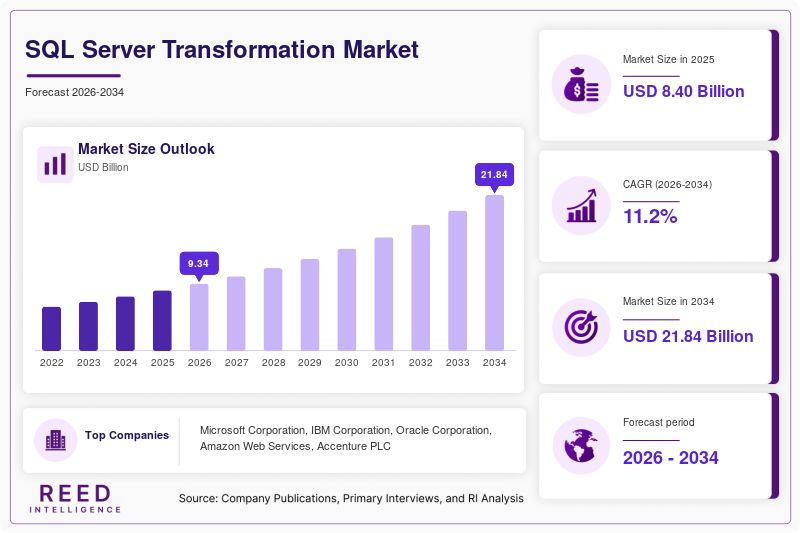
The global SQL Server Transformation Market size was valued at USD 8.4 billion in 2026 and is projected to reach USD 19.7 billion by 2034, expanding at a CAGR of 11.2% during the forecast period from 2026 to 2034. The market is gaining traction as enterprises accelerate database modernization initiatives to improve operational efficiency, support cloud-native applications, and manage rising volumes of enterprise data. SQL Server transformation solutions include migration services, modernization platforms, automation software, consulting frameworks, and managed transformation services designed to transition legacy database systems into scalable hybrid or cloud-based environments.
A major global factor supporting market growth is the increasing adoption of digital transformation strategies across banking, healthcare, manufacturing, retail, and public sector organizations. Enterprises are shifting from conventional on-premise infrastructures toward flexible multi-cloud ecosystems to reduce maintenance costs and enhance business continuity. Organizations are also prioritizing real-time analytics, AI-driven workloads, and automated database management, creating sustained demand for SQL Server transformation services and tools. The growing use of edge computing, remote workforce infrastructure, and data governance regulations is further influencing enterprises to modernize aging SQL Server environments.
Key Highlights
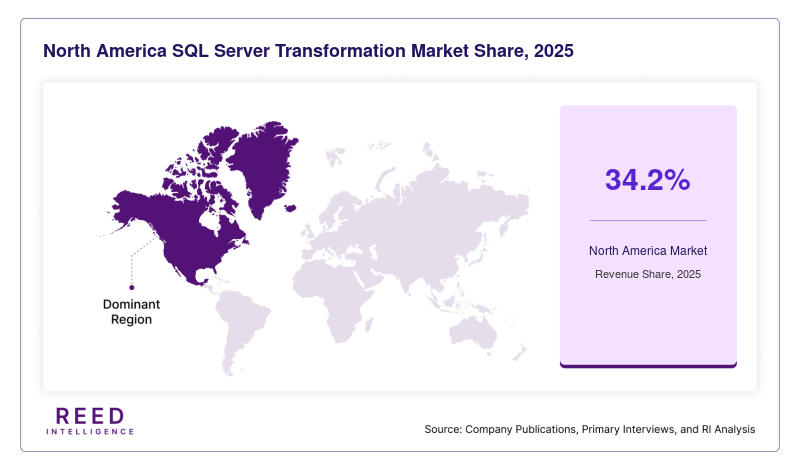
- North America dominated the market with a 34.2% share in 2025.
- Asia Pacific is expected to grow at the fastest CAGR of 12.1% during 2026–2034.
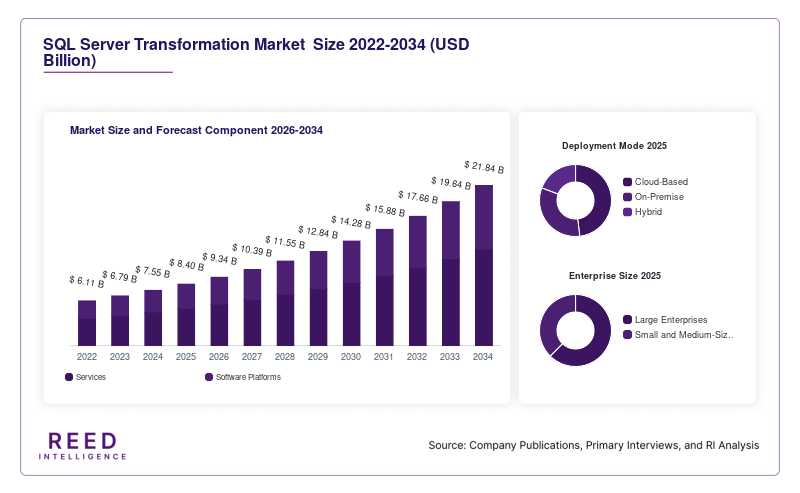
- By component, services accounted for the largest share of 56.4%.
- while software platforms are projected to grow at a CAGR of 12.8%.
- By deployment mode, cloud-based transformation solutions led with a 61.7% share.
whereas hybrid deployment is expected to expand at a CAGR of 13.2%. - By enterprise size, large enterprises held the leading share of 68.3%, while small and medium-sized enterprises are projected to grow at a CAGR of 12.9%.
- The United States remained the dominant country, with market values of USD 1.82 billion in 2024 and USD 2.01 billion in 2025.
Market Trends
Growing Integration of AI-Driven Database Automation
The SQL Server Transformation Market is witnessing increased adoption of AI-enabled automation tools that simplify database migration, workload optimization, and performance management. Enterprises are deploying intelligent transformation platforms capable of analyzing legacy database architectures, identifying compatibility gaps, and recommending migration pathways with reduced manual intervention. AI-powered monitoring tools are also improving predictive maintenance, query optimization, and resource allocation in transformed SQL environments. These capabilities help organizations minimize downtime while accelerating modernization timelines.
Technology vendors are integrating machine learning models into SQL Server transformation platforms to automate schema conversion, code refactoring, and workload balancing. Financial institutions and telecom providers are particularly investing in intelligent database modernization frameworks to manage complex transactional systems and ensure operational continuity. The increasing focus on automated compliance auditing and security monitoring is further driving adoption of AI-supported transformation services. As enterprises continue to modernize data infrastructures, AI-enabled transformation capabilities are expected to become a core component of enterprise database management strategies.
Expansion of Hybrid and Multi-Cloud Database Architectures
Hybrid and multi-cloud deployment strategies are becoming a significant trend in the SQL Server Transformation Market as organizations seek greater flexibility, scalability, and disaster recovery capabilities. Enterprises are increasingly transforming legacy SQL Server environments into hybrid infrastructures that combine on-premise systems with public and private cloud platforms. This approach enables businesses to retain sensitive workloads within controlled environments while leveraging cloud scalability for analytics, storage, and application development.
Cloud service providers are expanding interoperability features to support seamless SQL Server migration across multiple platforms. Retail, manufacturing, and healthcare companies are adopting hybrid architectures to support distributed operations and ensure uninterrupted access to business-critical data. Organizations are also using multi-cloud transformation strategies to avoid vendor dependency and optimize operational costs. The increasing adoption of containerized applications and cloud-native development practices is further supporting demand for flexible SQL Server transformation frameworks capable of integrating across diverse infrastructure environments.
Market Drivers
Rising Enterprise Demand for Legacy System Modernization
The growing need to modernize aging enterprise database infrastructures is a primary growth driver for the SQL Server Transformation Market. Many organizations continue to rely on outdated SQL Server systems that create operational inefficiencies, higher maintenance expenses, and limited scalability. Enterprises are investing in transformation services to improve application compatibility, increase system performance, and support digital business initiatives. Modernized SQL Server environments also provide enhanced security features, automated backup capabilities, and improved disaster recovery performance.
Industries such as banking, government, and manufacturing are under pressure to modernize legacy systems to meet changing customer expectations and regulatory requirements. Transformation projects allow organizations to integrate advanced analytics, AI applications, and cloud-native software into existing workflows. The growing dependence on data-driven decision-making is encouraging businesses to prioritize database modernization investments. As enterprise workloads become increasingly complex, the need for scalable and efficient SQL Server transformation solutions is expected to remain strong throughout the forecast period.
Increasing Cloud Migration Across Enterprise Operations
The rapid migration of enterprise workloads to cloud environments is significantly supporting demand in the SQL Server Transformation Market. Organizations are adopting cloud-based infrastructures to reduce hardware dependency, improve resource utilization, and support remote operational models. SQL Server transformation services help enterprises migrate databases, applications, and workloads into cloud ecosystems while minimizing disruption to business operations.
Cloud migration initiatives are particularly strong among enterprises managing high-volume transactional data and customer-facing digital applications. Companies are leveraging SQL Server transformation platforms to optimize data storage, enhance scalability, and improve cross-platform integration capabilities. The increasing popularity of software-as-a-service and infrastructure-as-a-service models is creating additional demand for efficient database transformation tools. Furthermore, cloud-based SQL transformation environments support faster deployment cycles, automated updates, and centralized management features, making them attractive for organizations pursuing agile operational strategies.
Market Restraint
High Complexity Associated with Large-Scale Migration Projects
One of the major restraints affecting the SQL Server Transformation Market is the complexity involved in migrating large-scale enterprise database environments. Organizations with decades of accumulated data often operate interconnected legacy systems containing customized applications, proprietary integrations, and inconsistent data structures. Transforming such environments requires extensive planning, testing, and validation to avoid operational disruptions or data loss. These complexities increase project timelines and implementation costs, particularly for enterprises operating mission-critical systems.
Many organizations face difficulties in maintaining compatibility between transformed SQL Server environments and legacy enterprise applications. Regulatory compliance requirements in sectors such as healthcare, banking, and government also add additional layers of complexity during migration projects. In some cases, enterprises delay modernization initiatives because of concerns related to downtime, cybersecurity vulnerabilities, and workforce skill gaps. Small and medium-sized enterprises often lack specialized database transformation expertise, limiting adoption rates in price-sensitive markets. These factors can slow project execution and reduce the pace of market expansion despite increasing demand for modernization solutions.
Market Opportunities
Increasing Adoption of Managed Transformation Services
The rising demand for managed database modernization services is creating significant opportunities in the SQL Server Transformation Market. Organizations are increasingly outsourcing transformation activities to specialized service providers capable of handling migration planning, infrastructure optimization, security management, and post-deployment monitoring. Managed service models help enterprises reduce operational burdens while improving implementation efficiency and minimizing business disruption.
Service providers are expanding offerings that include automated migration frameworks, continuous monitoring solutions, and performance optimization tools. Small and medium-sized enterprises are showing strong interest in managed SQL transformation services because these models reduce the need for internal technical expertise and lower upfront investment requirements. Managed transformation services also provide predictable operational costs and scalable deployment capabilities. As businesses continue to prioritize digital infrastructure modernization, service providers offering end-to-end transformation support are expected to benefit from growing enterprise demand across multiple industry verticals.
Growth Potential in Industry-Specific Cloud Modernization Solutions
Industry-focused transformation platforms represent another major opportunity for the SQL Server Transformation Market. Vendors are developing specialized solutions tailored to the operational requirements of sectors such as healthcare, retail, manufacturing, banking, and logistics. These customized platforms address industry-specific compliance standards, workload requirements, and data integration challenges while improving deployment efficiency.
Healthcare organizations, for example, require SQL transformation solutions that support patient data security, interoperability standards, and real-time analytics capabilities. Retail companies are investing in transformation frameworks designed to handle omnichannel customer data and inventory management systems. Manufacturing enterprises are modernizing SQL infrastructures to support industrial automation and predictive maintenance applications. Vendors offering industry-specific migration templates, compliance management tools, and sector-focused consulting services are expected to gain competitive advantages. The growing demand for tailored transformation ecosystems is likely to create long-term revenue opportunities across regional and global markets.
Segmental Analysis
By Component
Services represented the dominant subsegment within the SQL Server Transformation Market and accounted for 56.4% of total revenue in 2024. Enterprises continue to rely heavily on consulting, implementation, migration management, integration, and managed support services to execute complex database modernization projects. Large organizations operating mission-critical workloads often require customized migration planning and post-deployment optimization support, increasing demand for specialized transformation services. Service providers are expanding their capabilities to include automated migration assessment tools, cybersecurity monitoring, and cloud workload optimization frameworks.
The software platforms subsegment is projected to register the fastest CAGR of 12.8% during the forecast period. Organizations are increasingly adopting automated transformation software to simplify database migration, schema conversion, workload balancing, and performance optimization. AI-driven migration platforms are becoming popular among enterprises seeking to reduce manual intervention and shorten project timelines. The growing preference for cloud-native applications and hybrid deployment environments is also supporting adoption of advanced SQL transformation software. Vendors are introducing subscription-based licensing models that improve affordability and scalability for small and medium-sized enterprises, further strengthening segment growth.
By Deployment Mode
Cloud-based transformation solutions accounted for the largest share of the SQL Server Transformation Market in 2024, representing 61.7% of total revenue. Enterprises are increasingly migrating SQL Server workloads to cloud environments to improve scalability, reduce infrastructure costs, and support remote operational models. Cloud-based transformation platforms provide centralized monitoring, automated updates, and flexible resource allocation capabilities that enhance operational efficiency. Large enterprises are particularly adopting public and private cloud migration strategies to support data-intensive business applications and advanced analytics workloads.
Hybrid deployment is expected to witness the fastest growth, with a projected CAGR of 13.2% during the forecast period. Many organizations prefer hybrid infrastructures because they enable businesses to maintain sensitive data within private environments while leveraging public cloud scalability for non-critical workloads. Hybrid SQL transformation frameworks also support gradual migration strategies that reduce operational risk and improve business continuity. Financial institutions, healthcare organizations, and government agencies are among the leading adopters of hybrid deployment models because of strict regulatory and data security requirements. Increasing investments in multi-cloud integration and edge computing are expected to further accelerate demand for hybrid SQL transformation solutions.
By Enterprise Size
Large enterprises held the dominant share of the SQL Server Transformation Market in 2024, accounting for 68.3% of global revenue. These organizations manage extensive databases, complex enterprise applications, and high-volume transactional workloads that require advanced modernization strategies. Large enterprises are investing significantly in database transformation initiatives to improve scalability, integrate AI-driven analytics, and support cloud-native business operations. Many multinational corporations are also implementing enterprise-wide migration programs to standardize infrastructure management across multiple geographic locations.
Small and medium-sized enterprises are projected to record the fastest CAGR of 12.9% during the forecast period. Increasing availability of affordable cloud-based transformation platforms and subscription-driven service models is encouraging adoption among smaller businesses. SMEs are modernizing legacy SQL infrastructures to improve operational agility, strengthen cybersecurity, and support digital customer engagement strategies. Managed transformation service providers are also offering simplified migration frameworks designed specifically for resource-constrained organizations. Growing awareness regarding the long-term cost benefits of cloud modernization is expected to further support SQL Server transformation adoption across small and medium-sized enterprises.
Regional Analysis
North America
North America accounted for the largest share of the SQL Server Transformation Market in 2025, representing 34.2% of global revenue. The region is projected to expand at a CAGR of 10.8% during the forecast period due to strong cloud adoption and ongoing enterprise modernization initiatives. Large enterprises across the United States and Canada continue to invest in database transformation projects to improve operational agility and support AI-driven business applications. Financial institutions, healthcare providers, and government agencies are among the leading adopters of advanced SQL transformation platforms in the region.
The United States remains the dominant country within North America due to its mature cloud infrastructure ecosystem and high concentration of enterprise software vendors. Organizations in the country are increasingly modernizing legacy SQL Server environments to support hybrid work models and advanced analytics capabilities. The strong presence of hyperscale cloud providers and managed service companies is creating favorable conditions for large-scale transformation deployments. Increasing cybersecurity investments and compliance-driven modernization initiatives are also supporting sustained market expansion across enterprise sectors.
Europe
Europe held a significant share of the SQL Server Transformation Market in 2025 and is expected to register a CAGR of 10.3% between 2026 and 2034. Enterprises across Germany, the United Kingdom, France, and the Nordic countries are accelerating digital transformation strategies to improve operational resilience and regulatory compliance. Businesses are adopting SQL Server transformation platforms to modernize legacy infrastructures, enhance scalability, and support cloud-native application development. Growing demand for data governance and secure database management is further supporting regional market growth.
Germany continues to dominate the European market because of its strong industrial base and increasing investment in enterprise digitalization. Manufacturing companies in the country are modernizing SQL Server infrastructures to support industrial automation, predictive analytics, and connected production systems. Public sector organizations are also implementing database transformation initiatives to improve citizen services and streamline administrative operations. The expansion of regional cloud data centers and increasing collaboration between software vendors and enterprise clients are expected to drive additional growth opportunities across Europe.
Asia Pacific
Asia Pacific is projected to record the fastest growth rate in the SQL Server Transformation Market, with an estimated CAGR of 12.1% during the forecast period. The region is benefiting from rapid enterprise digitization, increasing cloud adoption, and expanding investments in data infrastructure modernization. Businesses across China, India, Japan, South Korea, and Southeast Asia are transforming legacy database environments to improve operational scalability and support digital commerce ecosystems. Rising internet penetration and mobile enterprise adoption are also contributing to increasing demand for advanced database transformation services.
China remains the leading market within Asia Pacific due to strong government support for digital infrastructure development and enterprise cloud adoption. Large enterprises in the country are modernizing SQL Server systems to support e-commerce platforms, fintech applications, and industrial automation projects. India is also emerging as a high-growth market because of increasing investments in IT services, banking digitization, and software outsourcing operations. The growing presence of regional cloud providers and managed transformation service firms is expected to strengthen long-term market expansion across Asia Pacific.
Middle East & Africa
The Middle East & Africa region is witnessing steady growth in the SQL Server Transformation Market and is forecast to expand at a CAGR of 9.4% through 2034. Organizations across the Gulf countries and South Africa are increasingly investing in enterprise modernization projects to support digital economy initiatives and diversify business operations. Government agencies, telecom providers, and financial institutions are implementing SQL Server transformation frameworks to improve operational efficiency and strengthen data management capabilities.
The United Arab Emirates remains the dominant market within the region due to extensive investments in smart city infrastructure and cloud computing initiatives. Enterprises in the country are transforming legacy SQL systems to support digital banking, e-government services, and advanced analytics platforms. Saudi Arabia is also experiencing rising demand for database modernization services as part of large-scale digital transformation programs. Increasing regional investments in cybersecurity infrastructure and data center development are expected to create additional opportunities for transformation solution providers.
Latin America
Latin America accounted for a moderate share of the SQL Server Transformation Market in 2025 and is projected to grow at a CAGR of 9.8% during the forecast period. Organizations across Brazil, Mexico, Chile, and Colombia are adopting SQL transformation platforms to improve operational efficiency and support cloud migration initiatives. Retail, banking, and logistics companies are among the major adopters of modernization solutions as they seek to improve data accessibility and customer experience management.
Brazil remains the leading country in the Latin American market due to expanding enterprise digitization efforts and rising investment in cloud-based IT infrastructure. Companies in the country are modernizing SQL Server environments to improve business continuity and support growing digital transaction volumes. Increasing demand for managed database services and hybrid cloud deployment models is further supporting regional market growth. Government-backed digital transformation initiatives and the expansion of regional technology partnerships are expected to strengthen future market opportunities across Latin America.
Competitive Landscape
The SQL Server Transformation Market is characterized by intense competition among cloud service providers, database modernization specialists, enterprise software companies, and managed IT service firms. Leading companies are focusing on strategic partnerships, AI-enabled migration automation, and cloud-native transformation capabilities to strengthen market positioning. Vendors are also expanding consulting and managed service offerings to address growing enterprise demand for end-to-end modernization support.
Microsoft remains the leading company in the market due to its extensive SQL Server ecosystem, strong Azure integration capabilities, and broad enterprise customer base. The company continues to invest in AI-driven migration tools and cloud optimization services to simplify enterprise transformation projects. IBM, Oracle, Amazon Web Services, and Accenture are also prominent participants offering comprehensive database modernization solutions across hybrid and multi-cloud environments.
Key Players
- Microsoft Corporation
- IBM Corporation
- Oracle Corporation
- Amazon Web Services
- Accenture PLC
- Infosys Limited
- Tata Consultancy Services
- Wipro Limited
- Cognizant Technology Solutions
- Capgemini SE
- HCL Technologies
- DXC Technology
- VMware Inc.
- Google Cloud
- SAP SE
Recent Developments
- In February 2026, Microsoft introduced an AI-assisted SQL Server migration framework integrated with Azure optimization tools to reduce enterprise transformation timelines.
- In July 2025, Accenture partnered with a major cloud infrastructure provider to launch industry-focused SQL modernization services for banking and healthcare organizations.
- In November 2025, IBM expanded its hybrid cloud transformation portfolio with automated database workload management capabilities for enterprise SQL environments.
SQL Server Transformation Market Segments
Component
- Services
- Software Platforms
Deployment Mode
- Cloud-Based
- On-Premise
- Hybrid
Enterprise Size
- Large Enterprises
- Small and Medium-Sized Enterprises
Industry Vertical
- Banking, Financial Services, and Insurance
- Healthcare
- Retail and E-Commerce
- Manufacturing
- Government and Public Sector
- IT and Telecommunications
- Energy and Utilities
- Others
By Region
- North America
- Europe
- APAC
- Middle East and Africa
- LATAM