SSL Devices Market Size, Share Demand Report By Product Type (SSL VPN Devices, SSL Accelerators, SSL Inspection Appliances, Cloud-Based SSL Security Appliances, SSL Certificate Management Systems), By Application (Enterprise Network Security, Cloud Workload Protection, Secure Remote Access, Data Center Traffic Management, Industrial Network Security), By End Use (Large Enterprises, Small and Medium-Sized Enterprises, Government Organizations, Telecom Providers, Financial Institutions) By Region
USD 3950
Market Overview
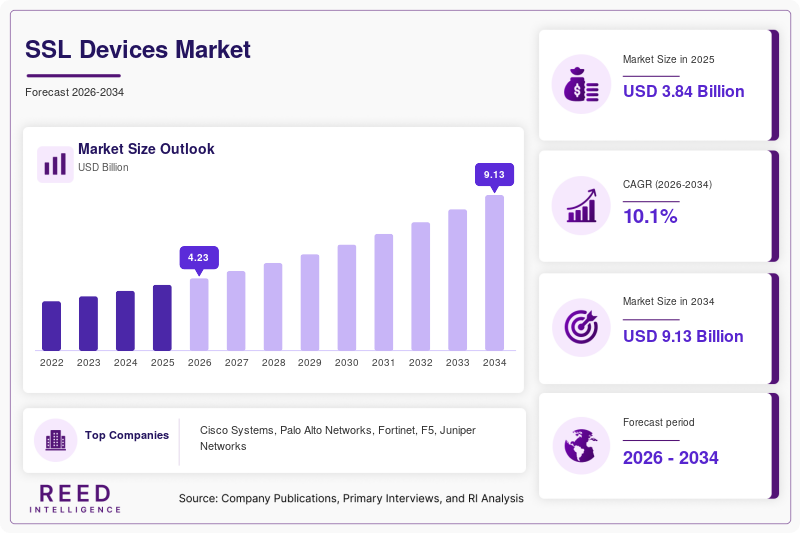
The global SSL Devices Market size was valued at USD 3.84 billion in 2026 and is projected to reach USD 8.27 billion by 2034, expanding at a CAGR of 10.1% during the forecast period from 2026 to 2034. The market continues to gain momentum as enterprises, financial institutions, healthcare organizations, and government agencies increase investments in encrypted digital infrastructure and cybersecurity modernization initiatives. SSL devices, including SSL accelerators, SSL VPN gateways, and dedicated encryption hardware, are becoming essential for secure communication, traffic inspection, identity verification, and data protection across enterprise networks and cloud environments.
One of the major global factors supporting market expansion is the rapid increase in cyberattacks targeting encrypted traffic channels. Organizations are deploying advanced SSL devices to inspect encrypted traffic without compromising network performance. The growth of remote work, hybrid cloud deployments, digital banking, e-commerce expansion, and connected industrial ecosystems has accelerated the adoption of secure sockets layer technologies. Businesses are also integrating SSL devices with zero-trust frameworks and AI-enabled security monitoring systems to improve visibility and threat detection across distributed networks.
Key Highlights
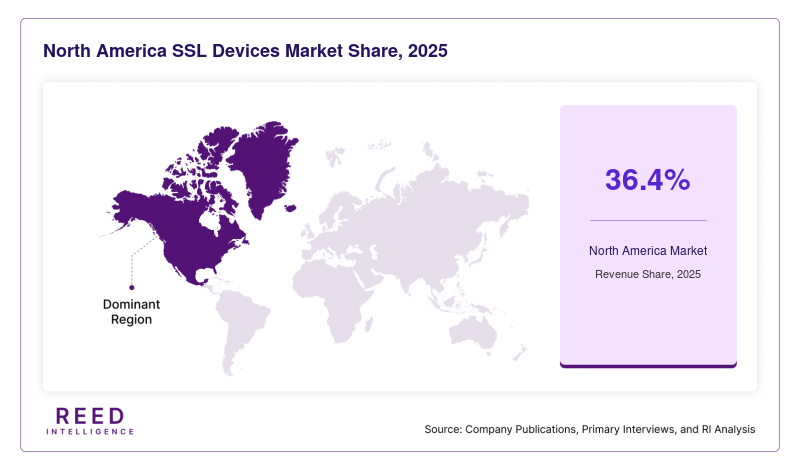
- North America dominated the market with a 36.4% share in 2025.
- Asia Pacific is expected to grow at the fastest CAGR of 11.8% during 2026–2034.
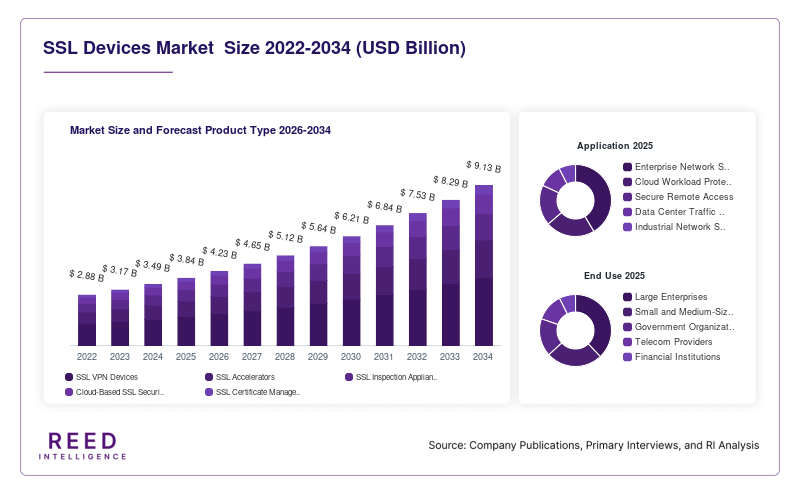
- By product type, SSL VPN devices accounted for the largest share of 39.1%, while cloud-based SSL security appliances are projected to grow at a CAGR of 12.6%.
- By application, enterprise network security led with a 43.8% share, whereas cloud workload protection is expected to expand at a CAGR of 12.2%.
- The United States remained the dominant country, with market values of USD 780 million in 2024 and USD 860 million in 2025.
Market Trends
Integration of AI-Enabled SSL Traffic Inspection Platforms
The SSL Devices Market is witnessing increasing integration of artificial intelligence and machine learning capabilities into encrypted traffic inspection platforms. Enterprises are adopting AI-enabled SSL devices that can identify abnormal traffic patterns, suspicious encrypted payloads, and emerging malware signatures in real time. Traditional SSL inspection systems often struggle to manage growing encrypted traffic volumes, creating demand for intelligent platforms capable of automating traffic prioritization and threat analysis. AI-based analytics also help organizations reduce false positives and improve response times in complex network environments.
Vendors are focusing on developing adaptive SSL security appliances that can optimize encryption workloads without negatively affecting network latency. Financial institutions, healthcare providers, and telecom operators are among the leading adopters of intelligent SSL inspection technologies due to rising compliance obligations and expanding digital operations. AI integration also supports predictive maintenance, automated certificate lifecycle management, and dynamic policy enforcement. As organizations continue migrating toward cloud-native and hybrid IT infrastructures, AI-powered SSL devices are expected to become a standard component of enterprise cybersecurity architecture.
Expansion of Cloud-Centric SSL Security Infrastructure
Cloud transformation initiatives across enterprises are driving demand for cloud-integrated SSL devices and virtualized encryption solutions. Organizations increasingly require scalable SSL infrastructure that can secure workloads across multi-cloud and hybrid cloud ecosystems. Traditional hardware-based SSL devices are being supplemented with virtual appliances capable of delivering encryption, decryption, and traffic management functions across distributed environments. This shift is particularly visible among digital service providers, e-commerce companies, and software-as-a-service vendors managing large volumes of encrypted transactions.
The adoption of edge computing and remote access platforms has further accelerated deployment of cloud-centric SSL security infrastructure. Businesses are prioritizing centralized visibility and policy management across geographically distributed operations. Cloud-based SSL devices offer flexible scalability, simplified updates, and lower infrastructure maintenance requirements compared to legacy systems. Vendors are also introducing subscription-based deployment models to improve accessibility for mid-sized enterprises. As cloud-native applications continue to expand globally, demand for software-defined SSL security architecture is expected to rise steadily throughout the forecast period.
Market Drivers
Rising Volume of Encrypted Internet Traffic Across Enterprises
The growing share of encrypted internet traffic is a major driver supporting expansion of the SSL Devices Market. Enterprises across sectors are implementing encrypted communication protocols to secure sensitive business information, financial transactions, healthcare records, and customer identities. As HTTPS traffic becomes dominant across digital platforms, organizations require specialized SSL devices to process encryption workloads efficiently without reducing network performance. Increasing use of mobile applications, cloud collaboration platforms, and digital payment ecosystems has amplified the need for advanced SSL inspection and acceleration technologies.
Large enterprises are investing in dedicated SSL hardware to manage higher data throughput and reduce processing pressure on primary servers. Telecom operators and data center providers are also deploying SSL acceleration devices to support expanding bandwidth requirements. Regulatory mandates related to privacy protection and secure digital communication are further increasing adoption rates. The combination of rising cyber risks and increasing encrypted traffic volumes is encouraging organizations to modernize legacy network infrastructure with high-capacity SSL security systems capable of supporting future digital growth.
Growth of Remote Work and Zero-Trust Security Models
The expansion of hybrid work environments and zero-trust cybersecurity frameworks is accelerating demand for SSL devices globally. Organizations now rely heavily on secure remote access systems to support employees, contractors, and third-party users operating outside traditional corporate networks. SSL VPN devices and encrypted access gateways provide secure connectivity while minimizing risks associated with unauthorized access and data interception. Businesses are increasingly integrating SSL devices into identity verification systems, endpoint protection platforms, and multi-factor authentication environments.
Zero-trust security architecture requires continuous verification of users and encrypted traffic across every access point. This requirement has created significant demand for scalable SSL inspection solutions capable of supporting dynamic authentication and policy enforcement. Government agencies, banking institutions, and healthcare organizations are among the leading adopters of SSL-based remote access systems due to the sensitive nature of their operations. The long-term transition toward decentralized workplaces and cloud-based collaboration environments is expected to sustain strong demand for SSL security infrastructure throughout the forecast period.
Market Restraint
High Deployment Costs and Performance Complexity
Despite strong market growth potential, the SSL Devices Market faces challenges related to high deployment costs and infrastructure complexity. Advanced SSL inspection devices require significant investment in specialized hardware, software integration, and ongoing certificate management processes. Small and medium-sized enterprises often face budget constraints that limit adoption of high-performance SSL acceleration systems. In addition, deployment of encrypted traffic inspection solutions can increase operational complexity, particularly in organizations managing hybrid networks and legacy IT environments.
SSL decryption and re-encryption processes consume considerable computational resources, which may affect network speed and application performance if not configured properly. Organizations also face challenges related to interoperability between SSL devices and existing cybersecurity infrastructure. In highly regulated sectors, concerns regarding encrypted data visibility and privacy compliance can complicate deployment strategies. For example, financial institutions operating across multiple jurisdictions must ensure SSL inspection policies align with local data protection regulations. These operational and financial barriers may slow adoption rates among cost-sensitive enterprises and organizations with limited cybersecurity expertise.
Market Opportunities
Increasing Adoption of SSL Security in Industrial IoT Networks
The expansion of Industrial Internet of Things ecosystems is creating substantial opportunities for SSL device vendors. Manufacturing facilities, energy utilities, transportation systems, and smart infrastructure networks increasingly rely on encrypted machine-to-machine communication to secure operational data and remote monitoring systems. Industrial operators are deploying SSL devices to protect connected sensors, industrial gateways, and automation platforms from cyber intrusions and unauthorized access. The growing adoption of smart factories and digital industrial systems is expected to accelerate demand for scalable SSL security infrastructure.
Industrial environments require low-latency encrypted communication capable of supporting real-time operations without compromising system reliability. Vendors are introducing ruggedized SSL appliances and lightweight encryption platforms specifically designed for industrial deployments. Increasing investments in critical infrastructure protection and industrial cybersecurity modernization programs are also contributing to market opportunities. As governments and enterprises prioritize resilience across essential infrastructure sectors, demand for SSL-based industrial communication security solutions is expected to rise steadily during the forecast period.
Emerging Demand for Post-Quantum Encryption Readiness
The transition toward post-quantum cybersecurity frameworks presents a long-term opportunity for the SSL Devices Market. Organizations are becoming increasingly aware of the future risks associated with quantum computing and its potential impact on traditional encryption algorithms. Enterprises are beginning to evaluate SSL devices capable of supporting hybrid cryptographic models and quantum-resistant encryption standards. This transition is creating demand for flexible SSL infrastructure that can accommodate evolving security protocols and encryption requirements.
Technology providers are investing in research and development initiatives focused on quantum-safe SSL acceleration and certificate management solutions. Government agencies and defense organizations are among the early adopters exploring post-quantum encryption readiness strategies. Financial institutions and cloud service providers are also evaluating advanced SSL platforms capable of supporting next-generation cryptographic workloads. As awareness regarding quantum cybersecurity risks continues to increase, vendors offering future-ready SSL security solutions are expected to gain competitive advantages in the evolving cybersecurity landscape.
Segmental Analysis
By Product Type
SSL VPN devices represented the dominant subsegment in 2024, accounting for 39.1% of the global SSL Devices Market share. Organizations across industries increasingly rely on SSL VPN infrastructure to provide secure remote access for employees, vendors, and external stakeholders. The widespread transition toward hybrid work environments and distributed enterprise operations has accelerated deployment of encrypted access gateways and secure authentication platforms. Financial institutions, healthcare providers, educational organizations, and government agencies are among the primary adopters of SSL VPN devices due to growing cybersecurity risks associated with remote connectivity. Vendors are also enhancing SSL VPN platforms with identity verification, behavioral analytics, and integrated endpoint protection capabilities. Growing dependence on cloud-based collaboration tools and enterprise mobility solutions continues to reinforce demand for scalable SSL VPN infrastructure capable of supporting large user volumes while maintaining high encryption performance and network reliability.
Cloud-based SSL security appliances are projected to register the fastest CAGR of 12.6% during the forecast period. Enterprises are increasingly adopting virtualized SSL platforms that can secure cloud-native workloads and distributed digital infrastructure without requiring extensive hardware investment. These solutions offer flexible scalability, centralized management, and simplified software updates, making them attractive for organizations transitioning toward hybrid and multi-cloud ecosystems. Cloud service providers and software-as-a-service companies are major adopters due to growing encrypted traffic volumes and rising compliance obligations. Vendors are also integrating AI-enabled threat analytics and automated certificate management features into cloud-based SSL appliances to improve operational efficiency. Demand for subscription-based cybersecurity models and software-defined network security platforms is expected to accelerate adoption further, particularly among mid-sized enterprises seeking cost-effective and scalable encryption infrastructure solutions.
By Application
Enterprise network security accounted for the largest market share of 43.8% in 2024 due to increasing deployment of SSL devices across corporate networks and digital communication platforms. Organizations require high-performance SSL inspection systems to monitor encrypted traffic, identify cyber threats, and maintain secure data transmission across internal and external networks. Expansion of cloud applications, digital collaboration platforms, and internet-connected enterprise devices has increased the complexity of encrypted traffic management. Businesses are deploying SSL acceleration hardware to improve network efficiency while maintaining strong security standards. Sectors such as banking, healthcare, retail, and telecommunications continue to invest heavily in enterprise network encryption infrastructure to address evolving cyber risks and regulatory requirements. Integration of SSL devices with security information and event management platforms and zero-trust frameworks is also contributing to continued growth within this application segment.
Cloud workload protection is expected to emerge as the fastest-growing application segment with a CAGR of 12.2% through 2034. Enterprises migrating critical workloads to public and hybrid cloud environments increasingly require advanced SSL security systems capable of protecting virtual machines, applications, APIs, and containerized environments. Cloud-native architectures generate substantial encrypted traffic, creating demand for scalable SSL inspection and certificate management solutions. Organizations are prioritizing workload-level encryption visibility to reduce the risk of data breaches and unauthorized access in distributed cloud infrastructures. Technology providers are introducing virtual SSL appliances optimized for cloud orchestration environments and software-defined networking frameworks. Growing investments in edge computing, AI-driven business applications, and cloud-based customer engagement platforms are expected to accelerate demand for SSL-enabled workload protection technologies throughout the forecast period.
By End Use
Large enterprises dominated the SSL Devices Market in 2024 with a share of 58.4% due to their extensive cybersecurity infrastructure requirements and higher encrypted traffic volumes. Multinational corporations, financial institutions, telecom operators, and hyperscale cloud providers require advanced SSL acceleration and inspection systems capable of supporting complex digital ecosystems. Large enterprises often manage geographically distributed operations and multiple cloud environments, increasing the need for centralized encryption management and secure remote access solutions. These organizations also face strict compliance obligations related to customer privacy, financial transactions, and critical infrastructure protection. As a result, they continue to invest in high-capacity SSL hardware integrated with AI-driven monitoring and analytics capabilities. Increasing adoption of zero-trust cybersecurity models and hybrid workforce strategies is expected to sustain strong enterprise-level demand for SSL devices over the coming years.
Small and medium-sized enterprises are projected to witness the fastest CAGR of 11.9% during the forecast period. SMEs are becoming increasingly vulnerable to ransomware attacks, phishing campaigns, and encrypted malware threats, encouraging greater investment in affordable SSL security infrastructure. Cloud-based SSL platforms and subscription-oriented deployment models are improving accessibility for smaller businesses with limited IT budgets and cybersecurity expertise. SMEs operating in e-commerce, healthcare, professional services, and fintech sectors are among the leading adopters of scalable SSL VPN and encrypted traffic management solutions. Vendors are also introducing simplified deployment frameworks and managed security services tailored specifically for small business environments. As digital transformation initiatives expand among SMEs globally, adoption of SSL devices is expected to rise steadily to support secure communication, regulatory compliance, and operational continuity.
Regional Analysis
North America
North America accounted for 36.4% of the global SSL Devices Market in 2025 and is projected to maintain steady growth at a CAGR of 9.6% during the forecast period. The region benefits from strong cybersecurity spending, advanced cloud infrastructure, and widespread enterprise adoption of encrypted communication technologies. Large-scale investments in data center modernization and digital banking platforms continue to support demand for SSL inspection and acceleration devices. The presence of leading cybersecurity vendors and mature enterprise IT ecosystems further strengthens regional market expansion.
The United States remains the dominant contributor within North America due to extensive adoption of zero-trust security frameworks across public and private sectors. Increasing cyberattack incidents targeting financial institutions and healthcare systems have accelerated deployment of advanced SSL traffic inspection platforms. Government cybersecurity initiatives and regulatory compliance requirements related to data privacy are also supporting market growth. Enterprises in the country are investing heavily in AI-integrated SSL security systems to improve threat visibility across distributed cloud and hybrid work environments.
Europe
Europe represented 27.1% of the global SSL Devices Market in 2025 and is expected to expand at a CAGR of 9.3% through 2034. The region is witnessing growing adoption of SSL security solutions across banking, manufacturing, and public administration sectors. Increasing focus on digital sovereignty and secure cross-border data communication has accelerated demand for encryption infrastructure. European enterprises are also upgrading legacy cybersecurity systems to align with evolving data protection regulations and secure cloud migration strategies.
Germany continues to dominate the regional market due to its strong industrial base and increasing investments in industrial cybersecurity. Manufacturing companies across the country are integrating SSL devices into smart factory environments and connected industrial systems. Growth in Industry 4.0 deployments and expansion of secure industrial IoT networks are major factors driving market demand. German enterprises are also prioritizing encrypted communication technologies to secure operational technology systems and prevent disruptions across critical manufacturing operations.
Asia Pacific
Asia Pacific held 22.6% of the SSL Devices Market in 2025 and is projected to register the fastest CAGR of 11.8% during the forecast period. Rapid digitalization, increasing cloud adoption, and expanding internet penetration are contributing significantly to regional growth. Enterprises across emerging economies are investing in encrypted network infrastructure to support digital commerce, fintech platforms, and remote work systems. Telecom operators and hyperscale data centers are also increasing deployment of SSL acceleration devices to manage rising encrypted traffic volumes.
China remains the dominant country in the region due to large-scale investments in digital infrastructure and cybersecurity modernization. Expansion of e-commerce ecosystems, cloud computing services, and smart city projects has increased demand for secure communication technologies. Government initiatives focused on domestic cybersecurity capabilities are further supporting adoption of SSL security appliances across public and private sectors. Chinese technology firms are also increasing investment in locally developed encryption hardware to strengthen national cybersecurity resilience.
Middle East & Africa
The Middle East & Africa region accounted for 7.2% of the global SSL Devices Market in 2025 and is expected to grow at a CAGR of 9.1% through 2034. Increasing digital transformation initiatives across banking, oil and gas, and government sectors are supporting regional market development. Organizations are adopting SSL security infrastructure to secure remote access platforms, financial transactions, and cloud-based enterprise operations. The expansion of smart government programs and connected infrastructure projects is further contributing to demand for encrypted communication systems.
Saudi Arabia remains the leading country within the region due to substantial investments in digital economy development and cybersecurity infrastructure. Government-led smart city projects and cloud migration initiatives are increasing deployment of advanced SSL security devices. Financial institutions and energy companies are strengthening encrypted communication capabilities to address rising cyber risks and regulatory requirements. The country’s broader digital transformation agenda continues to create opportunities for SSL device manufacturers and cybersecurity solution providers.
Latin America
Latin America captured 6.7% of the global SSL Devices Market in 2025 and is anticipated to expand at a CAGR of 8.8% during the forecast period. The region is experiencing increasing demand for secure digital communication technologies across banking, retail, and telecommunications sectors. Organizations are investing in SSL VPN systems and encrypted traffic management solutions to support growing online transaction volumes and hybrid workforce models. Expansion of digital payment ecosystems and e-commerce platforms is also accelerating market adoption.
Brazil remains the dominant market in Latin America due to rapid growth in financial technology services and cloud-based enterprise operations. Increasing cybercrime incidents targeting online banking and digital commerce platforms have encouraged organizations to strengthen encryption infrastructure. Government data protection regulations and rising enterprise cybersecurity awareness are additional growth factors supporting market demand. Brazilian enterprises are increasingly adopting cloud-integrated SSL security systems to improve visibility, scalability, and operational resilience across digital business environments.
Competitive Landscape
The SSL Devices Market is characterized by strong competition among cybersecurity vendors, network infrastructure providers, and cloud security companies focused on encrypted traffic management and secure communication technologies. Leading companies are prioritizing investments in AI-enabled SSL inspection, cloud-native security architecture, and integrated certificate lifecycle management systems to strengthen their market positions. Strategic partnerships, mergers, and product innovation remain central growth strategies across the competitive landscape.
Cisco Systems continues to maintain a leading position due to its extensive enterprise networking portfolio and advanced encrypted traffic analytics capabilities. The company recently expanded its AI-driven SSL inspection solutions for hybrid cloud environments, improving scalability and threat detection efficiency. Other prominent participants include Palo Alto Networks, Fortinet, F5, and Juniper Networks. These companies are increasing focus on cloud-delivered SSL security, zero-trust integration, and high-performance encryption processing technologies to address evolving enterprise cybersecurity requirements.
Key Players
- Cisco Systems
- Palo Alto Networks
- Fortinet
- F5
- Juniper Networks
- Broadcom
- Check Point Software Technologies
- Radware
- A10 Networks
- Citrix Systems
- Sophos
- Barracuda Networks
- Dell Technologies
- Huawei Technologies
- IBM
Recent Developments
- In February 2026, Cisco Systems introduced an upgraded AI-powered SSL inspection platform designed for large-scale hybrid cloud environments and encrypted traffic visibility enhancement.
- In September 2025, Palo Alto Networks expanded its cloud-delivered SSL security portfolio with integrated certificate lifecycle management and automated threat analysis capabilities.
- In June 2025, Fortinet launched a high-performance SSL acceleration appliance optimized for telecom operators and hyperscale data center deployments handling high encrypted traffic volumes.
SSL Devices Market Segments
Product Type
- SSL VPN Devices
- SSL Accelerators
- SSL Inspection Appliances
- Cloud-Based SSL Security Appliances
- SSL Certificate Management Systems
Application
- Enterprise Network Security
- Cloud Workload Protection
- Secure Remote Access
- Data Center Traffic Management
- Industrial Network Security
End Use
- Large Enterprises
- Small and Medium-Sized Enterprises
- Government Organizations
- Telecom Providers
- Financial Institutions
By Region
- North America
- Europe
- APAC
- Middle East and Africa
- LATAM