SSPA Satcom Amplifiers Market Size, Share, Growth & Industry Analysis Report By Frequency Band (C-Band, X-Band, Ku-Band, Ka-Band, Others), By Application (Defense & Government Communications, Broadband Connectivity Services, Broadcasting, Maritime Communications, Aviation Communications, Enterprise Networking), By End Use (Ground Station Operators, Satellite Service Providers, Defense Organizations, Commercial Enterprises, LEO Satellite Network Operators), By Region and Segment Forecasts, 2026–2
USD 3950
Market Overview
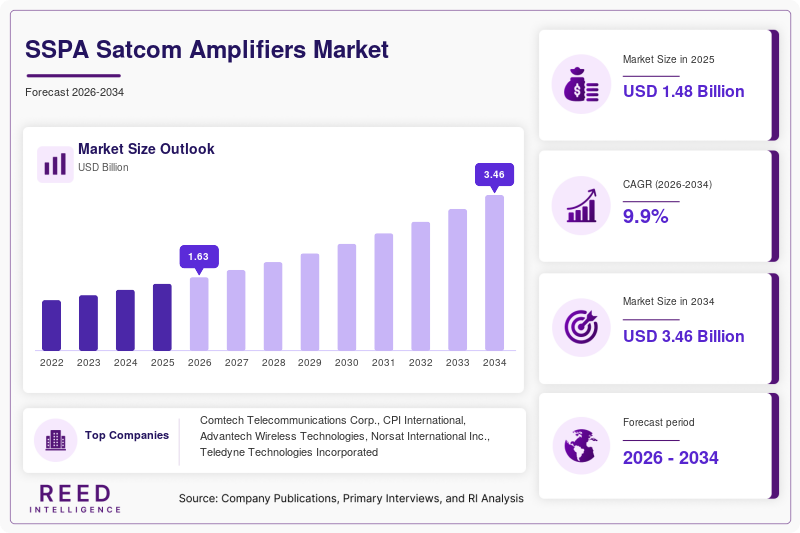
The global SSPA Satcom Amplifiers Market size was valued at approximately USD 1.48 billion in 2026 and is projected to reach USD 3.16 billion by 2034, expanding at a CAGR of 9.9% during 2026–2034. Solid-state power amplifiers (SSPAs) play a critical role in satellite communication systems by enhancing signal strength, improving transmission efficiency, and supporting reliable connectivity across commercial, government, defense, maritime, and aerospace applications. As satellite operators continue to expand high-throughput satellite networks and low Earth orbit constellations, demand for advanced amplification technologies is increasing steadily across developed and emerging markets.
A major global factor supporting market growth is the rapid expansion of satellite-based broadband connectivity. Governments, telecom operators, and private satellite companies are investing heavily in next-generation communication infrastructure to bridge connectivity gaps in remote and underserved regions. This trend is creating sustained demand for high-power, energy-efficient, and compact amplifier systems capable of supporting increasing bandwidth requirements. Additionally, advancements in gallium nitride (GaN) technology are improving amplifier efficiency, thermal performance, and operational lifespan, making SSPA solutions more attractive for both terrestrial and space-based communication platforms.
Key Highlights
- North America dominated the market with a 35.1% share in 2025, while Asia Pacific is expected to grow at the fastest CAGR of 11.4% during 2026–2034.
- By frequency band, Ku-Band amplifiers accounted for the largest share of 39.2%, while Ka-Band amplifiers are projected to grow at a CAGR of 12.7%.
- By application, Defense & Government Communications led with a 43.5% share, whereas Broadband Connectivity Services are expected to expand at a CAGR of 12.1%.
- By end use, Ground Station Operators accounted for the largest share of 46.8%, while LEO Satellite Network Operators are projected to grow at a CAGR of 13.2%.
- The United States remained the dominant country, with market values of USD 452 million in 2024 and USD 501 million in 2025.
Market Trends
Expansion of GaN-Based Amplifier Technologies
The adoption of gallium nitride semiconductor technology is becoming one of the most influential trends in the SSPA Satcom Amplifiers Market. Satellite communication providers increasingly prefer GaN-based amplifiers because they offer higher power density, improved efficiency, lower cooling requirements, and enhanced reliability compared to traditional technologies. These advantages enable satellite operators to reduce operational costs while improving network performance. Manufacturers are investing in research and development activities to introduce compact and lightweight amplifier systems suitable for both fixed and mobile satellite communication platforms. The growing use of high-throughput satellites and advanced communication architectures is further accelerating the shift toward GaN-based solutions, particularly in military, maritime, and aerospace communication applications.
Growing Deployment of LEO Satellite Constellations
The rapid deployment of low Earth orbit satellite constellations is transforming the global satellite communications ecosystem and creating new demand for advanced amplifier systems. LEO networks require highly efficient signal amplification technologies to support large-scale data transmission, low-latency communications, and continuous network coverage. As commercial satellite operators launch thousands of satellites to provide broadband connectivity, the need for scalable and energy-efficient SSPA solutions is increasing significantly. Amplifier manufacturers are developing products designed specifically for high-frequency communication environments associated with LEO systems. This trend is expected to strengthen market growth as governments, enterprises, and consumers increasingly rely on satellite-enabled connectivity services for communication, navigation, and data-intensive applications.
Market Drivers
Rising Demand for Satellite Broadband Connectivity
Growing demand for broadband connectivity in rural, remote, and geographically challenging regions is a major factor driving the SSPA Satcom Amplifiers Market. Satellite communication systems are increasingly being deployed to provide internet access where terrestrial infrastructure remains limited or economically unfeasible. Governments and telecom operators are expanding investments in satellite-based communication projects to improve digital inclusion and support economic development. As broadband service providers seek greater network capacity and reliability, demand for high-performance SSPAs continues to increase. Amplifiers capable of supporting higher frequencies and wider bandwidths are becoming essential components in modern communication architectures, creating favorable market conditions for equipment manufacturers and technology developers.
Increasing Defense and Secure Communication Investments
Defense organizations worldwide are investing heavily in secure communication systems to support military operations, intelligence gathering, surveillance missions, and emergency response activities. Satellite communication networks provide resilient and reliable connectivity in challenging operational environments, making them critical for modern defense strategies. SSPA systems are widely used in military communication terminals, airborne platforms, naval vessels, and mobile command centers. Growing geopolitical uncertainties and increasing defense modernization initiatives are encouraging governments to strengthen satellite communication capabilities. As military agencies continue to prioritize secure, uninterrupted communications, demand for ruggedized and high-power amplifier systems is expected to remain strong throughout the forecast period.
Market Restraint
High Development and Deployment Costs
The SSPA Satcom Amplifiers Market faces challenges associated with the high cost of developing, manufacturing, and deploying advanced amplifier systems. Modern SSPAs require sophisticated semiconductor materials, precision engineering, thermal management systems, and rigorous testing procedures to meet performance and reliability standards. These requirements increase production expenses and can limit adoption among smaller satellite operators or organizations with constrained budgets. In addition, integrating high-power amplifiers into existing communication infrastructure often involves substantial capital investment and technical expertise. For example, upgrading legacy satellite ground stations to support next-generation broadband services may require extensive equipment replacement and system optimization. Such financial barriers can delay purchasing decisions and slow market penetration in cost-sensitive regions. Although technological advancements are gradually improving manufacturing efficiency, pricing remains a key consideration for many end users, particularly in developing economies where communication infrastructure investments compete with other strategic priorities.
Market Opportunities
Expansion of Maritime and Aviation Connectivity Services
The growing need for uninterrupted connectivity across maritime and aviation sectors presents substantial opportunities for the SSPA Satcom Amplifiers Market. Commercial airlines, cargo operators, cruise companies, and offshore industries increasingly require high-speed communication services to support operational efficiency, passenger connectivity, and real-time monitoring capabilities. Satellite communication remains the most practical solution for maintaining coverage across oceans and remote air routes. As service providers expand satellite-enabled connectivity offerings, demand for reliable amplifier systems capable of handling high data traffic continues to rise. Manufacturers that develop compact, energy-efficient, and high-performance SSPAs tailored for mobility applications are expected to benefit significantly from expanding deployment opportunities across global transportation networks.
Growth of Emerging Space Programs
The expansion of national and private space programs is creating attractive opportunities for amplifier manufacturers. Many countries are increasing investments in satellite launches, Earth observation systems, scientific missions, and communication infrastructure to strengthen technological capabilities and economic competitiveness. Emerging space agencies and commercial space enterprises require advanced communication equipment capable of supporting mission-critical operations. SSPAs are essential components within satellite payloads, tracking stations, and communication terminals. As launch costs decline and commercial participation in space activities increases, demand for scalable amplifier technologies is expected to grow. Companies that offer innovative products optimized for space environments and next-generation satellite architectures are likely to secure new business opportunities throughout the forecast period.
Segmental Analysis
By Frequency Band
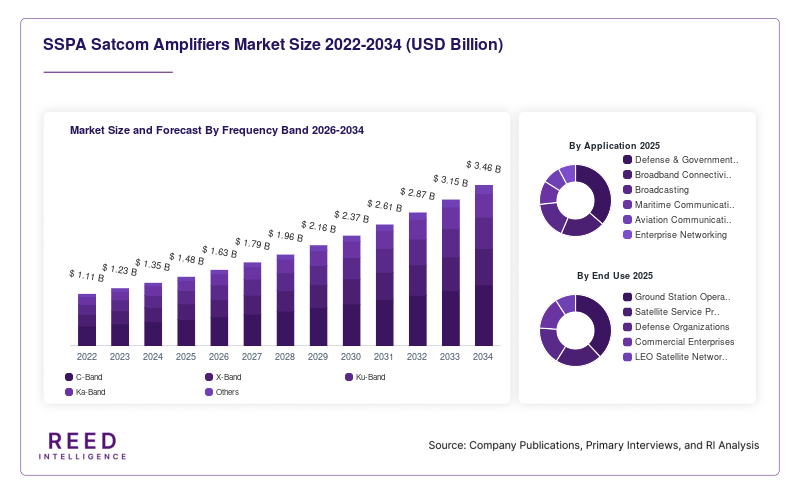
The Ku-Band segment held the dominant position in the SSPA Satcom Amplifiers Market, accounting for approximately 39.2% of total revenue in 2024. Ku-Band amplifiers are widely utilized across commercial satellite communication networks because they offer a practical balance between bandwidth capacity, equipment costs, and signal coverage. These amplifiers are commonly deployed in broadcasting, maritime communication, enterprise networking, and defense applications. The growing demand for satellite television services, broadband connectivity, and mobile communication systems has strengthened adoption of Ku-Band technologies. Their established infrastructure and broad compatibility with existing communication networks continue to support widespread deployment across developed and emerging markets, maintaining their leadership position within the industry.
The Ka-Band segment is expected to record the fastest growth, expanding at a CAGR of 12.7% during the forecast period. Increasing demand for high-throughput satellite services is driving adoption of Ka-Band communication systems capable of supporting significantly higher data transmission rates. Service providers are increasingly deploying Ka-Band networks to address growing bandwidth requirements associated with broadband internet access, cloud connectivity, and enterprise communications. Advancements in amplifier efficiency and signal processing technologies are helping mitigate challenges related to atmospheric interference. As operators seek to maximize network capacity and improve service quality, Ka-Band amplifier deployment is expected to accelerate across commercial, government, and defense communication environments.
By Application
Defense & Government Communications represented the largest application segment, accounting for approximately 43.5% of market revenue in 2024. Government agencies and defense organizations rely extensively on satellite communication systems to support mission-critical operations, intelligence sharing, surveillance activities, and emergency response capabilities. SSPAs provide the signal strength and reliability required for secure communication networks operating under challenging environmental conditions. Increasing geopolitical uncertainties and rising defense expenditures are encouraging investments in advanced communication infrastructure. The need for resilient and secure communication capabilities across land, air, and maritime platforms continues to support strong demand for amplifier technologies within this segment.
Broadband Connectivity Services are projected to experience the fastest growth, registering a CAGR of 12.1% through 2034. Growing demand for internet access in remote and underserved locations is encouraging service providers to expand satellite broadband coverage. High-throughput satellite systems and low Earth orbit constellations are creating new opportunities for communication service providers to deliver faster and more reliable connectivity. Amplifier systems capable of supporting increased bandwidth and network efficiency are becoming essential components within modern broadband infrastructure. Continued investments in digital inclusion initiatives and next-generation communication networks are expected to accelerate segment growth over the forecast period.
By End Use
Ground Station Operators accounted for the largest share of the SSPA Satcom Amplifiers Market, representing approximately 46.8% of total revenue in 2024. Ground stations serve as critical communication hubs connecting satellites with terrestrial networks, making amplifier systems essential for maintaining signal quality and transmission efficiency. The expansion of commercial satellite services, government communication programs, and Earth observation activities has increased demand for advanced ground station infrastructure. Operators are investing in high-performance amplifier technologies to support rising data traffic volumes and evolving communication requirements. Continuous modernization of ground communication facilities is expected to sustain demand for SSPAs throughout the forecast period.
LEO Satellite Network Operators are anticipated to emerge as the fastest-growing end-use segment, expanding at a CAGR of 13.2% during 2026–2034. Rapid deployment of large-scale low Earth orbit satellite constellations is driving significant investment in communication infrastructure capable of supporting dynamic network architectures. These networks require highly efficient amplifier technologies to manage continuous satellite handovers, high-speed data transmission, and extensive coverage areas. Growing demand for low-latency broadband services across consumer, enterprise, and government markets is accelerating investment in LEO systems. As constellation deployments continue to expand globally, demand for advanced amplifier solutions tailored to these environments is expected to increase substantially.
Regional Analysis
North America
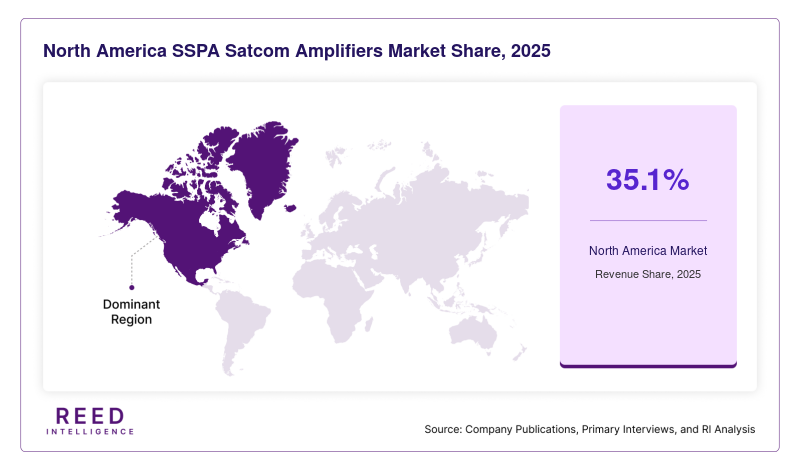
North America accounted for approximately 35.1% of the global SSPA Satcom Amplifiers Market in 2025 and maintained its position as the leading regional market. The region benefits from strong investments in satellite communication infrastructure, extensive defense spending, and the presence of major aerospace technology companies. Market growth is supported by ongoing deployment of high-throughput satellites and expanding broadband connectivity initiatives. The regional market is projected to grow at a CAGR of 8.8% through 2034, supported by continued innovation in amplifier technologies and satellite communication systems.
The United States remains the dominant country within the region due to its advanced satellite ecosystem and substantial government funding for defense and space programs. A key growth factor is the increasing deployment of commercial satellite broadband networks aimed at expanding connectivity coverage. The country also benefits from strong collaboration between private space companies and government agencies, creating favorable conditions for amplifier technology adoption across military, commercial, and scientific communication applications.
Europe
Europe represented approximately 25.3% of global market revenue in 2025 and continues to be an important contributor to industry expansion. The region is expected to register a CAGR of 8.9% during the forecast period, supported by increasing investments in satellite communications, digital infrastructure development, and secure government communication networks. Growing demand for resilient communication systems across transportation, emergency response, and defense sectors is driving adoption of advanced amplifier technologies throughout the region.
Germany remains the leading national market in Europe due to its strong aerospace manufacturing capabilities and advanced industrial infrastructure. A unique growth factor is the country's increasing focus on satellite-enabled industrial connectivity solutions supporting Industry 4.0 initiatives. German organizations are investing in communication technologies that enhance operational reliability and enable secure data transmission across industrial facilities, strengthening demand for high-performance satellite communication equipment.
Asia Pacific
Asia Pacific held approximately 22.8% of the global market share in 2025 and is anticipated to record the fastest regional CAGR of 11.4% through 2034. Rapid digital transformation, expanding telecommunications infrastructure, and increasing satellite deployments are driving regional growth. Governments across the region are investing heavily in space technology, broadband connectivity programs, and defense communication systems. These investments are creating strong demand for efficient and reliable amplifier solutions capable of supporting growing communication requirements.
China dominates the regional market due to its large-scale investments in satellite networks and space technology development. A significant growth factor is the country's continued expansion of domestic satellite communication infrastructure designed to improve connectivity across rural and remote regions. Rising demand for secure communication networks and increasing commercial participation in satellite services are expected to support sustained market growth throughout the forecast period.
Middle East & Africa
The Middle East & Africa accounted for approximately 9.2% of global revenue in 2025 and is projected to grow at a CAGR of 9.7% during 2026–2034. The market is benefiting from increasing investments in communication infrastructure, defense modernization programs, and satellite-based connectivity solutions. Several countries are utilizing satellite communications to support economic diversification strategies and improve digital access across geographically dispersed populations.
The United Arab Emirates represents the dominant country market within the region. A unique growth factor is the country's strong commitment to developing advanced space and satellite capabilities through national innovation initiatives. Significant investments in satellite communication systems, space exploration projects, and smart infrastructure development are supporting demand for sophisticated amplifier technologies capable of delivering reliable and high-capacity communications.
Latin America
Latin America captured approximately 7.6% of the global SSPA Satcom Amplifiers Market in 2025 and is expected to grow at a CAGR of 8.5% through 2034. Market expansion is driven by increasing demand for broadband connectivity, modernization of communication networks, and growing adoption of satellite-enabled services. Governments and telecom providers are utilizing satellite technologies to improve internet access in remote communities where terrestrial infrastructure remains limited.
Brazil remains the dominant country market across Latin America due to its extensive geographic coverage requirements and growing telecommunications sector. A key growth factor is the increasing use of satellite communication systems for rural connectivity programs and public service delivery initiatives. Investments in digital inclusion projects and communication infrastructure modernization are creating favorable opportunities for amplifier manufacturers operating within the region.
Competitive Landscape
The SSPA Satcom Amplifiers Market is characterized by a mix of established satellite communication equipment manufacturers and specialized RF technology providers. Companies compete through product innovation, amplifier efficiency improvements, frequency band expansion, and strategic partnerships with satellite operators and defense organizations. The competitive environment is shaped by increasing demand for high-power amplification systems capable of supporting advanced communication networks.
Among leading participants, Comtech Telecommunications Corp. maintains a strong market position due to its extensive satellite communication portfolio and global customer base. The company continues to invest in advanced GaN-based amplifier technologies to enhance operational efficiency and support emerging communication requirements.
Other significant players include CPI International, Advantech Wireless Technologies, Norsat International, and Teledyne Technologies. These companies focus on expanding product capabilities, improving power efficiency, and strengthening regional distribution networks. A notable recent development involved the introduction of next-generation high-power GaN SSPA platforms designed for high-throughput satellite applications, enabling improved performance and reduced operating costs. Market participants are also emphasizing customized solutions for defense, mobility, and broadband communication applications to strengthen competitive positioning and capture new growth opportunities.
Key Players
- Comtech Telecommunications Corp.
- CPI International
- Advantech Wireless Technologies
- Norsat International Inc.
- Teledyne Technologies Incorporated
- Gilat Satellite Networks Ltd.
- Stellant Systems
- ND SatCom GmbH
- Kratos Defense & Security Solutions
- ETL Systems Ltd.
- NEC Corporation
- Viasat Inc.
- Airbus Defence and Space
- L3Harris Technologies
- Thales Group
Recent Developments
- In 2025, a satellite communication equipment manufacturer launched a high-efficiency GaN-based SSPA platform designed for high-throughput satellite networks and broadband connectivity applications.
- In 2025, a defense communication technology provider expanded production capacity for advanced satellite amplifier systems to address growing military communication requirements.
- In 2024, a leading RF equipment company introduced compact SSPA solutions optimized for mobile satellite terminals used in aviation and maritime communication environments.
- In 2024, several satellite operators partnered with amplifier manufacturers to enhance ground station infrastructure supporting next-generation LEO satellite constellations.
- In 2025, an aerospace technology company announced development of advanced thermal management systems aimed at improving amplifier reliability and operational performance in demanding communication environments.
SSPA Satcom Amplifiers Market Segments
By Frequency Band
- C-Band
- X-Band
- Ku-Band
- Ka-Band
- Others
By Application
- Defense & Government Communications
- Broadband Connectivity Services
- Broadcasting
- Maritime Communications
- Aviation Communications
- Enterprise Networking
By End Use
- Ground Station Operators
- Satellite Service Providers
- Defense Organizations
- Commercial Enterprises
- LEO Satellite Network Operators
By Region
- North America
- Europe
- APAC
- Middle East and Africa
- LATAM