Stacking Conveyor Market Size, Share & Demand Report By Type (Radial Stacking Conveyors, Telescopic Stacking Conveyors, Tracked Stacking Conveyors, Fixed Stacking Conveyors), By Mobility (Stationary, Portable), By End-Use Industry (Mining, Construction, Logistics and Warehousing, Agriculture, Manufacturing, Ports and Shipping), By Region & Segment Forecasts, 2026–2034
USD 3950
Market Overview
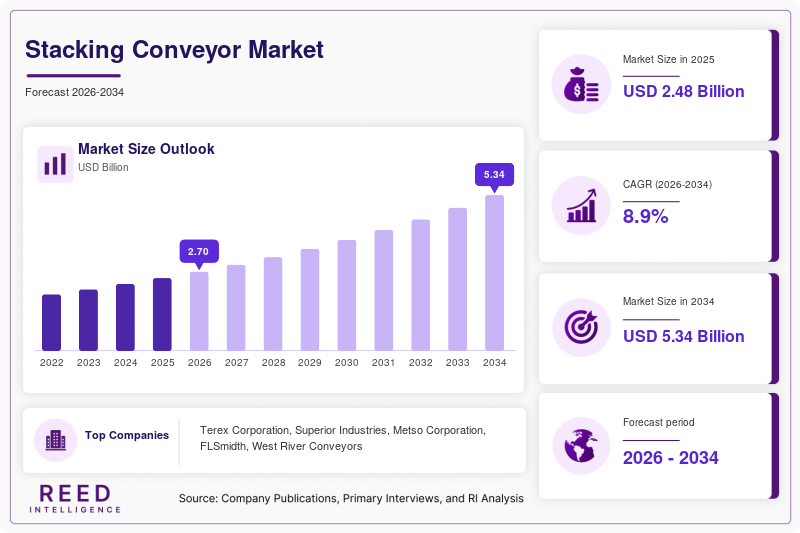
The global Stacking Conveyor Market size was valued at approximately USD 2.48 billion in 2026 and is projected to reach nearly USD 4.91 billion by 2034, expanding at a compound annual growth rate (CAGR) of 8.9% during the forecast period from 2026 to 2034. The market continues to gain momentum as industries increasingly adopt automated material handling systems to improve operational efficiency, reduce labor dependency, and streamline bulk transportation activities across manufacturing, mining, construction, logistics, and agricultural sectors. Stacking conveyors have become a critical component in modern industrial infrastructure because they enable efficient stockpiling, controlled material flow, and lower operational downtime in high-volume facilities.
One of the major global factors supporting market growth is the rapid expansion of industrial automation across emerging and developed economies. Companies are investing in smart factories and integrated warehouse systems to optimize production cycles and reduce manual intervention. This shift has increased the deployment of advanced conveyor systems equipped with sensors, remote monitoring capabilities, and energy-efficient drives. In addition, the rise in infrastructure development projects, mining activities, and e-commerce warehousing operations has accelerated demand for flexible stacking conveyor solutions that can handle varying material capacities while ensuring safety and productivity.
Key Highlights
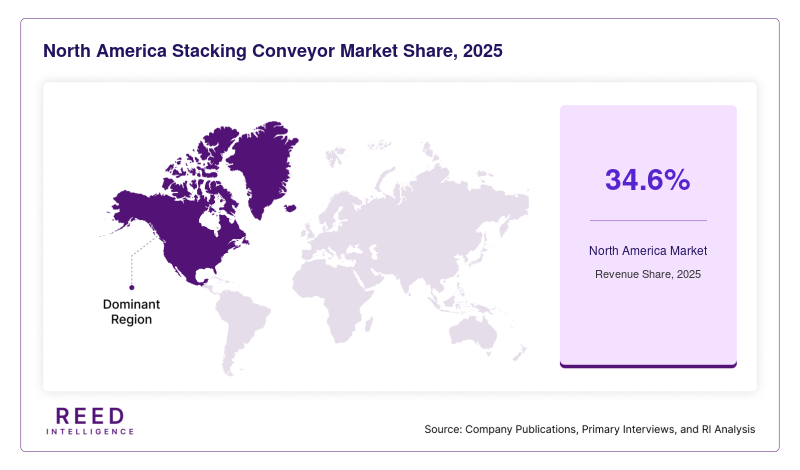
- North America dominated the market with a 34.6% share in 2025, while Asia Pacific is expected to grow at the fastest CAGR of 10.8% during 2026–2034.
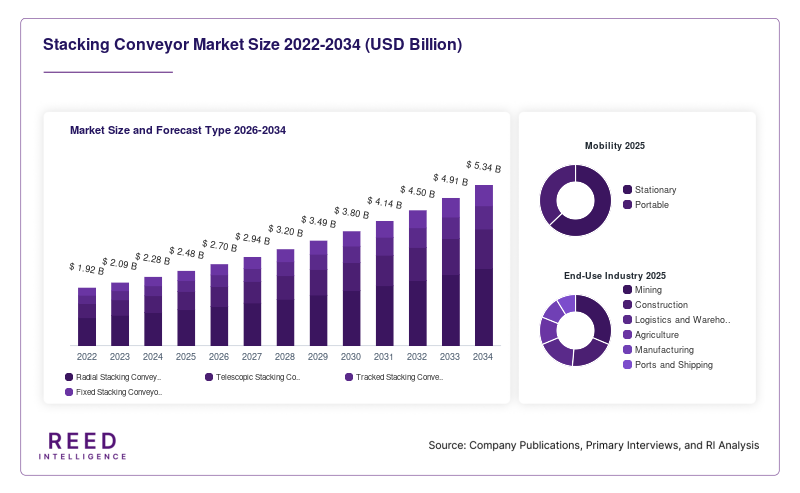
- By type, radial stacking conveyors accounted for the largest share of 39.4%, while tracked stacking conveyors are projected to grow at a CAGR of 11.5%.
- By mobility, stationary systems led with a 58.7% share, whereas portable systems are expected to expand at a CAGR of 10.9%.
- By end-use industry, mining accounted for the highest share of 36.8%, while logistics and warehousing are forecast to grow at a CAGR of 12.1%.
- The United States remained the dominant country, with market values of USD 620 million in 2024 and USD 680 million in 2025.
Market Trends
Integration of Smart Monitoring and Automation Technologies
The adoption of smart monitoring technologies is emerging as a major trend in the Stacking Conveyor Market as industries seek higher operational visibility and improved asset performance. Modern conveyor systems are increasingly integrated with IoT-enabled sensors, automated controls, and predictive maintenance software that help operators monitor belt conditions, load distribution, motor performance, and energy consumption in real time. These systems reduce downtime and maintenance costs by identifying operational issues before failures occur. Mining facilities, ports, and manufacturing plants are deploying automated stacking conveyors to optimize material handling processes and minimize human intervention in hazardous environments. In addition, companies are integrating cloud-based analytics platforms with conveyor systems to support centralized operations management and improve production planning. This trend is expected to strengthen further as industries continue prioritizing digital transformation and operational efficiency.
Rising Preference for Portable and Energy-Efficient Conveyor Systems
Industries are increasingly shifting toward portable and energy-efficient stacking conveyor solutions due to changing operational requirements and sustainability goals. Portable stacking conveyors offer flexibility in construction sites, aggregate processing plants, agricultural facilities, and temporary storage operations where material handling layouts frequently change. These systems reduce installation time and allow businesses to relocate equipment according to project demands. At the same time, manufacturers are developing energy-efficient conveyor technologies with variable frequency drives, low-friction belts, and lightweight structural components that reduce electricity consumption and operational expenses. Environmental regulations related to industrial emissions and energy use are encouraging companies to replace traditional conveyor systems with advanced alternatives that support sustainable operations. The growing demand for flexible, low-maintenance, and eco-friendly material handling equipment is expected to accelerate innovation and create long-term growth opportunities for conveyor manufacturers.
Market Drivers
Expansion of Mining and Bulk Material Handling Activities
The expansion of mining and bulk material handling activities across developing and developed economies is significantly driving the growth of the Stacking Conveyor Market. Governments and private organizations are increasing investments in mining projects to meet rising demand for minerals, metals, coal, and construction materials. Stacking conveyors play an important role in transporting and stockpiling bulk materials efficiently while reducing manual handling and operational delays. Mining operators prefer conveyor systems because they improve productivity, minimize material loss, and support continuous operations in harsh environments. In addition, growing infrastructure development activities and urbanization are increasing demand for cement, aggregates, and construction raw materials, further boosting the need for advanced conveyor systems. Conveyor manufacturers are responding by introducing heavy-duty equipment with enhanced load-bearing capacity, corrosion resistance, and automated controls to support demanding industrial applications.
Growth of E-Commerce Warehousing and Industrial Automation
Rapid growth in e-commerce operations and warehouse automation is creating strong demand for stacking conveyor systems worldwide. Distribution centers and logistics companies are increasingly investing in automated material handling infrastructure to improve order processing speed, reduce labor dependency, and enhance warehouse efficiency. Stacking conveyors are widely used in warehouses for product movement, temporary storage, and package handling because they simplify internal logistics operations. The rise in consumer demand for faster deliveries and large-scale inventory management has encouraged companies to modernize warehouse facilities with intelligent conveyor systems. Additionally, industries such as food processing, automotive manufacturing, and packaging are adopting automated conveyor technologies to support high-volume production environments. Integration with robotics, AI-based monitoring systems, and smart sorting technologies is further increasing the adoption of stacking conveyors in modern industrial operations.
Market Restraint
High Initial Investment and Maintenance Complexity
The high initial investment associated with advanced stacking conveyor systems remains a key restraint for market growth, particularly among small and medium-sized enterprises. Installation of large-scale conveyor systems requires significant capital expenditure for equipment procurement, structural integration, automation software, and safety infrastructure. Industries operating on limited budgets often delay conveyor modernization projects because of long return-on-investment periods and fluctuating raw material prices. In addition, maintenance complexity can create operational challenges for businesses using automated conveyor systems equipped with digital sensors, hydraulic systems, and integrated control units. Skilled technicians are required to inspect, repair, and calibrate these systems regularly to ensure smooth operations. Unexpected equipment failures can result in production disruptions and increased maintenance costs, especially in mining and manufacturing facilities operating continuously. For example, conveyor belt misalignment or motor failures in large mining projects can temporarily halt material transportation, leading to financial losses and project delays. These challenges may limit market penetration in price-sensitive regions despite growing demand for automation.
Market Opportunities
Increasing Adoption of Conveyor Systems in Renewable Energy Projects
The expansion of renewable energy projects is creating favorable opportunities for the Stacking Conveyor Market. Solar power plants, biomass processing facilities, and recycling operations increasingly require efficient material handling systems for transporting raw materials and industrial waste. Stacking conveyors are being used in biomass facilities to handle wood chips, pellets, and agricultural waste materials efficiently while supporting continuous production processes. In large solar infrastructure projects, conveyors assist in transporting construction materials and equipment across project sites. Governments worldwide are investing in clean energy infrastructure and sustainable industrial practices, which is expected to increase demand for automated conveyor systems with low energy consumption and durable designs. Manufacturers are also introducing conveyor solutions specifically designed for harsh outdoor environments and energy-intensive applications, creating new business opportunities in the renewable energy and environmental management sectors.
Emerging Demand from Developing Economies and Infrastructure Expansion
Developing economies across Asia Pacific, Latin America, and Africa are generating substantial opportunities for stacking conveyor manufacturers due to rapid industrialization and infrastructure expansion. Governments are increasing investments in transportation networks, mining operations, ports, and large-scale construction projects to support economic growth and urban development. These projects require efficient bulk material handling systems capable of operating under demanding conditions. Stacking conveyors are gaining popularity because they improve material flow efficiency, reduce labor costs, and support large-scale operations in infrastructure projects. Additionally, the growth of manufacturing industries and logistics facilities in emerging markets is encouraging companies to adopt modern conveyor technologies. International conveyor manufacturers are expanding their regional presence through partnerships, localized production facilities, and distribution agreements to capitalize on rising demand. This trend is expected to create long-term revenue opportunities and strengthen market competition over the forecast period.
Segmental Analysis
By Type
Radial stacking conveyors held the dominant share of the Stacking Conveyor Market in 2024, accounting for approximately 39.4% of global revenue. These conveyor systems are widely preferred in mining, aggregate processing, and bulk material handling applications because they provide efficient stockpiling capabilities while reducing material segregation. Radial conveyors allow operators to create larger stockpiles without repositioning equipment frequently, which improves operational productivity and minimizes labor costs. Industries also prefer these systems because they support continuous material flow and optimize storage capacity in limited spaces. Increasing demand for efficient stockpile management in ports, mining sites, and construction projects has strengthened adoption of radial stacking conveyors worldwide. Manufacturers are introducing enhanced models with automated radial movement, improved belt durability, and energy-efficient motors to meet growing industrial requirements.
Tracked stacking conveyors are projected to witness the fastest growth during the forecast period, expanding at a CAGR of 11.5%. These systems are gaining popularity due to their mobility, flexibility, and ability to operate efficiently in changing worksite conditions. Construction contractors, quarry operators, and recycling facilities increasingly prefer tracked conveyors because they can be relocated quickly without extensive installation requirements. The rise in temporary infrastructure projects and mobile crushing operations has significantly increased demand for tracked conveyor systems capable of handling large material volumes in remote environments. Manufacturers are integrating advanced hydraulic systems, remote-control technologies, and fuel-efficient engines into tracked conveyor models to improve operational performance. Growing emphasis on operational flexibility and reduced setup time is expected to accelerate the adoption of tracked stacking conveyors across multiple industrial sectors.
By Mobility
Stationary stacking conveyor systems dominated the market in 2024 and accounted for nearly 58.7% of total revenue. These systems are extensively used in large mining facilities, industrial manufacturing plants, and bulk cargo handling terminals where long-term material handling operations require stable and high-capacity infrastructure. Stationary conveyors are preferred because they offer higher load-bearing capabilities, continuous operational performance, and lower maintenance requirements compared to mobile alternatives. Industries handling large quantities of raw materials rely on stationary conveyor systems to maintain uninterrupted production cycles and improve efficiency in stockpiling operations. In addition, technological improvements in conveyor automation, belt monitoring, and energy management systems have enhanced the operational reliability of stationary conveyor installations. Their ability to support heavy-duty applications and long operational lifespans continues to strengthen demand in industrial environments.
Portable stacking conveyor systems are expected to register the fastest CAGR of 10.9% during the forecast period due to increasing demand for flexible material handling equipment. Portable conveyors are widely adopted in construction sites, agricultural operations, and temporary industrial facilities because they can be transported and installed quickly with minimal infrastructure requirements. Businesses operating in dynamic work environments prefer portable systems because they reduce operational downtime and allow efficient movement of materials across multiple locations. The growth of infrastructure development projects and seasonal agricultural processing activities has increased the need for adaptable conveyor solutions that support changing operational layouts. Manufacturers are focusing on lightweight structural designs, modular conveyor components, and energy-efficient drive systems to improve portability and reduce operating costs. These advancements are expected to support strong growth in the portable conveyor segment.
By End-Use Industry
The mining industry accounted for the largest share of the Stacking Conveyor Market in 2024, representing approximately 36.8% of global revenue. Mining operations require high-capacity conveyor systems for transporting ores, coal, minerals, and other bulk materials across large operational sites. Stacking conveyors are widely used in mining because they improve productivity, reduce material handling costs, and support continuous operations in demanding environments. Growing global demand for metals, industrial minerals, and energy resources has encouraged mining companies to expand production activities and modernize material handling infrastructure. Conveyor manufacturers are introducing heavy-duty systems with corrosion-resistant materials, automated controls, and advanced safety features to meet mining industry requirements. In addition, increasing investments in mineral exploration and extraction projects across emerging economies are expected to sustain demand for stacking conveyors in the mining sector.
Logistics and warehousing is anticipated to emerge as the fastest-growing end-use segment, expanding at a CAGR of 12.1% during the forecast period. The rapid expansion of e-commerce operations, retail distribution networks, and automated warehouse facilities is driving demand for conveyor systems capable of improving internal logistics efficiency. Stacking conveyors are increasingly used in fulfillment centers and distribution hubs for package movement, temporary storage, and inventory handling applications. Companies are investing in automated warehouse technologies to accelerate order processing, minimize labor dependency, and improve operational accuracy. Integration of conveyor systems with robotics, barcode scanners, and AI-powered sorting technologies is further supporting segment growth. The increasing need for high-speed logistics operations and smart warehouse infrastructure is expected to create substantial growth opportunities for stacking conveyor manufacturers.
Regional Analysis
North America
North America accounted for the largest share of the global Stacking Conveyor Market in 2025, contributing approximately 34.6% of total revenue. The region is projected to maintain stable growth at a CAGR of 7.9% during the forecast period due to widespread adoption of automated material handling technologies across industrial sectors. Strong demand from mining, logistics, manufacturing, and construction industries continues to support regional market expansion. Companies operating in the United States and Canada are investing heavily in conveyor modernization projects to improve productivity, workplace safety, and energy efficiency. The presence of advanced industrial infrastructure and high automation penetration also contributes to steady demand for technologically advanced conveyor systems.
The United States remained the dominant country in the North American market because of its extensive mining operations, large-scale warehouse facilities, and developed manufacturing sector. One unique growth factor driving the market in the country is the increasing deployment of smart warehousing infrastructure linked to the rapid growth of e-commerce and third-party logistics providers. Distribution centers are implementing intelligent conveyor systems integrated with robotics and digital monitoring platforms to improve operational efficiency and reduce order processing times. This trend is expected to sustain long-term demand for advanced stacking conveyor solutions across the country.
Europe
Europe represented a significant portion of the global Stacking Conveyor Market in 2025 and is anticipated to grow at a CAGR of 7.4% through 2034. The market is driven by rising investments in industrial automation, sustainable manufacturing practices, and modern logistics infrastructure. European industries are increasingly replacing traditional conveyor systems with energy-efficient alternatives that support regulatory compliance and lower operational costs. Countries across the region are focusing on environmentally sustainable industrial operations, which has increased demand for electric conveyor systems and digitally controlled material handling equipment. Growth in recycling operations, food processing industries, and bulk cargo transportation is also contributing to regional market expansion.
Germany dominated the European market due to its strong industrial manufacturing base and advanced engineering capabilities. A unique factor supporting market growth in the country is the widespread integration of Industry 4.0 technologies into manufacturing facilities. German manufacturers are adopting automated conveyor systems connected with predictive maintenance software and AI-based operational analytics to improve production efficiency and minimize downtime. This technological transformation is accelerating the replacement of conventional material handling systems with intelligent conveyor infrastructure across multiple industrial sectors.
Asia Pacific
Asia Pacific is projected to record the fastest growth in the Stacking Conveyor Market, with an estimated CAGR of 10.8% from 2026 to 2034. The region is benefiting from rapid industrialization, urban infrastructure development, and expanding manufacturing activities across China, India, Japan, and Southeast Asian countries. Demand for stacking conveyors is rising in mining operations, construction projects, logistics hubs, and agricultural processing facilities. Governments are investing heavily in transportation infrastructure and industrial corridors, creating favorable conditions for material handling equipment suppliers. In addition, rising labor costs and increasing focus on automation are encouraging industries to adopt conveyor systems that improve operational efficiency and reduce dependence on manual labor.
China remained the dominant country in the Asia Pacific market due to its large manufacturing sector, extensive mining activities, and expanding logistics industry. A unique growth factor driving the Chinese market is the rapid development of smart industrial parks and automated production facilities supported by government-backed digital transformation initiatives. Companies are deploying high-capacity conveyor systems equipped with intelligent controls and monitoring technologies to support large-scale industrial production. This trend is expected to strengthen China’s position as a major contributor to regional market growth over the coming years.
Middle East & Africa
The Middle East & Africa region is experiencing steady growth in the Stacking Conveyor Market and is projected to expand at a CAGR of 8.1% during the forecast period. Market growth is primarily supported by increasing mining activities, port expansion projects, and investments in large-scale infrastructure development. Countries across the Gulf region are modernizing industrial facilities and logistics networks to diversify their economies beyond oil and gas revenues. Stacking conveyors are increasingly used in cement production, mining operations, and cargo handling facilities to improve operational efficiency and manage bulk materials effectively. Rising construction activities and industrial diversification programs are also contributing to the adoption of advanced conveyor systems.
Saudi Arabia emerged as the dominant country in the regional market because of significant infrastructure investments and industrial development initiatives. One unique growth factor supporting market expansion is the government’s focus on large-scale economic diversification projects under long-term industrial development programs. These projects include mining expansion, logistics hub development, and manufacturing zone construction, all of which require efficient material handling infrastructure. As a result, demand for durable and high-capacity stacking conveyors is increasing across industrial sectors in the country.
Latin America
Latin America accounted for a moderate share of the global Stacking Conveyor Market in 2025 and is expected to witness a CAGR of 7.7% during the forecast period. Growth in the region is supported by expanding mining operations, agricultural processing industries, and infrastructure development activities. Countries such as Brazil, Chile, and Mexico are investing in industrial modernization projects to improve operational productivity and strengthen export capabilities. Stacking conveyors are widely used in mining facilities for ore transportation and stockpiling applications. In addition, increasing demand for efficient logistics and warehousing operations is encouraging companies to adopt automated conveyor systems across commercial and industrial facilities.
Brazil dominated the Latin American market due to its large mining industry and growing infrastructure investments. A unique growth factor driving market expansion in the country is the increasing development of agricultural export infrastructure. Brazil’s agricultural sector requires efficient bulk material handling systems for grain storage, transportation, and processing operations. Conveyor manufacturers are introducing customized conveyor solutions designed for high-capacity agricultural applications, which is strengthening demand across the country’s farming and export industries.
Competitive Landscape
The Stacking Conveyor Market is characterized by the presence of established international manufacturers and regional equipment suppliers competing through product innovation, strategic partnerships, and expansion into emerging markets. Companies are increasingly focusing on automation technologies, energy-efficient conveyor systems, and customized material handling solutions to strengthen their market positions. Competitive intensity has increased as industries demand conveyors with higher durability, intelligent monitoring capabilities, and reduced maintenance requirements.
Terex Corporation remains one of the leading companies in the market due to its extensive product portfolio, strong distribution network, and focus on heavy-duty material handling equipment. The company recently introduced upgraded tracked stacking conveyor systems equipped with improved fuel efficiency and remote operational controls to support mining and aggregate processing applications. Other major players are also investing in smart conveyor technologies integrated with IoT sensors and predictive maintenance software to improve operational efficiency.
Key Players
- Terex Corporation
- Superior Industries
- Metso Corporation
- FLSmidth
- West River Conveyors
- SKE Industries
- McCloskey International
- Masaba Inc.
- KPI-JCI
- EDGE Innovate
- Astec Industries
- Continental Conveyor
- Telestack Limited
- Thyssenkrupp Industrial Solutions
- Sandvik AB
Recent Developments
- Terex Corporation launched an upgraded tracked stacking conveyor series in 2025 featuring enhanced fuel efficiency, automated controls, and improved material handling capacity for aggregate and mining operations.
- Superior Industries expanded its manufacturing facility in North America in 2024 to increase production capacity for radial stacking conveyors and support rising demand from mining and construction industries.
- Metso Corporation introduced digitally connected conveyor monitoring solutions in 2025 that provide predictive maintenance analytics and real-time operational insights for industrial material handling systems.
- Telestack Limited partnered with logistics infrastructure companies in Asia Pacific during 2024 to deploy high-capacity mobile stacking conveyors across large warehouse and cargo handling projects.
- Sandvik AB announced the development of energy-efficient conveyor drive technologies in 2025 aimed at reducing operational power consumption in mining and industrial applications.
Stacking Conveyor Market Segments
Type
- Radial Stacking Conveyors
- Telescopic Stacking Conveyors
- Tracked Stacking Conveyors
- Fixed Stacking Conveyors
Mobility
- Stationary
- Portable
End-Use Industry
- Mining
- Construction
- Logistics and Warehousing
- Agriculture
- Manufacturing
- Ports and Shipping
By Region
- North America
- Europe
- APAC
- Middle East and Africa
- LATAM