Stannic Chloride Market Size, Share & Growth Report By Type (Industrial Grade, Laboratory Grade, Electronic Grade), By Application (Chemical Intermediates, Glass Coating, Electronics Processing, Metal Surface Treatment, Others), By End-Use Industry (Chemical Manufacturing, Electronics & Semiconductor, Glass Manufacturing, Renewable Energy Materials, Research Laboratories) & Global Forecast, 2025–2034
USD 3950
Market Overview
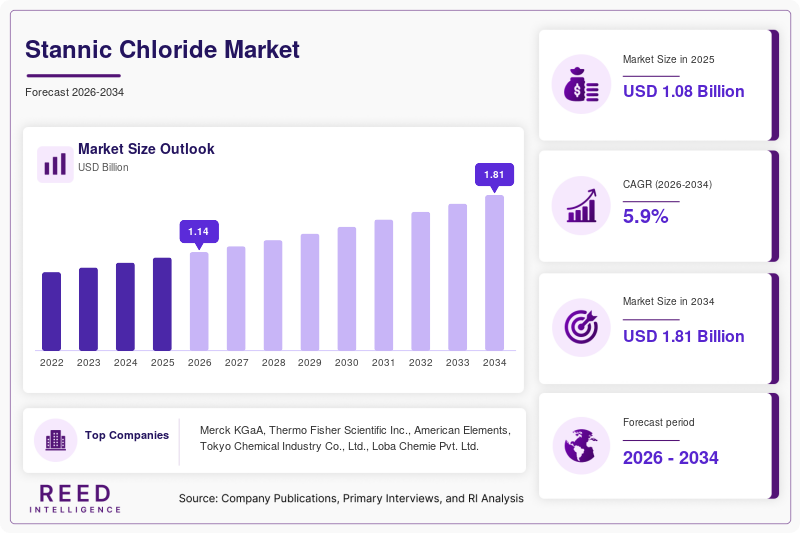
The Stannic Chloride Market size was valued at USD 1.08 billion in 2025 and is projected to reach USD 1.82 billion by 2034, expanding at a CAGR of 5.9% from 2025 to 2034. The market growth reflects steady demand from chemical synthesis, electronics processing, and specialty glass manufacturing industries. Stannic chloride, a highly reactive tin compound widely used as a catalyst and chemical intermediate, continues to gain importance in industrial chemistry due to its role in oxidation reactions, polymer modification, and advanced material processing.
One global factor supporting the growth of the Stannic Chloride Market is the expansion of specialty chemical manufacturing worldwide. Many industrial sectors are transitioning toward advanced catalytic systems to improve production efficiency and product quality. Stannic chloride serves as a versatile reagent in several processes including dye manufacturing, electroplating, pharmaceuticals, and electronic-grade materials. Rising investments in semiconductor fabrication, specialty polymers, and precision chemicals are therefore reinforcing long-term demand.
Key Highlights
- Asia Pacific dominated the Stannic Chloride Market with 41.6% share in 2025, while Middle East & Africa will record the fastest CAGR of 6.7% during 2025–2034.
- Industrial-grade stannic chloride led the type segment with 54.3% share in 2025, whereas electronic-grade material will grow fastest at a CAGR of 7.2%.
- Chemical intermediates application accounted for 36.8% of market share, while electronics processing will grow fastest at 7.5% CAGR.
- China, the dominant country, generated USD 238 million in 2025 and is expected to reach USD 252 million in 2026.
Market Trends
Increasing Use in Electronic Material Processing
The growing complexity of semiconductor and microelectronics manufacturing has increased the demand for specialized chemical reagents. Stannic chloride is being increasingly adopted in surface treatment and electronic component preparation processes. The compound assists in metal surface activation and thin-film preparation, which are important in circuit fabrication and conductive coating technologies. As electronics manufacturing expands globally, the Stannic Chloride Market is witnessing rising demand from high-purity chemical supply chains supporting semiconductor fabrication plants and electronic component manufacturers.
Shift Toward High-Purity Chemical Grades
Another noticeable trend in the Stannic Chloride Market is the shift toward high-purity and laboratory-grade products. Research institutions, pharmaceutical companies, and specialty chemical laboratories require stannic chloride with minimal contaminants to ensure reaction accuracy and product consistency. Manufacturers are therefore investing in improved purification technologies and controlled packaging systems to reduce moisture exposure and maintain product stability. The transition toward higher-purity chemical standards is encouraging suppliers to diversify their portfolios with analytical-grade and electronic-grade variants. This trend is expected to reshape the product mix within the global market over the next decade.
Market Drivers
Expanding Specialty Chemical Production
The expansion of specialty chemical manufacturing globally has significantly influenced the Stannic Chloride Market. Many specialty chemicals rely on catalytic intermediates that improve reaction selectivity and yield. Stannic chloride functions as an efficient catalyst in esterification, polymerization, and oxidation reactions used across industrial chemical production. As specialty chemicals become more important in coatings, pharmaceuticals, adhesives, and advanced materials, demand for catalytic reagents such as stannic chloride continues to increase. The growth of downstream chemical sectors has therefore strengthened the supply chain for tin-based compounds.
Rising Demand in Glass and Surface Treatment Industries
Stannic chloride also plays an important role in glass surface treatment and coating processes. The compound is widely used in glass manufacturing to create conductive or reflective coatings used in architectural glass, solar panels, and optical applications. As infrastructure development and energy-efficient construction materials gain importance worldwide, glass manufacturers are incorporating advanced coating technologies to enhance durability and performance. This expansion in coated glass production has increased the consumption of tin-based chemical agents, contributing to steady growth in the Stannic Chloride Market.
Market Restraint
Handling and Environmental Safety Concerns
One major restraint affecting the Stannic Chloride Market is the corrosive and moisture-reactive nature of the compound, which requires strict storage and handling protocols. Stannic chloride reacts with water to produce hydrochloric acid and heat, creating potential hazards during transportation and industrial processing. Due to these properties, regulatory agencies in many countries impose strict guidelines for chemical handling, packaging, and waste disposal.
Compliance with these regulations increases operational costs for manufacturers and distributors. Facilities must invest in specialized storage containers, ventilation systems, and protective handling procedures. In addition, worker safety training and environmental monitoring programs are often required for large-scale operations involving tin chlorides.
These regulatory and safety requirements can limit market expansion in regions where chemical safety infrastructure is less developed. Companies entering new markets must therefore allocate additional resources to ensure compliance with chemical safety standards, which may slow adoption in emerging industrial sectors.
Market Opportunities
Growth in Advanced Catalysis Research
One emerging opportunity in the Stannic Chloride Market lies in advanced catalytic chemistry research. Universities and chemical laboratories are increasingly exploring tin-based catalysts to improve selectivity in organic synthesis and polymer modification reactions. Stannic chloride has demonstrated promising catalytic behavior in several experimental processes involving specialty polymers and fine chemicals. As research institutions expand work on sustainable chemical processes and efficient catalytic pathways, demand for laboratory-grade stannic chloride is expected to increase steadily.
Increasing Use in Solar Glass Manufacturing
Another opportunity is linked to the growth of solar energy infrastructure. Solar panels require specialized coated glass surfaces to improve energy conversion efficiency and durability. Stannic chloride is used in certain glass coating processes that enhance conductivity and surface uniformity. As countries accelerate renewable energy installations and solar manufacturing capacity expands globally, demand for chemical coating agents is expected to rise. This trend will create new application areas for stannic chloride within the renewable energy materials supply chain.
Segmental Analysis
By Type
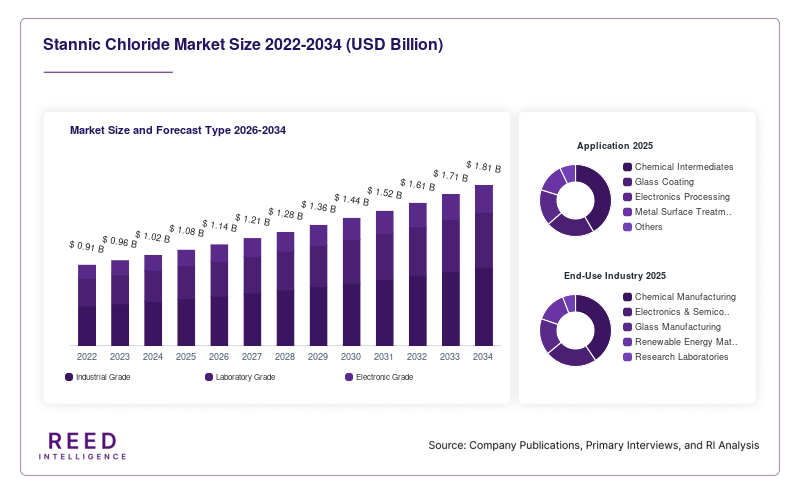
The industrial-grade stannic chloride segment dominated the Stannic Chloride Market in 2025, accounting for 54.3% of total market share. Industrial-grade material is widely used in chemical processing plants, glass coating facilities, and surface treatment operations. Its broad applicability and relatively lower purification requirements make it the preferred choice for large-scale industrial applications. Many manufacturing facilities use industrial-grade stannic chloride as a catalyst or chemical intermediate in bulk chemical synthesis processes.
The electronic-grade stannic chloride segment will register the fastest CAGR of 7.2% during the forecast period. Increasing demand for high-purity chemical reagents in semiconductor manufacturing and advanced electronic materials will drive this growth. Electronic-grade variants contain extremely low impurity levels and are designed for controlled chemical reactions used in microelectronics fabrication. The rapid expansion of semiconductor manufacturing plants worldwide will significantly increase demand for this specialized grade.
By Application
The chemical intermediates segment held the largest share of the Stannic Chloride Market in 2025 at 36.8%. Stannic chloride is widely used as an intermediate reagent in the synthesis of specialty chemicals, dyes, and pharmaceuticals. Its catalytic properties enable efficient reaction pathways in multiple organic synthesis processes. Large chemical production facilities rely on such intermediates to produce advanced materials and specialty compounds used across numerous industries.
The electronics processing segment will grow at the highest CAGR of 7.5% during the forecast period. The increasing complexity of semiconductor devices and electronic components requires specialized chemical treatment processes. Stannic chloride will increasingly be used in surface preparation and coating processes for electronic materials. Growth in global electronics manufacturing hubs will therefore create strong demand for chemical reagents used in precision processing applications.
By End-Use Industry
The chemical manufacturing industry dominated the Stannic Chloride Market with 38.5% share in 2025. Chemical producers use stannic chloride as a catalyst and reaction intermediate in several production processes involving polymers, dyes, and specialty materials. The scale of global chemical production ensures consistent demand for catalytic reagents used in industrial synthesis.
The renewable energy materials sector will emerge as the fastest-growing end-use segment with a CAGR of 6.9%. The expansion of solar panel manufacturing and coated glass production will increase demand for specialized chemical coating agents. Stannic chloride will be increasingly utilized in glass surface treatment processes that improve optical and conductive properties required in solar energy applications.
Regional Analysis
North America
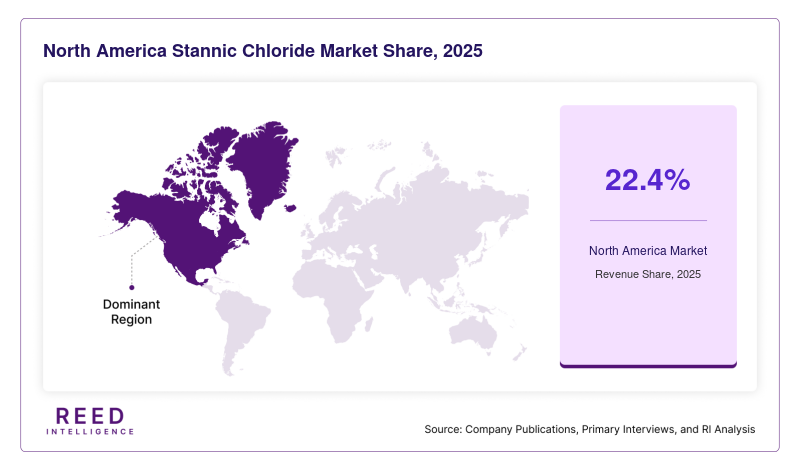
North America accounted for 22.4% of the global Stannic Chloride Market share in 2025. The regional market will expand at a CAGR of 5.4% between 2025 and 2034. Growth in this region is supported by well-established chemical manufacturing infrastructure and strong demand from research laboratories and specialty chemical producers. The presence of advanced pharmaceutical and polymer manufacturing facilities has sustained the consumption of catalytic reagents such as stannic chloride. In addition, the expansion of electronic component manufacturing in the United States and Mexico is expected to support steady chemical demand in the coming decade.
The United States remained the dominant country within the North American Stannic Chloride Market. The country hosts numerous research laboratories, chemical manufacturers, and electronics processing facilities that rely on specialty reagents for product development. Increasing investments in advanced materials research and semiconductor manufacturing are expected to support chemical reagent demand. These industries require high-purity chemicals for controlled reaction processes, which will continue to drive the consumption of stannic chloride across industrial and research applications.
Europe
Europe held 24.1% of the global Stannic Chloride Market share in 2025. The regional market will grow at a CAGR of 5.1% through 2034. Europe’s chemical industry is characterized by strong regulatory oversight and advanced research capabilities. The presence of large specialty chemical producers and glass manufacturing companies supports the steady consumption of tin-based reagents. In addition, increasing focus on high-performance materials and industrial catalysts has maintained consistent demand for stannic chloride in chemical synthesis applications.
Germany dominated the European Stannic Chloride Market due to its advanced chemical manufacturing ecosystem. The country hosts numerous specialty chemical producers and industrial research institutions focused on high-precision chemical processes. Germany’s strong automotive, materials science, and polymer industries require specialized catalysts and reaction intermediates. These factors contribute to stable demand for stannic chloride in research laboratories and industrial chemical production facilities throughout the country.
Asia Pacific
Asia Pacific represented the largest share of the global Stannic Chloride Market at 41.6% in 2025. The region is projected to expand at a CAGR of 6.3% during 2025–2034. Rapid industrialization and strong growth in electronics manufacturing have positioned Asia Pacific as the leading consumer of tin-based chemical compounds. Several countries in the region operate large-scale chemical manufacturing facilities that utilize stannic chloride as an intermediate reagent in multiple processes.
China remained the dominant country within the regional market. The country’s strong electronics manufacturing sector, large chemical production capacity, and expanding specialty materials industry continue to support demand for chemical reagents. China also maintains a strong supply chain for tin-based compounds due to its significant tin resources and refining infrastructure. These factors allow domestic producers to maintain cost-efficient production while supporting downstream industries that require stannic chloride.
Middle East & Africa
The Middle East & Africa accounted for 6.8% of the global Stannic Chloride Market in 2025. The regional market will expand at the fastest CAGR of 6.7% during the forecast period. Industrial diversification efforts across the region are supporting the development of chemical processing facilities and specialty manufacturing plants. Several countries are investing in chemical production infrastructure to reduce dependence on imported materials and strengthen local industrial supply chains.
Saudi Arabia dominated the regional Stannic Chloride Market due to its rapidly expanding chemical industry. The country has invested heavily in petrochemical and downstream chemical production facilities that require catalytic reagents and specialized chemical intermediates. As industrial diversification initiatives continue, demand for specialty chemical inputs such as stannic chloride is expected to increase across manufacturing sectors.
Latin America
Latin America held 5.1% of the global Stannic Chloride Market share in 2025 and will grow at a CAGR of 5.3% through 2034. The region’s market growth is supported by expanding chemical processing industries and gradual industrial development. Demand for catalytic reagents used in chemical manufacturing and metal surface treatment processes has increased steadily across the region.
Brazil emerged as the dominant country in the Latin American Stannic Chloride Market. The country’s diverse industrial base, including chemical production, glass manufacturing, and metallurgy, supports the use of tin-based compounds. Brazil’s growing investment in domestic chemical manufacturing capacity is expected to strengthen the regional supply chain and support future demand for specialized chemical intermediates.
Competitive Landscape
The global Stannic Chloride Market features a moderately consolidated structure with several specialty chemical suppliers and laboratory reagent manufacturers. Leading companies focus on product purity, consistent supply, and application-specific formulations to maintain competitive positioning.
Key suppliers include organizations such as Merck KGaA, Thermo Fisher Scientific, and American Elements, which provide high-purity chemical reagents for research and industrial applications. These companies maintain strong global distribution networks and invest in advanced purification technologies.
Among these players, Merck KGaA remains one of the leading suppliers of laboratory-grade tin compounds. The company recently expanded its specialty chemical portfolio through improved reagent purification systems to support advanced research and electronic-grade chemical demand.
Other companies compete through regional distribution networks and specialized chemical formulations tailored to laboratory and industrial users.
Key Players
- Merck KGaA
- Thermo Fisher Scientific
- American Elements
- Tokyo Chemical Industry
- Loba Chemie
- Santa Cruz Biotechnology
- Alfa Aesar
- Strem Chemicals
- MP Biomedicals
- Central Drug House
- Spectrum Chemical Manufacturing
- GFS Chemicals
- Jiangxi Ketai New Materials
- Henan Kingway Chemicals
- Noah Technologies
Recent Developments
- In 2024, Merck KGaA expanded its specialty reagent purification capabilities to support high-purity tin compounds used in advanced laboratory applications.
- In 2023, Thermo Fisher Scientific enhanced production capacity for specialty inorganic reagents to support growing research laboratory demand.
- In 2024, Tokyo Chemical Industry introduced new packaging solutions designed to improve storage stability for moisture-sensitive reagents such as stannic chloride.
Stannic Chloride Market Segments
Type
- Industrial Grade
- Laboratory Grade
- Electronic Grade
Application
- Chemical Intermediates
- Glass Coating
- Electronics Processing
- Metal Surface Treatment
- Others
End-Use Industry
- Chemical Manufacturing
- Electronics & Semiconductor
- Glass Manufacturing
- Renewable Energy Materials
- Research Laboratories
By Region
- North America
- Europe
- APAC
- Middle East and Africa
- LATAM