Starch Based Bioplastic Market Size, Share & Demand Report By Type (Thermoplastic Starch, Starch Blends, Starch-Based Polyesters), By Application (Packaging, Agriculture, Consumer Goods, Textile, Medical and Healthcare), By End-Use Industry (Food and Beverage, Personal Care and Cosmetics, Retail, Healthcare, Agriculture, Industrial), By Region & Segment Forecasts, 2026–2034
USD 3950
Market Overview
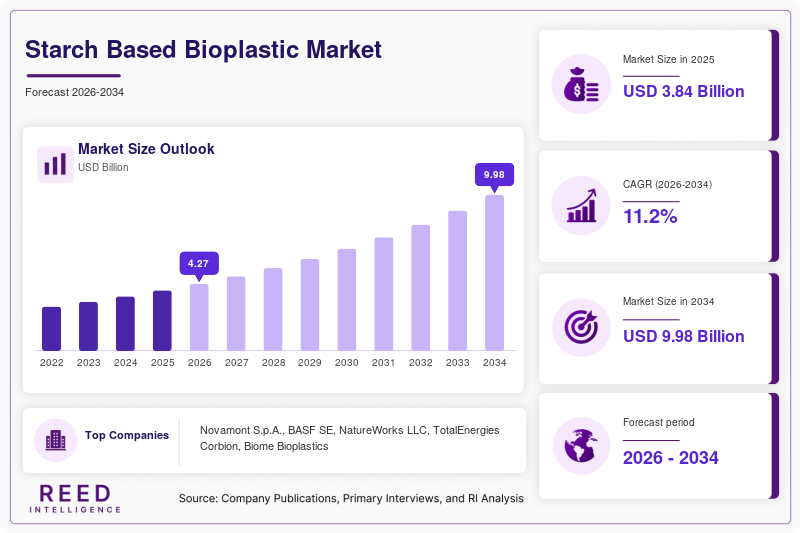
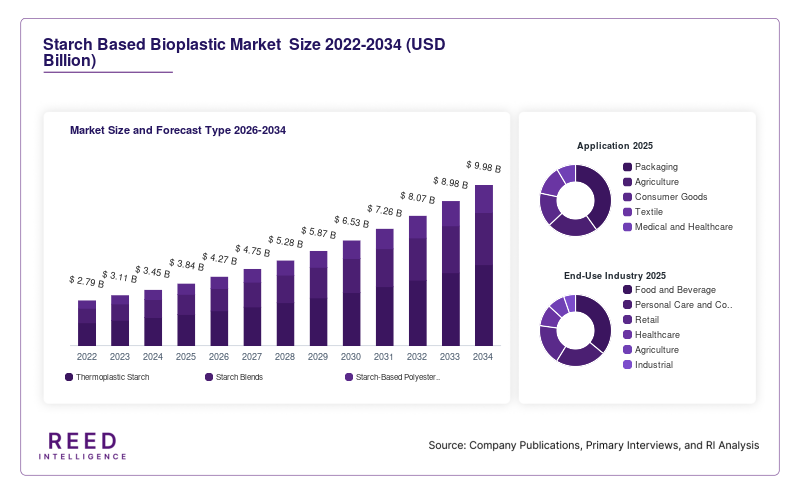
The global Starch Based Bioplastic Market size was valued at USD 3.84 billion in 2026 and is projected to reach USD 8.96 billion by 2034, expanding at a CAGR of 11.2% during the forecast period from 2026 to 2034. The market is witnessing consistent growth due to rising regulatory pressure on conventional petroleum-based plastics and increasing adoption of sustainable packaging materials across food, retail, agriculture, and consumer goods industries. Governments across developed and emerging economies are implementing regulations to reduce landfill waste and carbon emissions, which has accelerated demand for biodegradable and compostable alternatives. Starch-based bioplastics are gaining traction because they are produced from renewable feedstocks such as corn, potato, cassava, and wheat starch, making them suitable for circular economy initiatives.
Manufacturers are investing in advanced blending technologies to improve moisture resistance, tensile strength, and thermal stability of starch-based materials. Food packaging companies are integrating starch-based films and containers to align with sustainability targets and improve brand positioning among environmentally conscious consumers. In addition, increasing investment in bio-based polymer research has improved commercial scalability and reduced production costs in recent years. The growth of e-commerce packaging, flexible packaging solutions, and biodegradable agricultural films is also supporting market expansion.
Key Highlights
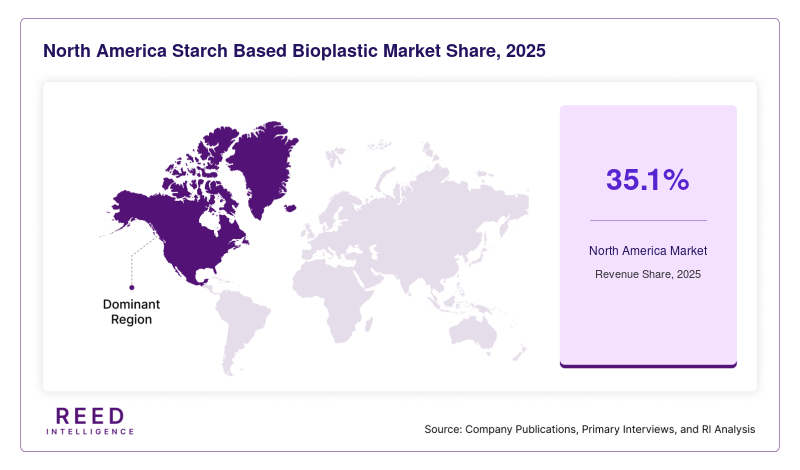
- North America dominated the market with a 35.1% share in 2025.
- Asia Pacific is expected to grow at the fastest CAGR of 12.6% during 2026–2034.
- By type, thermoplastic starch accounted for the largest share of 44.8%.
- while starch blends are projected to grow at a CAGR of 13.1%.
- By application, packaging led with a 48.3% share, whereas agriculture applications are expected to expand at a CAGR of 12.8%.
- The United States remained the dominant country, with market values of USD 870 million in 2024 and USD 960 million in 2025.
Market Trends
Expansion of Compostable Food Packaging Solutions
The increasing demand for compostable food packaging is emerging as a major trend in the Starch Based Bioplastic Market. Food service companies, grocery retailers, and packaged food manufacturers are replacing conventional plastic trays, films, and pouches with starch-based alternatives to meet sustainability targets and comply with evolving environmental policies. Consumers are actively seeking packaging that decomposes naturally and reduces environmental pollution, especially in urban markets where waste management concerns continue to rise. Several restaurant chains and beverage brands are introducing compostable cutlery, containers, and takeaway packaging made from starch-based polymers. This trend is also supported by municipal composting programs and growing awareness regarding single-use plastic waste. Manufacturers are developing multilayer starch-based packaging materials with enhanced durability and barrier performance to support broader adoption in frozen foods, snacks, and ready-to-eat meals.
Technological Advancements in Bio-Based Polymer Blending
Advancements in polymer blending technologies are reshaping the performance capabilities of starch-based bioplastics across industrial applications. Producers are combining starch with biodegradable polymers such as polylactic acid and polybutylene adipate terephthalate to improve flexibility, water resistance, and mechanical strength. These innovations are enabling starch-based materials to compete more effectively with petroleum-based plastics in packaging, agriculture, and disposable consumer products. The trend is particularly visible among manufacturers focused on industrial-scale applications requiring improved shelf life and heat stability. Companies are also investing in extrusion technologies and additive formulations that reduce brittleness while maintaining biodegradability standards. Increased collaboration between material science firms and packaging converters is accelerating commercial product launches. The growing availability of customized starch blends for specific end-use industries is expected to create broader market penetration during the forecast period.
Market Drivers
Increasing Government Regulations on Conventional Plastic Usage
Government regulations aimed at reducing plastic pollution are significantly driving growth in the Starch Based Bioplastic Market. Several countries have introduced bans or restrictions on single-use plastics, including shopping bags, disposable utensils, and food packaging products. Regulatory authorities are encouraging manufacturers to adopt biodegradable materials through subsidies, tax benefits, and sustainability mandates. Public procurement policies are also favoring eco-friendly packaging materials in healthcare, hospitality, and food service industries. These policy frameworks are encouraging packaging manufacturers and consumer goods companies to transition toward starch-based alternatives. In addition, environmental agencies are implementing strict landfill reduction targets and promoting compostable packaging certification systems. The increasing alignment between sustainability regulations and corporate environmental goals is strengthening long-term demand for starch-based bioplastics across multiple industries.
Rising Consumer Preference for Sustainable Consumer Products
Changing consumer behavior toward environmentally responsible products is accelerating the adoption of starch-based bioplastics worldwide. Consumers are increasingly concerned about microplastic contamination, marine pollution, and the environmental impact of traditional plastics. This shift in purchasing behavior is encouraging brands to adopt biodegradable materials in packaging and disposable products. Retailers and e-commerce companies are highlighting compostable packaging features as part of sustainability marketing campaigns, which is increasing consumer awareness and product visibility. Younger demographics are particularly influencing demand for sustainable packaging in food delivery, cosmetics, and household products. Manufacturers are responding by expanding their bio-based product portfolios and improving product aesthetics and performance. The growing willingness of consumers to pay a premium for environmentally responsible products is creating favorable conditions for long-term market expansion.
Market Restraint
Limited Performance Characteristics Compared to Conventional Plastics
Despite increasing demand for sustainable materials, the Starch Based Bioplastic Market continues to face challenges related to material performance and cost competitiveness. Starch-based bioplastics often exhibit lower moisture resistance, reduced thermal stability, and limited mechanical strength compared to conventional petroleum-based plastics. These limitations restrict their use in high-temperature packaging, heavy-duty industrial applications, and products requiring extended shelf life. Manufacturers are required to invest in additives and blending technologies to improve durability, which can increase production costs and reduce price competitiveness. In addition, inconsistent industrial composting infrastructure across developing regions limits effective disposal and recycling of biodegradable materials. Small and medium-sized manufacturers may also face difficulties in scaling production due to fluctuating raw material availability and higher processing costs. For example, food packaging producers operating in humid climates may experience challenges maintaining product integrity when using starch-based films for moisture-sensitive goods.
Market Opportunities
Growth Potential in Agricultural Biodegradable Films
The increasing use of biodegradable mulch films and agricultural packaging presents strong growth opportunities for the Starch Based Bioplastic Market. Farmers are seeking sustainable alternatives to polyethylene films due to rising concerns regarding soil contamination and disposal costs associated with conventional agricultural plastics. Starch-based bioplastics are being adopted in crop protection films, seed coatings, compost bags, and greenhouse applications because they naturally degrade in soil under suitable environmental conditions. Government support for sustainable farming practices and organic agriculture is further encouraging the adoption of biodegradable agricultural materials. Manufacturers are developing starch-based films with enhanced weather resistance and durability to meet the operational needs of large-scale farming operations. The expansion of precision agriculture and sustainable farming initiatives across Asia Pacific and Europe is expected to create additional opportunities for starch-based material suppliers.
Increasing Adoption in Personal Care and Consumer Goods Packaging
The personal care and consumer goods industries are creating new opportunities for starch-based bioplastic manufacturers. Beauty brands, hygiene product companies, and household goods manufacturers are introducing biodegradable packaging solutions to strengthen sustainability positioning and reduce environmental impact. Starch-based materials are increasingly used in cosmetic containers, shopping bags, disposable hygiene products, and protective packaging inserts. Brand owners are focusing on packaging differentiation and eco-friendly labeling to attract environmentally conscious consumers. Rising e-commerce sales are also increasing demand for lightweight and compostable packaging materials that reduce transportation emissions and landfill waste. Companies are investing in aesthetically appealing starch-based packaging designs with improved printability and texture. This growing integration of bio-based materials into premium consumer product packaging is expected to support revenue growth across the market during the forecast period.
Segmental Analysis
By Type
Thermoplastic starch held the dominant position in the Starch Based Bioplastic Market and accounted for 44.8% of total revenue in 2024. The segment benefits from broad commercial adoption across packaging films, disposable cutlery, shopping bags, and food containers due to its biodegradability and relatively low production cost. Thermoplastic starch is widely preferred because it can be processed using conventional plastic manufacturing equipment, allowing manufacturers to reduce infrastructure investment while transitioning toward sustainable materials. Food packaging companies continue to increase adoption of thermoplastic starch solutions to comply with environmental regulations and improve sustainability branding. The material also offers favorable compostability characteristics and compatibility with renewable feedstocks such as corn and potato starch. Growing demand for lightweight and flexible biodegradable packaging is expected to support continued segment dominance.
Starch blends are projected to witness the fastest growth during the forecast period, expanding at a CAGR of 13.1% from 2026 to 2034. These blends combine starch with biodegradable polymers to improve flexibility, moisture resistance, and mechanical durability for industrial applications. Manufacturers are increasingly adopting starch blends in flexible packaging, agricultural films, and consumer products requiring enhanced strength and shelf stability. The segment is benefiting from continuous advancements in blending technologies and additive formulations that improve product performance while maintaining biodegradability. Rising demand for high-performance compostable materials from e-commerce packaging and food delivery industries is further supporting segment growth. In addition, packaging companies are developing customized starch blend formulations to meet specific product requirements across healthcare, retail, and industrial applications.
By Application
Packaging emerged as the leading application segment in the Starch Based Bioplastic Market and accounted for 48.3% of global revenue in 2024. The segment is driven by rising demand for compostable films, pouches, trays, and disposable food containers across retail and food service industries. Consumers are increasingly favoring sustainable packaging materials, encouraging companies to replace conventional plastics with starch-based alternatives. Regulatory restrictions on single-use plastics are also accelerating adoption among packaged food producers and restaurant chains. Packaging manufacturers are investing in biodegradable material technologies that offer improved printability, flexibility, and barrier properties. The expansion of e-commerce and food delivery services is creating additional demand for lightweight and environmentally responsible packaging solutions. Strong commercial adoption across supermarkets, quick-service restaurants, and consumer goods industries continues to strengthen the packaging segment.
Agriculture applications are anticipated to grow at the fastest CAGR of 12.8% during the forecast period due to increasing use of biodegradable mulch films and compostable agricultural products. Farmers are adopting starch-based films to reduce soil contamination and eliminate the cost of collecting and disposing of conventional plastic waste. Government support for sustainable farming and organic agriculture is encouraging wider adoption of biodegradable materials across crop cultivation activities. The segment is also benefiting from advancements in starch-based formulations that improve weather resistance and degradation control under varying environmental conditions. Agricultural producers are increasingly using biodegradable bags, seed coatings, and plant support materials to align with environmental standards. Rising pressure to reduce agricultural plastic waste is expected to accelerate investment in compostable farming solutions across emerging economies.
By End-Use Industry
The food and beverage industry accounted for the largest share of the Starch Based Bioplastic Market in 2024, representing 39.6% of global revenue. The segment is experiencing strong adoption of starch-based packaging materials for takeaway containers, beverage cups, disposable utensils, and flexible food packaging. Food manufacturers are prioritizing sustainable packaging strategies to strengthen brand positioning and comply with environmental regulations related to single-use plastics. The growing popularity of online food delivery platforms and ready-to-eat meals is increasing demand for compostable packaging solutions with adequate durability and food safety compliance. In addition, large restaurant chains are integrating biodegradable materials into their operational sustainability initiatives. Consumer preference for environmentally responsible packaging continues to encourage investment in starch-based bioplastic applications across the food service ecosystem.
The personal care and cosmetics industry is projected to record the fastest CAGR of 12.3% from 2026 to 2034. Beauty and hygiene brands are increasingly introducing biodegradable packaging materials to reduce environmental impact and appeal to sustainability-focused consumers. Starch-based bioplastics are being used in cosmetic tubes, sachets, disposable applicators, and protective product packaging. Companies are focusing on packaging innovation to improve shelf appeal while maintaining biodegradability and lightweight characteristics. Rising consumer awareness regarding sustainable beauty products is encouraging multinational brands to expand their eco-friendly packaging portfolios. The rapid growth of premium skincare products, online beauty retail platforms, and sustainable lifestyle trends is expected to create additional opportunities for starch-based material suppliers within the cosmetics and personal care sector.
Regional Analysis
North America
North America accounted for 35.1% of the global Starch Based Bioplastic Market in 2025 and is expected to maintain a stable growth trajectory with a CAGR of 10.4% through 2034. The region benefits from strong regulatory support for sustainable packaging and a well-established compostable materials industry. Major food packaging companies are expanding the use of biodegradable materials across retail and food service applications. Consumer awareness regarding environmental sustainability remains high across the United States and Canada, supporting the transition away from conventional plastics. The presence of advanced research institutions and bio-based polymer manufacturers also contributes to regional market development.
The United States remains the dominant country within North America due to rising investment in sustainable packaging innovation and industrial composting infrastructure. Large retail chains and restaurant operators are replacing traditional single-use plastics with starch-based alternatives to comply with environmental commitments and state-level regulations. Increasing adoption of compostable packaging in online grocery delivery and takeaway food services is creating consistent product demand. The country is also witnessing rising collaboration between agricultural producers and biopolymer companies to improve domestic starch feedstock supply chains.
Europe
Europe represented 28.4% of the global Starch Based Bioplastic Market in 2025 and is projected to expand at a CAGR of 10.9% during the forecast period. The region remains a major center for biodegradable materials innovation due to strict environmental regulations and circular economy initiatives. European Union directives related to single-use plastics and waste reduction continue to accelerate market adoption across packaging, consumer goods, and agricultural industries. Strong consumer preference for eco-friendly products is encouraging companies to transition toward compostable materials. Regional manufacturers are focusing on product innovation and lifecycle sustainability to strengthen competitiveness.
Germany emerged as the leading country in the European market because of its advanced manufacturing base and strong environmental policy framework. The country has established extensive recycling and composting infrastructure, which supports the commercialization of starch-based bioplastics across packaging and industrial sectors. German automotive and consumer goods manufacturers are increasingly integrating biodegradable materials into secondary packaging and disposable components. In addition, strong collaboration between research institutes and packaging companies is accelerating the development of high-performance starch blends suitable for industrial-scale applications.
Asia Pacific
Asia Pacific is anticipated to record the fastest growth in the Starch Based Bioplastic Market, with a projected CAGR of 12.6% from 2026 to 2034. The region accounted for 24.6% of global revenue in 2025 and continues to attract investment from packaging manufacturers and bio-based polymer producers. Rapid urbanization, increasing plastic waste generation, and government restrictions on single-use plastics are supporting demand for biodegradable alternatives. Expanding food delivery services, retail packaging, and agricultural applications are further contributing to regional market expansion. Countries across the region are also investing in domestic biopolymer manufacturing facilities to reduce import dependence.
China remains the dominant country in the Asia Pacific market due to large-scale packaging production capacity and rising environmental policy enforcement. The government has introduced phased restrictions on non-biodegradable plastic bags and disposable products, encouraging manufacturers to adopt starch-based materials. The country also benefits from abundant agricultural feedstock availability, including corn and cassava starch. Increasing investment in biodegradable packaging for e-commerce logistics and food delivery applications is strengthening domestic demand. Chinese manufacturers are rapidly scaling production capabilities to serve both domestic and export markets.
Middle East & Africa
The Middle East & Africa region accounted for 5.8% of the global Starch Based Bioplastic Market in 2025 and is expected to expand at a CAGR of 9.3% during the forecast period. Although the market remains at an early stage of development, rising environmental awareness and increasing focus on waste management are supporting gradual adoption of biodegradable materials. Governments across several Gulf countries are implementing sustainability initiatives aimed at reducing plastic waste and promoting eco-friendly packaging solutions. Demand for starch-based bioplastics is increasing within hospitality, food packaging, and retail industries, particularly in urban commercial centers.
Saudi Arabia is emerging as a leading market within the region due to growing investment in sustainable industrial development and environmental diversification programs. The country is encouraging local manufacturing of biodegradable products through industrial incentives and sustainability-focused economic initiatives. Rising tourism activity and expanding food service industries are increasing the use of compostable packaging materials in restaurants and hospitality businesses. In addition, large retail operators are introducing environmentally responsible packaging strategies to align with national sustainability objectives and changing consumer expectations.
Latin America
Latin America captured 6.1% of the global Starch Based Bioplastic Market in 2025 and is projected to grow at a CAGR of 9.8% through 2034. The region is experiencing rising demand for biodegradable agricultural films, flexible packaging, and compostable consumer goods. Governments are implementing environmental regulations aimed at reducing dependence on petroleum-based plastics and encouraging sustainable packaging adoption. Growing agricultural activity and increasing exports of packaged food products are supporting demand for starch-based materials. Regional packaging manufacturers are also investing in biodegradable film technologies to improve competitiveness in export markets.
Brazil remains the dominant country in Latin America because of its strong agricultural sector and abundant starch feedstock availability. The country has a well-developed sugarcane and corn industry that supports bio-based material production. Local packaging manufacturers are increasingly adopting starch-based films and compostable bags to meet sustainability requirements from international retailers and food exporters. Rising awareness regarding plastic pollution in coastal regions is encouraging municipal authorities and businesses to invest in biodegradable waste management solutions. This trend is expected to strengthen regional market opportunities over the coming years.
Competitive Landscape
The Starch Based Bioplastic Market is characterized by increasing competition among global biopolymer manufacturers, packaging companies, and specialty material providers. Leading companies are focusing on product innovation, strategic partnerships, and production capacity expansion to strengthen market presence. Market participants are investing in research and development activities to improve the mechanical properties and moisture resistance of starch-based materials while maintaining biodegradability standards. Strategic collaborations with food packaging companies, agricultural product manufacturers, and retail brands are becoming increasingly common as companies seek to expand commercial adoption.
Novamont remains one of the leading companies in the market due to its broad biodegradable product portfolio and strong focus on sustainable material innovation. The company recently expanded its compostable packaging material production capabilities to address rising demand from European food packaging manufacturers. Other major companies are also increasing investments in bio-based polymer technologies and regional manufacturing facilities. Competitive differentiation is increasingly based on product performance, compostability certification, raw material sourcing efficiency, and long-term sustainability partnerships with consumer brands.
Key Players
- Novamont S.p.A.
- BASF SE
- Biome Bioplastics
- TotalEnergies Corbion
- NatureWorks LLC
- FKuR Kunststoff GmbH
- Plantic Technologies
- Cardia Bioplastics
- Biotec GmbH & Co. KG
- Rodenburg Biopolymers
- Green Dot Bioplastics
- Mitsubishi Chemical Group
- Toray Industries, Inc.
- Danimer Scientific
Recent Developments
- In February 2026, NatureWorks LLC announced expansion of its biodegradable polymer production network to support rising demand for compostable packaging applications across North America and Europe.
- In August 2025, BASF SE introduced a new starch-based flexible packaging formulation designed for food delivery and retail packaging applications with improved moisture resistance.
- In November 2025, Novamont S.p.A. partnered with regional packaging manufacturers to expand commercialization of compostable shopping bags and food service packaging solutions across Europe.
- In March 2026, Mitsubishi Chemical Group launched advanced starch blend materials targeted at personal care and consumer goods packaging manufacturers in Asia Pacific.
Starch Based Bioplastic Market Segments
Type
- Thermoplastic Starch
- Starch Blends
- Starch-Based Polyesters
Application
- Packaging
- Agriculture
- Consumer Goods
- Textile
- Medical and Healthcare
End-Use Industry
- Food and Beverage
- Personal Care and Cosmetics
- Retail
- Healthcare
- Agriculture
- Industrial
By Region
- North America
- Europe
- APAC
- Middle East and Africa
- LATAM