Starch Based Edible Coating Market Size, Share Demand Report By Type (Polysaccharide-Based Coatings, Protein-Based Coatings, Lipid-Based Coatings, Composite Coatings), By Source (Corn, Potato, Wheat, Cassava, Others), By Application (Fruits & Vegetables, Bakery Products, Dairy Products, Meat & Poultry, Confectionery), By End-Use (Food Processing Companies, Retail & Supermarkets, Foodservice Industry), By Distribution Channel (Direct Sales, Distributors, Online Channels) By Region & Segment Forec
USD 3950
Market Overview
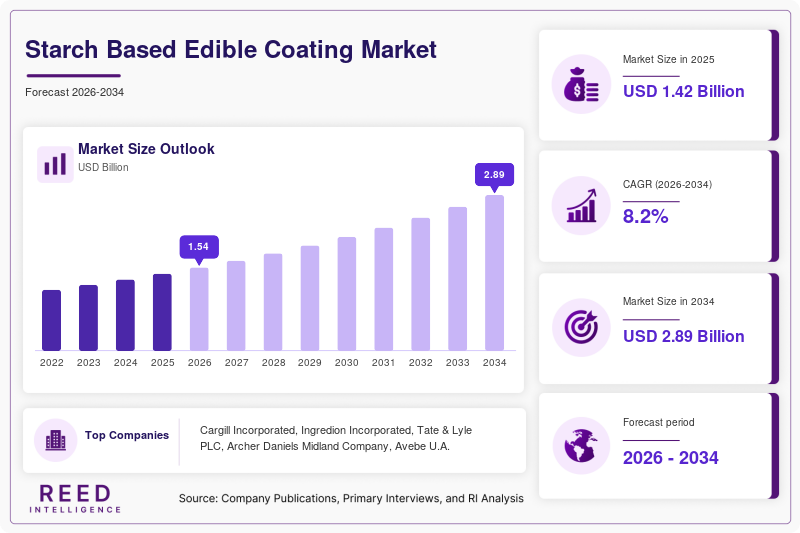
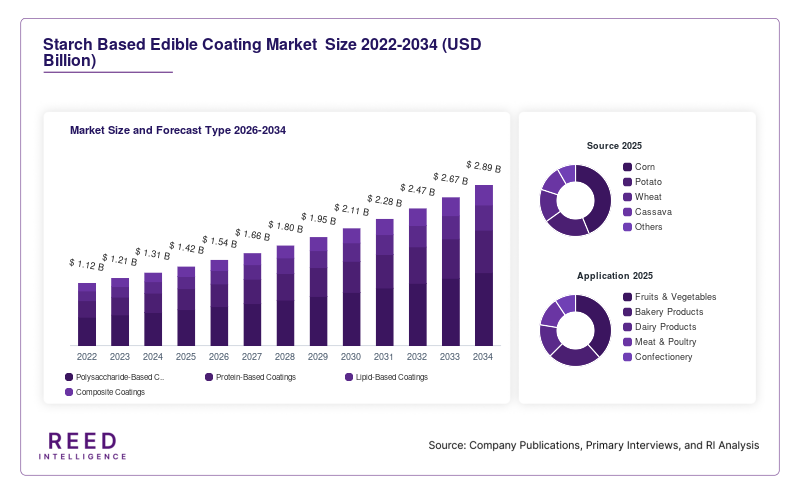
The global Starch Based Edible Coating Market size was valued at USD 1.42 billion in 2026 and is projected to reach USD 2.67 billion by 2034, expanding at a CAGR of 8.2% during the forecast period (2026–2034). The market has experienced consistent expansion due to the increasing shift toward sustainable and biodegradable food preservation solutions across the global food industry. A key global factor supporting market growth is the rising regulatory pressure to reduce synthetic plastic packaging, encouraging food manufacturers to adopt bio-based coating technologies derived from starch.
Starch-based edible coatings are widely used to enhance shelf life, maintain moisture content, and improve the visual appeal of fresh produce and processed foods. These coatings are primarily derived from corn, potato, wheat, and cassava starch, making them cost-effective and scalable for industrial applications.
Key Highlights:
- North America dominated the market with 34.8% share in 2025, while Asia Pacific is expected to grow at a CAGR of 9.6% during 2026–2034.
- By type, polysaccharide-based coatings led with 46.2% share in 2025, while composite coatings are projected to grow at a CAGR of 9.1%.
- By application, fruits & vegetables accounted for 41.5% share in 2025, whereas bakery products are expected to expand at a CAGR of 8.9%.
- The United States remained the dominant country, with market values of USD 392 million in 2024 and USD 418 million in 2025.
Market Trends
Rising Adoption of Active and Functional Coatings
The integration of antimicrobial agents, antioxidants, and natural preservatives into starch-based edible coatings is shaping the market. These functional coatings not only extend shelf life but also improve food safety, especially in perishable categories such as fresh fruits and meat products. Manufacturers are focusing on enhancing barrier properties through nano-emulsions and bioactive compounds.
Shift Toward Clean Label and Natural Ingredients
Consumers are increasingly preferring minimally processed foods with natural ingredients. This has driven demand for starch-based edible coatings as they align with clean-label requirements. Food producers are replacing synthetic waxes and chemical coatings with starch-based alternatives to meet consumer expectations and regulatory standards.
Market Drivers
Growing Demand for Sustainable Packaging Solutions
The increasing environmental concerns related to plastic waste have led to a surge in demand for biodegradable alternatives. Starch-based edible coatings serve as an eco-friendly solution, reducing reliance on traditional packaging materials while maintaining product integrity. This trend is particularly prominent in developed markets where sustainability regulations are more stringent.
Expansion of Fresh Produce Supply Chains
The globalization of food supply chains has increased the need for effective preservation technologies. Starch-based edible coatings help reduce spoilage during transportation and storage, making them essential for exporters and retailers. Their ability to maintain freshness without compromising food safety has accelerated adoption across the agriculture and food processing industries.
Market Restraint
Limited Mechanical Strength and Moisture Sensitivity
One of the major challenges in the Starch Based Edible Coating Market is the relatively low mechanical strength and high sensitivity to moisture compared to synthetic coatings. These limitations restrict their use in certain high-moisture or long-duration storage applications, prompting the need for continuous innovation.
Market Opportunities
Development of Hybrid and Composite Coatings
The emergence of composite coatings combining starch with proteins, lipids, and biopolymers offers significant growth potential. These hybrid formulations enhance barrier properties and mechanical strength, enabling wider applications across diverse food categories.
Increasing Adoption in Emerging Economies
Rapid urbanization and the expansion of organized retail in emerging markets are creating new opportunities. Countries in Asia Pacific and Latin America are witnessing increased demand for packaged and processed foods, driving the adoption of starch-based edible coatings in these regions.
Segmental Analysis
By Type
Dominant Subsegment:
Polysaccharide-based coatings accounted for 46.2% share in 2025 due to their cost-effectiveness, film-forming ability, and wide availability of raw materials such as corn and potato starch.
Fastest-Growing Subsegment:
Composite coatings are projected to grow at a CAGR of 9.1% during the forecast period, driven by their enhanced functional properties, including improved barrier performance and durability.
By Source
Dominant Subsegment:
Corn starch dominated with 38.7% share in 2025, owing to its abundant supply and low cost.
Fastest-Growing Subsegment:
Cassava starch is expected to grow at a CAGR of 9.3%, supported by its superior film-forming characteristics and increasing cultivation in tropical regions.
By Application
Dominant Subsegment:
Fruits & vegetables held 41.5% share in 2025, driven by the need to extend shelf life and reduce spoilage during transportation.
Fastest-Growing Subsegment:
Bakery products are anticipated to grow at a CAGR of 8.9%, as edible coatings help maintain moisture and improve product texture.
By End-Use
Dominant Subsegment:
Food processing companies accounted for 52.4% share in 2025, reflecting their extensive use of edible coatings in packaged foods.
Fastest-Growing Subsegment:
Retail and supermarkets are projected to grow at a CAGR of 8.7%, driven by increasing demand for fresh and minimally processed foods.
By Distribution Channel
Dominant Subsegment:
Direct sales held 44.1% share in 2025, as manufacturers prefer direct supply to large food processors.
Fastest-Growing Subsegment:
Online distribution channels are expected to grow at a CAGR of 10.2%, supported by digitalization and expanding e-commerce platforms.
Regional Analysis
North America
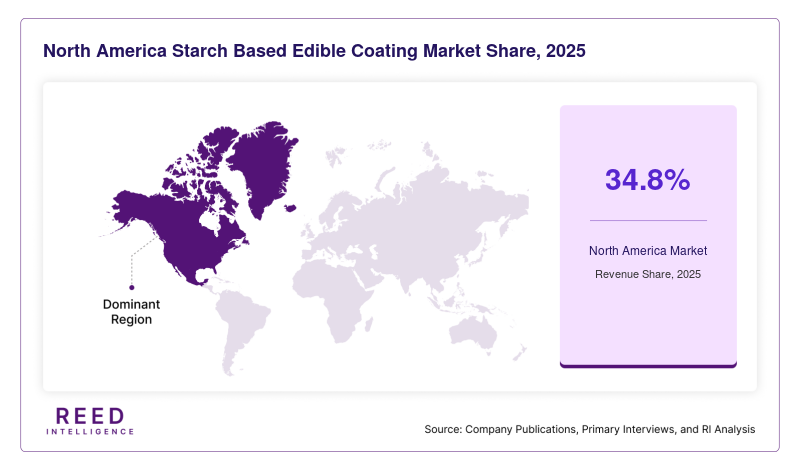
North America held 34.8% of the Starch Based Edible Coating Market share in 2025 and is expected to grow at a CAGR of 7.6% through 2034. The United States dominated the region due to strong demand for sustainable food packaging solutions and advanced food processing infrastructure. The presence of established food manufacturers and increasing investments in biodegradable technologies contributed to regional growth.
Europe
Europe accounted for 27.6% share in 2025 and is projected to expand at a CAGR of 7.9% during the forecast period. Germany led the regional market, supported by stringent environmental regulations and strong consumer preference for eco-friendly food products. The region’s focus on reducing food waste also boosted adoption.
Asia Pacific
Asia Pacific represented 22.4% share in 2025 and will grow at a CAGR of 9.6%, making it the fastest-growing region. China dominated the market due to its large agricultural base and expanding food processing sector. Increasing exports of fruits and vegetables have driven the demand for edible coatings.
Middle East & Africa
The Middle East & Africa held 8.1% share in 2025 and is anticipated to grow at a CAGR of 8.4%. The UAE emerged as a key country, driven by rising demand for imported fresh produce and the need for extended shelf life in arid climates.
Latin America
Latin America captured 7.1% share in 2025 and is expected to grow at a CAGR of 8.1%. Brazil led the region due to its strong agricultural exports and increasing adoption of preservation technologies to reduce post-harvest losses.
Competitive Landscape
The Starch Based Edible Coating Market is moderately fragmented, with several global and regional players focusing on product innovation and strategic partnerships. The market leader, Cargill Incorporated, has strengthened its position through the development of advanced starch-based coating solutions with enhanced barrier properties. The company recently introduced a new line of functional coatings targeting fresh produce applications.
Other key players such as Ingredion Incorporated, Tate & Lyle PLC, Archer Daniels Midland Company, and Avebe U.A. are actively investing in research and development to improve product performance and expand their application scope. These companies are also focusing on sustainability initiatives and expanding their presence in emerging markets.
Strategic collaborations with food manufacturers and investments in production capacity are common approaches adopted by market participants to maintain competitiveness and address evolving consumer preferences.
Key Players List
- Cargill Incorporated
- Ingredion Incorporated
- Tate & Lyle PLC
- Archer Daniels Midland Company
- Avebe U.A.
- Roquette Frères
- AGRANA Beteiligungs-AG
- Kerry Group plc
- DuPont Nutrition & Biosciences
- Ashland Global Holdings Inc.
- Koninklijke DSM N.V.
- Corbion N.V.
- NatureSeal Inc.
- Mantrose-Haeuser Co., Inc.
- Lactips
Recent Developments
- In 2025, Cargill Incorporated launched a new starch-based edible coating designed for fresh produce, focusing on improved moisture retention and shelf-life extension.
- Ingredion Incorporated expanded its product portfolio with clean-label starch solutions for edible coatings.
- Tate & Lyle PLC invested in R&D to develop hybrid starch-based coatings with enhanced functional properties.
- Archer Daniels Midland Company increased its production capacity for specialty starches used in food coatings.
- Roquette Frères introduced a new range of plant-based coating solutions targeting bakery applications.
Starch Based Edible Coating Market Segments
Type
- Polysaccharide-Based Coatings
- Protein-Based Coatings
- Lipid-Based Coatings
- Composite Coatings
Source
- Corn
- Potato
- Wheat
- Cassava
- Others
Application
- Fruits & Vegetables
- Bakery Products
- Dairy Products
- Meat & Poultry
- Confectionery
End-Use
- Food Processing Companies
- Retail & Supermarkets
- Foodservice Industry
Distribution Channel
- Direct Sales
- Distributors
- Online Channels
By Region
- North America
- Europe
- APAC
- Middle East and Africa
- LATAM