Starting Block Market Size, Share & Demand Report By Product Type (Adjustable Starting Blocks, Fixed Starting Blocks, Portable Starting Blocks, Smart Sensor-Integrated Starting Blocks), By Material (Aluminum, Steel), By Application (Track and Field Competitions, Swimming Competitions), By End-User (Professional Sports Organizations, Educational Institutions), By Distribution Channel (Direct Sales, Specialty Sports Stores, Online Retail) By Region & Segment Forecasts, 2026–2034
USD 3950
Market Overview
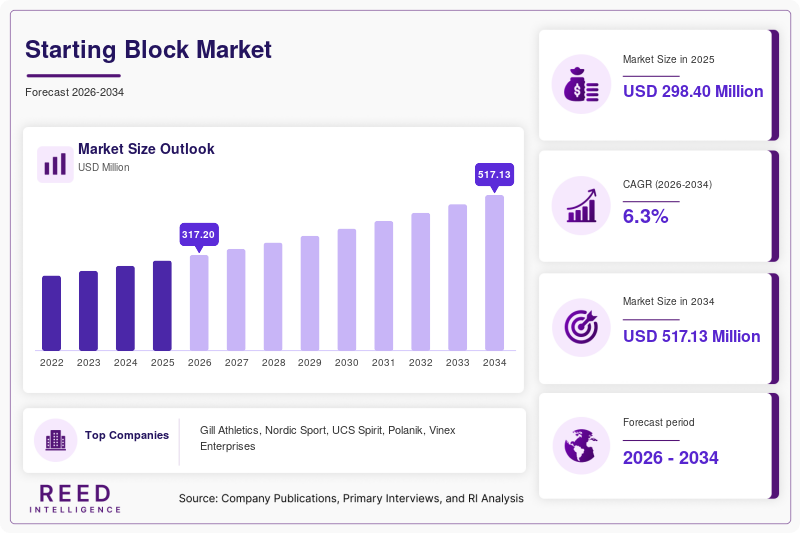
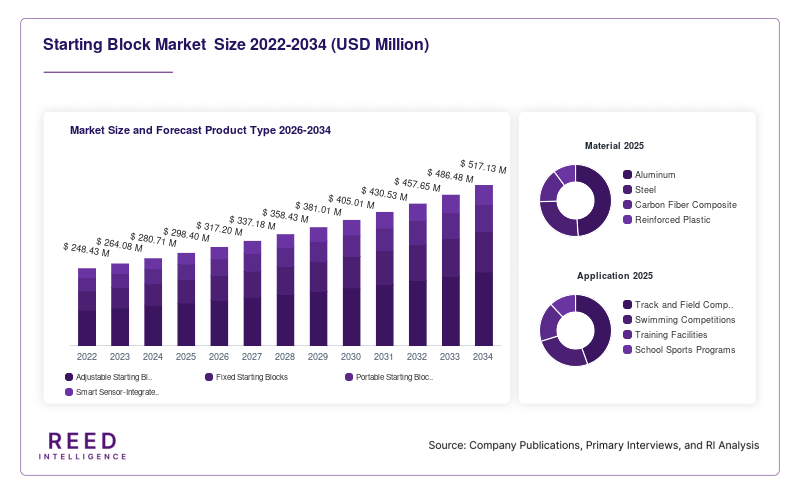
The Starting Block Market size was valued at USD 298.4 million in 2026 and is projected to reach USD 487.9 million by 2034, expanding at a CAGR of 6.3% during 2026–2034. The market growth has been supported by rising investments in sports infrastructure development across schools, universities, athletic clubs, and professional training facilities. Governments and private sports organizations have increased spending on track and field equipment to improve athlete performance standards and meet international competition requirements.
The Starting Block Market has witnessed steady adoption due to the growing popularity of athletics events, swimming competitions, and fitness-based sporting activities worldwide. Demand for technologically improved and adjustable starting blocks has expanded as professional athletes seek enhanced performance accuracy and injury prevention. Manufacturers are also focusing on lightweight materials, ergonomic footplates, and anti-slip technologies to improve user comfort and operational reliability.
Key Highlights
- North America accounted for 36.8% of the global Starting Block Market share in 2025, while Asia Pacific is projected to register the fastest CAGR of 7.5% during 2026–2034.
- By product type, adjustable starting blocks held the leading market share of 58.4% in 2025, while smart sensor-integrated starting blocks are anticipated to grow at a CAGR of 8.1%.
- By material, aluminum starting blocks dominated with 49.2% market share in 2025, while carbon fiber composite starting blocks are forecast to expand at a CAGR of 8.4%.
- By application, track and field competitions represented 61.7% of the market share in 2025, whereas swimming competition starting platforms are projected to grow at a CAGR of 7.2%.
- By end-user, professional sports organizations accounted for 44.5% of the market share in 2025, while educational institutions are expected to witness a CAGR of 7.0%.
- The United States dominated the market with values of USD 71.3 million in 2024 and USD 75.9 million in 2025.
Market Trends
Smart Performance Monitoring Integration
The adoption of sensor-enabled starting blocks has emerged as a notable trend in the Starting Block Market. Professional sports organizations increasingly use performance analytics systems integrated into starting blocks to measure reaction times, pressure distribution, and acceleration performance. These systems support data-driven athlete training and improve competitive analysis. Manufacturers are integrating wireless connectivity and digital timing synchronization technologies to enhance operational efficiency during competitions.
Rising Preference for Lightweight and Portable Designs
The demand for lightweight and portable starting blocks has increased across schools, athletic clubs, and temporary sports venues. Aluminum and carbon fiber materials are gaining traction because they offer strength, portability, and corrosion resistance. Portable starting blocks simplify transportation and installation while reducing storage requirements. This trend is particularly relevant in developing regions where multipurpose sports infrastructure is expanding rapidly.
Market Drivers
Growth in International and Regional Athletic Competitions
The increasing number of international athletics tournaments, regional championships, and youth sporting events has significantly driven the Starting Block Market. Sports governing bodies are investing in professional-grade equipment to meet competition standards and athlete safety requirements. Athletic associations are also replacing outdated equipment with adjustable and performance-oriented starting blocks to improve training outcomes.
Expansion of Sports Infrastructure Investments
Governments and private investors are expanding sports infrastructure projects across urban and semi-urban regions. The construction of stadiums, sports academies, swimming complexes, and athletic training centers has increased demand for modern sports equipment. Starting blocks are becoming standard equipment in newly developed track and field facilities due to growing participation in competitive athletics.
Market Restraint
High Initial Cost of Advanced Starting Systems
The high cost associated with sensor-integrated and competition-grade starting blocks remains a key restraint in the Starting Block Market. Smaller educational institutions and local sports clubs often face budget limitations, restricting the adoption of advanced systems. Maintenance and calibration expenses for smart starting blocks also add to operational costs.
Market Opportunities
Growing Adoption in Educational Sports Programs
Educational institutions are increasingly incorporating athletics and swimming activities into structured physical education programs. This trend is expected to create substantial opportunities for manufacturers offering affordable and durable starting blocks suitable for schools and colleges. Government-supported youth sports initiatives are further contributing to equipment demand.
Development of Eco-Friendly Sports Equipment
The growing emphasis on sustainability is encouraging manufacturers to develop recyclable and environmentally friendly starting blocks. Companies investing in sustainable composite materials and low-emission manufacturing technologies are expected to gain competitive advantages. Eco-conscious procurement practices by sports organizations are likely to support this opportunity.
Segmental Analysis
By Product Type
Adjustable Starting Blocks Dominated the Market: Adjustable starting blocks accounted for 58.4% of the global Starting Block Market share in 2025. Their dominance was attributed to flexibility in athlete positioning and suitability for multiple competition formats. Professional athletes and training institutions preferred adjustable models because they improve sprint start accuracy and athlete comfort. These products are widely used across track and field competitions at professional and educational levels.
Smart Sensor-Integrated Starting Blocks to Witness Fastest Growth: Smart sensor-integrated starting blocks are projected to grow at a CAGR of 8.1% during the forecast period. Their growth will be driven by increasing adoption of performance analytics technologies in professional sports. Sports organizations are expected to invest in systems capable of monitoring reaction times and acceleration metrics to enhance athlete training efficiency.
By Material
Aluminum Starting Blocks Led the Market: Aluminum starting blocks held 49.2% of the Starting Block Market share in 2025. Their popularity was linked to durability, lightweight structure, and corrosion resistance. Aluminum products are widely used in both indoor and outdoor sports facilities due to easy maintenance and long operational lifespan.
Carbon Fiber Composite Starting Blocks to Expand Rapidly: Carbon fiber composite starting blocks are expected to register a CAGR of 8.4% during 2026–2034. Their growth will be supported by rising demand for lightweight and high-strength equipment among professional athletes. Manufacturers are anticipated to focus on advanced composite engineering to improve portability and structural performance.
By Application
Track and Field Competitions Held Largest Share: Track and field competitions represented 61.7% of the market share in 2025. Demand remained strong because starting blocks are essential equipment for sprint events in professional athletics and school competitions. Sports governing bodies have emphasized standardized starting systems for competitive accuracy and athlete safety.
Swimming Competition Starting Platforms to Grow Significantly: Swimming competition starting platforms are anticipated to expand at a CAGR of 7.2% during the forecast period. Growth will be driven by rising investments in swimming academies and aquatic sports infrastructure. Professional swimming tournaments are expected to adopt advanced starting systems with improved grip and adjustable positioning features.
By End-User
Professional Sports Organizations Dominated: Professional sports organizations accounted for 44.5% of the Starting Block Market share in 2025. Their dominance was associated with continuous investments in high-performance sports equipment and athlete training technologies. International competition standards have encouraged procurement of advanced starting systems.
Educational Institutions to Witness Fastest Growth: Educational institutions are projected to grow at a CAGR of 7.0% during 2026–2034. Government-supported sports education programs and rising student participation in athletics will contribute to market demand. Schools and colleges are expected to increasingly invest in durable and affordable sports infrastructure equipment.
By Distribution Channel
Direct Sales Accounted for Largest Share: Direct sales represented 52.6% of the market share in 2025. Manufacturers preferred direct distribution channels for large institutional orders and customized equipment procurement. Professional sports organizations often procure directly from manufacturers to ensure product quality and compliance.
Online Distribution Channels to Register Fastest Growth: Online distribution channels are expected to expand at a CAGR of 7.6% during the forecast period. The growth will be driven by increasing digital procurement practices and expanding e-commerce platforms for sports equipment. Online sales channels provide broader product accessibility and pricing transparency.
Regional Analysis
North America
North America accounted for 36.8% of the Starting Block Market share in 2025 and is expected to grow at a CAGR of 5.9% during 2026–2034. The region has maintained strong market demand due to well-established athletics infrastructure and extensive participation in professional sporting activities. The United States remained the dominant country because of increasing investments in collegiate athletics programs and professional training facilities. Rising procurement of technologically advanced sports equipment by universities and sports associations has strengthened regional market expansion.
Europe
Europe held 27.6% of the global Starting Block Market share in 2025 and is projected to register a CAGR of 5.8% during the forecast period. The region has experienced consistent demand due to the presence of established sports clubs and organized athletic leagues. Germany dominated the European market due to its strong athletics culture and continuous modernization of public sports facilities. Regional manufacturers are focusing on durable and regulation-compliant equipment to meet international competition standards.
Asia Pacific
Asia Pacific represented 22.9% of the Starting Block Market share in 2025 and is anticipated to expand at the fastest CAGR of 7.5% during 2026–2034. Rapid urbanization and growing investments in sports infrastructure development have accelerated market growth across the region. China emerged as the leading country because of large-scale government support for athletic training centers and school sports programs. Rising participation in international athletics competitions is further supporting equipment demand.
Middle Easzca
Latin America captured 5.6% of the Starting Block Market share in 2025 and is projected to register a CAGR of 5.7% during 2026–2034. Growing youth participation in athletics and school-level sporting competitions has supported market expansion across the region. Brazil led the market because of increased investments in athletic facility modernization and sports education programs. Public sports infrastructure development projects are expected to support continued regional demand.

Competitive Landscape
The Starting Block Market remains moderately competitive, with manufacturers focusing on product innovation, lightweight materials, and performance-oriented technologies. Companies are expanding their global distribution networks and investing in advanced sports analytics integration to strengthen their market presence.
Gill Athletics emerged as a leading player due to its broad portfolio of professional athletics equipment and strong partnerships with sports organizations. The company recently introduced an upgraded adjustable starting block series featuring enhanced traction systems and reinforced aluminum construction for professional sprint competitions.
Nordic Sport has expanded its manufacturing capabilities for international athletics events. UCS Spirit continues to focus on ergonomic designs and portable starting systems for educational institutions and training facilities. Polanik has strengthened its European distribution network to increase regional market penetration. Vinex Enterprises has introduced cost-effective starting block solutions targeting emerging markets and school sports programs.
Key Players List
- Gill Athletics
- Nordic Sport
- UCS Spirit
- Polanik
- Vinex Enterprises
- Nelco Specialties
- First Place Spiritwear
- O'Shea Sporting Goods
- Cantabrian Sports
- SPORTSYSTEM
- Blazer Athletic Equipment
- AAE Athletic & Fitness
- Champion Sports
- Schelde Sports
- Atlet Sports Equipment
Recent Developments
- In January 2025, Gill Athletics launched a new adjustable sprint starting block featuring enhanced anti-slip pedal technology for professional competitions.
- In March 2025, Nordic Sport expanded its athletics equipment manufacturing facility to improve production efficiency and export capabilities.
- In June 2024, Vinex Enterprises introduced lightweight portable starting blocks designed for educational sports programs and temporary athletic events.
- In September 2024, Polanik unveiled a carbon fiber composite starting block series focused on reducing equipment weight for elite athletes.
- In February 2025, UCS Spirit partnered with regional sports academies to supply customized training-oriented starting block systems.
Starting Block Market Segments
Product Type
- Adjustable Starting Blocks
- Fixed Starting Blocks
- Portable Starting Blocks
- Smart Sensor-Integrated Starting Blocks
Material
- Aluminum
- Steel
- Carbon Fiber Composite
- Reinforced Plastic
Application
- Track and Field Competitions
- Swimming Competitions
- Training Facilities
- School Sports Programs
End-User
- Professional Sports Organizations
- Educational Institutions
- Sports Clubs
- Fitness and Recreational Centers
Distribution Channel
- Direct Sales
- Specialty Sports Stores
- Online Retail
- Distributors and Dealers
By Region
- North America
- Europe
- APAC
- Middle East and Africa
- LATAM