Static Drive Synchronous Condenser Market Size, Share Demand Report By Cooling System (Air-Cooled, Hydrogen-Cooled), By Application (Utility Grid Stabilization, Renewable Integration, Industrial Power Quality), By Voltage Range (Up to 132 kV, 132 kV–220 kV, Above 220 kV), By End Use (Transmission Operators & Utilities, Industrial Users), By Region & Segment Forecasts, 2026–2034
USD 3950
Market Overview
The global Static Drive Synchronous Condenser Market size was valued at USD 1.42 billion in 2026 and is projected to reach USD 2.86 billion by 2034, expanding at a CAGR of 9.1% from 2026 to 2034. The market has gained momentum as utilities and grid operators modernize transmission systems to manage voltage stability, reactive power compensation, and inertia support in networks with rising renewable energy penetration. Static drive synchronous condensers combine advanced starting systems with rotating synchronous machines, making them suitable for rapid deployment in high-voltage substations and renewable integration hubs.
A major global factor supporting growth has been the accelerated transition toward low-carbon power generation. The retirement of conventional thermal plants has reduced natural grid inertia in many countries. As a result, utilities have increasingly adopted synchronous condenser solutions to maintain short-circuit strength and stabilize frequency fluctuations. Static drive technology has further improved commissioning speed, reduced mechanical stress during startup, and lowered maintenance requirements compared with legacy starting methods.
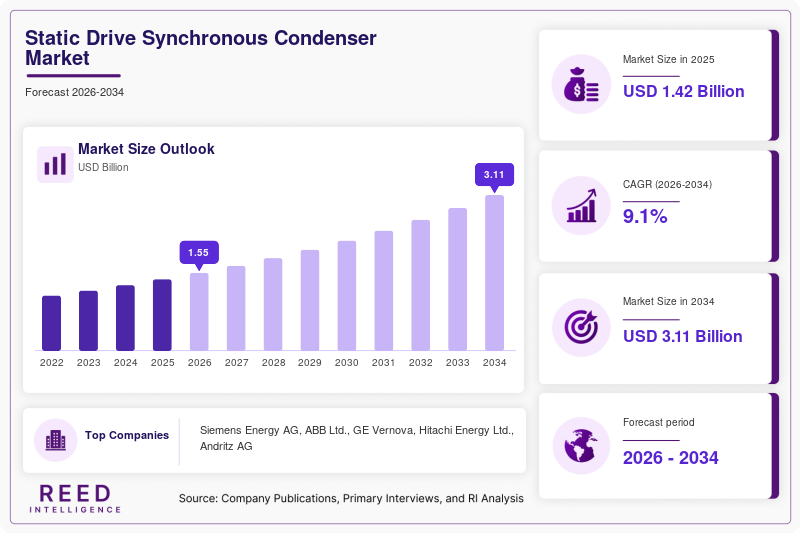
Key Highlights
- North America held the dominant regional share of 34.8% in 2025.
- Asia Pacific is expected to be the fastest-growing region with a CAGR of 10.8% from 2026 to 2034.
- By cooling system, Air-Cooled Systems led with 58.6% share in 2025.
- By application, Utility Grid Stabilization remained the leading subsegment with 61.3% share in 2025.
- By voltage range, 132 kV–220 kV was the dominant subsegment with 42.5% share in 2025.
- By end use, Transmission Operators & Utilities accounted for the largest share in 2025.
- Fastest-growing subsegments included Hydrogen-Cooled Systems at 10.6% CAGR, Renewable Integration at 11.2% CAGR, and Above 220 kV at 10.9% CAGR.
- The dominant country, the United States, recorded market values of USD 332 million in 2024 and USD 358 million in 2025.
Market Trends
Digital Monitoring and Predictive Maintenance
A major trend in the Static Drive Synchronous Condenser Market is the adoption of digital asset management platforms. Operators are integrating sensors, thermal monitoring, vibration analytics, and cloud dashboards to improve uptime. Predictive maintenance tools help utilities schedule servicing before failure events, reducing outage risk and lifecycle costs.
Hybrid Grid Support Solutions
Another notable trend is the deployment of hybrid systems that combine synchronous condensers with STATCOMs and battery storage. This model provides both mechanical inertia and fast-response reactive support. Grid operators are selecting hybrid architectures where renewable penetration is high and dynamic stability requirements are complex.
Market Drivers
Expansion of Renewable Power Capacity
Rapid growth in wind and solar generation has created variable power flows and weaker system inertia. Static drive synchronous condensers help utilities maintain voltage profiles and system strength, making them an important support asset in renewable-heavy grids.
Transmission Network Modernization
Many countries are replacing aging substations and upgrading long-distance transmission lines. These projects often require dynamic reactive compensation and fault current support, which has increased procurement activity in the Static Drive Synchronous Condenser Market.
Market Restraint
High Initial Capital Investment
Large synchronous condenser systems require substantial upfront spending for equipment, civil works, transformers, and integration. Budget constraints among smaller utilities and developing markets may delay adoption timelines.
Market Opportunities
Grid Stability Needs in Emerging Economies
Emerging economies are expanding electricity access and renewable generation simultaneously. This creates demand for stable grid infrastructure, opening opportunities for modular synchronous condenser solutions.
Repurposing Retired Thermal Power Assets
Utilities are converting generators from retired coal or gas plants into synchronous condenser assets. Static drive retrofits can reduce project cost and shorten deployment schedules, creating a strong aftermarket opportunity.
Segmental Analysis
By Cooling System
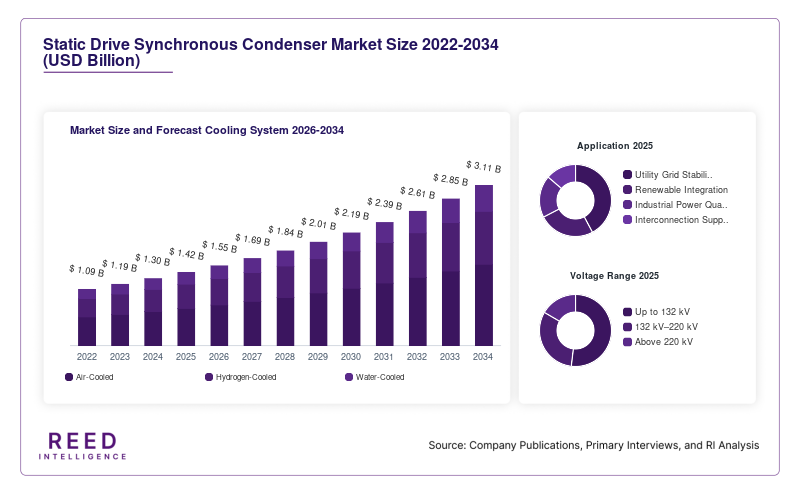
Air-cooled systems held the dominant 58.6% share in 2025 due to simpler maintenance requirements, lower water dependency, and suitability for medium-capacity projects.
Hydrogen-cooled systems are projected to grow at a 10.6% CAGR through 2034. Their higher efficiency and compact footprint will support adoption in high-capacity utility installations where performance density is important.
By Voltage Range
The 132 kV–220 kV category accounted for 42.5% share in 2025, supported by widespread use in transmission substations and renewable evacuation corridors.
The Above 220 kV segment will grow at a 10.9% CAGR during the forecast period. Expansion of bulk power transfer networks and interregional grids will create stronger demand for higher-voltage compensation systems.
By Application
Utility Grid Stabilization dominated with 61.3% share in 2025 as utilities remained the largest purchasers of condenser systems for voltage regulation and fault level support.
Renewable Integration is expected to advance at an 11.2% CAGR through 2034. Wind and solar connection points will increasingly require synchronous support to meet grid compliance standards.
By End Use
Transmission Operators & Utilities held the leading share in 2025 because large network owners manage most high-voltage compensation assets.
Industrial Power Users will grow at a 9.8% CAGR over the forecast period. Heavy industries such as mining, metals, and petrochemicals will adopt condensers to improve power quality and reduce voltage disturbances.
By Installation Type
New Installations represented the largest share in 2025 due to ongoing grid expansion and new renewable substations.
Retrofit Installations are forecast to grow at a 10.4% CAGR as utilities convert idle generators and modernize legacy rotating assets using static drive packages.
Regional Analysis
North America
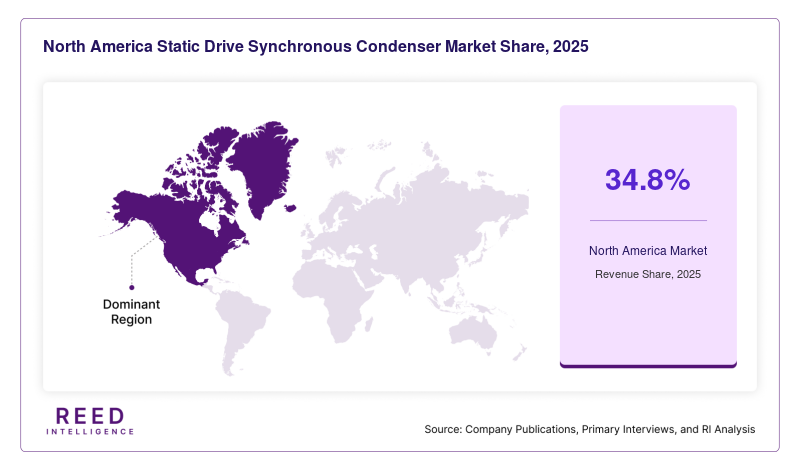
North America accounted for 34.8% of the market share in 2025 and is projected to grow at a CAGR of 8.4% through 2034. The United States leads the region due to large-scale renewable interconnections and transmission reliability programs. Grid operators have invested in condenser projects to support retiring thermal fleets and maintain system strength.
Europe
Europe represented 27.6% of the market share in 2025 and will expand at a CAGR of 8.9% during the forecast period. The United Kingdom remains the leading country as offshore wind expansion and grid balancing reforms continue to drive installations. National grid operators have prioritized inertia restoration solutions.
Asia Pacific
Asia Pacific held 24.1% of the market share in 2025 and is expected to register the fastest CAGR of 10.8% from 2026 to 2034. China dominates the region due to ultra-high-voltage transmission projects and extensive renewable capacity additions. Large provincial grids are deploying condenser systems for voltage control and power transfer efficiency.
Middle East & Africa
Middle East & Africa captured 7.4% of the market share in 2025 and is forecast to grow at a CAGR of 9.7%. Saudi Arabia leads the region through major grid expansion linked to industrial zones and utility-scale solar developments. Network resilience remains a central investment priority.
Latin America
Latin America accounted for 6.1% of the market share in 2025 and is anticipated to grow at a CAGR of 9.2%. Brazil was the leading country due to hydropower balancing needs and long-distance transmission reinforcement. Renewable diversification is increasing demand for advanced grid support assets.
Competitive Landscape
The Static Drive Synchronous Condenser Market remains moderately consolidated, with established electrical equipment manufacturers and specialist grid technology providers competing through turnkey engineering capability, service networks, and digital monitoring features. Leading participants focus on utility tenders, renewable interconnection projects, and retrofit contracts.
Siemens Energy AG held a leading market position due to its strong transmission portfolio and broad project execution footprint. The company recently expanded its grid stabilization offering by integrating advanced condition monitoring modules into condenser packages for remote diagnostics.
ABB Ltd. continues to supply excitation systems, drives, and balance-of-plant solutions for utility customers. GE Vernova remains active in grid modernization programs across North America and Europe. Hitachi Energy Ltd. has strengthened its presence through substation integration expertise and hybrid compensation projects. Andritz AG serves retrofit opportunities, particularly in generator conversion programs. Other competitors are enhancing lifecycle services, localized manufacturing, and EPC partnerships to improve win rates in developing markets.
Key Players List
- Siemens Energy AG
- ABB Ltd.
- GE Vernova
- Hitachi Energy Ltd.
- Andritz AG
- Mitsubishi Electric Corporation
- Toshiba Energy Systems & Solutions Corporation
- Eaton Corporation plc
- WEG S.A.
- Hyundai Electric & Energy Systems Co., Ltd.
- Ansaldo Energia S.p.A.
- Voith GmbH & Co. KGaA
- Bharat Heavy Electricals Limited
- Fuji Electric Co., Ltd.
- Nidec Corporation
Recent Developments
- In 2025, Siemens Energy AG launched an upgraded digital diagnostics suite for synchronous condenser fleets.
- In 2025, Hitachi Energy secured a utility contract for renewable grid stabilization in Europe.
- In 2024, GE Vernova announced expanded services for condenser retrofit projects in North America.
- In 2024, ABB Ltd. introduced enhanced excitation control systems for rotating grid support assets.
- In 2025, Andritz AG completed a generator-to-condenser conversion project for a regional utility.
Static Drive Synchronous Condenser Market Segments
Cooling System
- Air-Cooled
- Hydrogen-Cooled
- Water-Cooled
Application
- Utility Grid Stabilization
- Renewable Integration
- Industrial Power Quality
- Interconnection Support
Voltage Range
- Up to 132 kV
- 132 kV–220 kV
- Above 220 kV
End Use
- Transmission Operators & Utilities
- Industrial Users
- Independent Power Producers
Installation Type
- New Installation
- Retrofit Installation
By Region
- North America
- Europe
- APAC
- Middle East and Africa
- LATAM