Steam Trap Monitor Market Size, Share & Demand Report By Component (Hardware Systems, Software Platforms, Services), By Monitoring Method (Wired Monitoring, Wireless Monitoring, Cloud-Based Monitoring Systems), By End-Use Industry (Oil and Gas, Chemical Processing, Power Generation, Food and Beverage, Pharmaceutical Manufacturing, Pulp and Paper, Others), By Region & Segment Forecasts, 2026–2034
USD 3950
Market Overview
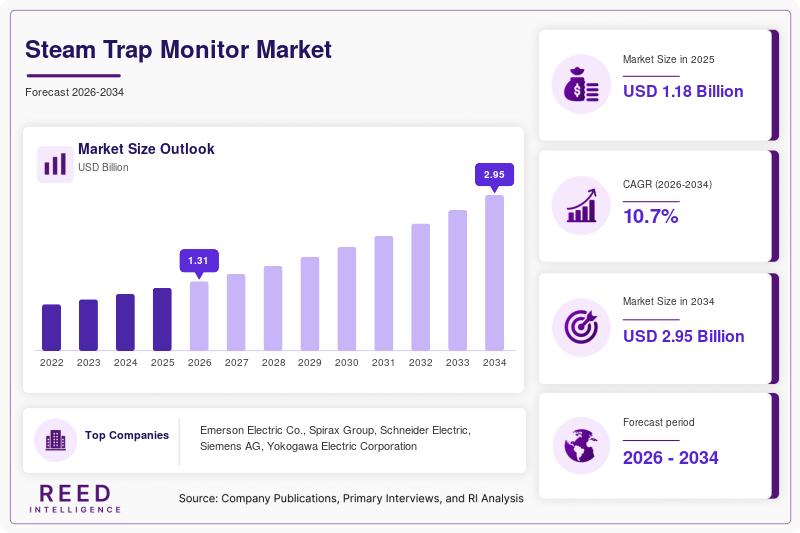
The global Steam Trap Monitor Market size was valued at USD 1.18 billion in 2026 and is projected to reach USD 2.67 billion by 2034, expanding at a CAGR of 10.7% during the forecast period from 2026 to 2034. The market continues to gain momentum as industrial facilities increase investments in energy efficiency, predictive maintenance, and digital monitoring systems. Steam trap monitoring systems are widely used across manufacturing plants, power generation facilities, chemical processing units, food processing operations, pharmaceutical production sites, and oil and gas infrastructure. These systems help detect steam leakage, blocked traps, and operational failures that can lead to higher energy consumption and maintenance costs.
The growing focus on industrial sustainability has become one of the major factors supporting market expansion worldwide. Governments and industrial organizations are implementing stricter regulations related to energy conservation and carbon emission reduction. Steam systems account for a considerable share of industrial energy consumption, making steam trap monitoring solutions an effective method for improving operational efficiency. The adoption of Industrial Internet of Things technologies and wireless sensing platforms has further accelerated deployment across both large enterprises and mid-sized manufacturing facilities. In addition, industries are increasingly integrating cloud-based analytics and remote monitoring capabilities into plant management strategies to reduce downtime and improve asset utilization.
Key Highlights
- North America dominated the market with a 35.1% share in 2025.
- Asia Pacific is expected to grow at the fastest CAGR of 11.8% during 2026–2034.
- By component, hardware systems accounted for the largest share of 43.8%.
- while software platforms are projected to grow at a CAGR of 12.9%.
- By monitoring method, wireless monitoring led with a 46.2% share, whereas cloud-based monitoring systems are expected to expand at a CAGR of 13.4%.
- By end-use industry, oil and gas held a 28.7% share, while pharmaceutical manufacturing is projected to register a CAGR of 12.1%.
- The United States remained the dominant country, with market values of USD 398 million in 2024 and USD 438 million in 2025.
Market Trends
Rising Integration of Industrial IoT Platforms
Industrial facilities are increasingly integrating Industrial Internet of Things platforms into steam management infrastructure to improve visibility across plant operations. Steam trap monitors equipped with wireless sensors and cloud connectivity allow maintenance teams to track trap performance continuously and identify failures before they affect production efficiency. Real-time data collection has become important for industries operating large steam distribution systems because manual inspection processes often miss intermittent failures. Companies are deploying centralized dashboards that consolidate performance metrics from multiple facilities, allowing maintenance departments to prioritize repair schedules more effectively. The integration of predictive analytics into monitoring software is also supporting demand growth because organizations can reduce energy waste and improve steam system reliability through automated alerts and performance forecasting.
Another factor supporting this trend is the expansion of smart manufacturing initiatives across sectors such as chemicals, pharmaceuticals, food processing, and pulp and paper. These industries are adopting digital asset management solutions to improve plant productivity and reduce operational interruptions. Steam trap monitoring systems are increasingly linked with enterprise resource planning software and industrial automation platforms, enabling better decision-making and resource allocation. Vendors are developing modular wireless solutions that reduce installation complexity and support scalable deployment across large industrial networks. As industrial companies continue modernizing legacy infrastructure, the integration of connected monitoring technologies is expected to remain a major trend within the Steam Trap Monitor Market.
Expansion of Predictive Maintenance Strategies
Predictive maintenance has become a central operational strategy for industrial manufacturers seeking to minimize equipment downtime and maintenance costs. Steam trap monitoring systems play an important role in predictive maintenance programs because failed steam traps can lead to significant energy losses, equipment damage, and production disruptions. Companies are moving away from scheduled manual inspections toward continuous automated monitoring systems that provide early fault detection and operational diagnostics. Ultrasonic monitoring devices and acoustic analysis technologies are gaining wider adoption because they allow maintenance teams to identify trap performance issues quickly and accurately.
The trend is further supported by increasing pressure on industrial operators to improve energy efficiency and reduce greenhouse gas emissions. Predictive monitoring systems help companies maintain optimal steam utilization while preventing unnecessary steam loss. Industries with high thermal energy usage, including power generation and petrochemicals, are investing in advanced analytics software that delivers performance insights and maintenance recommendations. The availability of remote monitoring capabilities has also expanded the adoption of predictive maintenance solutions across geographically distributed facilities. As labor costs continue rising and industrial operators seek greater operational efficiency, predictive maintenance adoption is expected to create sustained growth opportunities for steam trap monitoring technologies.
Market Drivers
Increasing Focus on Industrial Energy Efficiency
The growing emphasis on industrial energy efficiency is one of the primary drivers supporting the expansion of the Steam Trap Monitor Market. Steam systems are widely used across industrial sectors for heating, power generation, sterilization, and process operations. However, malfunctioning steam traps can cause substantial energy losses and increase operational expenses. Industries are therefore investing in automated monitoring systems that identify leaking, blocked, or failed traps in real time. Steam trap monitoring solutions help reduce fuel consumption, lower maintenance costs, and improve overall process efficiency. Industrial operators are also under pressure to comply with government energy conservation regulations and carbon reduction targets, which further supports market demand.
The adoption of advanced monitoring technologies is increasing as companies pursue long-term sustainability goals and operational optimization strategies. Large manufacturing plants often operate thousands of steam traps, making manual inspections inefficient and labor intensive. Automated wireless monitoring systems allow maintenance personnel to receive instant alerts regarding abnormal trap conditions, enabling faster corrective actions. The expansion of environmental compliance initiatives across North America, Europe, and Asia Pacific is encouraging industrial companies to modernize steam infrastructure with digital monitoring solutions. Rising energy prices and the need to reduce operating expenses are expected to maintain strong demand for steam trap monitoring systems throughout the forecast period.
Growing Adoption of Automation in Process Industries
The increasing automation of industrial processes is another major factor driving the Steam Trap Monitor Market. Industries such as oil and gas, chemicals, food processing, pharmaceuticals, and pulp and paper are adopting advanced automation systems to improve operational consistency and productivity. Steam trap monitoring technologies are becoming integrated components of broader industrial automation ecosystems because they provide continuous performance data and support centralized asset management. Automated monitoring systems reduce the dependence on manual inspection routines and help maintenance teams optimize operational efficiency through data-driven decision-making.
The expansion of Industry 4.0 initiatives is accelerating the deployment of intelligent monitoring infrastructure across industrial facilities. Wireless communication technologies, cloud-based analytics platforms, and AI-powered diagnostic tools are enhancing the functionality of modern steam trap monitoring systems. Industrial operators increasingly prefer integrated monitoring platforms capable of connecting with distributed control systems and plant-wide automation networks. This integration supports predictive maintenance planning, reduces unexpected downtime, and improves production reliability. The growing need for operational transparency and real-time performance monitoring is expected to drive further investment in automated steam management solutions over the coming years.
Market Restraints
High Initial Installation and Integration Costs
The relatively high upfront cost associated with installing advanced steam trap monitoring systems remains a key restraint affecting market growth. Industrial facilities often require extensive sensor deployment, wireless communication infrastructure, software integration, and maintenance training before implementing a comprehensive monitoring solution. Small and medium-sized enterprises frequently face budget limitations that reduce their ability to adopt advanced monitoring technologies, especially in price-sensitive manufacturing sectors. In facilities with older steam systems, retrofitting modern monitoring equipment can also involve additional infrastructure modifications, leading to increased project expenses and operational disruptions during installation.
The complexity of integrating monitoring systems with existing industrial automation platforms further limits adoption in some industries. Companies operating legacy infrastructure may encounter compatibility challenges when connecting monitoring devices to centralized maintenance software or enterprise management systems. In developing regions, limited awareness regarding long-term energy savings and return on investment also slows implementation rates. For example, smaller food processing plants and regional textile manufacturers often continue relying on manual inspection methods because they perceive automated monitoring systems as costly investments. Although long-term operational savings can offset installation expenses, the initial capital requirement continues to create barriers for broader adoption across cost-sensitive industries.
Market Opportunities
Expansion of Smart Manufacturing Facilities
The ongoing expansion of smart manufacturing facilities presents substantial growth opportunities for the Steam Trap Monitor Market. Industrial companies are investing in connected production systems that improve operational visibility, automate maintenance processes, and optimize energy utilization. Steam trap monitoring technologies align closely with smart manufacturing objectives because they provide continuous condition monitoring and real-time diagnostics for steam distribution networks. As more factories adopt digital infrastructure and connected equipment, the demand for intelligent monitoring systems is expected to increase steadily.
Emerging economies in Asia Pacific and Latin America are witnessing significant investment in modern industrial facilities, particularly in sectors such as electronics, pharmaceuticals, chemicals, and automotive manufacturing. These facilities are increasingly incorporating wireless monitoring systems during the design and construction phases, creating opportunities for equipment suppliers and software developers. Vendors are also developing scalable cloud-based monitoring platforms that support centralized monitoring across multiple production sites. The increasing availability of cost-effective wireless sensors and industrial connectivity solutions is expected to support broader adoption among mid-sized manufacturers seeking operational efficiency improvements.
Growing Demand from Pharmaceutical and Food Industries
The pharmaceutical and food processing industries are creating new opportunities for steam trap monitoring solution providers due to strict operational and hygiene requirements. Steam plays a critical role in sterilization, heating, cooking, cleaning, and humidity control applications within these industries. Any steam trap failure can disrupt production consistency, compromise product quality, and increase contamination risks. As a result, companies operating in highly regulated manufacturing environments are increasingly adopting continuous monitoring technologies to maintain process reliability and compliance standards.
The expansion of pharmaceutical manufacturing capacity across Asia Pacific, North America, and Europe is supporting demand for advanced steam management systems. Food processing companies are also investing in energy-efficient production infrastructure to reduce operating expenses and meet sustainability targets. Monitoring systems equipped with automated reporting and remote diagnostic features are gaining popularity because they simplify compliance documentation and maintenance scheduling. Additionally, increasing consumer demand for processed food products and pharmaceutical supplies is encouraging manufacturers to expand production capacity, creating additional opportunities for steam trap monitoring vendors across global industrial markets.
Segmental Analysis
By Component
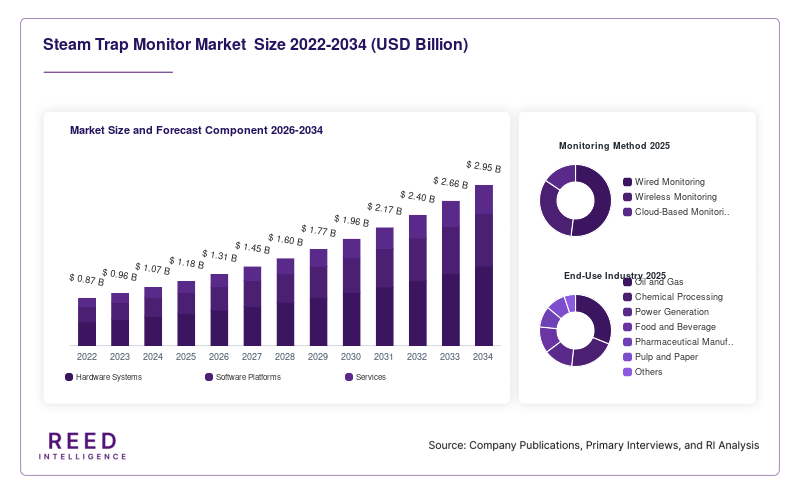
Hardware systems accounted for the largest share of the Steam Trap Monitor Market in 2024, representing 43.8% of total revenue. The dominance of this subsegment is primarily linked to the extensive use of sensors, transmitters, acoustic detectors, and wireless communication modules across industrial steam systems. Industrial facilities require reliable hardware infrastructure to continuously monitor steam trap performance and detect failures in real time. Wireless sensor deployment has increased significantly in industries such as oil and gas, chemicals, and power generation where large steam distribution networks require continuous condition assessment. Companies are increasingly investing in durable hardware systems capable of operating under harsh industrial conditions, including high pressure and elevated temperatures. The demand for ultrasonic and acoustic sensing technologies has also strengthened because these devices provide accurate diagnostics and reduce manual inspection requirements. In addition, many industrial operators prioritize hardware upgrades when modernizing legacy steam management systems.
Software platforms are projected to witness the fastest CAGR of 12.9% during the forecast period due to growing adoption of cloud analytics and predictive maintenance applications. Modern monitoring software enables centralized asset tracking, automated alert generation, performance reporting, and maintenance scheduling across multiple industrial facilities. Companies are increasingly using AI-driven analytics tools to identify recurring steam trap failures and optimize maintenance planning. Integration with enterprise resource planning systems and industrial automation platforms is another major factor supporting software demand. Industrial operators prefer scalable software solutions that provide remote accessibility and operational visibility across distributed production sites. Vendors are developing subscription-based cloud platforms that reduce implementation costs while supporting real-time monitoring capabilities. The increasing adoption of Industrial Internet of Things infrastructure and connected industrial devices is expected to accelerate software platform deployment across both developed and emerging industrial markets.
By Monitoring Method
Wireless monitoring represented the dominant subsegment in 2024 and accounted for 46.2% of the global market share. The segment has expanded rapidly because wireless systems simplify installation procedures and reduce maintenance complexity compared to traditional wired monitoring infrastructure. Industrial facilities operating extensive steam distribution networks prefer wireless technologies because they support flexible deployment across difficult-to-access locations. Wireless systems also reduce cabling costs and allow maintenance teams to monitor trap conditions remotely through centralized dashboards. Industries including refining, chemical processing, and pulp and paper have adopted wireless steam trap monitoring solutions to improve operational reliability and reduce energy waste. The expansion of industrial connectivity technologies and low-power communication protocols has further improved the performance of wireless monitoring devices. In addition, manufacturers are introducing battery-efficient monitoring equipment with longer operational lifecycles, increasing their attractiveness for large-scale industrial deployment.
Cloud-based monitoring systems are expected to register the fastest CAGR of 13.4% during the forecast period due to increasing demand for remote operational visibility and predictive analytics capabilities. Cloud-based platforms allow industrial operators to access steam trap performance data from multiple facilities through centralized digital interfaces. This capability is particularly valuable for multinational manufacturers managing geographically dispersed production plants. Cloud integration supports advanced data analysis, automated fault detection, and historical performance tracking that improve maintenance decision-making. Companies are increasingly adopting cloud-enabled monitoring systems because they reduce the need for on-site inspections and support real-time operational alerts. The growth of industrial cybersecurity solutions and secure cloud infrastructure is also improving confidence among industrial users. As industries continue shifting toward digital operations management and data-driven maintenance strategies, cloud-based monitoring technologies are expected to gain substantial market traction.
By End-Use Industry
The oil and gas industry held the largest share of the Steam Trap Monitor Market in 2024, accounting for 28.7% of global revenue. Steam systems play a major role in refining, petrochemical processing, enhanced oil recovery, and thermal energy management operations. Because these facilities operate under demanding environmental conditions, steam trap failures can significantly affect operational efficiency and safety. Oil and gas companies therefore invest heavily in automated monitoring systems that provide continuous diagnostics and early fault detection. The implementation of predictive maintenance strategies across refineries and processing plants has further strengthened demand for steam trap monitoring technologies. Wireless monitoring systems are widely adopted within the industry because they allow maintenance teams to monitor large industrial networks without extensive manual inspections. In addition, growing pressure to reduce energy consumption and carbon emissions is encouraging oil and gas operators to modernize steam infrastructure with advanced monitoring equipment.
Pharmaceutical manufacturing is anticipated to register the fastest CAGR of 12.1% during the forecast period due to increasing investments in sterile processing and energy-efficient production systems. Steam is essential for sterilization, heating, humidification, and cleaning applications within pharmaceutical facilities. Any disruption in steam quality or system reliability can affect product consistency and regulatory compliance. As pharmaceutical production expands globally, manufacturers are increasingly implementing automated monitoring technologies to ensure operational reliability and process stability. Continuous monitoring systems help pharmaceutical companies maintain strict hygiene standards while minimizing maintenance-related disruptions. The rapid growth of biologics manufacturing and vaccine production facilities is creating additional demand for reliable steam management infrastructure. Furthermore, pharmaceutical companies are adopting cloud-connected monitoring platforms that support audit documentation, remote diagnostics, and predictive maintenance planning across advanced manufacturing environments.
Regional Analysis
North America
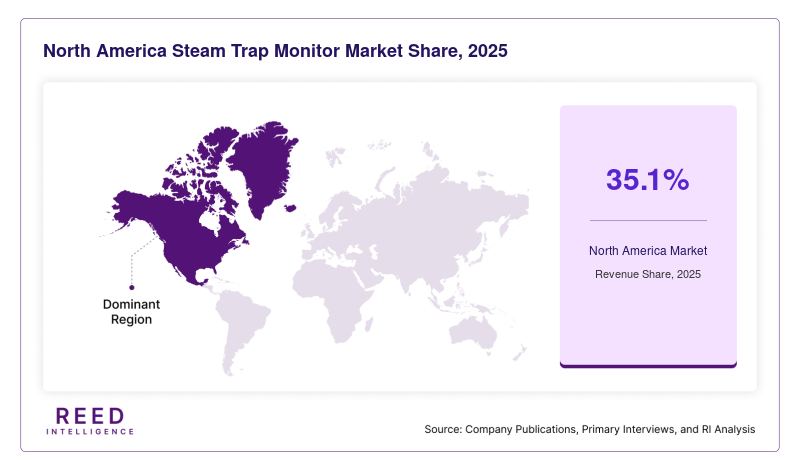
North America accounted for 35.1% of the global Steam Trap Monitor Market in 2025 and is expected to maintain stable growth at a CAGR of 9.6% during the forecast period. The region benefits from widespread adoption of industrial automation systems and strong investments in predictive maintenance technologies. Industrial facilities across the United States and Canada continue upgrading steam infrastructure to improve energy efficiency and reduce operating expenses. The growing implementation of environmental regulations related to industrial emissions has further accelerated demand for advanced monitoring solutions across power generation, chemicals, and manufacturing sectors.
Europe
Europe represented 27.4% of the global Steam Trap Monitor Market in 2025 and is projected to register a CAGR of 9.2% through 2034. The regional market is supported by strong regulatory frameworks focused on energy conservation and industrial sustainability. Industrial operators across Germany, France, Italy, and the United Kingdom are adopting steam monitoring systems to improve energy utilization and comply with carbon reduction initiatives. The region also benefits from advanced manufacturing capabilities and high awareness regarding predictive maintenance technologies.
Asia Pacific
Asia Pacific held 22.3% of the global Steam Trap Monitor Market in 2025 and is expected to witness the fastest CAGR of 11.8% during the forecast period. Rapid industrialization, urban infrastructure development, and rising manufacturing investments are driving market growth across the region. Countries including China, India, Japan, and South Korea are expanding industrial production capacities, creating strong demand for steam management technologies. The adoption of industrial automation and digital monitoring systems is increasing as manufacturers seek to improve productivity and reduce energy losses.
Middle East & Africa
The Middle East & Africa region accounted for 8.1% of the global Steam Trap Monitor Market in 2025 and is projected to grow at a CAGR of 8.7% through 2034. Market expansion is supported by rising investments in oil and gas processing facilities, petrochemical plants, and power generation infrastructure. Industrial operators across the Gulf Cooperation Council countries are increasingly focusing on operational efficiency and energy conservation to reduce production costs. Steam trap monitoring systems are gaining traction because they support preventive maintenance and improve steam utilization in high-temperature industrial environments.
Latin America
Latin America represented 7.1% of the global Steam Trap Monitor Market in 2025 and is anticipated to register a CAGR of 8.9% during the forecast period. The regional market is supported by growing industrial modernization efforts and rising investments in food processing, mining, and energy sectors. Manufacturers across Brazil, Mexico, and Argentina are adopting automated monitoring technologies to improve operational performance and reduce energy losses associated with steam system failures. Increased awareness regarding predictive maintenance strategies is also contributing to regional market development.
Competitive Landscape
The Steam Trap Monitor Market is characterized by the presence of global industrial automation companies, specialized steam management solution providers, and regional monitoring technology manufacturers. Market participants are focusing on product innovation, wireless communication capabilities, and predictive analytics integration to strengthen their competitive positions. Strategic partnerships with industrial automation providers and energy management companies are becoming increasingly common as vendors seek to expand their customer base across process industries.
Emerson Electric Co. remains one of the leading companies in the market due to its extensive industrial automation portfolio and strong global distribution network. The company has expanded its wireless monitoring offerings and enhanced predictive maintenance capabilities through advanced analytics integration. Spirax Group continues to strengthen its market presence by introducing energy-efficient steam management technologies designed for industrial sustainability initiatives. Schneider Electric and Siemens AG are also investing in connected industrial monitoring platforms that support centralized asset management and remote diagnostics.
Key Players
- Emerson Electric Co.
- Spirax Group
- Schneider Electric
- Siemens AG
- Yokogawa Electric Corporation
- TLV Co., Ltd.
- Armstrong International Inc.
- Forbes Marshall
- Honeywell International Inc.
- Thermax Limited
- Flowserve Corporation
- Gestra AG
- CIRCOR International, Inc.
- Watts Water Technologies
- ABB Ltd.
Recent Developments
- Emerson Electric Co. introduced an upgraded wireless steam trap monitoring platform in 2025 featuring predictive analytics and cloud-based diagnostics for large industrial facilities.
- Spirax Group expanded its industrial monitoring solutions portfolio in 2024 by launching energy optimization software integrated with remote steam trap monitoring capabilities.
- Schneider Electric partnered with an industrial IoT solutions provider in 2025 to develop centralized steam system monitoring applications for smart manufacturing facilities.
- Siemens AG announced the integration of AI-powered maintenance analytics into its industrial steam management platform to support predictive fault detection across process industries.
Steam Trap Monitor Market Segments
Component
- Hardware Systems
- Software Platforms
- Services
Monitoring Method
- Wired Monitoring
- Wireless Monitoring
- Cloud-Based Monitoring Systems
End-Use Industry
- Oil and Gas
- Chemical Processing
- Power Generation
- Food and Beverage
- Pharmaceutical Manufacturing
- Pulp and Paper
- Others
By Region
- North America
- Europe
- APAC
- Middle East and Africa
- LATAM