Stearyl Alcohol Market Size, Share & Demand Report By Type (Vegetable-Derived, Synthetic), By Application (Personal Care Products, Pharmaceuticals, Industrial Applications), By End-Use Industry (Cosmetics & Personal Care, Pharmaceuticals, Chemicals & Industrial), By Region & Segment Forecasts, 2026–2034
USD 3950
Market Overview
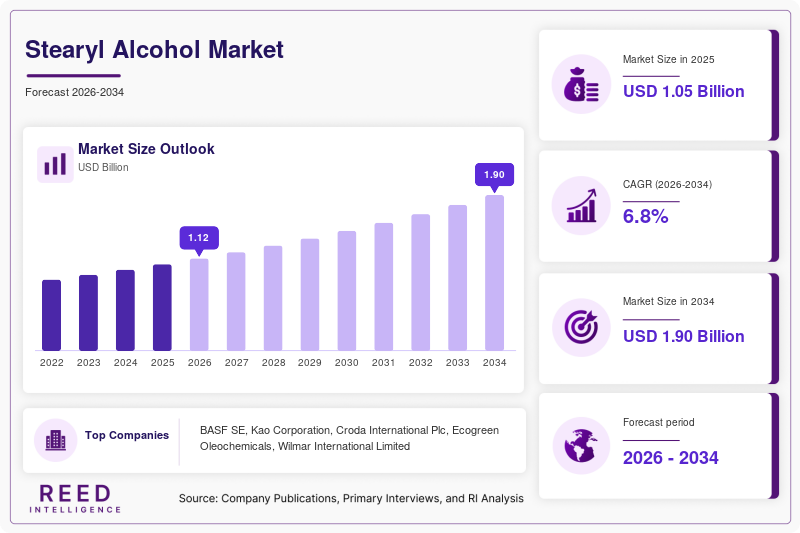
The global Stearyl Alcohol Market was valued at approximately USD 1.05 billion in 2026 and is projected to reach USD 1.78 billion by 2034, expanding at a CAGR of 6.8% during the forecast period (2026–2034). Stearyl alcohol, a fatty alcohol derived primarily from natural oils such as palm and coconut, is widely used in personal care, pharmaceuticals, and industrial formulations due to its emulsifying, thickening, and stabilizing properties. The growing demand for bio-based ingredients across end-use industries has significantly supported market expansion in recent years.
A key global factor driving market growth is the increasing consumer shift toward sustainable and plant-derived ingredients in cosmetics and personal care products. Manufacturers are responding by incorporating stearyl alcohol into formulations for creams, lotions, conditioners, and ointments. Additionally, regulatory encouragement for eco-friendly chemicals has further boosted its adoption, especially in developed markets.
Key Highlights
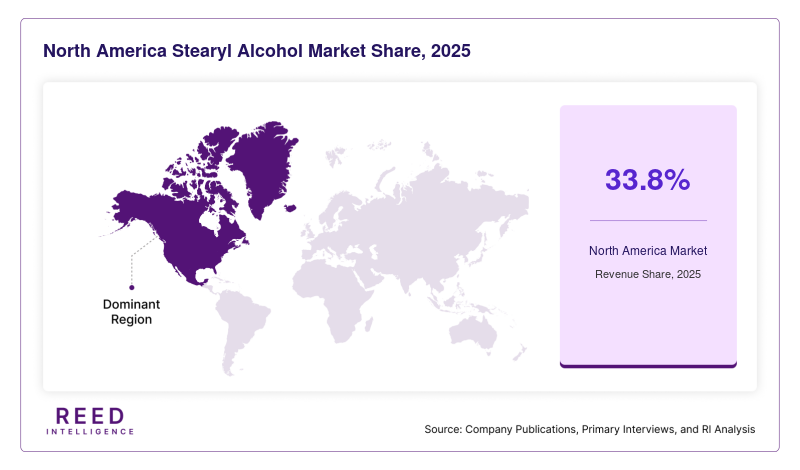
- North America dominated the market with a 33.8% share in 2025.
- Asia Pacific is expected to grow at the fastest CAGR of 7.9% during 2026–2034.
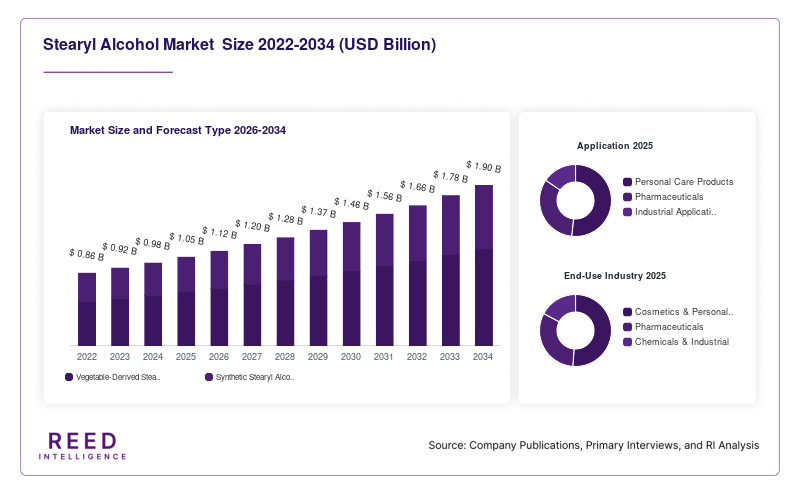
- By type, vegetable-derived stearyl alcohol accounted for the largest share of 61.4%, while synthetic variants are projected to grow at a CAGR of 7.3%.
- By application, personal care products led with a 44.6% share, whereas pharmaceutical formulations are expected to expand at a CAGR of 7.6%.
- The United States remained the dominant country, with market values of USD 285 million in 2024 and USD 305 million in 2025.
Market Trends
Rising Preference for Plant-Based and Sustainable Ingredients
The increasing consumer awareness regarding environmental sustainability has led to a noticeable shift toward plant-based ingredients in various industries. Stearyl alcohol, when derived from vegetable sources such as palm or coconut oil, aligns well with this trend. Personal care brands are actively reformulating products to replace synthetic or petroleum-based ingredients with bio-based alternatives. This shift is particularly evident in skincare and haircare segments, where consumers prioritize natural labeling and clean beauty standards. Regulatory frameworks in regions such as Europe and North America also encourage the use of renewable raw materials, reinforcing this transition. As a result, manufacturers are investing in certified sustainable sourcing and transparent supply chains, which further strengthens the position of plant-based stearyl alcohol in the global market.
Increasing Application in Pharmaceutical Formulations
The pharmaceutical sector is emerging as a significant growth avenue for the stearyl alcohol market. It is widely used as an excipient in ointments, creams, and topical medications due to its stabilizing and thickening properties. With the global rise in chronic conditions and dermatological treatments, the demand for effective topical formulations is increasing. Stearyl alcohol enhances the consistency and shelf life of these products, making it an essential component in pharmaceutical manufacturing. Moreover, advancements in drug delivery systems and the growing demand for semi-solid dosage forms have expanded its application scope. Pharmaceutical companies are focusing on high-purity grades of stearyl alcohol, which further supports market growth.
Market Drivers
Expanding Personal Care and Cosmetics Industry
The rapid growth of the global personal care and cosmetics industry is a primary driver of the stearyl alcohol market. Products such as moisturizers, conditioners, and lotions rely heavily on emulsifying agents to maintain stability and texture, making stearyl alcohol a critical ingredient. Rising disposable incomes, urbanization, and changing lifestyle patterns have contributed to increased spending on grooming and skincare products. Additionally, the influence of social media and beauty trends has accelerated product innovation and consumption. Emerging markets in Asia Pacific and Latin America are witnessing strong demand for affordable yet effective cosmetic products, further boosting the use of stearyl alcohol in formulations.
Growth in Industrial and Chemical Applications
Stearyl alcohol is widely used in industrial applications, including lubricants, plastics, and coatings, due to its chemical stability and functional properties. The expanding chemical manufacturing sector, particularly in developing economies, has increased the demand for versatile compounds like stearyl alcohol. It acts as a dispersing agent and improves the performance characteristics of various industrial products. Additionally, its compatibility with other chemicals makes it suitable for diverse formulations. As industries continue to focus on efficiency and product quality, the demand for functional additives such as stearyl alcohol is expected to grow steadily.
Market Restraint
Volatility in Raw Material Prices and Supply Chain Challenges
One of the primary restraints affecting the stearyl alcohol market is the volatility in raw material prices, particularly those derived from palm and coconut oils. These raw materials are subject to fluctuations due to factors such as climate conditions, geopolitical issues, and trade regulations. For instance, disruptions in palm oil production caused by adverse weather or regulatory restrictions on deforestation can significantly impact supply availability. This volatility increases production costs for manufacturers and creates pricing uncertainties in the market.
Additionally, supply chain challenges have become more prominent in recent years due to global disruptions and logistical constraints. Manufacturers often face delays in sourcing raw materials and delivering finished products, which can affect overall market efficiency. Smaller players are particularly vulnerable, as they may lack the resources to absorb cost fluctuations or secure long-term supply contracts. These challenges can hinder market growth and limit the adoption of stearyl alcohol in price-sensitive applications. To mitigate these issues, companies are exploring alternative sourcing strategies and investing in supply chain resilience, although such measures require time and capital.
Market Opportunities
Expansion in Emerging Markets
Emerging economies present significant growth opportunities for the stearyl alcohol market due to rising industrialization and increasing consumer spending. Countries in Asia Pacific, Latin America, and parts of Africa are experiencing rapid urbanization, which drives demand for personal care products, pharmaceuticals, and industrial goods. As local manufacturers expand their production capabilities, the need for cost-effective and functional ingredients like stearyl alcohol is increasing. Additionally, government initiatives supporting domestic manufacturing and foreign investments are creating a favorable environment for market expansion. Companies that establish a strong presence in these regions can benefit from long-term growth potential.
Development of High-Purity and Specialty Grades
The development of high-purity and specialty grades of stearyl alcohol offers new opportunities for market players. Industries such as pharmaceuticals and high-end cosmetics require ingredients that meet strict quality standards. By investing in advanced production technologies, manufacturers can produce refined grades of stearyl alcohol with enhanced performance characteristics. These specialty products can command higher prices and cater to niche applications. Furthermore, innovation in formulation techniques is enabling the use of stearyl alcohol in new product categories, such as advanced skincare solutions and functional coatings. This trend is expected to drive value addition and market differentiation.
Segmental Analysis
By Type
Vegetable-derived stearyl alcohol dominated the market in 2024, accounting for approximately 61.4% of the total share. This dominance is attributed to the growing preference for natural and sustainable ingredients across industries. Derived from renewable sources such as palm and coconut oil, this type aligns with consumer demand for eco-friendly products. It is widely used in personal care and pharmaceutical applications due to its compatibility with skin and low environmental impact. Manufacturers are increasingly focusing on certified sustainable sourcing, which further strengthens the position of vegetable-derived stearyl alcohol in the market.
Synthetic stearyl alcohol is projected to be the fastest-growing subsegment, with a CAGR of 7.3% during the forecast period. Its growth is driven by its consistent quality and availability, which make it suitable for industrial applications. Unlike natural variants, synthetic stearyl alcohol offers greater control over chemical composition, enabling its use in specialized formulations. The expanding industrial sector, particularly in developing regions, is contributing to its increased adoption. Additionally, advancements in production technologies are improving efficiency and reducing costs, further supporting growth.
By Application
Personal care products represented the largest application segment in 2024, accounting for 44.6% of the market share. Stearyl alcohol is widely used in creams, lotions, and hair conditioners as an emulsifier and thickening agent. Its ability to enhance product texture and stability makes it a preferred ingredient in cosmetic formulations. The growing demand for skincare and haircare products, driven by changing consumer preferences and increasing awareness of personal grooming, has significantly boosted this segment.
Pharmaceutical applications are expected to be the fastest-growing segment, with a CAGR of 7.6% during the forecast period. The increasing demand for topical medications and ointments is a key growth factor. Stearyl alcohol plays a crucial role in improving the consistency and effectiveness of pharmaceutical formulations. Additionally, the rising prevalence of skin-related conditions and chronic diseases is driving the need for advanced drug delivery systems, which further supports market growth.
By End-Use Industry
The cosmetics and personal care industry dominated the market in 2024, accounting for a significant share due to high product consumption. Stearyl alcohol is a key ingredient in a wide range of products, including moisturizers, sunscreens, and hair conditioners. The industry’s focus on innovation and product differentiation has increased the demand for functional ingredients. Additionally, the growing trend of premium and organic products has further boosted the use of stearyl alcohol in formulations.
The industrial sector is projected to be the fastest-growing end-use segment, with a CAGR of 7.1% during the forecast period. Its growth is driven by the increasing use of stearyl alcohol in lubricants, coatings, and plastics. The compound’s versatility and compatibility with various formulations make it suitable for industrial applications. As manufacturing activities continue to expand globally, the demand for high-performance additives is expected to rise, supporting the growth of this segment.
Regional Analysis
North America
North America accounted for approximately 33.8% of the global stearyl alcohol market share in 2025 and is projected to grow at a CAGR of 6.2% during the forecast period. The region’s well-established personal care and pharmaceutical industries contribute significantly to market demand. Increasing consumer preference for high-quality and sustainable products further supports growth.
The United States dominates the regional market due to its strong manufacturing base and high consumer spending. A unique growth factor is the increasing demand for clean-label cosmetics, which encourages the use of plant-derived stearyl alcohol in formulations.
Europe
Europe held around 27.5% of the market share in 2025 and is expected to grow at a CAGR of 6.5% through 2034. The region benefits from stringent regulations promoting environmentally friendly chemicals, which drives the adoption of bio-based stearyl alcohol.
Germany leads the European market due to its advanced chemical industry. A key growth factor is the strong emphasis on sustainability and circular economy practices, encouraging manufacturers to adopt renewable raw materials.
Asia Pacific
Asia Pacific accounted for 24.2% of the market in 2025 and is projected to grow at the fastest CAGR of 7.9% during the forecast period. Rapid industrialization and increasing consumer demand for personal care products are major growth drivers.
China dominates the regional market due to its large manufacturing capacity. A unique growth factor is the expansion of domestic cosmetic brands, which are increasingly incorporating stearyl alcohol into their formulations.
Middle East & Africa
The Middle East & Africa region held a smaller share of 7.3% in 2025 but is expected to grow at a CAGR of 6.7%. Growth is driven by increasing investments in industrial and chemical sectors.
Saudi Arabia leads the region due to its expanding petrochemical industry. A key growth factor is the diversification of economies, which supports the development of downstream chemical industries.
Latin America
Latin America accounted for 7.2% of the market share in 2025 and is projected to grow at a CAGR of 6.9%. The region is witnessing steady growth in personal care and pharmaceutical industries.
Brazil dominates the regional market due to its large consumer base. A unique growth factor is the increasing demand for affordable personal care products, which drives the use of cost-effective ingredients like stearyl alcohol.
Competitive Landscape
The stearyl alcohol market is characterized by moderate competition, with several global and regional players focusing on product innovation and capacity expansion. Key companies are investing in sustainable production processes and high-purity product development to gain a competitive edge. Strategic partnerships and mergers are also common, as companies aim to strengthen their market presence and expand their product portfolios.
A leading player in the market is BASF SE, which has a strong global presence and a diverse product portfolio. The company recently expanded its production capacity for fatty alcohols to meet increasing demand from the personal care and industrial sectors. Other major players are also focusing on enhancing their supply chain capabilities and improving product quality. The competitive landscape is expected to remain dynamic, with companies emphasizing sustainability and innovation to maintain their market position.
Key Players
- BASF SE
- Kao Corporation
- Croda International Plc
- Ecogreen Oleochemicals
- Wilmar International Limited
- Emery Oleochemicals
- Kuala Lumpur Kepong Berhad
- Godrej Industries Limited
- VVF LLC
- Musim Mas Holdings
- IOI Oleochemical Industries
- Sasol Limited
- Shell Chemicals
- Procter & Gamble Chemicals
- Oleon NV
Recent Developments
- In 2025, BASF SE expanded its fatty alcohol production facility in Asia to meet growing regional demand.
- In 2024, Croda International Plc introduced a new high-purity grade of stearyl alcohol for pharmaceutical applications.
- In 2025, Wilmar International Limited announced a sustainability initiative focused on certified palm oil sourcing for oleochemical products.
Stearyl Alcohol Market Segments
Type
- Vegetable-Derived Stearyl Alcohol
- Synthetic Stearyl Alcohol
Application
- Personal Care Products
- Pharmaceuticals
- Industrial Applications
End-Use Industry
- Cosmetics & Personal Care
- Pharmaceuticals
- Chemicals & Industrial
By Region
- North America
- Europe
- APAC
- Middle East and Africa
- LATAM