Steel Pipe Piles Market Size, Share & Demand Report By Type (Open-End Steel Pipe Piles, Closed-End Steel Pipe Piles, Coated Steel Pipe Piles), By Application (Marine Construction, Offshore Energy Projects, Industrial Facilities, Commercial Buildings), By End-Use (Construction Contractors, Renewable Energy Developers, Industrial Operators, Port & Marine Authorities), By Region & Segment Forecasts, 2026–2034
USD 3950
Market Overview
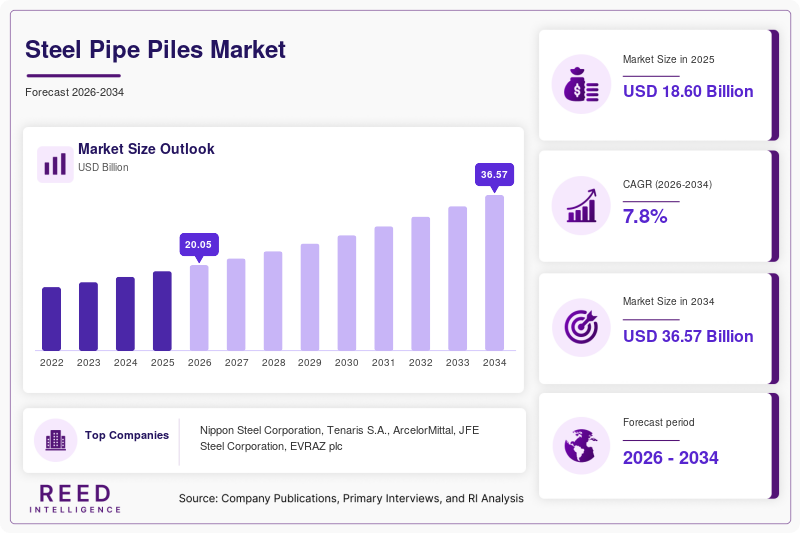
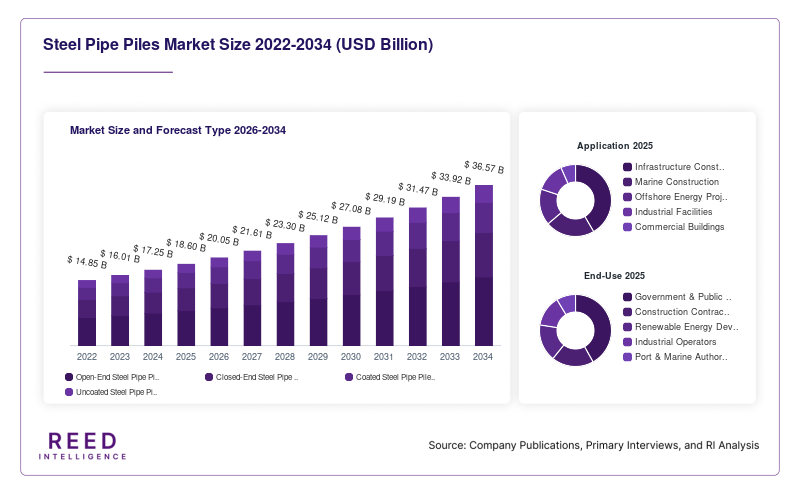
The global Steel Pipe Piles Market size was valued at USD 18.6 billion in 2026 and is projected to reach USD 33.9 billion by 2034, expanding at a CAGR of 7.8% during 2026–2034. The market continues to benefit from rising investments in transportation infrastructure, marine construction projects, industrial facilities, energy developments, and urban expansion programs across both developed and emerging economies. Steel pipe piles are widely used in foundation systems because of their high load-bearing capacity, structural durability, adaptability to varying soil conditions, and suitability for deep foundation applications.
Governments worldwide are allocating substantial budgets toward bridges, ports, highways, rail corridors, airports, and coastal protection projects. These initiatives are increasing the demand for robust foundation materials capable of supporting large-scale infrastructure assets. Steel pipe piles provide engineers with a dependable solution for projects requiring superior axial and lateral load resistance. In addition, technological improvements in steel manufacturing, corrosion-resistant coatings, and automated pile-driving equipment have enhanced installation efficiency and lifecycle performance.
Key Highlights
- North America dominated the market with a 34.2% share in 2025.
- while Asia Pacific is expected to grow at the fastest CAGR of 9.8% during 2026–2034.
- By type, Open-End Steel Pipe Piles accounted for the largest share of 44.7%.
- while Coated Steel Pipe Piles are projected to grow at a CAGR of 8.9%.
- By application, Infrastructure Construction led with a 41.3% share.
- whereas Offshore Energy Projects are expected to expand at a CAGR of 9.6%.
- By end-use, Government & Public Infrastructure accounted for the largest share of 48.5%.
- while Renewable Energy Developers are projected to grow at a CAGR of 10.1%.
- The United States remained the dominant country, with market values of USD 5.32 billion in 2024 and USD 5.71 billion in 2025.
Market Trends
Growing adoption of offshore renewable energy foundation systems
The expansion of offshore wind power installations is emerging as a significant trend within the Steel Pipe Piles Market. Governments are accelerating renewable energy deployment targets to reduce carbon emissions and strengthen energy security. Offshore wind farms require highly durable foundation systems capable of withstanding harsh marine environments, strong currents, and varying seabed conditions. Steel pipe piles offer excellent structural strength and long service life, making them suitable for monopile and jacket foundation systems. Increasing investments in offshore renewable projects across Europe, Asia Pacific, and North America are generating sustained demand for large-diameter steel pipe piles. Manufacturers are also developing advanced corrosion-resistant products specifically designed for offshore environments, further supporting market growth.
Integration of advanced manufacturing and protective coating technologies
Another important trend shaping the market is the adoption of advanced manufacturing processes and protective coating solutions. Project developers increasingly seek pile systems with longer operational lifespans and lower maintenance requirements. As a result, producers are investing in automated welding technologies, precision fabrication systems, and high-performance coating applications. Enhanced coatings help protect steel pipe piles from corrosion, moisture exposure, chemical degradation, and saltwater damage. Digital quality control systems are also improving product consistency and reducing defects during manufacturing. These innovations improve installation efficiency, lower lifecycle costs, and enhance project reliability, encouraging wider adoption across infrastructure, industrial, and marine construction sectors.
Market Drivers
Expanding global infrastructure development investments
Large-scale infrastructure modernization programs remain one of the primary growth drivers for the Steel Pipe Piles Market. Governments are investing heavily in transportation networks, ports, airports, bridges, railways, tunnels, and urban transit systems to support economic development and population growth. Such projects often require deep foundation solutions capable of handling substantial structural loads. Steel pipe piles provide high strength, installation flexibility, and performance reliability in challenging soil conditions. Their ability to support major infrastructure assets has made them a preferred choice among engineers and contractors. Continuous public and private sector investments in infrastructure development are expected to sustain demand throughout the forecast period.
Rising demand for resilient marine and coastal construction
Increasing coastal development activities are creating strong demand for steel pipe pile systems. Ports, harbors, seawalls, shipyards, coastal bridges, and waterfront commercial facilities require durable foundation structures capable of resisting environmental stress. Climate-related concerns and rising sea levels have also encouraged governments to invest in coastal protection infrastructure. Steel pipe piles offer excellent resistance to lateral forces and provide reliable support for marine construction projects. Their suitability for underwater installation and adaptability to varying geotechnical conditions make them valuable in coastal engineering applications. Growing maritime trade volumes and port expansion initiatives further reinforce demand across global markets.
Market Restraints
Volatility in raw material prices and project cost pressures
Fluctuations in steel prices represent a significant restraint for the Steel Pipe Piles Market. Steel pipe pile manufacturing depends heavily on raw steel availability and pricing stability. Variations in iron ore costs, energy expenses, transportation charges, trade policies, and global supply chain disruptions can directly affect production costs. Sudden price increases create budgeting challenges for infrastructure developers and construction contractors, particularly in long-duration projects with fixed-price agreements.
The impact extends beyond manufacturers, affecting procurement planning and project profitability throughout the value chain. Contractors may delay purchases during periods of price uncertainty, while project owners may reconsider capital expenditure schedules. For example, large bridge or port developments requiring thousands of tons of steel pipe piles can experience significant cost escalation when steel prices rise unexpectedly. These financial pressures may influence project timelines, procurement decisions, and investment returns. Although long-term demand remains favorable, persistent raw material volatility continues to create operational and financial challenges for industry participants.
Market Opportunities
Expansion of offshore wind energy infrastructure
The global transition toward clean energy presents substantial opportunities for market participants. Offshore wind installations continue to expand as governments pursue renewable energy targets and reduce dependence on fossil fuels. Many offshore wind projects require large-diameter steel pipe piles for foundation support systems. The increasing scale of offshore developments is generating demand for specialized piling products capable of supporting larger turbines and deeper water installations. Manufacturers that invest in advanced fabrication capabilities, corrosion-resistant technologies, and customized engineering solutions are likely to benefit from rising project activity. The long-term pipeline of offshore renewable energy developments creates a favorable environment for sustained market growth.
Urban expansion and smart city development projects
Rapid urbanization across emerging economies presents another major opportunity. Cities are expanding transportation systems, residential complexes, industrial parks, logistics hubs, and utility infrastructure to accommodate growing populations. Many smart city initiatives involve extensive underground and structural foundation work that requires reliable piling solutions. Steel pipe piles are increasingly selected because of their strength, design flexibility, and suitability for dense urban environments. Demand is particularly strong in regions experiencing industrialization and large-scale construction investment. As governments prioritize urban resilience and sustainable infrastructure, the need for advanced foundation technologies is expected to increase significantly during the forecast period.
Segmental Analysis
By Type
Open-End Steel Pipe Piles represented the dominant subsegment and accounted for approximately 44.7% of market revenue in 2024. Their popularity stems from installation flexibility, cost efficiency, and suitability for a wide range of geotechnical conditions. Open-end piles allow soil entry during driving operations, reducing displacement and facilitating deeper penetration. These characteristics make them attractive for transportation infrastructure, industrial facilities, marine structures, and commercial construction projects. Contractors often prefer open-end designs because they can achieve required load capacities while maintaining installation efficiency. Their versatility across different project types has enabled widespread adoption in both developed and emerging markets, supporting their leading market position.
Coated Steel Pipe Piles are expected to register the fastest CAGR of 8.9% during the forecast period. Growing emphasis on durability, lifecycle performance, and maintenance reduction is driving demand for advanced protective coating technologies. Infrastructure developers increasingly seek products capable of withstanding corrosion, moisture exposure, and harsh environmental conditions. Coated piles are particularly attractive for marine construction, offshore energy installations, and coastal infrastructure projects. Advancements in coating materials and application processes have improved protection performance while extending service life. As asset owners prioritize long-term operational efficiency and lower maintenance costs, adoption of coated steel pipe piles is expected to increase steadily.
By Application
Infrastructure Construction emerged as the leading application segment, accounting for approximately 41.3% of total market revenue in 2024. The segment includes bridges, highways, rail systems, airports, ports, and public utility projects that require robust foundation support. Growing government expenditure on transportation and urban infrastructure has strengthened demand for steel pipe pile solutions. Their high load-bearing capacity and adaptability to diverse soil conditions make them suitable for large-scale public works projects. Infrastructure construction remains a core demand generator because foundation integrity directly influences structural safety and operational performance. Continued investments in modernization and expansion programs are expected to maintain segment leadership.
Offshore Energy Projects are anticipated to record the fastest CAGR of 9.6% between 2026 and 2034. Expansion of offshore wind farms and marine energy developments is creating significant opportunities for foundation system suppliers. Steel pipe piles are widely utilized in offshore installations because of their structural strength, resistance to environmental stress, and compatibility with deep-water conditions. Developers increasingly require larger and more sophisticated piling systems to support higher-capacity energy assets. Government incentives supporting renewable energy deployment and long-term decarbonization goals are expected to drive additional investment in offshore projects, contributing to rapid segment growth.
By End-Use
Government & Public Infrastructure accounted for the largest market share of approximately 48.5% in 2024. Public sector organizations remain major consumers of steel pipe pile systems due to their involvement in transportation, water management, urban development, and coastal protection projects. Large infrastructure investments require foundation solutions capable of delivering long-term structural stability and safety. Steel pipe piles meet these requirements through their strength, reliability, and adaptability. Increasing public spending on infrastructure modernization and resilience initiatives continues to support demand. The segment benefits from long project pipelines and strategic government commitments to economic development through infrastructure investment.
Renewable Energy Developers are projected to witness the fastest CAGR of 10.1% throughout the forecast period. Growing investment in offshore wind farms, coastal renewable energy facilities, and emerging marine energy technologies is accelerating demand for specialized foundation systems. Steel pipe piles provide the structural support necessary for energy infrastructure operating in challenging environmental conditions. As countries implement carbon reduction strategies and expand renewable energy capacity, project activity is expected to increase significantly. Technological advancements in turbine design and offshore construction methods are further supporting demand. These factors position renewable energy developers as a rapidly growing end-user category within the market.
Regional Analysis
North America
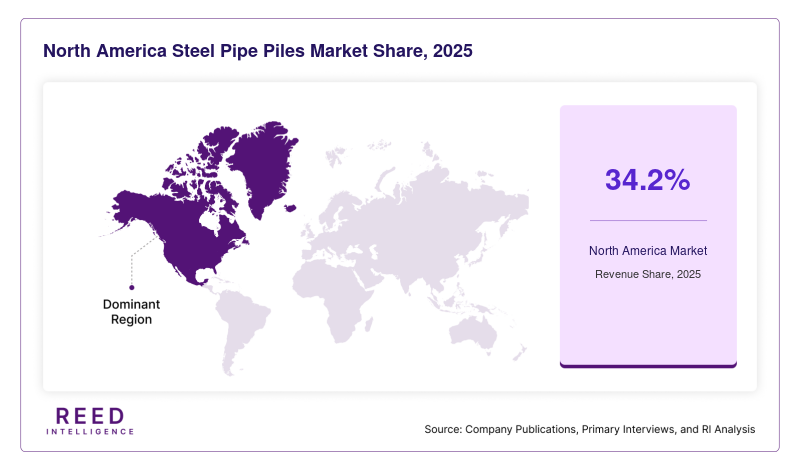
North America accounted for approximately 34.2% of the Steel Pipe Piles Market in 2025 and maintained its position as the largest regional market. The region is projected to expand at a CAGR of 6.9% through 2034. Demand is supported by extensive investments in transportation infrastructure, bridge rehabilitation projects, industrial facilities, and port modernization programs. Strong adoption of advanced construction technologies and favorable public infrastructure funding continue to support market expansion across the region.
The United States represents the dominant country within North America. Significant federal and state investments in highways, bridges, airports, and coastal infrastructure are driving demand for steel pipe pile systems. A unique growth factor is the ongoing modernization of aging infrastructure assets that require foundation reinforcement and replacement. The combination of infrastructure renewal initiatives and energy sector investments creates a stable demand environment for manufacturers and contractors.
Europe
Europe held approximately 25.1% of the global market in 2025 and is expected to grow at a CAGR of 7.1% during the forecast period. Demand is supported by transportation upgrades, marine construction projects, renewable energy developments, and urban redevelopment initiatives. The region’s emphasis on sustainable infrastructure and long-term asset durability encourages the use of high-performance piling solutions across both public and private projects.
Germany remains the leading country in the European market due to its strong industrial base and engineering expertise. A unique growth factor is the region’s accelerating offshore wind deployment strategy. Multiple offshore renewable energy projects require specialized foundation systems capable of operating in demanding marine conditions. This trend continues to create opportunities for steel pipe pile manufacturers serving the European renewable energy sector.
Asia Pacific
Asia Pacific accounted for nearly 28.7% of the Steel Pipe Piles Market in 2025 and is forecast to register the fastest CAGR of 9.8% through 2034. Rapid urbanization, industrial development, transportation expansion, and population growth are fueling demand across major economies. Governments continue to invest heavily in rail networks, highways, airports, industrial corridors, and commercial construction projects, creating substantial opportunities for piling solution providers.
China remains the dominant country in the region owing to its extensive infrastructure development activities. A unique growth factor is the large-scale development of industrial and logistics zones designed to support manufacturing and trade expansion. These projects require significant foundation work and contribute to sustained demand for steel pipe piles. Continued urban growth and infrastructure spending are expected to reinforce regional market leadership.
Middle East & Africa
The Middle East & Africa represented approximately 7.1% of the global market in 2025 and is projected to grow at a CAGR of 7.6% during the forecast period. Rising investments in commercial construction, transportation networks, industrial facilities, and coastal infrastructure are contributing to regional growth. Governments are actively diversifying their economies through infrastructure development programs that require reliable foundation systems.
Saudi Arabia remains the leading market within the region. A unique growth factor is the implementation of large-scale economic diversification and mega-development projects. These initiatives involve extensive construction activities, including transportation corridors, urban developments, industrial complexes, and tourism infrastructure. The scale of these projects continues to create substantial demand for steel pipe pile products and related engineering services.
Latin America
Latin America accounted for approximately 4.9% of the Steel Pipe Piles Market in 2025 and is expected to grow at a CAGR of 7.3% through 2034. Increasing investments in transportation infrastructure, mining operations, energy projects, and urban development are supporting market growth. Governments and private investors are focusing on improving logistics efficiency and expanding industrial capacity across key economies.
Brazil dominates the regional market due to its extensive infrastructure and energy development activities. A unique growth factor is the expansion of port infrastructure supporting agricultural exports and international trade. Modernization of port facilities requires durable foundation systems capable of handling heavy operational loads and marine conditions. These investments are expected to generate steady demand for steel pipe piles throughout the forecast period.
Competitive Landscape
The Steel Pipe Piles Market is moderately consolidated, with established manufacturers competing through capacity expansion, product innovation, engineering expertise, and geographic reach. Companies focus on developing high-strength pile systems, corrosion-resistant coatings, and customized foundation solutions to meet evolving project requirements. Strategic partnerships with construction firms and infrastructure developers remain common across the industry.
Nippon Steel Corporation continues to maintain a leading position due to its extensive manufacturing capabilities and strong presence in infrastructure and marine construction applications. Recent developments include investments in advanced steel processing technologies designed to improve product durability and operational efficiency. Other significant participants include Tenaris, ArcelorMittal, JFE Steel Corporation, and EVRAZ. These companies are expanding production capabilities and strengthening regional distribution networks to capture growing opportunities in infrastructure and renewable energy projects. Competitive differentiation increasingly depends on product quality, engineering support, sustainability initiatives, and the ability to deliver customized solutions for complex construction environments.
Key Players
- Nippon Steel Corporation
- Tenaris S.A.
- ArcelorMittal
- JFE Steel Corporation
- EVRAZ plc
- United States Steel Corporation
- TMK Group
- Vallourec S.A.
- Tata Steel Limited
- Seah Steel Corporation
- Hyundai Steel Company
- Northwest Pipe Company
- Welspun Corp Ltd.
- JSW Steel Ltd.
- Marubeni-Itochu Steel Inc.
Recent Developments
- Nippon Steel Corporation expanded production capacity for large-diameter steel pipe piles to support offshore energy and infrastructure projects.
- Tenaris introduced enhanced corrosion-resistant pile solutions designed for marine and coastal construction applications.
- ArcelorMittal invested in advanced steel processing technologies aimed at improving pile durability and manufacturing efficiency.
- JFE Steel Corporation expanded engineering support services for large-scale infrastructure foundation projects across Asia Pacific.
- EVRAZ strengthened its product portfolio through the development of high-strength steel grades for demanding geotechnical conditions
Steel Pipe Piles Market Segments
Type
- Open-End Steel Pipe Piles
- Closed-End Steel Pipe Piles
- Coated Steel Pipe Piles
- Uncoated Steel Pipe Piles
Application
- Infrastructure Construction
- Marine Construction
- Offshore Energy Projects
- Industrial Facilities
- Commercial Buildings
End-Use
- Government & Public Infrastructure
- Construction Contractors
- Renewable Energy Developers
- Industrial Operators
- Port & Marine Authorities
By Region
- North America
- Europe
- APAC
- Middle East and Africa
- LATAM