Steel Wear Liner Market Size, Share & Demand Report By Product Type (Abrasion-Resistant Steel Liners, Composite Steel Wear Liners, Alloy Steel Wear Liners), By Application (Mining Equipment, Bulk Material Handling Systems, Cement Processing Equipment, Steel Manufacturing Equipment), By End-Use Industry (Construction Materials, Cement Industry, Steel Industry, Power Generation, Renewable Energy and Recycling), By Region & Segment Forecasts, 2026–2034
USD 3950
Market Overview
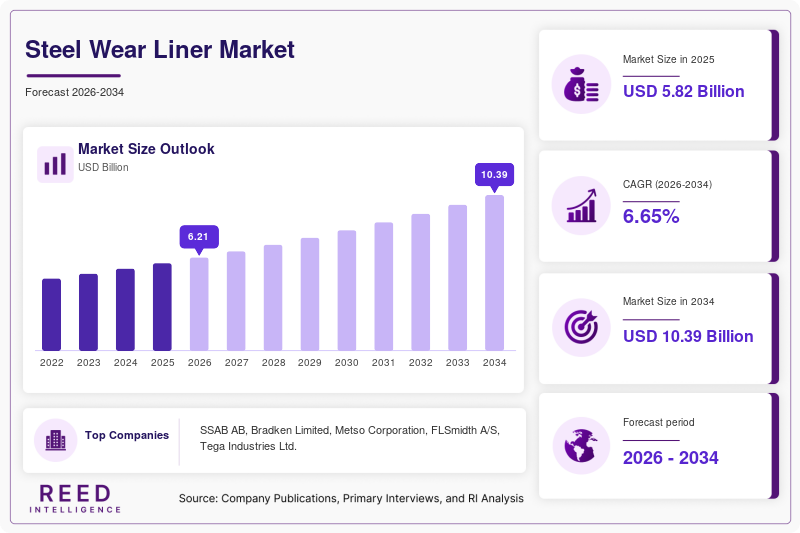
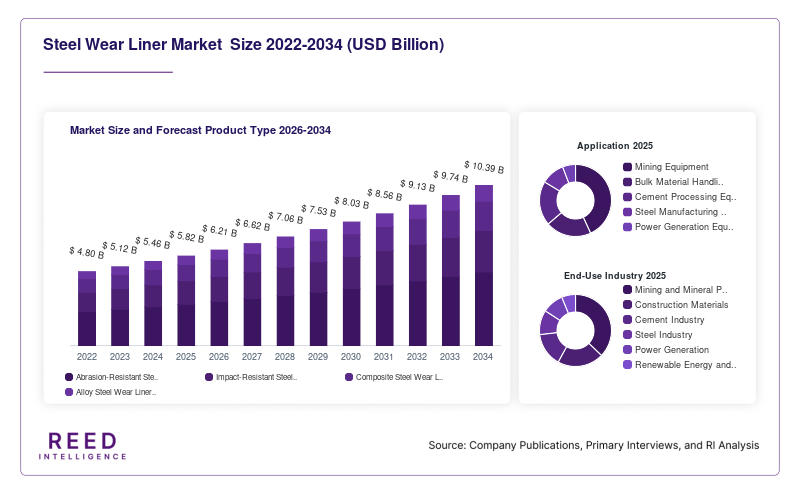
The global Steel Wear Liner Market size was valued at approximately USD 5.82 billion in 2026 and is projected to reach USD 9.74 billion by 2034, expanding at a CAGR of 6.65% during the forecast period from 2026 to 2034. Steel wear liners are engineered protective components used to reduce abrasion, impact damage, and material wear in heavy industrial equipment. These liners are widely deployed across mining, cement, steel production, construction, power generation, and bulk material handling industries where equipment longevity and operational efficiency remain critical priorities.
A major factor supporting market growth is the continued expansion of global mining and infrastructure activities. Governments and private organizations are increasing investments in transportation networks, energy facilities, industrial manufacturing plants, and mineral extraction projects. Such developments create sustained demand for wear-resistant solutions capable of extending equipment life while reducing maintenance costs. In addition, the growing adoption of advanced high-hardness steel grades and customized liner designs has enhanced operational performance across industrial environments characterized by severe abrasion and impact conditions.
Key Highlights
- North America dominated the market with a 33.8% share in 2025.
- Asia Pacific is expected to grow at the fastest CAGR of 8.3% during 2026–2034.
- By product type, abrasion-resistant steel liners accounted for the largest share of 44.6%.
- while composite steel wear liners are projected to grow at a CAGR of 8.8%.
- By application, mining equipment led with a 39.4% share.
- whereas bulk material handling systems are expected to expand at a CAGR of 8.6%.
- By end-use industry, mining and mineral processing held the dominant share of 42.7%.
- while renewable energy and industrial recycling facilities are projected to grow at a CAGR of 8.4%.
- The United States remained the dominant country, with market values of USD 1.56 billion in 2024 and USD 1.68 billion in 2025.
Market Trends
Adoption of Advanced High-Hardness Steel Materials
The Steel Wear Liner Market is witnessing increasing adoption of advanced high-hardness steel materials designed to withstand extreme abrasion and impact conditions. Manufacturers are developing liners using specialized alloy compositions and optimized heat-treatment techniques that deliver superior wear resistance compared to conventional steel grades. These products are increasingly used in mining trucks, crushers, chutes, hoppers, and conveyor systems where equipment failure can result in substantial operational losses. Industrial operators are prioritizing longer replacement intervals and lower maintenance requirements, driving demand for enhanced wear-resistant materials. The trend is further supported by rising investments in automation and asset optimization programs across heavy industries, where equipment reliability has become a key performance metric.
Growth of Customized and Modular Wear Protection Solutions
A significant trend shaping the market is the growing preference for customized and modular wear liner solutions. Industrial facilities increasingly require wear protection systems tailored to specific equipment geometries, material flow patterns, and operating conditions. Manufacturers are responding by offering engineered liner packages that improve installation efficiency and operational performance. Modular systems allow damaged sections to be replaced individually instead of replacing entire liner assemblies, reducing maintenance costs and downtime. This approach is particularly beneficial in mining and bulk material handling operations where continuous production is essential. As industries focus on lifecycle cost reduction and productivity enhancement, demand for customized liner engineering services continues to expand across multiple end-use sectors.
Market Drivers
Expansion of Global Mining and Mineral Processing Activities
Mining remains one of the strongest growth drivers for the Steel Wear Liner Market. Rising demand for iron ore, copper, lithium, nickel, gold, and rare earth minerals is encouraging mining companies to expand production capacities and invest in new extraction projects. Mining equipment operates in highly abrasive environments where wear protection is critical for maintaining productivity and minimizing equipment downtime. Steel wear liners provide effective protection for crushers, mills, chutes, bins, and haulage systems. As mineral exploration activities increase across Asia Pacific, North America, Latin America, and Africa, demand for high-performance wear liners continues to rise. The industry's focus on maximizing asset utilization and reducing maintenance expenditures further strengthens market growth prospects.
Rising Infrastructure and Industrial Development Investments
Large-scale infrastructure and industrial development projects are creating significant demand for wear-resistant equipment components. Construction materials production, cement manufacturing, steel processing, and power generation facilities rely heavily on machinery exposed to continuous abrasion and impact. Steel wear liners help improve operational efficiency by extending equipment service life and reducing repair frequency. Governments worldwide are allocating substantial budgets toward transportation networks, industrial corridors, urban development, and energy infrastructure. These investments increase demand for bulk material handling equipment and processing systems that require durable wear protection. The resulting growth in industrial activity is expected to support long-term expansion of the Steel Wear Liner Market throughout the forecast period.
Market Restraint
Volatility in Raw Material Prices and Production Costs
Fluctuating prices of steel, alloying elements, and energy resources remain a notable challenge for the Steel Wear Liner Market. Manufacturing wear liners requires specialized steel grades that often depend on raw materials such as chromium, manganese, nickel, and molybdenum. Variations in global commodity prices can significantly affect production costs and profit margins for manufacturers. In addition, transportation expenses and supply chain disruptions may increase overall product costs, particularly for international suppliers serving multiple regions. Higher prices can delay replacement cycles among cost-sensitive industrial operators and limit purchasing decisions in emerging markets. For example, mining operators facing lower commodity prices may postpone equipment upgrades and maintenance projects, reducing short-term demand for wear liners. These cost-related uncertainties continue to influence market dynamics and purchasing strategies across industrial sectors.
Market Opportunities
Increasing Demand from Renewable Energy and Recycling Facilities
The expansion of renewable energy infrastructure and industrial recycling operations presents promising opportunities for market participants. Recycling plants handling metal scrap, construction waste, and industrial byproducts operate equipment exposed to significant wear and abrasion. Similarly, biomass processing and waste-to-energy facilities require durable material handling systems capable of maintaining continuous operations. Steel wear liners enhance equipment longevity and reduce maintenance requirements in these demanding environments. As governments and industries focus on sustainability goals, investments in recycling and circular economy initiatives continue to increase. This trend creates additional demand for wear-resistant solutions and opens new revenue streams for manufacturers seeking diversification beyond traditional mining and heavy industry applications.
Technological Advancements in Smart Maintenance Solutions
The integration of digital monitoring technologies with wear management programs offers substantial growth potential. Industrial operators are increasingly implementing predictive maintenance systems to improve equipment reliability and reduce unplanned downtime. Wear liner manufacturers are exploring solutions that combine advanced materials with monitoring technologies capable of tracking wear conditions and replacement schedules. These innovations enable operators to optimize maintenance planning and maximize equipment utilization. As Industry 4.0 adoption expands across manufacturing, mining, and material handling sectors, demand for technologically advanced wear protection solutions is expected to increase. Companies capable of offering data-driven maintenance support alongside high-performance wear liners may gain competitive advantages and strengthen long-term customer relationships.
Segmental Analysis
By Product Type
Abrasion-resistant steel liners represented the dominant product type, accounting for approximately 44.6% of market revenue in 2024. These liners are extensively used in mining, cement manufacturing, aggregate processing, and bulk material handling systems where equipment faces continuous exposure to abrasive materials. Their popularity stems from a combination of durability, cost-effectiveness, and proven operational performance. High-hardness steel grades provide reliable protection against wear, helping operators reduce maintenance frequency and extend equipment service life. The widespread adoption of abrasion-resistant liners across multiple industries contributes significantly to their market leadership. Furthermore, ongoing improvements in steel metallurgy and manufacturing processes continue to enhance product performance, reinforcing their position as the preferred wear protection solution for demanding industrial applications.
Composite steel wear liners are projected to be the fastest-growing product category, expanding at a CAGR of 8.8% during the forecast period. These solutions combine steel with additional wear-resistant materials to achieve enhanced durability and performance under severe operating conditions. Industrial operators increasingly favor composite designs because they can offer improved wear resistance without substantially increasing equipment weight. Growing demand for customized wear protection solutions and longer maintenance intervals is supporting adoption across mining, recycling, and material handling industries. Manufacturers are investing in product innovation to address specific customer requirements, resulting in broader application opportunities. As industries continue seeking lifecycle cost reductions and improved equipment efficiency, demand for composite steel wear liners is expected to accelerate.
By Application
Mining equipment emerged as the largest application segment, accounting for approximately 39.4% of total market revenue in 2024. Equipment used in extraction and mineral processing operations is routinely exposed to abrasive rock, ore, and aggregate materials that can cause significant wear. Steel wear liners are installed in crushers, grinding mills, hoppers, chutes, and haul trucks to protect critical equipment components and maintain operational reliability. The mining industry's continuous focus on productivity and cost control has strengthened demand for durable wear protection solutions. Rising global consumption of industrial minerals and metals is encouraging mining companies to expand production capacities, further increasing the requirement for wear-resistant equipment components capable of supporting intensive operating conditions.
Bulk material handling systems are expected to register the fastest growth, with a forecast CAGR of 8.6% between 2026 and 2034. Industries including ports, power generation, cement manufacturing, and logistics increasingly rely on efficient material transportation infrastructure. Conveyors, transfer points, bins, and loading systems require effective wear protection to withstand constant material flow and impact. Growth in industrial production and infrastructure development is driving investment in modern material handling systems designed for higher throughput and reliability. Steel wear liners play a critical role in reducing maintenance interruptions and improving equipment longevity. As industrial operators prioritize operational efficiency and asset optimization, demand within this application segment is projected to expand steadily.
By End-Use Industry
Mining and mineral processing held the largest share of the market, contributing approximately 42.7% of total revenue in 2024. The sector's heavy reliance on abrasive processing environments creates substantial demand for high-performance wear protection solutions. Steel wear liners help maintain operational continuity by protecting equipment against erosion, impact damage, and material degradation. Mining companies increasingly recognize the economic benefits of extending equipment lifespan and reducing maintenance-related downtime. Growing global demand for metals required in construction, manufacturing, electronics, and energy applications continues to support investments in mining operations. These factors collectively reinforce the segment’s dominant position within the Steel Wear Liner Market and sustain long-term demand for advanced wear-resistant products.
Renewable energy and industrial recycling facilities are anticipated to be the fastest-growing end-use segment, expanding at a CAGR of 8.4% through 2034. Recycling operations process abrasive materials such as metal scrap, construction debris, and industrial waste, creating strong demand for durable wear protection systems. Renewable energy facilities handling biomass and alternative fuels also require reliable material handling infrastructure capable of operating under challenging conditions. Government policies promoting sustainability, resource recovery, and waste reduction are encouraging investments in these sectors. As facility operators seek to improve operational efficiency and reduce maintenance costs, adoption of advanced steel wear liners is expected to increase significantly, creating attractive growth opportunities for market participants.
Regional Analysis
North America
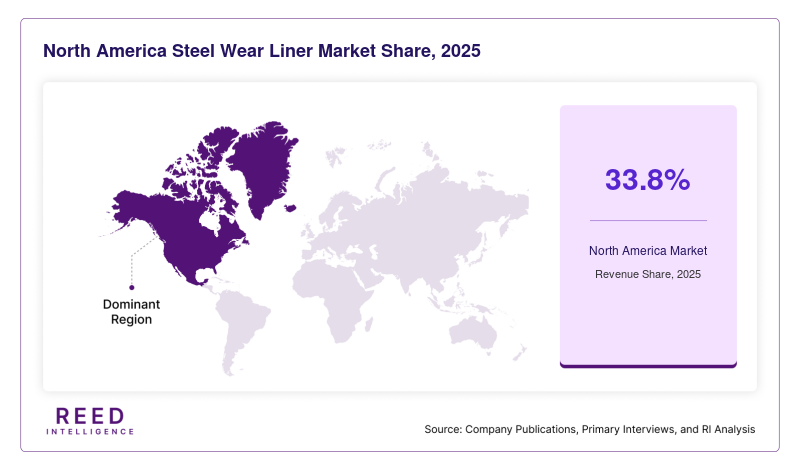
North America accounted for approximately 33.8% of the Steel Wear Liner Market in 2025 and continues to represent the largest regional market. The region is expected to register a CAGR of 5.8% through 2034. Growth is supported by extensive mining operations, strong industrial infrastructure, and continuous investments in equipment modernization. Demand for wear-resistant components remains high across mineral processing facilities, aggregate production plants, and bulk material handling operations. The presence of established manufacturers and advanced metallurgical capabilities further contributes to regional market leadership.
The United States dominates the regional market due to its large mining industry and advanced manufacturing ecosystem. A unique growth factor is the increasing adoption of predictive maintenance technologies in heavy industries. Industrial operators are integrating wear management strategies with digital asset monitoring systems to improve operational efficiency. This trend is driving demand for premium steel wear liners capable of delivering consistent performance and extended service life in demanding industrial environments.
Europe
Europe represented approximately 24.9% of the global Steel Wear Liner Market in 2025 and is projected to expand at a CAGR of 5.9% during the forecast period. The region benefits from a strong industrial base, advanced engineering capabilities, and ongoing modernization of manufacturing facilities. Steel production, cement manufacturing, and material processing industries continue to invest in durable wear-resistant components to improve productivity and reduce maintenance-related costs. Sustainability initiatives are also encouraging operators to extend equipment life through improved wear protection technologies.
Germany remains the dominant country within the European market. A distinctive growth factor is the region’s emphasis on industrial efficiency and resource optimization. Manufacturers are increasingly investing in advanced wear protection solutions that reduce operational waste and enhance equipment reliability. The country's strong engineering expertise and focus on high-performance industrial systems continue to support demand for technologically advanced steel wear liners across multiple sectors.
Asia Pacific
Asia Pacific held approximately 28.6% of the Steel Wear Liner Market in 2025 and is forecast to achieve the fastest CAGR of 8.3% through 2034. Rapid industrialization, urbanization, and infrastructure development across major economies are creating substantial demand for wear-resistant equipment solutions. The region hosts significant mining operations, steel manufacturing facilities, and construction activities that rely heavily on durable wear protection systems. Increasing industrial output and capital investments continue to strengthen market expansion.
China dominates the regional market due to its extensive industrial and mining activities. A unique growth factor is the country's large-scale infrastructure development programs that require significant volumes of construction materials and industrial processing equipment. Rising investments in transportation networks, renewable energy projects, and manufacturing facilities are increasing demand for steel wear liners designed to withstand intensive operating conditions while supporting productivity objectives.
Middle East & Africa
The Middle East & Africa accounted for approximately 6.5% of the global market in 2025 and is expected to grow at a CAGR of 6.7% through 2034. Expanding mining projects, industrial diversification initiatives, and infrastructure investments are driving regional demand. Material handling systems used in mining, cement production, and bulk commodity transportation require effective wear protection to maintain operational continuity. Increasing industrial development across several countries is supporting market growth.
South Africa remains the dominant country in the regional market. A distinctive growth factor is its extensive mineral extraction sector, which includes gold, platinum, manganese, and iron ore operations. Mining companies are investing in advanced wear management solutions to improve equipment reliability and reduce downtime. This focus on operational efficiency is generating consistent demand for high-performance steel wear liners across processing and transportation applications.
Latin America
Latin America captured approximately 6.2% of the Steel Wear Liner Market in 2025 and is projected to register a CAGR of 6.5% over the forecast period. The region benefits from abundant mineral resources and expanding mining activities. Demand for wear-resistant products is increasing as operators seek to improve equipment durability and productivity in harsh operating environments. Investments in mineral processing facilities and transportation infrastructure are further contributing to market development.
Brazil leads the regional market due to its significant iron ore and mineral production activities. A unique growth factor is the modernization of mining infrastructure aimed at increasing operational efficiency and export competitiveness. Mining companies are upgrading equipment fleets and processing facilities to enhance productivity. These investments are creating favorable conditions for the adoption of advanced steel wear liners across extraction, processing, and material handling operations.
Competitive Landscape
The Steel Wear Liner Market is moderately consolidated, with global and regional manufacturers competing through product quality, material innovation, customization capabilities, and service offerings. Companies continue investing in advanced metallurgical technologies to enhance wear resistance and improve operational performance. Strategic partnerships with mining, cement, and industrial processing companies remain common as suppliers seek long-term contracts and recurring revenue opportunities.
Among leading participants, SSAB AB maintains a strong market position due to its extensive portfolio of high-hardness steel products and global distribution network. The company recently expanded its engineered wear solutions portfolio to support mining and bulk material handling customers seeking longer equipment service life. Other notable market participants focus on customized fabrication, composite liner development, and regional expansion strategies to strengthen competitiveness. Growing demand for premium wear protection systems is encouraging manufacturers to invest in research and development initiatives. Competitive differentiation increasingly depends on lifecycle performance, technical support capabilities, and the ability to provide application-specific solutions that reduce maintenance requirements and improve customer productivity.
Key Players
- SSAB AB
- Bradken Limited
- Metso Corporation
- FLSmidth A/S
- Tega Industries Ltd.
- H-E Parts International
- Hardox Wearparts
- Columbia Steel Casting Co.
- Trimay Wear Plate Ltd.
- JADCO Manufacturing Inc.
- Castolin Eutectic
- KenCast Inc.
- Multotec Group
- Hunan Valin Steel Co., Ltd.
- Bisalloy Steel Group
Recent Developments
- SSAB AB introduced an enhanced wear-resistant steel liner portfolio designed for high-abrasion mining and aggregate processing applications.
- Metso Corporation expanded its wear protection solutions business by introducing engineered liner systems focused on improving maintenance efficiency in mineral processing facilities.
- Tega Industries Ltd. increased manufacturing capacity for wear-resistant products to support growing demand from mining and bulk material handling customers across Asia Pacific.
- Bradken Limited launched new customized liner designs aimed at extending service intervals in heavy-duty crushing and material handling operations.
- FLSmidth A/S strengthened its wear solutions offering through advanced liner technologies developed for large-scale mining and cement processing equipment.
Steel Wear Liner Market Segments
Product Type
- Abrasion-Resistant Steel Liners
- Impact-Resistant Steel Liners
- Composite Steel Wear Liners
- Alloy Steel Wear Liners
Application
- Mining Equipment
- Bulk Material Handling Systems
- Cement Processing Equipment
- Steel Manufacturing Equipment
- Power Generation Equipment
End-Use Industry
- Mining and Mineral Processing
- Construction Materials
- Cement Industry
- Steel Industry
- Power Generation
- Renewable Energy and Recycling
By Region
- North America
- Europe
- APAC
- Middle East and Africa
- LATAM