Straight Grinders Market Size, Share & Demand Report By Product Type (Electric Straight Grinders, Pneumatic Straight Grinders, Cordless Straight Grinders), By Application (Metal Fabrication, Precision Finishing and Polishing, Deburring, Weld Grinding, Surface Preparation), By End-Use Industry (Manufacturing, Automotive, Aerospace, Construction, Energy & Utilities, Shipbuilding), By Region & Segment Forecasts, 2026–2034
USD 3950
Market Overview
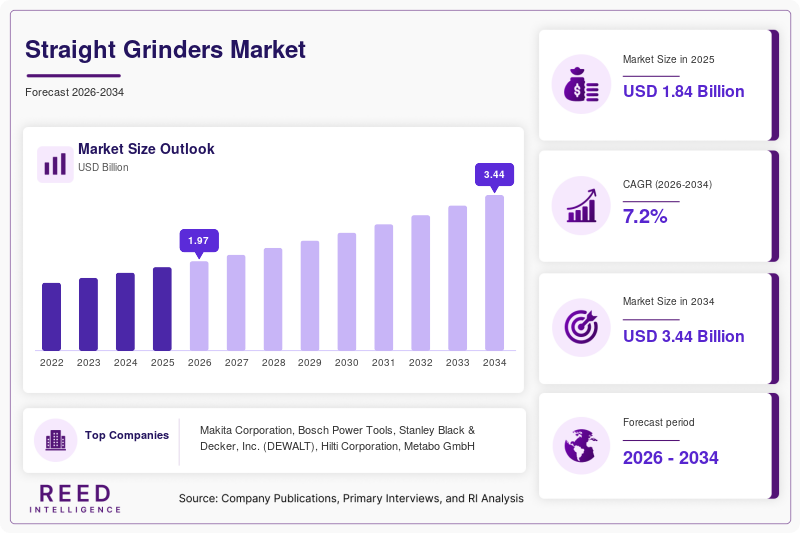
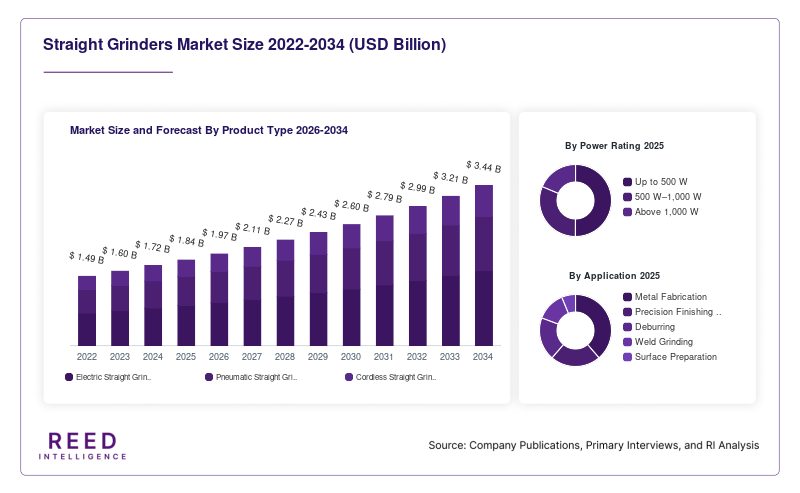
The global Straight Grinders Market size was valued at approximately USD 1.84 billion in 2026 and is projected to reach USD 3.21 billion by 2034, expanding at a CAGR of 7.2% during 2026–2034. Straight grinders are widely used for grinding, polishing, deburring, finishing, and material removal operations across metalworking, automotive, aerospace, construction, shipbuilding, and industrial manufacturing sectors. Their ability to deliver high precision in confined spaces and complex geometries continues to make them an essential tool in modern production environments.
A major global factor supporting market expansion is the sustained growth of industrial automation and advanced manufacturing activities. Manufacturers are increasingly investing in productivity-enhancing equipment that improves machining accuracy while reducing operational downtime. Straight grinders equipped with ergonomic designs, variable-speed controls, brushless motors, and vibration-reduction technologies are gaining widespread acceptance across industrial facilities. Additionally, the expansion of infrastructure projects, rising automotive production volumes, and increasing demand for maintenance and repair activities have strengthened equipment demand worldwide.
The market is also benefiting from technological innovations that improve tool durability, energy efficiency, and operator safety. Cordless models powered by advanced lithium-ion batteries are becoming increasingly popular due to their flexibility and portability. Furthermore, industrial users are prioritizing tools that support continuous operation while maintaining precision across demanding applications. These developments are expected to create a favorable environment for long-term market growth.
Key Highlights
- North America dominated the market with a 35.1% share in 2025, while Asia Pacific is expected to grow at the fastest CAGR of 8.9% during 2026–2034.
- By product type, electric straight grinders accounted for the largest share of 56.8%, while cordless straight grinders are projected to grow at a CAGR of 9.4%.
- By application, metal fabrication led with a 42.6% share, whereas precision finishing and polishing is expected to expand at a CAGR of 8.8%.
- By end-use, manufacturing industries accounted for the largest share of 48.7%, while the aerospace sector is projected to grow at a CAGR of 9.1%.
- The United States remained the dominant country, with market values of USD 482 million in 2024 and USD 518 million in 2025.
Market Trends
Adoption of Cordless and Battery-Powered Industrial Tools
The straight grinders industry is witnessing a significant shift toward cordless and battery-powered equipment. Industrial users increasingly prefer portable tools that can operate efficiently in remote job sites, construction environments, and maintenance applications where access to power outlets may be limited. Improvements in lithium-ion battery technology have enabled cordless straight grinders to deliver power levels comparable to traditional corded models while maintaining longer operating times. Manufacturers are focusing on lightweight designs, fast-charging capabilities, and enhanced safety features to meet changing customer requirements. This trend is particularly visible in automotive repair, fabrication workshops, and field maintenance operations where operational flexibility directly impacts productivity and workflow efficiency.
Integration of Ergonomic and Smart Tool Technologies
Industrial buyers are placing greater emphasis on operator comfort, workplace safety, and productivity enhancement. As a result, manufacturers are integrating advanced ergonomic features such as anti-vibration systems, improved grip designs, reduced noise levels, and optimized weight distribution into straight grinders. Simultaneously, smart technologies are becoming more common, including electronic speed regulation, overload protection, predictive maintenance indicators, and motor performance monitoring systems. These innovations help reduce worker fatigue while improving operational accuracy and tool lifespan. Growing awareness regarding workplace safety standards and efficiency targets is encouraging industrial facilities to replace conventional equipment with technologically advanced straight grinders capable of supporting modern manufacturing environments.
Market Drivers
Expansion of Global Manufacturing and Metalworking Activities
The growth of manufacturing output across developed and emerging economies remains a key factor driving demand for straight grinders. Industries such as automotive, heavy machinery, industrial equipment, and fabricated metal products require grinding, deburring, and finishing processes to maintain quality standards. Straight grinders play a vital role in achieving precision surface treatment and component finishing. Rising investments in industrial production facilities, coupled with increasing demand for fabricated metal components, continue to create strong market opportunities. As manufacturers seek to improve productivity and reduce material waste, the adoption of efficient grinding tools is expected to increase steadily throughout the forecast period.
Growth in Infrastructure Development and Construction Projects
Large-scale infrastructure investments are contributing significantly to market expansion. Governments and private organizations worldwide are increasing spending on transportation networks, commercial buildings, industrial facilities, and energy projects. Construction contractors frequently use straight grinders for metal preparation, weld finishing, surface cleaning, and structural fabrication tasks. The growing number of renovation and maintenance projects further supports equipment demand. Additionally, urbanization and industrialization trends across Asia Pacific, the Middle East, and Latin America are accelerating construction activity. These developments are generating sustained demand for durable and high-performance grinding equipment capable of operating in challenging work environments while maintaining precision and reliability.
Market Restraint
High Maintenance Requirements and Competition from Alternative Tools
Despite favorable growth prospects, the market faces challenges associated with maintenance costs and competition from alternative finishing technologies. Straight grinders require periodic replacement of accessories, regular servicing, and operator training to maintain optimal performance. In high-volume industrial environments, maintenance-related downtime can affect production schedules and increase operational expenses. Furthermore, several end users are adopting specialized CNC finishing equipment, automated grinding systems, and multifunctional power tools that can perform similar tasks with reduced manual intervention. Small and medium-sized enterprises often delay equipment upgrades due to budget limitations, particularly during periods of economic uncertainty. For example, fabrication workshops operating with narrow profit margins may prefer repairing existing tools rather than purchasing advanced grinder models. These factors can limit market penetration in cost-sensitive regions and create pricing pressures for manufacturers seeking to expand their customer base.
Market Opportunities
Rising Demand from Aerospace Manufacturing and Maintenance
The aerospace industry presents substantial growth opportunities for straight grinder manufacturers. Aircraft production requires highly accurate grinding and finishing processes to ensure component quality, structural integrity, and compliance with strict industry standards. Straight grinders are widely used for deburring turbine components, finishing metal surfaces, and performing maintenance operations. Growing commercial aviation fleets and increasing aircraft maintenance requirements are driving demand for precision tools capable of operating in confined spaces. Furthermore, aerospace manufacturers are adopting advanced lightweight materials that require specialized finishing techniques. These factors are expected to encourage equipment innovation and create new revenue opportunities across developed and emerging aviation markets.
Increasing Penetration of Industrial Maintenance Services
The expansion of industrial maintenance, repair, and overhaul activities is creating favorable conditions for market growth. Manufacturing facilities, energy plants, transportation networks, and processing industries increasingly prioritize preventive maintenance strategies to minimize equipment failures and operational disruptions. Straight grinders are essential tools for maintenance teams performing surface preparation, rust removal, component repair, and precision finishing. As industries seek to extend equipment life cycles and improve asset reliability, demand for versatile grinding tools is expected to rise. Service providers are also investing in advanced portable equipment that enables technicians to perform maintenance tasks efficiently across diverse industrial environments, supporting long-term market expansion.
Segmental Analysis
By Product Type
Electric straight grinders represented the dominant subsegment, accounting for approximately 56.8% of the market share in 2024. These tools remain widely preferred across industrial facilities due to their consistent power output, operational reliability, and suitability for continuous-duty applications. Manufacturing plants, fabrication workshops, and maintenance facilities rely on electric grinders for precision grinding, deburring, and finishing processes. Their availability in various power ratings and spindle configurations enables users to select equipment according to specific operational requirements. In addition, electric models often offer lower operating costs compared to pneumatic alternatives, making them an attractive option for organizations seeking long-term productivity improvements while maintaining equipment efficiency and precision standards.
Cordless straight grinders are expected to register the fastest growth, advancing at a CAGR of 9.4% during 2026–2034. Increasing demand for mobility, flexibility, and convenience across industrial environments is driving adoption. Advances in battery technology have significantly improved power delivery and operating duration, reducing performance gaps between cordless and corded tools. Industrial maintenance teams, construction contractors, and field service technicians increasingly prefer cordless equipment because it allows uninterrupted operation in locations without direct access to electrical infrastructure. Manufacturers are also introducing compact and lightweight designs that improve user comfort, further supporting rapid adoption across a broad range of professional applications.
By Application
Metal fabrication emerged as the largest application segment, accounting for approximately 42.6% of global market share in 2024. Fabrication processes frequently require grinding, shaping, deburring, and weld finishing activities to ensure product quality and dimensional accuracy. Straight grinders provide the precision necessary for handling complex components and difficult-to-reach areas. Demand remains particularly strong across automotive, machinery, construction equipment, and industrial component manufacturing industries. As fabrication companies continue to focus on productivity improvement and quality assurance, investment in reliable grinding equipment remains a priority. The growing production of fabricated metal products worldwide further strengthens demand within this segment.
Precision finishing and polishing is projected to record the fastest growth, expanding at a CAGR of 8.8% through 2034. Industries are increasingly prioritizing surface quality, aesthetic appearance, and product performance, creating demand for advanced finishing solutions. Aerospace, medical device manufacturing, electronics, and high-end industrial equipment producers require precise finishing operations to meet stringent quality standards. Straight grinders equipped with advanced speed controls and specialized accessories are becoming essential tools for achieving consistent surface finishes. The increasing use of high-value materials and precision-engineered components is expected to support long-term growth within this application segment.
By End-Use Industry
Manufacturing industries accounted for the largest share of the market in 2024, representing approximately 48.7% of total revenue. This dominance reflects extensive use of straight grinders in production facilities involved in metalworking, machinery manufacturing, automotive assembly, and industrial equipment production. Manufacturers depend on grinding tools to support component finishing, defect removal, and process optimization. Rising investments in factory modernization and industrial automation continue to support equipment demand. Additionally, the need to maintain consistent product quality while reducing production inefficiencies encourages industrial operators to adopt advanced grinding solutions that enhance operational performance and manufacturing precision.
The aerospace sector is anticipated to witness the fastest growth, progressing at a CAGR of 9.1% during the forecast period. Aircraft manufacturing and maintenance activities require highly precise grinding and finishing operations to ensure compliance with strict performance and safety standards. Straight grinders are used extensively for component preparation, surface treatment, and maintenance applications involving specialized materials. Increasing global air travel demand, fleet expansion programs, and aircraft maintenance requirements are creating favorable market conditions. The industry's ongoing focus on lightweight materials and advanced engineering solutions is expected to further increase the need for sophisticated grinding equipment.
Regional Analysis
North America
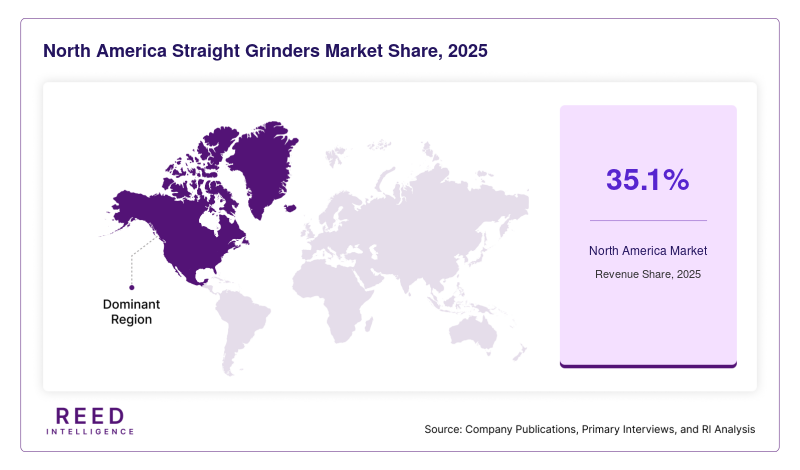
North America accounted for approximately 35.1% of the global Straight Grinders Market in 2025 and continues to represent the largest regional market. The region is expected to expand at a CAGR of 6.5% through 2034, supported by strong industrial activity and continuous investments in advanced manufacturing technologies. Demand remains particularly strong across automotive, aerospace, and heavy equipment manufacturing sectors. The widespread adoption of automation and productivity-enhancing tools has encouraged industrial facilities to upgrade grinding equipment, contributing to stable market growth across the United States and Canada.
The United States remains the dominant country in the region due to its extensive manufacturing infrastructure and large industrial workforce. A unique growth factor is the increasing modernization of maintenance operations across industrial plants. Companies are investing in advanced portable tools to reduce downtime and improve operational efficiency. The presence of major equipment manufacturers and a strong focus on workplace safety standards further support market expansion, enabling steady adoption of technologically advanced straight grinders.
Europe
Europe represented approximately 27.4% of global market revenue in 2025 and is projected to grow at a CAGR of 6.8% during the forecast period. The region benefits from a strong industrial base, particularly in Germany, Italy, France, and the United Kingdom. Growing investments in precision engineering and high-quality manufacturing processes continue to support equipment demand. The increasing adoption of energy-efficient industrial tools is also contributing to market development across various manufacturing sectors.
Germany dominates the European market due to its leadership in industrial machinery, automotive production, and engineering excellence. A unique growth factor is the country's emphasis on Industry 4.0 initiatives and smart manufacturing systems. Industrial facilities are integrating advanced tools with digital monitoring capabilities to improve productivity and quality control. This trend is creating favorable conditions for innovative straight grinder solutions and encouraging replacement demand across mature industrial sectors.
Asia Pacific
Asia Pacific held approximately 24.8% of global market share in 2025 and is expected to register the fastest CAGR of 8.9% through 2034. Rapid industrialization, urbanization, and infrastructure development are driving substantial demand for grinding equipment across the region. Expanding manufacturing output in automotive, electronics, metal fabrication, and construction industries continues to support market growth. Rising foreign direct investment in industrial projects further strengthens demand for high-performance tools.
China remains the leading country within Asia Pacific owing to its large manufacturing sector and extensive industrial supply chain. A unique growth factor is the government's ongoing support for domestic manufacturing modernization and industrial upgrading programs. Investments in advanced production facilities and export-oriented manufacturing activities are increasing demand for precision finishing tools. Additionally, growing adoption of cordless industrial equipment is contributing to strong market momentum throughout the country.
Middle East & Africa
The Middle East & Africa accounted for approximately 6.5% of the global market in 2025 and is anticipated to grow at a CAGR of 7.3% during 2026–2034. Growth is supported by increasing investments in infrastructure development, industrial diversification programs, and energy-related projects. Demand for straight grinders is expanding across construction, fabrication, and maintenance applications. Governments are actively promoting industrial development initiatives to reduce dependence on traditional economic sectors, creating new opportunities for equipment suppliers.
Saudi Arabia leads the regional market due to large-scale industrial and infrastructure investments. A unique growth factor is the expansion of manufacturing and construction projects under long-term economic diversification programs. Industrial facilities require reliable grinding equipment for fabrication and maintenance tasks associated with new industrial zones and infrastructure developments. This sustained investment environment is expected to strengthen equipment demand over the forecast period.
Latin America
Latin America captured approximately 6.2% of global revenue in 2025 and is forecast to grow at a CAGR of 7.0% through 2034. The region is benefiting from increasing construction activity, mining operations, and industrial modernization efforts. Growing demand for metal fabrication and maintenance services supports the adoption of straight grinders across multiple sectors. Investments in transportation infrastructure and manufacturing expansion projects are also contributing to market development.
Brazil remains the dominant country in Latin America owing to its diversified industrial economy and extensive manufacturing activities. A unique growth factor is the growing expansion of metalworking and fabrication industries serving construction, agriculture, and mining sectors. Rising demand for industrial maintenance services and equipment upgrades is encouraging businesses to invest in efficient grinding tools capable of improving operational productivity and reducing project completion times.
Competitive Landscape
The Straight Grinders Market is characterized by the presence of established international manufacturers and regional suppliers competing through product innovation, distribution expansion, and technology development. Companies are focusing on ergonomic improvements, cordless technology, motor efficiency, and operator safety features to strengthen their market positions. Strategic partnerships with industrial distributors and investments in research and development remain common competitive strategies.
Among leading participants, Makita Corporation maintains a strong market position due to its extensive product portfolio and global distribution network. The company recently introduced enhanced cordless grinding solutions designed to improve battery performance and operational flexibility. Other major competitors continue to expand their offerings through advanced brushless motor technologies, vibration-control systems, and industrial-grade durability enhancements.
Competition is expected to intensify as industrial customers increasingly seek productivity-focused equipment with lower maintenance requirements. Manufacturers that successfully combine performance, reliability, portability, and energy efficiency are likely to strengthen their competitive standing during the forecast period.
Key Players
- Makita Corporation
- Bosch Power Tools
- Stanley Black & Decker, Inc.
- Hilti Corporation
- Metabo GmbH
- Atlas Copco AB
- Ingersoll Rand Inc.
- Chicago Pneumatic
- Fein Power Tools Inc.
- Dynabrade Inc.
- Fuji Tools
- DeWalt
- Milwaukee Tool
- Koki Holdings Co., Ltd.
- Panasonic Corporation
Recent Developments
- In 2025, a leading power tool manufacturer expanded its production capacity for cordless straight grinders to address increasing demand from industrial maintenance, fabrication, and construction sectors.
- In 2025, several industrial tool companies launched next-generation brushless motor straight grinders featuring improved energy efficiency, longer operating life, and reduced maintenance requirements.
- In 2024, a major equipment producer introduced an advanced high-precision straight grinder designed for aerospace and metal fabrication applications requiring enhanced surface finishing performance.
- In 2024, manufacturers increased investments in ergonomic tool development programs focused on reducing vibration levels, improving operator comfort, and enhancing workplace safety compliance.
- In 2025, strategic partnerships between power tool manufacturers and industrial distributors accelerated the adoption of cordless straight grinder solutions across manufacturing facilities and field maintenance operations.
Straight Grinders Market Segments
By Product Type
- Electric Straight Grinders
- Pneumatic Straight Grinders
- Cordless Straight Grinders
By Power Rating
- Up to 500 W
- 500 W–1,000 W
- Above 1,000 W
By Application
- Metal Fabrication
- Precision Finishing & Polishing
- Deburring
- Weld Grinding
- Surface Preparation
By End-Use Industry
- Manufacturing
- Automotive
- Aerospace
- Construction
By Region
- North America
- Europe
- APAC
- Middle East and Africa
- LATAM