Strand Displacement Amplification Market Size, Share & Demand Report By Type (Reagent Kits, Instruments), By Application (Infectious Disease Diagnostics, Oncology Diagnostics, Genetic Testing), By End-Use (Hospitals and Diagnostic Laboratories, Research Institutes, Others) By Region & Segment Forecasts, 2025–2034
USD 3950
Market Overview
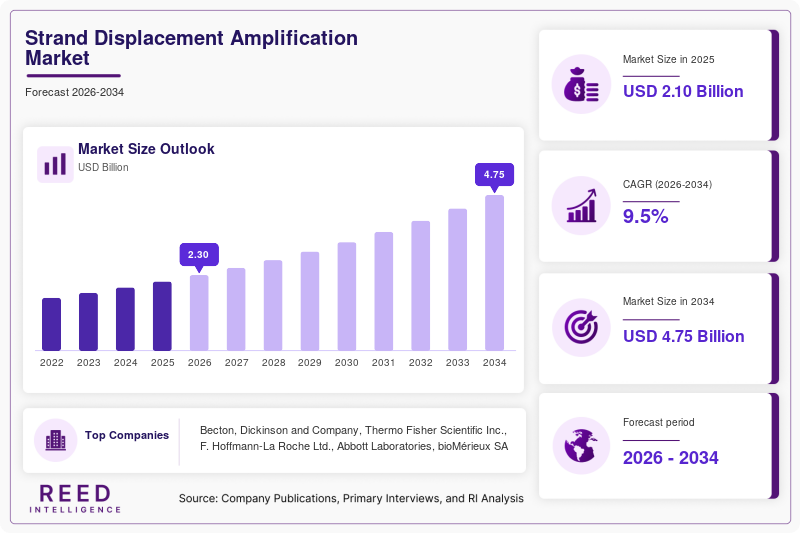
The Strand Displacement Amplification Market size is estimated at USD 2.1 billion and is projected to reach approximately USD 2.3 billion in 2026. The market is expected to expand significantly, reaching USD 4.8 billion by 2034, registering a compound annual growth rate (CAGR) of 9.5% during the forecast period from 2025 to 2034. This growth trajectory reflects increasing adoption in clinical diagnostics, infectious disease detection, and point-of-care testing applications.
One of the primary growth factors is the rising demand for rapid diagnostic solutions that eliminate the need for thermal cycling, making strand displacement amplification highly suitable for decentralized healthcare settings. Additionally, the growing prevalence of infectious diseases such as tuberculosis, influenza, and emerging viral infections is fueling the need for efficient nucleic acid amplification technologies. Another major driver is the increasing investment in biotechnology research, particularly in genomics and molecular biology, where SDA offers advantages in speed and simplicity compared to traditional PCR methods.
Key Highlights
- The market size is estimated at USD 2.1 billion in 2025 and is expected to reach USD 2.3 billion in 2026.
This steady increase reflects growing adoption of advanced molecular diagnostic technologies across healthcare settings. - The market is forecasted to reach USD 4.8 billion by 2034 at a CAGR of 9.5%.
This growth is supported by continuous innovation and expanding applications in clinical and research diagnostics. - Rising demand for rapid and isothermal amplification technologies is driving market expansion.
These technologies enable faster results without complex thermal cycling, making them suitable for point-of-care use. - The increasing prevalence of infectious diseases globally is boosting demand for efficient diagnostic solutions.
Early detection and disease control efforts are accelerating the adoption of strand displacement amplification methods.
Market Trends
Increasing Adoption of Point-of-Care Testing
The growing emphasis on decentralized healthcare has led to a significant rise in the adoption of point-of-care testing solutions, which is directly influencing the Strand Displacement Amplification Market. SDA technology is well-suited for these applications due to its ability to operate under isothermal conditions, eliminating the need for complex laboratory infrastructure. This trend is particularly evident in remote and resource-limited settings where access to centralized laboratories is limited. Healthcare providers are increasingly relying on rapid diagnostic tools that deliver accurate results within a short timeframe. As a result, SDA-based assays are being integrated into portable diagnostic devices, enabling real-time disease detection and management. This shift toward patient-centric care models is expected to continue driving demand.
Integration with Microfluidics and Lab-on-a-Chip Systems
Another emerging trend in the market is the integration of strand displacement amplification with microfluidic and lab-on-a-chip technologies. These systems allow for miniaturization of diagnostic processes, reducing reagent consumption and improving efficiency. The combination of SDA with microfluidics enhances automation, enabling simultaneous processing of multiple samples with minimal human intervention. This trend is gaining traction in research laboratories and clinical diagnostics due to its ability to improve throughput and reduce operational costs. Furthermore, advancements in chip design and material science are enabling the development of compact, user-friendly diagnostic devices that incorporate SDA technology, expanding its applicability across various sectors.
Market Drivers
Rising Burden of Infectious Diseases
The increasing global burden of infectious diseases is a major driver for the Strand Displacement Amplification Market. Diseases such as COVID-19, influenza, and tuberculosis require rapid and accurate diagnostic methods for effective management and containment. SDA technology offers high sensitivity and specificity, making it suitable for detecting low levels of pathogens in clinical samples. The need for early diagnosis and timely treatment has led to increased adoption of molecular diagnostic techniques, including SDA. Governments and healthcare organizations are investing in diagnostic infrastructure to improve disease surveillance and response capabilities. This growing focus on public health is expected to sustain demand for SDA-based diagnostic solutions.
Technological Advancements in Molecular Diagnostics
Continuous advancements in molecular diagnostic technologies are significantly contributing to market growth. Innovations in enzyme engineering and nucleic acid chemistry have enhanced the performance of strand displacement amplification assays. These improvements have resulted in faster reaction times, higher accuracy, and reduced false positives. Additionally, the development of multiplex assays allows for the simultaneous detection of multiple pathogens, increasing the efficiency of diagnostic processes. The integration of SDA with digital health platforms and data analytics tools is further enhancing its utility in clinical and research settings. These technological developments are making SDA a preferred choice for various diagnostic applications.
Market Restraint
Limited Awareness and Standardization Challenges
One of the primary restraints affecting the Strand Displacement Amplification Market is the limited awareness among healthcare professionals and end-users regarding the benefits and applications of SDA technology. Despite its advantages, many diagnostic laboratories continue to rely on conventional PCR methods due to familiarity and established protocols. This lack of awareness hampers the widespread adoption of SDA-based assays.
Additionally, the absence of standardized protocols and regulatory guidelines poses a challenge for market growth. Variability in assay performance and differences in reagent quality can lead to inconsistent results, affecting reliability and trust among users. For example, smaller diagnostic laboratories may face difficulties in implementing SDA due to a lack of technical expertise and training. These challenges can delay the adoption of SDA technologies, particularly in developing regions where resources are limited. Addressing these issues through education, training programs, and standardization efforts will be crucial for unlocking the full potential of the market.
Market Opportunities
Expansion in Emerging Markets
Emerging economies present significant growth opportunities for the Strand Displacement Amplification Market. Countries in Asia Pacific, Latin America, and Africa are investing heavily in healthcare infrastructure to improve diagnostic capabilities. The increasing prevalence of infectious diseases in these regions is driving the demand for rapid and cost-effective diagnostic solutions. SDA technology, with its relatively simple operational requirements, is well-suited for deployment in these markets. Governments and international organizations are supporting initiatives to enhance diagnostic accessibility, creating favorable conditions for market expansion. This trend is expected to open new revenue streams for manufacturers and service providers.
Growing Applications in Non-Clinical Sectors
The expanding use of SDA technology in non-clinical applications such as food safety, environmental monitoring, and veterinary diagnostics offers another promising opportunity. In the food industry, SDA is used for detecting pathogens and ensuring product safety, while in environmental monitoring, it helps identify microbial contamination. The versatility of SDA technology makes it suitable for a wide range of applications beyond healthcare. As industries increasingly prioritize quality control and regulatory compliance, the demand for reliable diagnostic tools is expected to rise. This diversification of applications is likely to drive sustained growth in the market.
Segmental Analysis
By Type
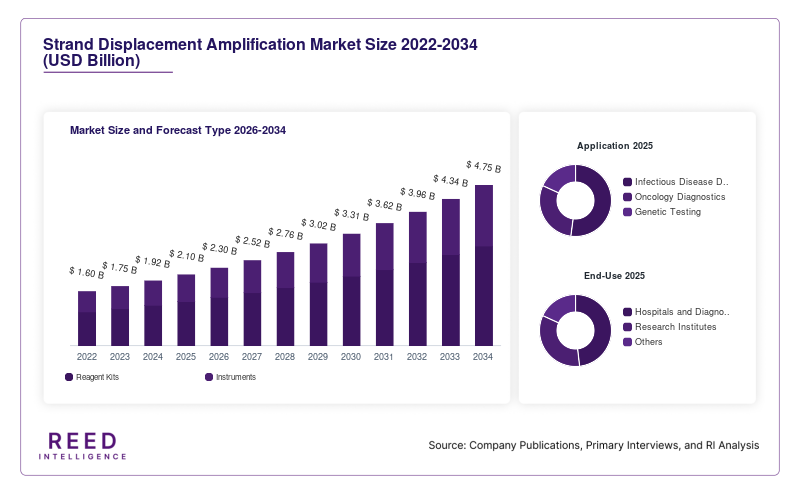
The reagent kits segment dominated the market in 2024, accounting for approximately 45% of the total share. This dominance is attributed to the recurring demand for consumables in diagnostic procedures. Reagent kits are essential components of SDA assays, and their continuous use in clinical and research settings ensures steady revenue generation. The increasing adoption of molecular diagnostics and the growing number of diagnostic tests conducted globally are driving demand for reagent kits. Additionally, advancements in reagent formulations are improving assay performance, further supporting segment growth.
The instruments segment is expected to be the fastest-growing, with a CAGR of 10.8% during the forecast period. The growth is driven by increasing automation in diagnostic laboratories and the rising demand for high-throughput systems. Advanced instruments equipped with integrated SDA capabilities are enhancing efficiency and reducing turnaround time. The growing focus on laboratory modernization and the need for scalable diagnostic solutions are key factors contributing to the rapid growth of this segment.
By Application
Infectious disease diagnostics held the largest share in 2024, accounting for around 50% of the market. The high prevalence of infectious diseases and the need for rapid and accurate diagnostic methods are driving this segment. SDA technology is widely used for detecting pathogens due to its high sensitivity and specificity. The increasing focus on disease surveillance and outbreak management is further boosting demand for SDA-based diagnostic solutions in this segment.
The oncology diagnostics segment is projected to grow at the fastest rate, with a CAGR of 11.5%. The rising incidence of cancer and the growing demand for early detection methods are key factors driving this growth. SDA technology is being increasingly used in cancer diagnostics for detecting genetic mutations and biomarkers. The integration of SDA with advanced genomic technologies is enhancing its applicability in oncology, supporting segment expansion.
By End-Use
Hospitals and diagnostic laboratories dominated the market in 2024, accounting for approximately 55% of the total share. These facilities are the primary users of SDA technology due to the high volume of diagnostic tests performed. The availability of skilled professionals and advanced infrastructure enables efficient implementation of SDA-based assays. The increasing patient load and the need for rapid diagnostics are driving demand in this segment.
Research institutes are expected to be the fastest-growing end-use segment, with a CAGR of 10.5%. The growth is driven by increasing research activities in genomics and molecular biology. SDA technology is widely used in research applications for studying gene expression and detecting nucleic acids. The rising investment in life sciences research and the growing focus on innovation are supporting the growth of this segment.
Regional Analysis
North America
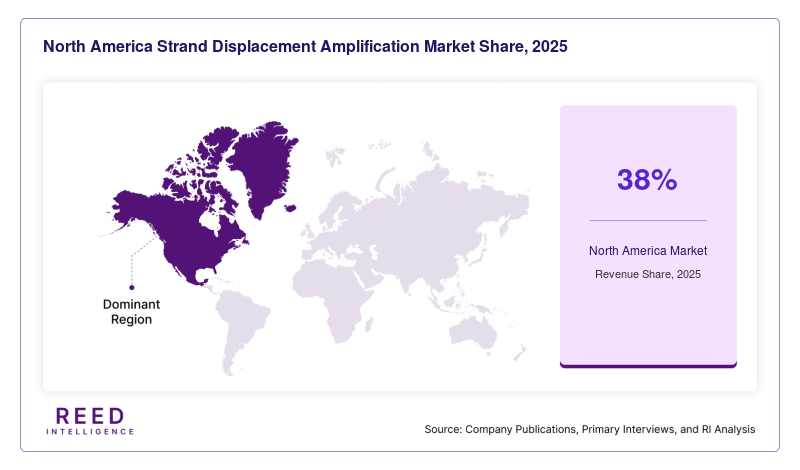
North America accounted for the largest share of the Strand Displacement Amplification Market in 2025, contributing approximately 38% of the global revenue. The region is expected to maintain its dominance with a CAGR of 8.9% during the forecast period. The presence of advanced healthcare infrastructure, high adoption of molecular diagnostics, and strong investment in research and development are key factors driving market growth. Additionally, favorable reimbursement policies and regulatory support further enhance market expansion.
The United States is the dominant country in this region, driven by its well-established biotechnology sector and high healthcare spending. A unique growth factor is the strong collaboration between academic institutions and biotech companies, which accelerates innovation and commercialization of SDA technologies. These partnerships enable rapid development of new diagnostic solutions, strengthening the market position of North America.
Europe
Europe held a significant share of around 26% in 2025 and is projected to grow at a CAGR of 8.5% through 2034. The region benefits from a robust healthcare system and increasing focus on early disease detection. Government initiatives aimed at improving diagnostic capabilities and promoting research activities are supporting market growth. The rising prevalence of chronic and infectious diseases is also contributing to increased demand for SDA-based diagnostics.
Germany is the leading country in Europe, owing to its strong emphasis on research and innovation in molecular diagnostics. A unique growth factor is the presence of well-established regulatory frameworks that ensure the quality and safety of diagnostic products. This regulatory clarity encourages manufacturers to invest in the development of advanced SDA technologies.
Asia Pacific
Asia Pacific is expected to witness the fastest growth, with a CAGR of 11.2% during the forecast period, and accounted for approximately 20% of the market share in 2025. The region is characterized by a large patient population and increasing healthcare expenditure. Rapid urbanization and growing awareness about early disease detection are driving the adoption of molecular diagnostic technologies.
China dominates the Asia Pacific market due to its expanding biotechnology industry and government support for healthcare innovation. A unique growth factor is the increasing number of local manufacturers entering the market, offering cost-effective SDA solutions. This competitive landscape is driving affordability and accessibility, boosting market growth.
Middle East & Africa
The Middle East & Africa region held a smaller share of around 8% in 2025 but is expected to grow at a CAGR of 9.8%. The market is driven by increasing investments in healthcare infrastructure and rising awareness about advanced diagnostic technologies. Governments are focusing on improving healthcare access, particularly in underserved areas, which is creating demand for portable diagnostic solutions.
South Africa is a key market in this region, supported by initiatives to combat infectious diseases such as HIV and tuberculosis. A unique growth factor is the increasing involvement of international organizations in funding healthcare projects, which facilitates the adoption of SDA technologies in resource-limited settings.
Latin America
Latin America accounted for approximately 8% of the market share in 2025 and is projected to grow at a CAGR of 9.2%. The region is experiencing steady growth due to improving healthcare infrastructure and rising demand for advanced diagnostic solutions. Increasing awareness about the benefits of early disease detection is also contributing to market expansion.
Brazil is the dominant country in Latin America, driven by its large healthcare sector and growing investment in medical technologies. A unique growth factor is the expansion of private diagnostic laboratories, which are adopting advanced technologies such as SDA to enhance service quality and efficiency.
Competitive Landscape
The Strand Displacement Amplification Market is moderately competitive, with several key players focusing on innovation and strategic partnerships to strengthen their market position. Leading companies are investing in research and development to enhance the performance and reliability of SDA-based diagnostic solutions. The market is characterized by the presence of both established players and emerging companies, creating a dynamic competitive environment.
A leading player in the market is Becton, Dickinson and Company, which has a strong portfolio of molecular diagnostic products and a global presence. The company focuses on expanding its product offerings through continuous innovation and strategic acquisitions. Other major players are also actively engaged in developing advanced SDA technologies and expanding their geographical footprint.
Recent developments include product launches, collaborations, and mergers aimed at enhancing technological capabilities and market reach. Companies are increasingly focusing on integrating SDA technology with digital platforms to improve diagnostic efficiency and data management. These strategies are expected to intensify competition and drive market growth.
Key Players List
- Becton, Dickinson and Company
- Thermo Fisher Scientific Inc.
- F. Hoffmann-La Roche Ltd.
- Abbott Laboratories
- bioMérieux SA
- QIAGEN N.V.
- Danaher Corporation
- Hologic Inc.
- Meridian Bioscience Inc.
- Quidel Corporation
- GenMark Diagnostics
- Illumina Inc.
- Agilent Technologies
- PerkinElmer Inc.
- Bio-Rad Laboratories Inc.
Recent Developments
- A leading diagnostics company launched a new SDA-based rapid testing kit designed for point-of-care applications, improving turnaround time and accuracy.
- A strategic collaboration between biotechnology firms focused on integrating SDA technology with microfluidic platforms to enhance diagnostic efficiency.
- A major player expanded its manufacturing capacity to meet the growing demand for SDA reagent kits in emerging markets.
Strand Displacement Amplification Market Segments
Type
- Reagent Kits
- Instruments
Application
- Infectious Disease Diagnostics
- Oncology Diagnostics
- Genetic Testing
End-Use
- Hospitals and Diagnostic Laboratories
- Research Institutes
- Others
By Region
- North America
- Europe
- APAC
- Middle East and Africa
- LATAM