Stretch Film Machinery Market Size, Share & Demand Report By Machine Type (Automatic Stretch Film Machinery, Semi-Automatic Stretch Film Machinery, Robotic Stretch Wrapping Systems, Turntable Stretch Wrappers, Rotary Arm Stretch Wrappers), By Application (Pallet Wrapping, Food and Beverage Packaging, Industrial Product Packaging, Pharmaceutical Packaging, Logistics and Warehousing), By End-Use Industry (Food and Beverage, Pharmaceuticals, Consumer Goods, Chemicals, Construction Materials, Automo
USD 3950
Market Overview
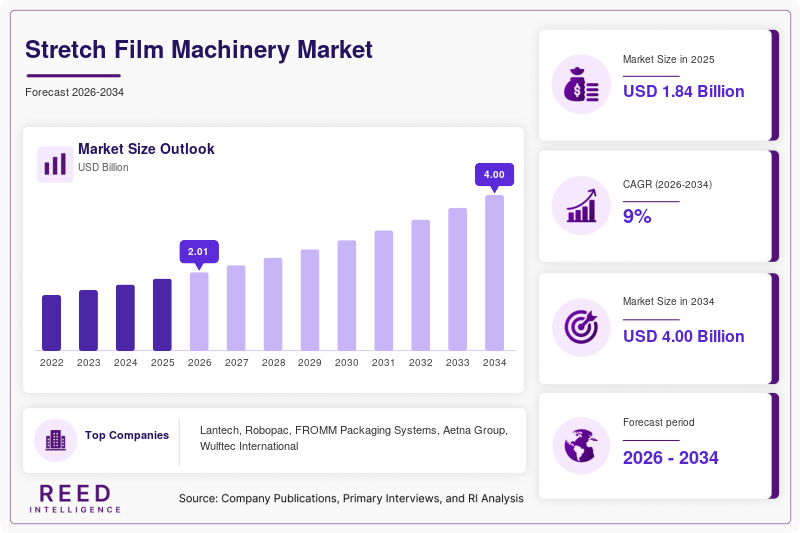
The global Stretch Film Machinery Market size was valued at USD 1.84 billion in 2026 and is projected to reach USD 3.67 billion by 2034, expanding at a CAGR of 9.0% during the forecast period from 2026 to 2034. The market continues to gain momentum due to the growing demand for efficient packaging solutions across logistics, food processing, pharmaceuticals, construction materials, and consumer goods industries. Increasing international trade volumes and rising investments in automated warehousing systems have encouraged manufacturers to adopt advanced stretch film machinery capable of improving productivity and reducing packaging waste.
The expansion of e-commerce and organized retail infrastructure has significantly influenced market growth. Warehousing operators and distribution centers increasingly rely on automated pallet wrapping and stretch packaging systems to ensure product safety during transportation. Manufacturers are also integrating digital monitoring systems, predictive maintenance capabilities, and energy-efficient motors into machinery designs to improve operational efficiency. In addition, sustainability initiatives are encouraging companies to develop machinery compatible with recyclable and downgauged stretch films, supporting long-term industry transformation.
Key Highlights
- North America dominated the market with a 35.1% share in 2025.
- Asia Pacific is expected to grow at the fastest CAGR of 10.8% during 2026–2034.
- By machine type, automatic stretch film machinery accounted for the largest share of 46.8%, while robotic stretch wrapping systems are projected to grow at a CAGR of 11.5%.
- By application, pallet wrapping led with a 43.6% share, whereas food and beverage packaging is expected to expand at a CAGR of 10.9%.
- The United States remained the dominant country, with market values of USD 470 million in 2024 and USD 515 million in 2025.
Market Trends
Integration of Smart Automation and Industry 4.0 Technologies
The Stretch Film Machinery Market is experiencing a significant shift toward smart automation technologies. Manufacturers are increasingly incorporating sensors, programmable logic controllers, remote diagnostics, and cloud-connected monitoring systems into machinery platforms. These technologies help production facilities reduce downtime, improve wrapping precision, and optimize film consumption. Packaging companies are seeking automated machinery capable of real-time performance tracking to improve efficiency and lower operational costs. Smart systems also enable predictive maintenance, reducing unexpected equipment failures and extending machinery lifespan.
The adoption of Industry 4.0 technologies has become more visible in high-capacity logistics and warehouse operations. Automated stretch film machinery equipped with AI-assisted controls can adjust wrapping tension and rotation speed according to product dimensions and pallet load stability. This trend is helping companies reduce material wastage while maintaining packaging integrity during transportation. As industrial facilities continue modernizing production lines, demand for digitally integrated stretch film machinery is expected to increase steadily across developed and emerging economies.
Rising Preference for Sustainable and Energy-Efficient Machinery
Sustainability has emerged as a major trend influencing machinery manufacturers and packaging operators worldwide. Companies are increasingly investing in stretch film machinery designed to minimize film usage, lower electricity consumption, and support recyclable packaging materials. Manufacturers are developing systems compatible with thinner stretch films without compromising load stability, helping businesses reduce packaging costs and environmental impact simultaneously.
Energy-efficient motors, optimized film carriage systems, and low-power automation modules are becoming standard features in new machinery installations. Many industrial users are also adopting machinery capable of operating with biodegradable and recycled stretch films to align with corporate sustainability objectives. Regulatory pressure related to plastic waste management in Europe and North America is further encouraging innovation in eco-friendly packaging machinery. This trend is expected to create long-term growth opportunities for manufacturers focusing on sustainable machinery technologies and environmentally responsible packaging operations.
Market Drivers
Expansion of Global Logistics and Warehousing Infrastructure
The rapid expansion of logistics networks and warehousing facilities is one of the major factors driving the Stretch Film Machinery Market. Growing cross-border trade activities and rising consumer demand for fast product delivery have increased the need for secure pallet packaging solutions. Warehousing operators require efficient stretch wrapping systems to protect products from dust, moisture, and transportation damage. Automatic machinery significantly improves packaging speed and operational consistency compared to manual wrapping methods.
E-commerce companies and third-party logistics providers are investing heavily in automated packaging infrastructure to improve supply chain efficiency. High-volume distribution centers increasingly prefer stretch film machinery with conveyor integration and robotic handling capabilities to reduce labor dependency. The growth of organized retail and industrial manufacturing in developing economies is also contributing to higher machinery adoption. As supply chains become more complex and shipment volumes continue rising, demand for advanced stretch wrapping equipment is expected to remain strong throughout the forecast period.
Increasing Demand for Cost-Effective Packaging Solutions
Industrial manufacturers are focusing on reducing packaging costs while maintaining product safety and transportation efficiency. Stretch film machinery enables companies to optimize film usage and minimize material wastage through controlled wrapping tension and automated film dispensing systems. Businesses are increasingly adopting automated machinery to lower labor expenses and improve productivity in packaging operations.
The need for standardized packaging quality across food processing, pharmaceuticals, electronics, and consumer goods industries is also accelerating market growth. Automated stretch wrapping systems help companies achieve uniform packaging performance while reducing the risk of damaged shipments. In addition, rising labor shortages in industrial sectors are encouraging companies to shift toward automated packaging technologies. High-speed machinery with advanced load stabilization features provides long-term operational savings, making stretch film machinery an attractive investment for manufacturers seeking cost-efficient packaging solutions.
Market Restraint
High Initial Investment and Maintenance Costs
The high capital investment associated with advanced stretch film machinery remains a significant restraint for market growth, particularly among small and medium-sized enterprises. Fully automatic and robotic wrapping systems require substantial upfront expenditure for machinery procurement, installation, software integration, and employee training. Many smaller manufacturers operating with limited budgets continue relying on semi-automatic or manual packaging methods due to financial constraints.
Maintenance and servicing costs also create challenges for end users. Advanced machinery equipped with automation systems, sensors, and robotic components often requires specialized technical support and periodic software upgrades. Unplanned downtime caused by equipment malfunction can disrupt packaging operations and increase operational expenses. In emerging economies, limited availability of skilled technicians and replacement parts may further restrict machinery adoption. For example, smaller food processing facilities in developing regions often delay investments in automated stretch film machinery because of concerns related to long-term maintenance expenses and uncertain return on investment. These financial barriers may slow market penetration in cost-sensitive industries despite the growing advantages of automation.
Market Opportunities
Growing Adoption of Robotic Stretch Wrapping Systems
The increasing use of robotic packaging technologies presents substantial growth opportunities for the Stretch Film Machinery Market. Robotic stretch wrapping systems offer flexibility, mobility, and automation advantages compared to conventional stationary machinery. These systems are particularly beneficial for facilities handling irregular pallet sizes or operating within limited floor space. Manufacturers are increasingly developing compact robotic wrapping equipment capable of autonomous movement and adaptive wrapping patterns.
Industries such as food processing, beverages, chemicals, and logistics are adopting robotic machinery to improve packaging speed and reduce manual labor requirements. Integration with automated guided vehicles and warehouse management systems is further enhancing operational efficiency. Robotic systems also help companies achieve consistent load stability while minimizing film consumption. As industrial facilities continue embracing smart manufacturing technologies, demand for robotic stretch film machinery is expected to rise significantly, creating opportunities for machinery manufacturers focused on automation and intelligent packaging systems.
Rising Industrialization Across Emerging Economies
Emerging economies in Asia Pacific, Latin America, and the Middle East are creating favorable opportunities for stretch film machinery manufacturers. Rapid industrialization, infrastructure development, and expansion of manufacturing facilities are increasing demand for modern packaging solutions. Countries such as India, Vietnam, Indonesia, Brazil, and Saudi Arabia are witnessing strong growth in food processing, pharmaceuticals, construction materials, and consumer goods production, all of which require efficient pallet packaging systems.
Government initiatives supporting manufacturing sector expansion and foreign direct investment are encouraging companies to modernize packaging operations. Many local manufacturers are transitioning from manual wrapping processes to automated machinery to improve efficiency and product protection. Rising export activities are also contributing to demand for reliable stretch wrapping equipment capable of ensuring shipment safety during long-distance transportation. As industrial production capacity expands across emerging markets, machinery suppliers are expected to benefit from increasing equipment installations and long-term service contracts.
Segmental Analysis
By Machine Type
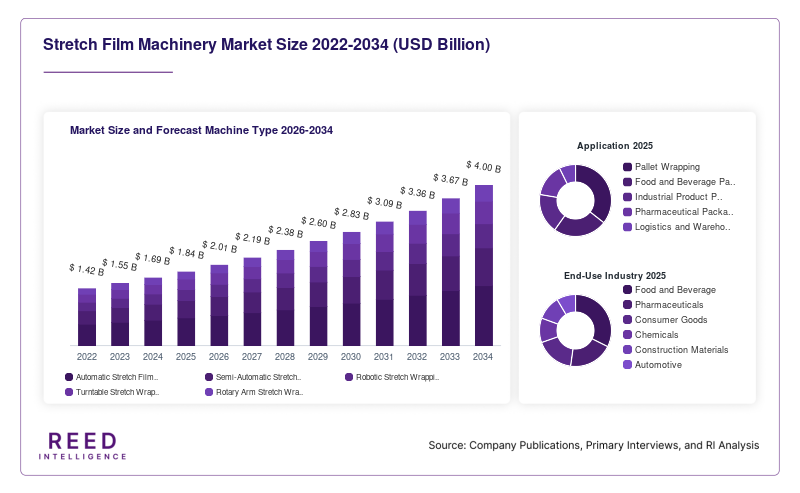
Automatic stretch film machinery held the dominant share of 46.8% in 2024 due to increasing demand for high-speed and labor-efficient packaging operations. Large manufacturing facilities and logistics centers increasingly prefer automatic systems because they improve wrapping consistency, reduce film wastage, and enhance operational productivity. These machines are widely used in food processing, pharmaceuticals, beverages, and consumer goods industries where packaging speed and load stability are critical. Automatic machinery also helps businesses reduce labor dependency and maintain standardized packaging quality across large shipment volumes.
The segment benefits from integration with conveyor systems and warehouse automation platforms. Many companies are adopting fully automatic pallet wrapping systems capable of continuous operation with minimal human intervention. Advanced machines equipped with programmable controls and remote monitoring capabilities are improving operational efficiency and predictive maintenance performance. Rising investments in industrial automation and smart packaging infrastructure continue supporting the expansion of this segment across developed and emerging markets.
By Application
Pallet wrapping accounted for the largest market share of 43.6% in 2024 due to its widespread use in transportation and logistics operations. Stretch film machinery used for pallet wrapping helps secure products during storage and shipment, reducing the risk of damage caused by movement or environmental exposure. Manufacturing industries handling large shipment volumes rely heavily on pallet wrapping systems to maintain supply chain efficiency and product integrity. Automated pallet wrapping machinery also supports improved packaging consistency and reduced labor requirements.
The growth of e-commerce and international trade has significantly increased the importance of pallet wrapping applications. Distribution centers and logistics providers are investing in high-speed wrapping systems integrated with automated conveyor networks to improve operational throughput. Food processing, pharmaceuticals, chemicals, and construction materials industries continue generating substantial demand for pallet wrapping machinery due to increasing shipment volumes and packaging safety requirements.
By End Use Industry
The food and beverage industry dominated the Stretch Film Machinery Market with a 31.9% share in 2024 due to rising packaged food consumption and increasing global food trade activities. Manufacturers in this industry require reliable packaging systems to protect products during transportation and maintain hygiene standards. Stretch film machinery helps improve pallet stability and reduces the risk of contamination or damage during storage and distribution. Automated wrapping systems are widely adopted in beverage bottling plants, dairy processing facilities, frozen food production units, and packaged snack manufacturing operations.
The industry’s demand for high-speed packaging solutions continues increasing due to growing production volumes and expanding retail distribution networks. Food manufacturers are investing in automated machinery integrated with smart monitoring technologies to improve operational efficiency and packaging consistency. Rising consumer preference for packaged and convenience food products is expected to maintain strong demand for stretch film machinery across the food and beverage sector.
Regional Analysis
North America
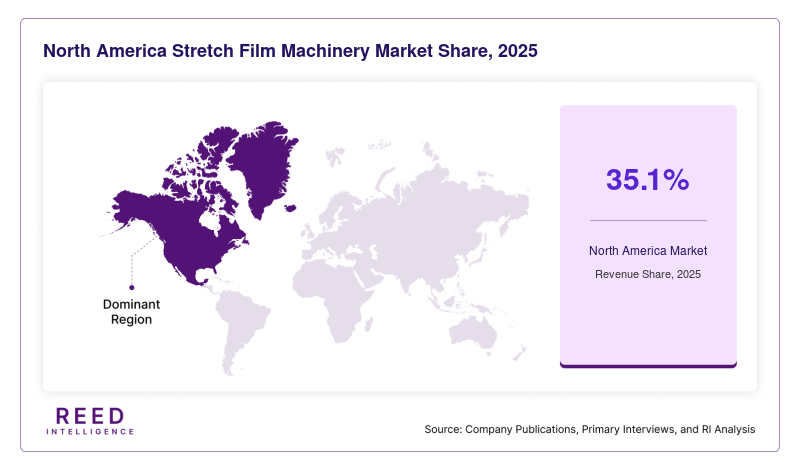
North America accounted for 35.1% of the global Stretch Film Machinery Market share in 2025 and continues to maintain a strong position due to widespread industrial automation and advanced packaging infrastructure. The region is projected to expand at a CAGR of 8.5% during the forecast period. Demand for high-speed pallet wrapping systems is increasing across logistics, food processing, and pharmaceutical sectors. Companies in the region are investing heavily in automated warehouse operations and intelligent packaging technologies to improve supply chain efficiency and reduce labor costs.
The United States remains the dominant country in North America due to its extensive manufacturing base and growing e-commerce industry. Rising investments in smart warehouses and distribution centers are driving machinery demand across the country. Major logistics operators are adopting robotic stretch wrapping systems integrated with conveyor networks to improve packaging throughput. The increasing focus on sustainable packaging solutions and reduced plastic consumption is also encouraging adoption of advanced machinery capable of operating with downgauged stretch films.
Europe
Europe represented 27.4% of the global Stretch Film Machinery Market in 2025 and is anticipated to grow at a CAGR of 8.1% between 2026 and 2034. The region benefits from strong manufacturing activity, advanced packaging regulations, and increasing investments in sustainable industrial operations. Demand for automated wrapping equipment is particularly high in Germany, Italy, France, and the United Kingdom. Packaging companies are focusing on machinery capable of reducing film waste and improving energy efficiency to meet environmental compliance standards.
Germany remains the leading country in the European market due to its strong industrial automation sector and well-established machinery manufacturing industry. German packaging companies are increasingly adopting intelligent stretch wrapping systems equipped with digital monitoring technologies. The country’s automotive, food processing, and logistics sectors continue generating significant demand for automated pallet packaging equipment. Investments in smart factories and energy-efficient production systems are further supporting machinery installations across industrial facilities.
Asia Pacific
Asia Pacific is expected to register the fastest CAGR of 10.8% during the forecast period due to rapid industrialization and expanding manufacturing activities. The region accounted for 24.6% of the global Stretch Film Machinery Market share in 2025. Countries such as China, India, Japan, South Korea, and Vietnam are witnessing rising demand for automated packaging systems across food processing, pharmaceuticals, electronics, and consumer goods sectors. Increasing export-oriented manufacturing is further driving demand for secure pallet packaging solutions.
China dominates the Asia Pacific market because of its large industrial base and extensive packaging industry. Rapid growth in logistics infrastructure and e-commerce distribution centers is encouraging widespread adoption of stretch film machinery. Chinese manufacturers are investing in automated production lines and high-speed packaging equipment to improve productivity and maintain global competitiveness. Government initiatives supporting industrial automation and smart manufacturing are also accelerating machinery deployment across the country.
Middle East & Africa
The Middle East & Africa Stretch Film Machinery Market accounted for 6.1% of global revenue in 2025 and is projected to grow at a CAGR of 7.6% during the forecast period. The region is experiencing increasing demand for industrial packaging solutions due to growth in construction materials, chemicals, food processing, and logistics sectors. Industrial diversification initiatives in Gulf countries are supporting investments in automated manufacturing and packaging technologies.
Saudi Arabia remains the dominant country in the regional market due to ongoing industrial expansion and infrastructure development projects. The country’s growing manufacturing sector and investments in logistics hubs are encouraging adoption of advanced stretch film machinery. Food and beverage manufacturers are increasingly implementing automated wrapping systems to improve packaging consistency and reduce labor dependency. Government-led industrial development programs are also supporting modernization of packaging operations across multiple sectors.
Latin America
Latin America accounted for 6.8% of the global Stretch Film Machinery Market share in 2025 and is forecast to expand at a CAGR of 7.9% during 2026–2034. The region is benefiting from increasing industrial production, growing food exports, and rising investments in packaging automation. Brazil, Mexico, and Argentina are among the key contributors to regional demand. Manufacturers are increasingly adopting stretch wrapping systems to improve transportation safety and reduce packaging inefficiencies.
Brazil dominates the Latin American market due to its large food processing and consumer goods industries. Packaging companies in the country are modernizing production facilities to improve operational efficiency and product protection. Rising export activities and growth in agricultural packaging are increasing demand for reliable stretch film machinery. Local industries are also adopting automated wrapping systems to reduce labor costs and maintain consistent packaging quality.
Competitive Landscape
The Stretch Film Machinery Market is moderately fragmented, with global and regional manufacturers competing through automation innovation, energy efficiency, and customized packaging solutions. Companies are focusing on expanding product portfolios and integrating smart technologies into machinery platforms to strengthen market presence. Strategic partnerships with logistics providers and industrial manufacturers are also becoming common as suppliers seek long-term equipment contracts and service agreements.
Among leading participants, Lantech remains a prominent market leader due to its extensive portfolio of automatic and semi-automatic stretch wrapping systems. The company continues investing in advanced automation technologies and sustainable packaging solutions. In 2025, Lantech introduced an upgraded intelligent wrapping system featuring remote diagnostics and optimized film tension control to improve packaging efficiency and reduce material consumption.
Key Players
- Lantech
- Robopac
- FROMM Packaging Systems
- Aetna Group
- Wulftec International
- ARPAC LLC
- Phoenix Wrappers
- Highlight Industries
- Technowrapp
- Cousins Packaging
- Orion Packaging Systems
- Tosa Group
- Nitech IPM
- Packway Inc.
- EFFE3ti Packaging Technologies
Recent Developments
- In 2025, Robopac launched a new AI-enabled robotic stretch wrapping system designed for high-capacity warehouse operations and improved film optimization.
- In 2024, Aetna Group expanded its manufacturing facility in Europe to increase production capacity for automatic pallet wrapping machinery.
- In 2025, FROMM Packaging Systems introduced an energy-efficient stretch wrapping platform compatible with recyclable stretch films for sustainable industrial packaging applications.
Stretch Film Machinery Market Segments
Machine Type
- Automatic Stretch Film Machinery
- Semi-Automatic Stretch Film Machinery
- Robotic Stretch Wrapping Systems
- Turntable Stretch Wrappers
- Rotary Arm Stretch Wrappers
Application
- Pallet Wrapping
- Food and Beverage Packaging
- Industrial Product Packaging
- Pharmaceutical Packaging
- Logistics and Warehousing
End-Use Industry
- Food and Beverage
- Pharmaceuticals
- Consumer Goods
- Chemicals
- Construction Materials
- Automotive
By Region
- North America
- Europe
- APAC
- Middle East and Africa
- LATAM