Structured Cabling System Market Size, Share & Demand Report By Product Type (Copper Cabling, Fiber Optic Cabling, Connectivity Components, Racks & Cabinets), By Application (Data Centers, LAN Infrastructure, Smart Building Infrastructure, Industrial Automation), By End Use (IT & Telecommunications, Commercial Buildings, Healthcare, Government, Manufacturing, Education), By Region & Segment Forecasts, 2026–2034
USD 3950
Market Overview
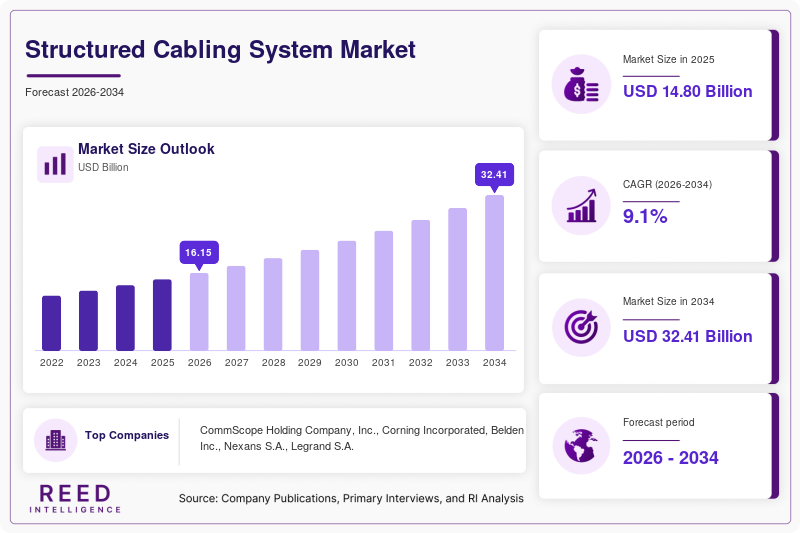
The global Structured Cabling System Market size was valued at USD 14.8 billion in 2026 and is projected to reach USD 29.6 billion by 2034, expanding at a CAGR of 9.1% during the forecast period from 2026 to 2034. Structured cabling systems are becoming essential for modern communication infrastructure due to growing enterprise digitization, rapid cloud adoption, and increasing deployment of smart buildings and connected devices. Organizations across sectors such as IT & telecom, healthcare, manufacturing, retail, and government are investing in high-performance network infrastructure to support rising bandwidth requirements and data traffic.
The expansion of hyperscale data centers and the increasing deployment of 5G infrastructure are supporting long-term market growth. Businesses are upgrading legacy copper networks with advanced fiber-optic cabling solutions to improve network reliability, speed, and scalability. In addition, demand for integrated communication systems in commercial buildings and industrial automation projects is creating consistent opportunities for structured cabling providers. The market is also benefiting from rising investments in smart city development and edge computing infrastructure.
Key Highlights
- North America dominated the market with a 35.1% share in 2025, while Asia Pacific is expected to grow at the fastest CAGR of 10.8% during 2026–2034.
- By product type, copper cabling accounted for the largest share of 46.3%, while fiber optic cabling is projected to grow at a CAGR of 11.6%.
- By application, data centers led with a 39.4% share, whereas smart building infrastructure is expected to expand at a CAGR of 12.1%.
- By end use, IT & telecommunications accounted for the largest share of 33.8%, while healthcare is projected to grow at a CAGR of 11.3%.
- The United States remained the dominant country, with market values of USD 3.9 billion in 2024 and USD 4.3 billion in 2025.
Market Trends
Growing Integration of Fiber-Optic Infrastructure Across Enterprises
Enterprises are increasingly adopting fiber-optic structured cabling systems to support high-speed communication networks and long-distance data transmission. The shift toward cloud computing, artificial intelligence workloads, and real-time analytics has increased the need for low-latency connectivity solutions. Fiber-optic systems offer improved bandwidth capacity, better signal integrity, and enhanced scalability compared to conventional copper infrastructure. Large organizations are modernizing office campuses, industrial facilities, and data centers with advanced fiber installations to manage increasing network traffic efficiently.
The adoption of hybrid work models and digital collaboration tools is also contributing to the expansion of enterprise networking infrastructure. Businesses are deploying structured cabling systems capable of supporting video conferencing, IoT connectivity, and secure cloud access. In addition, hyperscale data center operators are accelerating investments in fiber-rich infrastructure to support rising data consumption. The trend is especially visible in developed economies where enterprises are replacing outdated network architectures with high-capacity cabling systems to improve operational performance and long-term scalability.
Increasing Demand for Smart Building Connectivity Solutions
The development of smart commercial buildings is becoming a significant trend in the Structured Cabling System Market. Property developers and facility managers are integrating advanced communication infrastructure to support building automation systems, security monitoring, smart lighting, HVAC control, and occupancy management technologies. Structured cabling systems provide centralized and organized network architecture that simplifies maintenance and enhances operational efficiency in connected buildings.
The rise of smart campuses and intelligent industrial facilities is creating demand for scalable cabling platforms capable of supporting multiple communication protocols simultaneously. Governments across several countries are promoting energy-efficient construction projects, which is further increasing deployment of smart infrastructure technologies. Structured cabling systems are also becoming essential for integrating wireless access points, IoT sensors, and real-time monitoring systems within commercial facilities. As enterprises continue to prioritize digital transformation and operational automation, the demand for intelligent building connectivity infrastructure is expected to increase steadily during the forecast period.
Market Drivers
Expansion of Hyperscale Data Centers and Cloud Infrastructure
The rapid expansion of hyperscale data centers worldwide is a major factor supporting the growth of the Structured Cabling System Market. Increasing internet usage, digital commerce activities, streaming services, and enterprise cloud migration are generating significant demand for scalable network infrastructure. Data center operators require highly organized cabling systems to manage extensive server connections, minimize downtime, and improve airflow efficiency within facilities.
Cloud service providers are investing heavily in large-scale infrastructure projects across North America, Europe, and Asia Pacific to support rising enterprise demand for storage and computing capacity. Structured cabling solutions help improve network performance, reduce operational complexity, and simplify future infrastructure upgrades. The increasing deployment of edge data centers for low-latency applications is also contributing to market expansion. Furthermore, growing investments in AI processing infrastructure and machine learning applications are increasing the need for high-density cabling systems capable of handling large data volumes efficiently.
Rising Adoption of 5G Networks and IoT Ecosystems
The deployment of 5G communication infrastructure is significantly increasing demand for advanced structured cabling systems globally. Telecom operators are investing in high-speed fiber networks, small cell installations, and distributed antenna systems to support next-generation wireless connectivity. Structured cabling solutions play an essential role in enabling seamless data transmission between network components and supporting higher bandwidth requirements.
The growing adoption of IoT devices across industries such as manufacturing, healthcare, logistics, and retail is further strengthening market demand. Smart factories and connected industrial facilities require reliable cabling infrastructure to support real-time monitoring, predictive maintenance, and automated production systems. In healthcare environments, connected medical devices and digital patient management systems depend on stable communication networks. The increasing use of connected technologies in smart homes and commercial facilities is also contributing to continuous infrastructure modernization, supporting long-term growth opportunities for structured cabling providers worldwide.
Market Restraint
High Installation and Infrastructure Upgrade Costs
The high initial investment associated with structured cabling installations remains a major restraint for market expansion, particularly among small and medium-sized enterprises. Deploying advanced cabling systems often requires substantial expenses related to network design, cable routing, hardware integration, testing, and workforce training. Organizations upgrading legacy infrastructure may also experience operational disruptions and additional costs during the transition process.
Fiber-optic installations are comparatively more expensive than traditional copper systems due to higher material costs and specialized installation requirements. Many developing economies face limitations in adopting advanced cabling infrastructure because of budget constraints and inadequate technical expertise. In older commercial buildings, retrofitting structured cabling systems can become technically complex and financially demanding. For example, manufacturing facilities with outdated layouts may require significant redesign efforts to accommodate modern connectivity infrastructure. These challenges can delay purchasing decisions and reduce adoption rates among cost-sensitive organizations despite the long-term operational benefits associated with structured cabling systems.
Market Opportunities
Expansion of Smart City Infrastructure Projects
The increasing number of smart city initiatives worldwide is creating substantial opportunities for structured cabling system providers. Governments and municipal authorities are investing in digital infrastructure to support intelligent transportation systems, surveillance networks, public Wi-Fi connectivity, energy management platforms, and integrated communication systems. Structured cabling serves as the foundation for these interconnected urban technologies by enabling secure and reliable data transmission across various applications.
Emerging economies in Asia Pacific, the Middle East, and Latin America are increasing investments in urban modernization programs to improve public infrastructure and operational efficiency. Structured cabling vendors are benefiting from rising demand for high-capacity fiber networks capable of supporting large-scale data communication. In addition, smart transportation systems and intelligent traffic management platforms require advanced networking infrastructure to ensure seamless connectivity. The growing integration of IoT-enabled public services and real-time monitoring systems is expected to generate long-term business opportunities for companies operating in the structured cabling industry.
Rising Digital Transformation Across Healthcare Facilities
Healthcare institutions are increasingly modernizing communication infrastructure to support digital healthcare services, creating strong growth opportunities in the Structured Cabling System Market. Hospitals and medical centers require reliable networking systems for electronic health records, connected medical devices, telemedicine services, and real-time patient monitoring applications. Structured cabling systems provide scalable infrastructure capable of supporting high-speed data exchange across healthcare environments.
The growing adoption of smart medical equipment and AI-assisted diagnostic systems is increasing demand for low-latency communication networks. Healthcare providers are also investing in integrated security systems, digital imaging platforms, and wireless communication technologies that depend on organized cabling architecture. In developing regions, expanding healthcare infrastructure and increasing government spending on hospital modernization projects are creating new market opportunities. The need for uninterrupted communication and secure data management in critical care environments is expected to accelerate adoption of advanced structured cabling systems throughout the forecast period.
Segmental Analysis
By Product Type
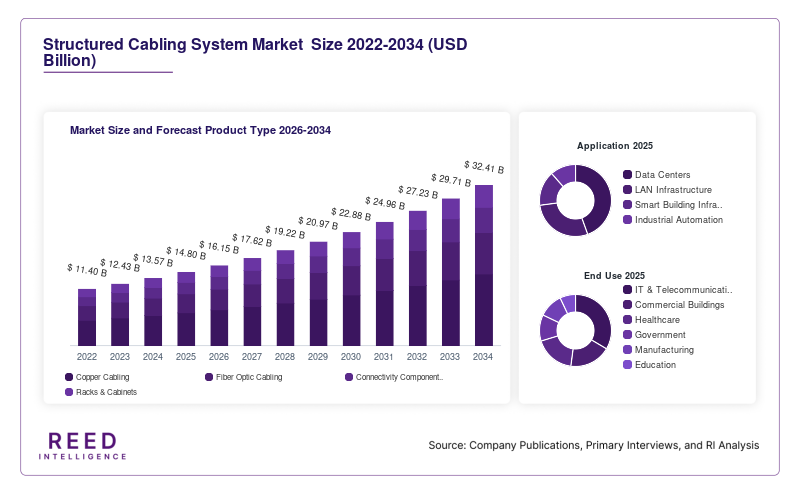
Copper cabling accounted for the largest share of the Structured Cabling System Market in 2024, representing 46.3% of global revenue. Copper-based solutions continue to maintain strong adoption across commercial buildings, enterprise offices, and telecommunications infrastructure due to their cost efficiency and widespread compatibility with existing network systems. Many organizations continue to rely on copper cabling for local area network applications because of its relatively lower installation costs and simpler maintenance requirements. Category 6 and Category 6A cabling systems are especially popular for enterprise networking due to their ability to support high-speed data transmission and power-over-Ethernet applications. Small and medium-sized businesses prefer copper cabling solutions because they offer reliable connectivity without requiring major infrastructure modifications. The segment also benefits from continued demand in educational institutions, retail facilities, and government offices where cost-sensitive networking solutions remain a priority.
Fiber optic cabling is expected to witness the fastest CAGR of 11.6% during the forecast period due to increasing demand for high-bandwidth communication infrastructure. Enterprises are transitioning toward fiber-based systems to support cloud computing, AI workloads, video streaming, and advanced industrial automation applications. Fiber-optic networks provide improved signal quality, enhanced security, and longer transmission distances compared to traditional copper systems. The expansion of hyperscale data centers and 5G communication infrastructure is significantly accelerating adoption of fiber cabling technologies worldwide. Telecom operators are deploying fiber-rich networks to support higher data transfer speeds and low-latency communication services. In addition, smart city infrastructure projects and intelligent transportation systems are creating additional demand for advanced fiber connectivity solutions capable of supporting large-scale digital communication requirements efficiently.
By Application
Data centers represented the dominant application segment in 2024 and accounted for 39.4% of the global market share. The increasing need for cloud computing services, enterprise storage solutions, and digital content delivery is driving substantial investments in data center infrastructure worldwide. Structured cabling systems are essential for maintaining organized connectivity between servers, switches, and networking equipment within large-scale facilities. Data center operators prioritize scalable cabling architecture to improve airflow management, reduce maintenance complexity, and enhance operational efficiency. The rapid growth of artificial intelligence applications and machine learning workloads is further increasing demand for high-density networking infrastructure. Colocation providers and hyperscale cloud companies are continuously expanding facility capacity to accommodate rising digital traffic volumes. In addition, the growing importance of cybersecurity and business continuity planning is encouraging enterprises to invest in reliable data center communication infrastructure supported by advanced structured cabling systems.
Smart building infrastructure is anticipated to register the fastest CAGR of 12.1% during the forecast period due to increasing adoption of connected building technologies. Commercial property developers are integrating automation systems for lighting control, HVAC management, occupancy monitoring, and security surveillance. Structured cabling solutions provide centralized connectivity infrastructure that simplifies integration across multiple building management systems. Enterprises are increasingly prioritizing intelligent office environments that support wireless communication, IoT devices, and energy-efficient operations. Governments are also promoting sustainable construction practices and digital building management standards, further supporting segment growth. The rising deployment of smart campuses, healthcare facilities, and mixed-use commercial complexes is contributing to increased demand for scalable networking systems. Businesses are adopting structured cabling platforms capable of supporting future technology upgrades and improving operational efficiency across connected building environments.
By End Use
The IT & telecommunications segment held the largest market share of 33.8% in 2024 due to continuous investments in digital communication infrastructure. Telecom operators and technology companies are upgrading network systems to support 5G deployment, cloud services, and high-speed broadband connectivity. Structured cabling systems are widely used in switching facilities, telecom towers, enterprise communication centers, and internet exchange hubs. The growing use of video conferencing platforms, digital collaboration tools, and remote workforce technologies is increasing demand for reliable networking infrastructure. Telecom companies are also investing in fiber-optic expansion projects to improve connectivity performance and support increasing consumer data usage. In addition, rapid deployment of edge computing infrastructure is strengthening demand for high-performance cabling systems that can handle large-scale data communication efficiently. The segment continues to benefit from ongoing digital transformation initiatives across both public and private sector organizations globally.
Healthcare is projected to witness the fastest CAGR of 11.3% during the forecast period due to increasing digitalization of medical infrastructure. Hospitals and healthcare facilities are deploying connected medical devices, telemedicine systems, and electronic health record platforms that require stable communication networks. Structured cabling solutions support seamless data transmission across critical healthcare applications and help improve operational coordination within medical environments. The rising use of AI-assisted diagnostic systems and remote patient monitoring technologies is further increasing demand for advanced networking infrastructure. Healthcare providers are also investing in intelligent security systems, digital imaging platforms, and integrated communication technologies to improve patient care efficiency. Government investments in hospital modernization projects and healthcare IT infrastructure development are creating additional growth opportunities for structured cabling vendors. The need for uninterrupted communication in emergency and critical care environments remains a major factor driving adoption across healthcare institutions.
Regional Analysis
North America
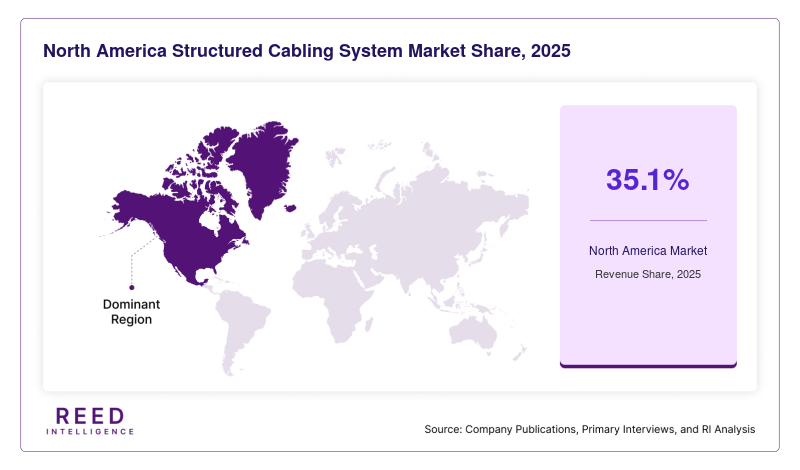
North America accounted for 35.1% of the global Structured Cabling System Market share in 2025 and is expected to maintain steady growth during the forecast period with a CAGR of 8.4%. The region benefits from widespread deployment of hyperscale data centers, advanced telecom infrastructure, and strong enterprise digitization initiatives. Businesses across the United States and Canada are continuously upgrading communication infrastructure to support cloud computing, cybersecurity frameworks, and AI-driven operations. The presence of established technology companies and increasing investments in edge computing infrastructure are also contributing to stable market demand.
The United States remained the dominant country in the regional market due to rising investments in 5G deployment and smart commercial infrastructure. Enterprises are modernizing legacy networking systems to improve operational efficiency and connectivity performance. Another important growth factor is the strong expansion of colocation data centers across major metropolitan areas. Technology firms and cloud service providers are investing heavily in advanced fiber-optic networks to support rising digital traffic and enterprise cloud adoption throughout the country.
Europe
Europe represented 26.4% of the global market share in 2025 and is projected to grow at a CAGR of 8.1% during the forecast period. The region is experiencing increasing demand for high-speed communication networks due to rapid industrial automation and digital transformation across enterprises. Several countries are investing in smart manufacturing facilities and connected industrial systems, which require reliable structured cabling infrastructure. In addition, the growing focus on energy-efficient buildings and green infrastructure development is supporting market expansion across commercial sectors.
Germany emerged as the leading country within the European market due to its advanced industrial base and strong adoption of Industry 4.0 technologies. Manufacturing companies are integrating automated production systems, IoT sensors, and AI-enabled monitoring platforms that depend on stable networking infrastructure. Another important growth factor is the increasing deployment of intelligent transportation systems and connected logistics networks. Enterprises are prioritizing scalable cabling solutions to support growing data communication requirements across industrial and commercial operations.
Asia Pacific
Asia Pacific held 24.8% of the global Structured Cabling System Market share in 2025 and is expected to register the fastest CAGR of 10.8% during 2026–2034. Rapid urbanization, increasing internet penetration, and large-scale digital infrastructure projects are driving regional growth. Countries across the region are investing heavily in data center development, telecom expansion, and smart city initiatives. The rising adoption of cloud services and connected technologies among businesses is also increasing demand for advanced cabling infrastructure.
China dominated the regional market due to strong government investments in digital transformation and communication infrastructure modernization. The country continues to expand its 5G network coverage and hyperscale data center capacity to support industrial automation and digital commerce activities. Another major growth factor is the rapid development of smart manufacturing facilities across industrial zones. Enterprises are implementing advanced networking systems to improve production efficiency, real-time monitoring, and automated operational management.
Middle East & Africa
The Middle East & Africa accounted for 7.1% of the global market share in 2025 and is anticipated to grow at a CAGR of 8.9% during the forecast period. Increasing investments in commercial infrastructure, hospitality projects, and smart city development are supporting market growth across the region. Governments are prioritizing digital transformation strategies and telecommunications modernization to diversify economic activities beyond traditional industries. Structured cabling systems are increasingly being integrated into large commercial complexes, airports, and healthcare facilities.
The United Arab Emirates remained the dominant country in the regional market due to continuous investments in smart infrastructure and advanced communication technologies. The expansion of connected commercial buildings and luxury hospitality developments is generating strong demand for organized networking systems. Another significant growth factor is the rapid deployment of intelligent surveillance systems and public connectivity infrastructure within urban development projects. Businesses are adopting scalable cabling solutions to improve operational reliability and support future technology integration.
Latin America
Latin America captured 6.6% of the global Structured Cabling System Market share in 2025 and is projected to grow at a CAGR of 8.3% during the forecast period. Increasing enterprise digitization and improving telecommunications infrastructure are contributing to regional market growth. Governments and private organizations are investing in broadband connectivity and commercial infrastructure modernization to support digital economic activities. Structured cabling systems are gaining adoption across banking, retail, healthcare, and educational institutions throughout the region.
Brazil remained the dominant country in the Latin American market due to increasing investments in data center expansion and corporate IT modernization projects. Large enterprises are adopting advanced communication infrastructure to support cloud applications and remote workforce operations. Another important growth factor is the rising adoption of smart retail technologies and connected payment systems across urban commercial centers. Businesses are upgrading existing networking infrastructure to improve bandwidth capacity, operational flexibility, and digital service delivery.
Competitive Landscape
The Structured Cabling System Market is moderately consolidated, with leading companies focusing on product innovation, strategic partnerships, and global expansion initiatives to strengthen their market positions. Major players are investing in fiber-optic technologies, intelligent infrastructure management systems, and high-density connectivity solutions to address evolving enterprise networking requirements. Companies are also expanding manufacturing capabilities and regional distribution networks to support rising global demand.
CommScope Holding Company, Inc. remains one of the leading participants in the market due to its extensive product portfolio and strong presence across telecom and enterprise networking sectors. The company recently introduced advanced fiber connectivity platforms designed for hyperscale data center environments and 5G infrastructure deployments. Other major participants are emphasizing mergers, acquisitions, and collaboration agreements to improve technological capabilities and expand customer reach. Market competition is also increasing due to the entry of regional suppliers offering customized cabling solutions for commercial and industrial applications. Vendors are prioritizing sustainable product development and energy-efficient networking systems to align with changing infrastructure requirements across global markets.
Key Players
- CommScope Holding Company, Inc.
- Corning Incorporated
- Belden Inc.
- Nexans S.A.
- Legrand S.A.
- Schneider Electric SE
- Panduit Corporation
- Siemon Company
- Furukawa Electric Co., Ltd.
- Hitachi Cable America Inc.
- TE Connectivity Ltd.
- Datwyler IT Infra GmbH
- ABB Ltd.
- HUBER+SUHNER AG
- Rosenberger Group
Recent Developments
- In March 2026, CommScope Holding Company, Inc. launched a next-generation fiber distribution platform designed for high-density hyperscale data center deployments.
- In October 2025, Corning Incorporated expanded its optical connectivity manufacturing operations in Asia Pacific to address increasing regional demand for fiber-optic infrastructure.
- In January 2026, Schneider Electric SE introduced intelligent structured cabling management solutions integrated with AI-enabled building monitoring systems.
- In August 2025, Panduit Corporation partnered with telecom infrastructure providers to support advanced 5G network expansion projects across North America.
- In February 2026, Nexans S.A. announced the development of sustainable low-emission cabling solutions for smart commercial building applications.
Structured Cabling System Market Segments
Product Type
- Copper Cabling
- Fiber Optic Cabling
- Connectivity Components
- Racks & Cabinets
Application
- Data Centers
- LAN Infrastructure
- Smart Building Infrastructure
- Industrial Automation
End Use
- IT & Telecommunications
- Commercial Buildings
- Healthcare
- Government
- Manufacturing
- Education
By Region
- North America
- Europe
- APAC
- Middle East and Africa
- LATAM