Student Housing Market Size, Share & Trends Analysis Report By Accommodation Type (University-Owned Housing, Private Purpose-Built Student Accommodation, Private Rented & Shared Housing), By Student Type (Domestic Students, International Students), By Housing Format (Shared/Cluster Accommodation, Studios, Apartments), By Ownership (University-Owned, Privately Owned) Forecasts, 2026–2034
USD 3950
Student Housing Market Size
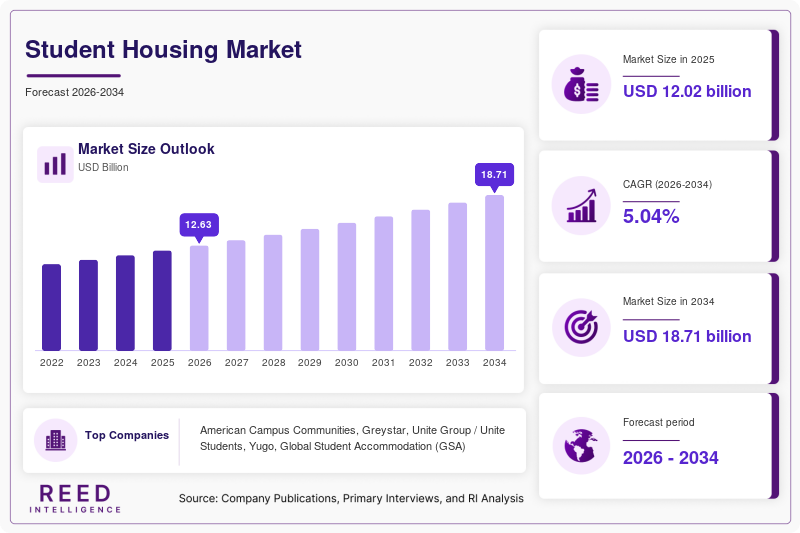
The global student housing market size was valued at USD 12.02 billion in 2025 and is projected to grow from USD 12.63 billion in 2026 to USD 18.71 billion by 2034, registering a CAGR of 5.04% during the forecast period from 2026 to 2034.
Student housing is shifting from a university-support service into a specialized residential real-estate segment shaped by enrollment growth, international student mobility, urban housing shortages, and the increasing preference for professionally managed accommodation. The underlying demand pool remains large. The U.S. recorded approximately 23.29 million students in degree-granting postsecondary institutions in 2025, while the UK reported 2.86 million higher-education students in 2024/25. India reported nearly 44.6 million higher-education enrollments in 2022/23, providing a substantial long-term student accommodation base.
The more important market signal is the mismatch between where students study and where suitable housing is available. The European Commission reported in 2026 that students in Europe spend almost half of their budgets on housing on average, while its new student and youth housing working group is focused specifically on affordability and access. In APAC, JLL reported that student-housing investment transactions tripled between 2022 and 2025 and identified structural supply shortages as a central investment driver.
Demand, however, is not uniform. The UK recorded a 1% decline in higher-education student numbers in 2024/25, while Nottingham reported higher PBSA vacancy as international and domestic recruitment softened. This creates a market where location, university quality, affordability, room configuration, and international-student exposure increasingly determine occupancy and rental performance.
Student Housing Market Drivers
Growth in higher-education participation and international student mobility
Student housing demand ultimately follows enrollment, but international mobility adds a stronger accommodation requirement because overseas students are less likely to have established local housing networks. The U.S. hosted 1,177,766 international students in 2024/25, up 5% from the previous academic year. Australia recorded 851,780 international students commencing or continuing study in 2025, while higher-education international enrolments reached 545,259 during the year. The accommodation mechanism is direct: universities expanding international recruitment create additional demand near campuses, particularly for furnished, flexible and professionally managed housing.
The effect is strongest in university cities where local rental markets already face pressure. Japan's official Study in Japan guidance states that approximately 79% of international students live in private houses or apartments, while university and local-government dormitories have limited capacity. This indicates that student housing demand extends well beyond formal PBSA and university residences into private rental markets.
Structural shortage of purpose-built accommodation in major university markets
The supply side is increasingly important because new student demand cannot be converted into occupied beds where planning, land, construction and financing restrict development. Unite Group reported in February 2026 that new UK PBSA supply was 50% below pre-pandemic levels, while demand and housing need remained strongest around high-quality universities.
The same mechanism is visible in APAC. JLL reported in September 2026 that cross-border investors represented nearly two-thirds of APAC student-housing transaction activity in 2025 and highlighted a projected 140,000-bed student accommodation shortfall in Hong Kong by 2029/30. Limited supply increases the value of existing well-located properties and supports new development where developers can secure planning and university proximity. The commercial effect is therefore not simply higher occupancy; it also encourages institutional investors to assemble portfolios around major university clusters.
Shift toward professionally managed, amenity-rich accommodation
Students increasingly compare housing on more than room price. Location, Wi-Fi, security, furnished rooms, communal spaces, fitness facilities, study areas, digital booking and all-inclusive bills influence the purchasing decision. Scape, for example, markets furnished rooms, communal amenities, gyms, study areas, 24/7 support and included utilities across its UK portfolio.
This changes the competitive structure because professionally operated PBSA can standardize service quality, pricing and leasing. Universities and private developers are also using public-private partnerships to modernize older housing stock. In May 2026, the University of Massachusetts Amherst selected a team led by American Campus Communities to plan phased housing modernization while maintaining affordability and existing capacity.
Student Housing Market Restraints
Affordability and construction economics limit new supply
Student accommodation faces a difficult cost equation. Land near universities is expensive, construction costs remain elevated in many cities, and financing costs can weaken development feasibility. The European Commission has identified affordability and supply as central housing challenges and has called for measures to accelerate affordable and student housing while streamlining permitting.
For students, higher rents can also reduce effective demand for premium studios and high-amenity properties. Nottingham's 2026 student-accommodation review found that studios had a 16.1% vacancy rate compared with 11.6% for cluster flats, partly reflecting weaker demand among international postgraduate students and stronger preference for affordable shared accommodation.
Student demand can vary sharply by city and student segment
The market is not a uniform global growth story. UK higher-education entrants declined in 2024/25, with international postgraduate taught entrants particularly weak, while Nottingham reported a third consecutive year of softer PBSA demand. Australia also recorded a 6.9% decline in international students in YTD May 2026 compared with the same period of 2025.
These changes create occupancy risk for developers that overbuild expensive studios or concentrate heavily on one international student source market. Operators therefore increasingly need flexible pricing, diversified university exposure and room configurations that can accommodate changing affordability preferences.
Student Housing Market Opportunities
Expansion of institutional PBSA in undersupplied APAC markets
APAC provides a substantial development opportunity because the region combines large student populations with relatively immature institutional student-housing markets. India had nearly 44.6 million higher-education enrollments in 2022/23, while JLL describes APAC student housing as structurally undersupplied and reports rapidly increasing institutional transaction activity.
Australia, Japan, Singapore and Hong Kong are developing as institutional markets, while India and other Asian markets offer a much larger potential student base. JLL reported that Australia accounted for 61% of APAC student-housing transactions in H1 2026, illustrating where institutional capital is currently concentrated. The commercial opportunity is to develop professionally managed accommodation close to universities while maintaining room-price points that match local student affordability.
University partnerships and redevelopment of existing housing
Public-private partnerships can reduce the barriers associated with university capital constraints and aging residence halls. American Campus Communities currently reports more than 70 public-private partnerships and more than USD 8.9 billion in development activity. The UMass Amherst partnership similarly demonstrates how universities can combine institutional planning with private development expertise.
The opportunity extends beyond new construction. Redevelopment, refurbishment, adaptive reuse and conversion of underutilized buildings can add beds without requiring entirely new land parcels. This model is particularly relevant in dense European and APAC cities where land availability is a major development constraint.
Segmental Analysis
By Accommodation Type
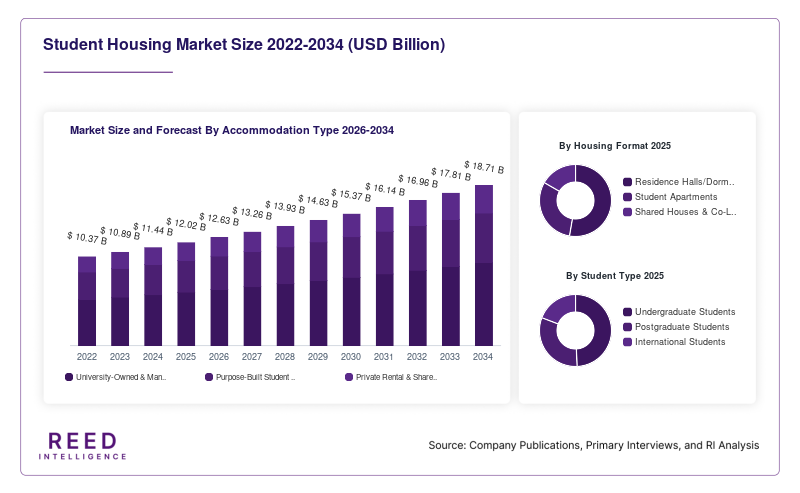
Private Purpose-Built Student Accommodation: Private PBSA represents approximately 44% of the global market in 2025, supported by the expansion of professionally managed housing close to major universities and the limited ability of university-owned accommodation to satisfy total demand. Unite's 2026 data shows that high-quality university locations continue to attract strong housing demand despite a more competitive leasing environment.
University-Owned Housing: University-operated residences account for approximately 34% of the market. These properties remain important because universities use accommodation to support student recruitment, campus experience and retention. However, capital requirements for modernization and expansion can restrict new supply.
Private Rented & Shared Housing: Private rented and shared housing represents approximately 22% of the market and remains particularly important where formal student accommodation is undersupplied. Japan provides a strong example, with roughly 79% of international students living in private houses or apartments.
By Student Type
Domestic Students: Domestic students represent approximately 64% of the market. Their demand is closely tied to university enrollment, commuting distance, local housing affordability and campus attendance. In the UK, domestic student numbers remained comparatively resilient even as international student numbers weakened in 2024/25.
International Students: International students represent approximately 36% of the market and are the fastest-growing student segment, at about 6.6% CAGR. Their accommodation requirement is stronger because they frequently relocate across borders and seek furnished, secure and easily bookable housing. The U.S. hosted nearly 1.18 million international students in 2024/25, while Australia recorded more than 851,000 international students studying during 2025.
By Housing Format
Shared/Cluster Accommodation: Shared or cluster accommodation holds approximately 55% market share, reflecting its lower effective rent per student and suitability for undergraduate populations. The format also allows operators to place communal kitchens and social areas between individual bedrooms.
Studios: Studios account for approximately 27% of the market and are the fastest-growing format at about 6.4% CAGR. Studios appeal particularly to postgraduate and international students seeking privacy and self-contained facilities, although higher rents can limit demand in price-sensitive cities.
Apartments: Student apartments represent approximately 18% of the market. They are commonly used by postgraduate students, couples and groups seeking longer leases or greater independence.
By Ownership
Privately Owned: Privately owned properties represent approximately 58% of the market and are the faster-growing ownership category at about 5.8% CAGR. Institutional investors are increasingly entering student housing through acquisitions, development partnerships and platform strategies. JLL reported that APAC student-housing investment volumes tripled between 2022 and 2025.
University-Owned: University-owned accommodation accounts for approximately 42%. It remains strategically important but faces competing capital requirements for academic facilities, infrastructure and residential modernization.
Regional Analysis
North America Student Housing Market
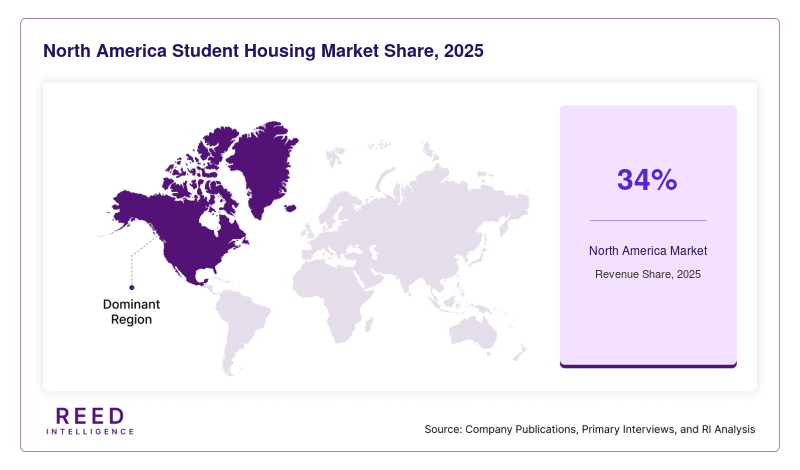
North America represents approximately 34% of the global student housing market in 2025, supported by the large U.S. higher-education population, extensive university networks and established private student-housing operators. U.S. degree-granting postsecondary enrollment reached approximately 23.29 million students in 2025, creating a broad underlying demand pool. International mobility adds another demand layer: the United States hosted 1,177,766 international students during the 2024/25 academic year, an increase of 5% year over year.
The market is increasingly shaped by university-private developer partnerships. American Campus Communities describes itself as the largest U.S. developer, owner and manager of student housing and reports partnerships across 72 campuses. Its May 2026 collaboration with UMass Amherst illustrates how universities are using private capital and development expertise to modernize housing while maintaining affordability and capacity.
North America is also seeing greater portfolio consolidation. In November 2025, Morgan Stanley Investment Management and GSA acquired an eight-property, 6,200-bed U.S. portfolio, with Yugo appointed as manager. Greystar subsequently expanded its university-linked development strategy, including a 1,505-bed Penn State project announced in July 2026.
The region is expected to record approximately 4.7% CAGR, with demand concentrated around large universities and markets where enrollment growth exceeds nearby rental supply. The main constraints are construction costs, university affordability requirements, interest rates and differences in enrollment performance between individual cities.
Europe Student Housing Market
Europe represents approximately 31% market share and is projected to expand at approximately 4.6% CAGR. The region has a large and mature university system but significant differences between national student-housing markets. The UK alone recorded 2.86 million higher-education students in 2024/25, although total enrollment declined 1% and international students declined 6%.
Housing affordability is becoming a policy issue. The European Commission reported in June 2026 that students spend almost half of their budgets on housing on average and established a working group dedicated to student and youth housing. The Commission's wider Affordable Housing Act framework also specifically identifies accelerating student-housing supply as part of the response to housing stress.
Private operators are responding through acquisitions and development. Greystar acquired 1,600 additional PBSA beds in Spain in March 2026, doubling its Spanish PBSA portfolio to approximately 3,000 beds. In Ireland, its June 2026 acquisition brought its national PBSA portfolio to 1,906 beds. Brookfield's 2025 sale of Livensa Living for €1.2 billion also demonstrated the scale of institutional platform transactions in Southern European student accommodation.
The region's primary constraint is affordability, especially in major university cities. Demand is strongest around high-quality universities, but development remains restricted by planning, construction costs and financing conditions.
APAC Student Housing Market
APAC holds approximately 23% of the global market and is the fastest-growing region, at about 6.7% CAGR. The region combines a very large student population with comparatively low institutional penetration in several markets. India's higher-education enrollment reached nearly 44.6 million in 2022/23, while Australia recorded 1.06 million international student enrolments across all education sectors in 2025.
Institutional capital is increasingly targeting the region. JLL reported in September 2026 that APAC student-housing transaction volumes had tripled between 2022 and 2025, with cross-border investors responsible for nearly two-thirds of transaction activity in 2025. Australia accounted for 61% of APAC student-housing transaction volume in H1 2026, followed by emerging activity in Japan and Singapore.
Australia remains a particularly important market because international education generates substantial economic activity. Australian international education was worth almost AUD 55 billion in 2025, while the government has introduced a managed framework for overseas student commencements in 2026. Japan represents another important market, although its official guidance indicates that most international students live in private apartments rather than university dormitories, demonstrating the scope for private accommodation solutions.
The main APAC constraints are affordability, uneven regulatory environments, land availability and differences in market maturity. Nevertheless, structural undersupply and rising institutional participation support the region's higher growth rate.
Middle East and Africa Student Housing Market
Middle East and Africa represents approximately 6% of the market and is projected to grow at around 5.8% CAGR. Demand is concentrated in major university cities, education hubs and countries investing in international education infrastructure. Student accommodation development is increasingly connected with broader urban development, private universities and international education strategies.
The commercial model varies substantially across the region. In established education hubs, students and universities increasingly seek professionally managed residences with security, transport access, furnished rooms and communal amenities. In less mature markets, accommodation is more fragmented and frequently supplied through private landlords or institution-owned residences.
The region's development opportunity is therefore linked to formalization. Developers can consolidate fragmented housing supply into professionally managed properties, while universities can use partnerships to expand accommodation without bearing the full capital cost. Constraints include lower institutional penetration, financing availability, affordability and country-specific regulatory requirements.
Latin America Student Housing Market
Latin America represents approximately 6% market share and is expected to grow at approximately 6.0% CAGR. Student housing demand is concentrated around major metropolitan university clusters, private higher-education institutions and cities where students relocate from other regions.
The market remains more fragmented than North America and mature European PBSA markets, creating opportunities for operators capable of combining standardized property management with locally appropriate pricing. Shared housing and smaller private rentals remain important because affordability limits the addressable market for premium studios.
Future expansion is likely to depend on university partnerships, redevelopment of centrally located properties and professionalization of fragmented rental supply. Key constraints include construction financing, currency volatility, household affordability and differences in university enrollment trends between countries.
Competitive Landscape
The student housing market remains fragmented geographically, but institutional ownership is increasing in mature markets. Competition is shifting from simply providing beds toward controlling high-quality locations near universities, building operating scale and establishing university partnerships. Operators increasingly differentiate through room configuration, amenities, digital booking, flexible leasing, sustainability and all-inclusive pricing.
Unite Group reported 95% of its beds reserved for the 2026/27 academic year in September 2026, while its portfolio remains concentrated around the UK's strongest universities. This illustrates how university concentration can support occupancy and pricing.
Greystar is expanding through both acquisitions and university-linked developments. Its 2026 Spain acquisition added 1,600 beds, while its Penn State project involves 1,505 beds.
Yugo expanded its U.S. platform through the acquisition of Campus Advantage in 2025, increasing its combined reach to nearly 40,000 beds across 88 properties and 28 states. Yugo was also appointed manager of a 6,200-bed U.S. portfolio acquired by Morgan Stanley Investment Management and GSA.
Key Market Players
- American Campus Communities
- Greystar
- Unite Group / Unite Students
- Yugo
- Global Student Accommodation (GSA)
- Scape
- Landmark Properties
- Nido Living
- Empiric Student Property
- Campus Living Villages
- The Dot Group
- Student.com
Recent Market Developments
- September 2026 – Unite Group: Unite reported that 95% of its beds were reserved for the 2026/27 academic year, while 719-bed Hawthorne House was fully let on opening. The development demonstrates continued demand for professionally managed accommodation in strong university locations.
- July 2026 – Greystar: Greystar closed its University Drive project near Penn State University, comprising 1,505 beds across four buildings. The project strengthens the university-public/private partnership model in the U.S. student-housing sector.
Student Housing Market Segments
By Accommodation Type
- University-Owned & Managed Housing
- Purpose-Built Student Accommodation
- Private Rental & Shared Housing
By Housing Format
- Residence Halls/Dormitories
- Student Apartments
- Shared Houses & Co-Living
By Student Type
- Undergraduate Students
- Postgraduate Students
- International Students
By Management Model
- University-Managed
- Private Operators
- Public-Private Partnerships
By Region
- North America
- Europe
- APAC
- Middle East and Africa
- LATAM