Stump Cutter Grinder Market Size, Share & Demand Report By Equipment Type (Tow-Behind Stump Grinders, Self-Propelled Stump Grinders, Handheld Stump Grinders), By Application (Landscaping Services, Municipal Services, Forestry, Agriculture), By End-Use (Residential, Commercial, Industrial), By Region & Segment Forecasts, 2026–2034
USD 3950
Market Overview
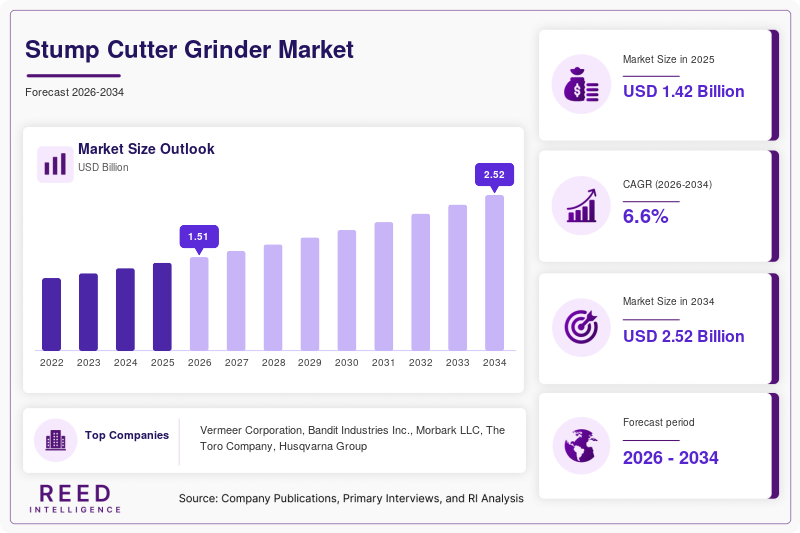
The global Stump Cutter Grinder Market size was valued at approximately USD 1.42 billion in 2026 and is projected to reach USD 2.36 billion by 2034, expanding at a CAGR of 6.6% during the forecast period (2026–2034). The market is experiencing steady growth due to increasing demand for land clearing, landscaping services, and urban development projects. Stump cutter grinders, also known as stump grinders, play a critical role in removing tree stumps efficiently, improving soil usability, and supporting infrastructure expansion across residential, commercial, and municipal sectors.
A key global factor driving the market is the rise in urbanization and infrastructure development, particularly in emerging economies. Rapid city expansion has increased demand for land preparation and vegetation management, where stump grinders offer cost-effective and time-saving solutions. Additionally, environmental regulations encouraging proper tree removal and land restoration are contributing to the adoption of advanced stump cutting equipment.
Key Highlights
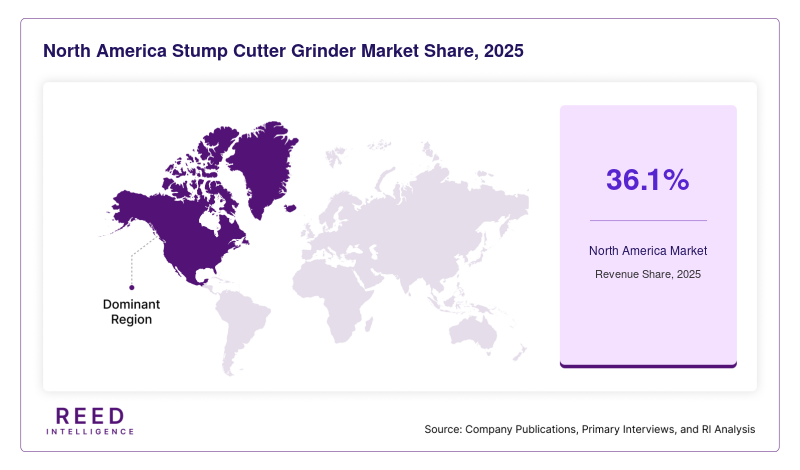
- North America dominated the market with a 36.1% share in 2025.
- Asia Pacific is expected to grow at the fastest CAGR of 7.8% during 2026–2034.
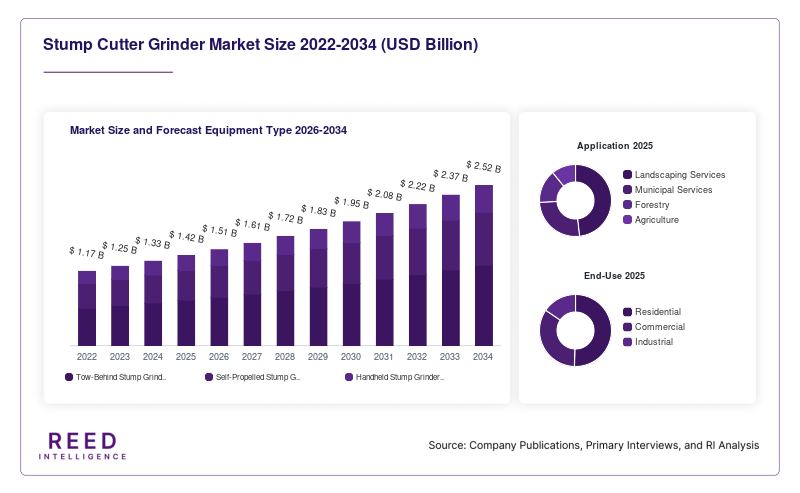
- By equipment type, tow-behind stump grinders accounted for the largest share of 39.4%, while self-propelled stump grinders are projected to grow at a CAGR of 7.2%.
- By application, landscaping services led with a 43.6% share, whereas municipal services are expected to expand at a CAGR of 7.5%.
- The United States remained the dominant country, with market values of USD 420 million in 2024 and USD 455 million in 2025.
Market Trends
Increasing Adoption of Compact and Portable Equipment
The market is witnessing a shift toward compact and portable stump cutter grinders, particularly among small-scale contractors and residential users. These machines are designed for ease of transportation, maneuverability, and operation in confined spaces such as urban gardens and narrow residential areas. Manufacturers are focusing on lightweight designs without compromising cutting efficiency, which is attracting landscaping professionals and rental service providers. The trend is further supported by the growth of do-it-yourself landscaping activities, especially in developed regions. Portable grinders also reduce operational costs, making them a preferred choice for cost-sensitive customers. This trend is expected to continue as urban density increases globally.
Integration of Advanced Technologies and Automation
Technological innovation is shaping the stump cutter grinder market, with manufacturers integrating automation and smart features into equipment. Remote-controlled stump grinders, GPS tracking, and automated cutting depth control systems are gaining popularity among professional users. These features improve precision, safety, and operational efficiency. Additionally, the use of electric-powered stump grinders is emerging as a sustainable alternative to traditional fuel-based machines. This trend aligns with global sustainability goals and regulatory pressures to reduce emissions. As technology continues to evolve, the market is expected to witness increased adoption of digitally enabled and environmentally friendly equipment solutions.
Market Drivers
Growth in Landscaping and Lawn Care Services
The increasing demand for landscaping and lawn maintenance services is a significant driver for the stump cutter grinder market. Residential and commercial property owners are investing in aesthetic improvements, which often require the removal of old tree stumps. Landscaping companies rely heavily on stump grinders to enhance efficiency and reduce manual labor. The expansion of real estate and hospitality sectors is also fueling demand for professional landscaping services. As consumer preferences shift toward well-maintained outdoor spaces, the adoption of stump cutter grinders is expected to rise steadily.
Expansion of Infrastructure and Land Development Projects
Global infrastructure development is accelerating the demand for stump cutter grinders. Construction projects, including roads, highways, and residential complexes, require land clearing before development. Stump grinders provide an efficient solution for removing tree remnants and preparing land for construction. Governments across developing regions are investing heavily in infrastructure, further boosting equipment demand. Additionally, the mining and forestry industries are contributing to market growth by requiring land clearing operations. This driver is expected to sustain long-term growth in the market.
Market Restraint
High Initial Investment and Maintenance Costs
One of the major restraints in the stump cutter grinder market is the high initial investment required for purchasing advanced equipment. Professional-grade stump grinders with hydraulic systems, automation features, and high cutting capacity can be expensive, making them less accessible for small contractors and individual users. In addition to the purchase cost, maintenance expenses such as blade replacement, engine servicing, and fuel consumption add to the overall operational cost. This financial burden can limit market penetration, especially in developing regions where cost sensitivity is high.
Furthermore, the availability of rental services can reduce the need for outright equipment purchases, impacting sales growth for manufacturers. For example, small landscaping firms often prefer renting stump grinders instead of investing in expensive machinery. This trend may restrict the expansion of the market, particularly among budget-conscious users. Manufacturers are attempting to address this challenge by offering financing options and cost-efficient models; however, the impact of high costs remains a significant barrier.
Market Opportunities
Growth in Emerging Markets
Emerging economies present significant growth opportunities for the stump cutter grinder market. Rapid urbanization, infrastructure development, and increasing awareness about land management practices are driving demand in regions such as Asia Pacific and Latin America. Governments are investing in smart city projects and urban expansion, creating a need for efficient land clearing equipment. Additionally, the growth of the construction and agriculture sectors in these regions is contributing to increased adoption. Manufacturers can capitalize on this opportunity by introducing affordable and region-specific products tailored to local needs.
Rising Demand for Eco-Friendly Equipment
The increasing focus on environmental sustainability is creating opportunities for the development of eco-friendly stump cutter grinders. Electric and hybrid models are gaining attention as alternatives to traditional fuel-powered machines. These models produce lower emissions and noise levels, making them suitable for urban environments. Regulatory pressures to reduce carbon footprints are encouraging manufacturers to innovate in this segment. Companies investing in sustainable technologies are likely to gain a competitive advantage. This opportunity is expected to drive innovation and expand the market in the coming years.
Segmental Analysis
By Equipment Type
Tow-behind stump grinders dominated the market in 2024, accounting for a share of 39.4%. These machines are widely used due to their affordability, ease of transport, and compatibility with various towing vehicles. They are particularly popular among small contractors and rental service providers. Their versatility allows them to be used in residential and light commercial applications, making them a preferred choice. Additionally, their relatively low maintenance requirements contribute to their widespread adoption. The demand for tow-behind stump grinders is expected to remain stable due to their cost-effectiveness.
Self-propelled stump grinders are the fastest-growing subsegment, with a projected CAGR of 7.2%. These machines offer enhanced mobility, efficiency, and cutting power, making them suitable for large-scale operations. They are increasingly adopted in commercial landscaping and municipal applications. The growth is driven by the need for high-performance equipment that can handle complex tasks. Technological advancements, including automation and improved safety features, are further supporting the adoption of self-propelled stump grinders.
By Application
Landscaping services accounted for the largest share of 43.6% in 2024. The increasing demand for aesthetic outdoor spaces is driving the adoption of stump grinders in this segment. Landscaping companies rely on these machines to improve efficiency and reduce manual labor. The growth of residential and commercial landscaping projects is contributing to the dominance of this segment. Additionally, the rising popularity of outdoor living spaces is boosting demand for professional landscaping services.
Municipal services are the fastest-growing subsegment, with a CAGR of 7.5%. Governments are investing in urban development and public infrastructure, which requires land clearing and maintenance. Stump grinders are essential for maintaining public parks, roadsides, and green spaces. The growth is supported by increasing government initiatives to improve urban infrastructure. Additionally, the adoption of advanced equipment is enhancing operational efficiency in municipal services.
By End-Use
The commercial sector dominated the market in 2024, with a share of 46.8%. This includes landscaping companies, construction firms, and rental service providers. The demand for stump grinders in this segment is driven by the need for efficient land clearing solutions. Commercial users require high-performance equipment to handle large-scale operations. The growth of construction and landscaping industries is supporting the dominance of this segment.
The residential segment is the fastest-growing, with a CAGR of 6.9%. Homeowners are increasingly investing in lawn care and landscaping activities. The availability of compact and user-friendly stump grinders is encouraging adoption among residential users. The growth is also supported by the rising trend of do-it-yourself landscaping. Manufacturers are focusing on developing affordable and easy-to-use equipment to cater to this segment.
Regional Analysis
North America
North America accounted for a dominant share of 36.1% in 2025 and is projected to grow at a CAGR of 5.9% during the forecast period. The region’s growth is driven by the well-established landscaping industry and high adoption of advanced equipment. The presence of leading manufacturers and strong demand from residential and commercial sectors further supports market expansion.
The United States dominates the regional market due to extensive landscaping activities and infrastructure projects. A unique growth factor is the increasing demand for rental equipment services, which allows small contractors to access high-quality stump grinders without significant capital investment. This trend is supporting overall market growth.
Europe
Europe held a market share of 24.7% in 2025 and is expected to grow at a CAGR of 6.1%. The region benefits from strict environmental regulations and a strong focus on sustainable land management practices. Countries are adopting advanced machinery to improve efficiency and reduce environmental impact.
Germany leads the European market, driven by its robust construction and landscaping industries. A unique growth factor is the emphasis on eco-friendly equipment, with increasing adoption of electric stump grinders. This trend aligns with the region’s sustainability goals and regulatory framework.
Asia Pacific
Asia Pacific is the fastest-growing region, with a CAGR of 7.8% and a market share of 21.5% in 2025. Rapid urbanization and infrastructure development are key drivers in this region. The demand for land clearing equipment is increasing significantly across emerging economies.
China dominates the Asia Pacific market due to large-scale infrastructure projects and urban expansion. A unique growth factor is government investment in smart city initiatives, which require efficient land preparation solutions. This is boosting demand for stump cutter grinders.
Middle East & Africa
The Middle East & Africa region accounted for 9.3% of the market share in 2025 and is expected to grow at a CAGR of 6.4%. Growth is driven by increasing construction activities and land development projects, particularly in urban areas.
The United Arab Emirates leads the region, supported by ongoing infrastructure development. A unique growth factor is the expansion of tourism-related construction projects, which require extensive landscaping and land clearing operations.
Latin America
Latin America held an 8.4% market share in 2025 and is projected to grow at a CAGR of 6.7%. The region’s growth is supported by agricultural expansion and increasing construction activities.
Brazil dominates the market due to its large agricultural sector. A unique growth factor is the growing adoption of mechanized farming practices, which include the use of stump grinders for land preparation and productivity improvement.
Competitive Landscape
The stump cutter grinder market is moderately fragmented, with several global and regional players competing based on product innovation, pricing, and distribution networks. Key companies are focusing on expanding their product portfolios and integrating advanced technologies to gain a competitive edge.
Vermeer Corporation is considered a leading player in the market, known for its wide range of high-performance stump grinders. The company recently introduced a new line of electric-powered stump grinders, reflecting its focus on sustainability and innovation. Other major players are investing in research and development to enhance product efficiency and reduce operational costs.
Strategic partnerships, mergers, and acquisitions are also common in the market, enabling companies to expand their geographic presence. Additionally, manufacturers are strengthening their distribution channels to reach a broader customer base. The competitive landscape is expected to remain dynamic, with continuous innovation driving market growth.
Key Players
- Vermeer Corporation
- Bandit Industries Inc.
- Morbark LLC
- Toro Company
- Husqvarna Group
- Carlton Professional Tree Equipment
- Rayco Manufacturing Inc.
- Dosko (Great Northern Equipment)
- Predator Power Equipment
- Barreto Manufacturing Inc.
- Bluebird Industries
- EZG Manufacturing
- Jansen USA
- Laski s.r.o.
- Greenteeth Manufacturing
Recent Developments
- In 2025, Vermeer Corporation launched an electric stump grinder to meet sustainability demands.
- In 2024, Bandit Industries expanded its product line with advanced hydraulic stump grinders.
- In 2025, Husqvarna Group introduced a compact stump grinder targeting residential users.
Stump Cutter Grinder Market Segments
Equipment Type
- Tow-Behind Stump Grinders
- Self-Propelled Stump Grinders
- Handheld Stump Grinders
Application
- Landscaping Services
- Municipal Services
- Forestry
- Agriculture
End-Use
- Residential
- Commercial
- Industrial
By Region
- North America
- Europe
- APAC
- Middle East and Africa
- LATAM