Subdural Hematoma Treatment Market Size, Share Demand Report By Treatment Type (Surgical Procedures, Minimally Invasive Procedures, Pharmacological Treatment), By Diagnosis Method (CT Scan, MRI, AI-Assisted Imaging), By End-Use (Hospitals, Ambulatory Surgical Centers, Specialty Clinics) By Region & Segment Forecasts, 2026–2034
USD 3950
Market Overview
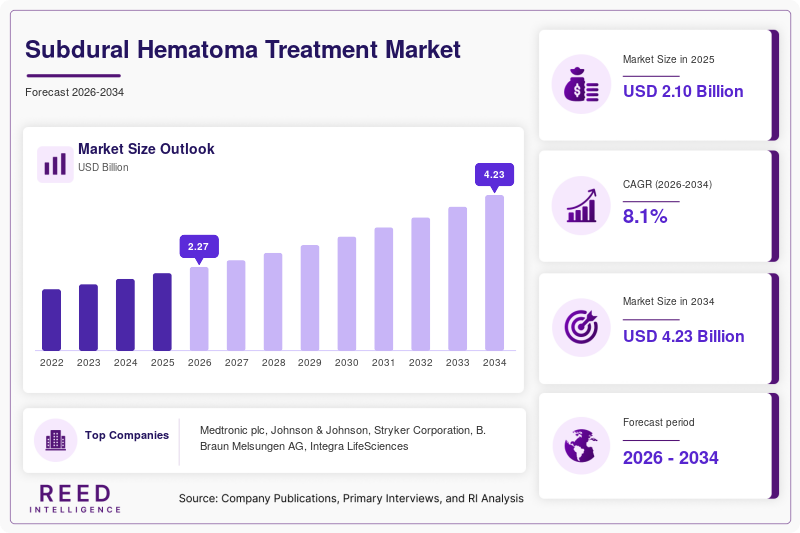
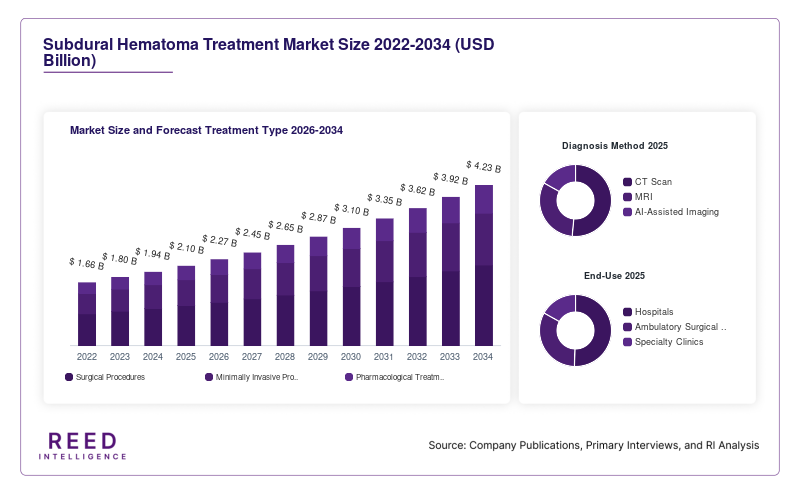
The Subdural Hematoma Treatment Market size was valued at approximately USD 2.1 billion in 2026 and is projected to reach around USD 3.9 billion by 2034, expanding at a CAGR of 8.1% during the forecast period (2026–2034). The market is witnessing steady growth due to increasing incidence of traumatic brain injuries (TBI), particularly among aging populations and individuals involved in road accidents and sports-related injuries. Rising awareness regarding early diagnosis and timely neurosurgical intervention has also contributed to market expansion. Furthermore, advancements in minimally invasive neurosurgical techniques and imaging technologies have improved treatment outcomes, supporting broader adoption across healthcare facilities.
A key global factor supporting market growth is the rising geriatric population, which is more susceptible to chronic subdural hematomas due to age-related brain atrophy and increased use of anticoagulant medications. Healthcare systems across developed and emerging economies are focusing on improving neurosurgical infrastructure, which is further driving demand for effective treatment solutions.
Key Highlights
- North America dominated the market with a 36.5% share in 2025.
- Asia Pacific is expected to grow at the fastest CAGR of 9.4% during 2026–2034.
- By treatment type, surgical procedures accounted for the largest share of 58.7%.
- while minimally invasive procedures are projected to grow at a CAGR of 9.8%.
- By end-use, hospitals led with a 62.3% share, whereas ambulatory surgical centers are expected to expand at a CAGR of 9.1%.
- The United States remained the dominant country, with market values of USD 620 million in 2024 and USD 670 million in 2025.
Market Trends
Increasing adoption of minimally invasive neurosurgical procedures
The Subdural Hematoma Treatment Market is experiencing a notable shift toward minimally invasive procedures such as burr hole drainage and endoscopic evacuation techniques. These approaches offer reduced recovery time, lower risk of complications, and shorter hospital stays compared to traditional craniotomy procedures. Healthcare providers are increasingly adopting these methods to improve patient outcomes and optimize resource utilization within hospitals. Additionally, advancements in surgical instruments and real-time imaging systems have enhanced the precision of these procedures, making them more accessible across various healthcare settings.
The growing preference for minimally invasive solutions is also driven by patient demand for less invasive treatments and faster rehabilitation. This trend is particularly evident in developed regions where healthcare infrastructure supports advanced surgical technologies. As medical device manufacturers continue to innovate in this space, the adoption of minimally invasive treatment options is expected to increase further, contributing significantly to market growth over the forecast period.
Integration of advanced imaging technologies in diagnosis and treatment
Another key trend shaping the market is the integration of advanced imaging technologies such as CT scans, MRI, and intraoperative imaging systems in the diagnosis and management of subdural hematomas. These technologies enable early detection and accurate assessment of hematoma size, location, and severity, which is critical for determining appropriate treatment strategies. The use of artificial intelligence in imaging analysis is also gaining traction, helping clinicians make faster and more informed decisions.
Hospitals and diagnostic centers are increasingly investing in high-resolution imaging systems to enhance clinical outcomes. This trend is particularly important in emergency care settings where rapid diagnosis can significantly impact patient survival rates. The continued evolution of imaging technologies is expected to play a central role in improving treatment accuracy and expanding the overall market scope.
Market Drivers
Rising incidence of traumatic brain injuries globally
The increasing prevalence of traumatic brain injuries is a major factor driving the growth of the Subdural Hematoma Treatment Market. Road accidents, falls, and sports injuries remain the primary causes of TBIs worldwide, leading to a significant number of subdural hematoma cases. Urbanization and increased vehicle usage have contributed to higher accident rates, particularly in emerging economies. As a result, the demand for effective and timely treatment solutions has grown substantially.
Healthcare systems are prioritizing emergency response capabilities and neurosurgical care to manage TBI cases more efficiently. Government initiatives aimed at improving trauma care infrastructure are also supporting market expansion. Additionally, the growing awareness among patients and caregivers regarding early symptoms and treatment options has led to increased diagnosis rates, further boosting demand for treatment services.
Expanding geriatric population and associated risk factors
The aging global population is another critical driver of market growth. Older adults are more prone to subdural hematomas due to increased vulnerability of blood vessels and higher likelihood of falls. The widespread use of anticoagulant and antiplatelet medications among elderly individuals further increases the risk of bleeding complications, including subdural hematomas.
Healthcare providers are focusing on developing specialized care pathways for elderly patients to manage these conditions effectively. This includes improved diagnostic protocols, tailored surgical approaches, and post-treatment rehabilitation programs. As the proportion of elderly individuals continues to rise, particularly in developed regions, the demand for subdural hematoma treatment is expected to grow steadily, reinforcing the overall market expansion.
Market Restraint
High treatment costs and limited access in developing regions
One of the primary challenges facing the Subdural Hematoma Treatment Market is the high cost associated with advanced diagnostic and surgical procedures. Treatments such as craniotomy and minimally invasive neurosurgery require specialized equipment, skilled professionals, and well-equipped healthcare facilities, which significantly increase overall healthcare expenditure. This creates affordability issues, particularly in low- and middle-income countries where healthcare budgets are limited.
The lack of adequate neurosurgical infrastructure in rural and underserved areas further restricts access to timely treatment. Patients in these regions often face delays in diagnosis and intervention, leading to poor clinical outcomes. Additionally, reimbursement limitations and uneven healthcare coverage contribute to reduced adoption of advanced treatment options. Addressing these disparities remains a key challenge for stakeholders aiming to expand market reach and improve patient outcomes globally.
Market Opportunities
Growth potential in emerging healthcare markets
Emerging economies present significant opportunities for the Subdural Hematoma Treatment Market due to improving healthcare infrastructure and increasing healthcare spending. Countries in Asia Pacific, Latin America, and parts of the Middle East are investing in advanced medical facilities and expanding access to specialized care. These developments are creating a favorable environment for the adoption of modern diagnostic and treatment technologies.
Private healthcare providers and international collaborations are playing a key role in bridging infrastructure gaps. Additionally, government initiatives focused on strengthening trauma care systems are expected to enhance market growth. As awareness about neurological conditions continues to rise in these regions, the demand for effective treatment solutions is likely to increase, offering substantial growth opportunities for market participants.
Advancements in medical technology and treatment innovation
Technological innovation is opening new avenues for growth in the Subdural Hematoma Treatment Market. The development of advanced surgical tools, robotic-assisted procedures, and AI-driven diagnostic systems is transforming the treatment landscape. These innovations are improving surgical precision, reducing complications, and enhancing patient recovery rates.
Research and development activities are also focused on developing non-invasive and pharmacological treatment options, which could reduce the need for surgical intervention in certain cases. Medical device companies and research institutions are collaborating to bring innovative solutions to market, creating opportunities for differentiation and competitive advantage. As technology continues to evolve, it is expected to play a crucial role in shaping the future of subdural hematoma treatment.
Segmental Analysis
By Treatment Type
Surgical procedures dominated the Subdural Hematoma Treatment Market in 2024, accounting for approximately 58.7% of the total share. This segment includes craniotomy and burr hole drainage, which are widely used for managing acute and chronic subdural hematomas. The dominance of surgical procedures is attributed to their effectiveness in removing accumulated blood and relieving intracranial pressure. Hospitals and neurosurgical centers prefer these methods due to their established clinical outcomes and ability to handle severe cases.
Minimally invasive procedures are expected to be the fastest-growing subsegment, with a projected CAGR of 9.8% during the forecast period. The growth is driven by increasing demand for less invasive treatment options that offer quicker recovery and reduced complications. Technological advancements in endoscopic equipment and imaging systems are enabling more precise and efficient procedures. This trend is expected to drive significant growth in this segment over the coming years.
By Diagnosis Method
Imaging techniques such as CT scans and MRI held the largest share of the market in 2024, accounting for around 64.2%. These diagnostic tools are essential for identifying subdural hematomas and assessing their severity. The widespread availability of imaging systems in hospitals and diagnostic centers has contributed to their dominance. Additionally, advancements in imaging technology have improved diagnostic accuracy and speed.
AI-assisted imaging is emerging as the fastest-growing subsegment, with a CAGR of 10.1%. The integration of artificial intelligence in diagnostic processes is enhancing the ability to detect subtle abnormalities and predict patient outcomes. This technology is particularly useful in emergency settings where rapid decision-making is critical. As adoption increases, AI-assisted imaging is expected to play a significant role in market growth.
By End-Use
Hospitals accounted for the largest share of the Subdural Hematoma Treatment Market in 2024, with approximately 62.3%. This dominance is due to the availability of advanced medical equipment, skilled professionals, and comprehensive care facilities. Hospitals are the primary centers for managing severe cases, including emergency surgeries and intensive care.
Ambulatory surgical centers are projected to be the fastest-growing subsegment, with a CAGR of 9.1%. The growth is driven by increasing demand for cost-effective and efficient treatment options. These centers offer shorter hospital stays and lower costs compared to traditional hospital settings. As healthcare systems focus on improving efficiency and reducing costs, the role of ambulatory surgical centers is expected to expand significantly.
Regional Analysis
North America
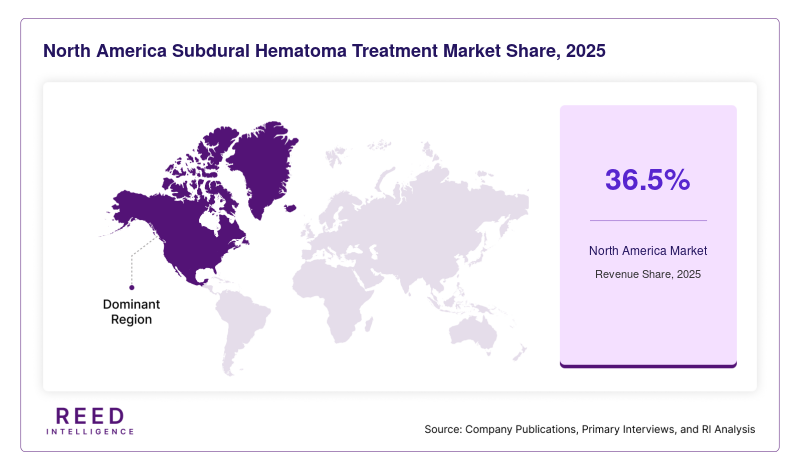
North America held the largest share of the Subdural Hematoma Treatment Market in 2025, accounting for approximately 36.5% of the global market. The region is expected to maintain steady growth with a CAGR of 7.8% during the forecast period. This dominance is attributed to advanced healthcare infrastructure, high adoption of innovative medical technologies, and strong presence of leading market players. The region also benefits from well-established trauma care systems and high awareness regarding neurological disorders.
The United States is the dominant country in North America, driven by a high incidence of traumatic brain injuries and a well-developed healthcare system. A key growth factor is the widespread availability of advanced imaging technologies and specialized neurosurgical centers. Continuous investments in research and development, along with favorable reimbursement policies, further support market expansion in the country.
Europe
Europe accounted for a significant share of the global market in 2025, with steady growth projected at a CAGR of 7.5% through 2034. The region’s growth is supported by increasing healthcare expenditure, rising geriatric population, and strong regulatory frameworks that promote high-quality medical care. Countries across Europe are focusing on improving access to advanced treatment options and enhancing patient outcomes.
Germany leads the European market due to its robust healthcare system and strong focus on medical innovation. A unique growth factor in the region is the increasing adoption of minimally invasive neurosurgical techniques, supported by government initiatives and training programs for healthcare professionals. This has contributed to improved treatment efficiency and patient satisfaction.
Asia Pacific
Asia Pacific is expected to witness the fastest growth in the Subdural Hematoma Treatment Market, with a CAGR of 9.4% during the forecast period. The region held a moderate share in 2025 but is rapidly expanding due to improving healthcare infrastructure and rising awareness about neurological conditions. Increasing investments in healthcare and growing medical tourism are also contributing to market growth.
China is the dominant country in the region, driven by a large patient population and expanding healthcare facilities. A key growth factor is the government’s focus on enhancing emergency medical services and trauma care systems. This has led to increased diagnosis and treatment rates, supporting overall market development.
Middle East & Africa
The Middle East & Africa region held a smaller share of the global market in 2025 but is expected to grow at a steady CAGR of 6.9% during the forecast period. Growth in the region is driven by increasing healthcare investments and efforts to improve medical infrastructure. However, challenges such as limited access to specialized care and uneven healthcare distribution persist.
Saudi Arabia is the leading country in this region, supported by government initiatives aimed at modernizing healthcare systems. A unique growth factor is the increasing focus on establishing advanced medical facilities and attracting skilled healthcare professionals. These efforts are expected to enhance the availability of specialized treatments, driving market growth.
Latin America
Latin America accounted for a moderate share of the Subdural Hematoma Treatment Market in 2025 and is projected to grow at a CAGR of 7.2% during the forecast period. The region is experiencing gradual improvements in healthcare infrastructure and increasing awareness about neurological disorders. Economic development and healthcare reforms are also contributing to market expansion.
Brazil is the dominant country in Latin America, driven by a large population and improving access to healthcare services. A key growth factor is the expansion of private healthcare providers and increasing investment in advanced medical technologies. These developments are expected to enhance treatment availability and support market growth in the region.
Competitive Landscape
The Subdural Hematoma Treatment Market is characterized by the presence of several established players focusing on innovation and strategic collaborations. Companies are investing in research and development to introduce advanced surgical tools and diagnostic technologies. The market is moderately competitive, with key players aiming to strengthen their global presence through partnerships and product launches.
Medtronic plc is considered a leading player in the market, supported by its strong portfolio of neurosurgical devices and continuous innovation. A recent development includes the introduction of advanced minimally invasive surgical tools designed to improve precision and patient outcomes. Other companies are also focusing on expanding their product offerings and enhancing their distribution networks to gain a competitive edge.
Key Players List
- Medtronic plc
- Johnson & Johnson
- Stryker Corporation
- B. Braun Melsungen AG
- Integra LifeSciences
- Terumo Corporation
- Zimmer Biomet Holdings
- Natus Medical Incorporated
- Sophysa SA
- Spiegelberg GmbH & Co. KG
- Penumbra, Inc.
- GE HealthCare
- Siemens Healthineers
- Canon Medical Systems Corporation
- Koninklijke Philips N.V.
Recent Developments
- Medtronic plc launched a new minimally invasive neurosurgical device aimed at improving precision in hematoma evacuation procedures.
- Stryker Corporation expanded its neurosurgical product portfolio with advanced imaging integration systems to support real-time surgical guidance.
- Siemens Healthineers introduced an AI-powered imaging solution designed to enhance early detection and diagnosis of intracranial conditions, including subdural hematomas.
Subdural Hematoma Treatment Market Segments
Treatment Type
- Surgical Procedures
- Minimally Invasive Procedures
- Pharmacological Treatment
Diagnosis Method
- CT Scan
- MRI
- AI-Assisted Imaging
End-Use
- Hospitals
- Ambulatory Surgical Centers
- Specialty Clinics
By Region
- North America
- Europe
- APAC
- Middle East and Africa
- LATAM