Subsea Swivel Joints Flanges Market Size, Share & Demand Report By Type (Flanged Swivel Joints, Clamp-Type Swivel Joints), By Application (FPSO Systems, Subsea Pipeline Systems), By End-Use (Oil & Gas, Renewable Energy) By Region & Segment Forecasts, 2025–2034
USD 3950
Market Overview
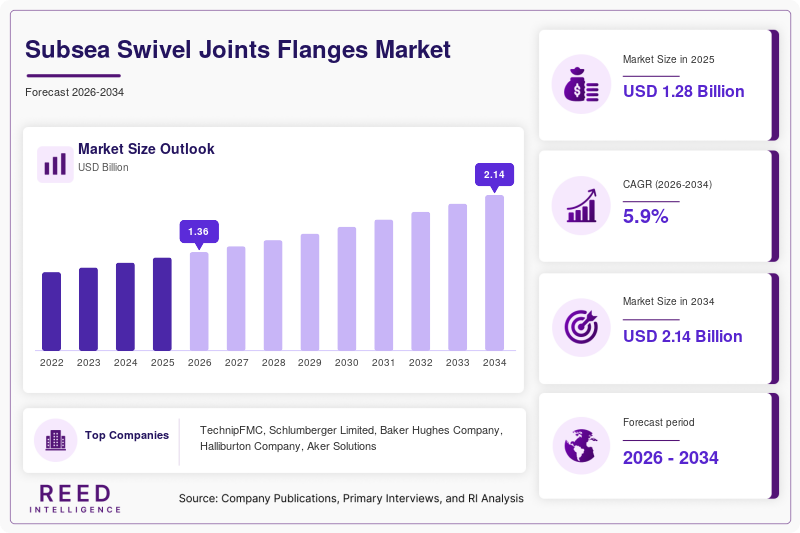
The Subsea Swivel Joints Flanges Market size is witnessing steady expansion driven by increasing offshore exploration activities and the rising need for efficient fluid transfer systems in deepwater environments. In 2025, the global market size is estimated at approximately USD 1.28 billion and is projected to reach around USD 1.36 billionin 2026. Over the forecast period from 2025 to 2034, the market is expected to grow at a compound annual growth rate (CAGR) of 5.9%, reaching nearly USD 2.05 billion by 2034.
Subsea swivel joints flanges are critical components in offshore oil and gas production systems, allowing pipelines and risers to rotate without causing stress or leakage. These systems play a crucial role in maintaining operational efficiency in floating production storage and offloading (FPSO) units and subsea installations. As offshore drilling projects move into deeper waters, the complexity of subsea infrastructure increases, driving the demand for durable and high-performance swivel joint flange systems.
Key Highlights
- Market size projected to grow from USD 1.28 billion (2025) to USD 2.05 billion (2034)
- CAGR of 5.9% during the forecast period (2025–2034)
- Increasing deepwater exploration activities driving demand
- Technological advancements improving product durability and efficiency
- Rising investments in offshore oil and gas infrastructure
Market Trends
Increasing Adoption of Advanced Materials and Coatings
The subsea swivel joints flanges market is experiencing a shift toward the use of advanced materials and protective coatings designed to withstand harsh underwater environments. Manufacturers are increasingly utilizing corrosion-resistant alloys, duplex stainless steel, and composite materials to enhance product longevity. These materials reduce maintenance frequency and extend operational life, which is particularly valuable in deepwater installations where maintenance is costly and complex. Additionally, advanced coatings such as thermal spray coatings and anti-corrosion layers are being integrated to prevent degradation caused by saltwater exposure. This trend is also aligned with the industry’s focus on reducing total lifecycle costs and improving reliability in offshore operations.
Integration of Digital Monitoring and Smart Technologies
Another notable trend is the integration of digital monitoring systems into subsea swivel joints flanges. Operators are adopting smart sensors and condition monitoring technologies to track performance metrics such as pressure, temperature, and rotational movement in real time. This enables predictive maintenance and minimizes the risk of unexpected failures. The use of digital twins and data analytics is also gaining traction, allowing companies to simulate operational conditions and optimize performance. This trend is contributing to improved operational efficiency and reduced downtime, making subsea systems more reliable and cost-effective for offshore projects.
Market Drivers
Expansion of Offshore Oil and Gas Exploration Activities
The increasing demand for energy is driving offshore exploration activities, particularly in deepwater and ultra-deepwater regions. As onshore reserves become limited, oil and gas companies are investing heavily in offshore projects to meet global energy needs. Subsea swivel joints flanges play a vital role in these projects by enabling flexible connections in dynamic environments. The growth of offshore exploration in regions such as South America and Africa is significantly contributing to market expansion. Additionally, advancements in drilling technologies are making it feasible to explore previously inaccessible reserves, further boosting demand for subsea equipment.
Rising Demand for Efficient Fluid Transfer Systems
Efficient fluid transfer systems are essential for maintaining productivity in offshore operations. Subsea swivel joints flanges allow for continuous rotation and movement without disrupting fluid flow, making them indispensable in FPSO units and subsea pipelines. The increasing complexity of offshore projects has led to a higher demand for reliable and high-performance components. Operators are prioritizing systems that can handle extreme pressures and temperatures while ensuring minimal leakage. This demand is driving innovation in product design and materials, thereby supporting market growth.
Market Restraint
High Installation and Maintenance Costs
One of the major challenges in the subsea swivel joints flanges market is the high cost associated with installation and maintenance. Subsea systems require specialized equipment and skilled labor, which significantly increases operational expenses. Additionally, maintenance activities in deepwater environments are complex and often require remotely operated vehicles (ROVs), adding to the overall cost. These factors can deter smaller operators from investing in advanced subsea systems. For example, in ultra-deepwater projects, the cost of replacing or repairing a faulty swivel joint can be substantial, impacting project profitability. As a result, cost considerations remain a key restraint for market growth.
Market Opportunities
Growth in Subsea Tieback Projects
Subsea tieback projects are emerging as a cost-effective solution for developing offshore fields. These projects involve connecting new wells to existing infrastructure, reducing the need for additional platforms. Subsea swivel joints flanges are essential components in these systems, enabling flexible connections and efficient fluid transfer. The increasing adoption of tieback strategies is creating new opportunities for market players. This trend is particularly prominent in mature offshore regions where operators are looking to maximize resource utilization while minimizing capital expenditure.
Increasing Investments in Renewable Offshore Energy
The transition toward renewable energy is opening new avenues for the subsea swivel joints flanges market. Offshore wind and tidal energy projects require robust subsea infrastructure, including flexible joints and connectors. While traditionally associated with oil and gas, swivel joint technologies are being adapted for use in renewable energy applications. The growing number of offshore wind farms, particularly in Europe and Asia Pacific, is expected to drive demand for subsea components. This diversification into renewable energy sectors presents significant growth potential for market participants.
Segmental Analysis
By Type
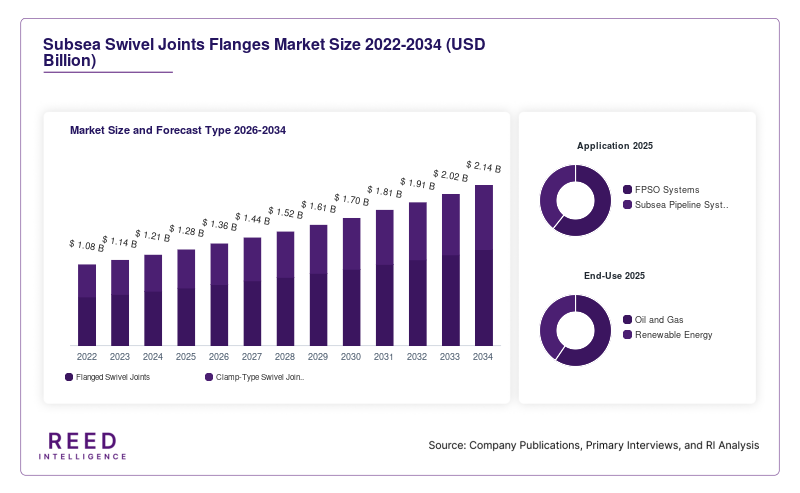
The flanged swivel joints segment dominated the market in 2024, accounting for approximately 58% of the total share. These components are widely used due to their ability to provide secure connections and withstand high-pressure conditions in subsea environments. Their robust design and ease of installation make them a preferred choice for offshore applications. Additionally, flanged swivel joints offer enhanced durability and reliability, which are critical in deepwater operations. The growing demand for high-performance subsea equipment is further supporting the dominance of this segment.
The clamp-type swivel joints segment is expected to be the fastest-growing, with a CAGR of 6.7% during the forecast period. This growth is driven by the increasing need for flexible and lightweight solutions in offshore projects. Clamp-type joints offer easier installation and maintenance compared to traditional flanged systems, making them suitable for complex subsea operations. The rising adoption of modular subsea systems is also contributing to the growth of this segment.
By Application
The FPSO systems segment held the largest share in 2024, accounting for around 52% of the market. FPSO units rely heavily on swivel joints flanges for efficient fluid transfer and rotational movement. The increasing deployment of FPSO units in offshore oil fields is driving demand for these components. Additionally, the need for reliable and durable systems in harsh marine environments is supporting the growth of this segment.
Subsea pipeline systems are expected to be the fastest-growing application segment, with a CAGR of 6.3%. The expansion of long-distance pipeline networks and subsea tieback projects is driving demand for swivel joints flanges. These systems require flexible connections to accommodate movement and prevent stress on pipelines. The growing focus on cost-effective offshore development strategies is further boosting this segment.
By End-Use
The oil and gas industry dominated the market in 2024, accounting for approximately 76% of the total share. The extensive use of subsea swivel joints flanges in offshore exploration and production activities is a key factor driving this dominance. The increasing complexity of offshore projects and the need for reliable fluid transfer systems are supporting demand in this segment.
The renewable energy segment is projected to grow at the highest CAGR of 7.1% during the forecast period. The increasing adoption of offshore wind and tidal energy projects is driving demand for subsea components. Swivel joints flanges are being adapted for use in renewable energy applications, providing new growth opportunities for market players.
Regional Analysis
North America
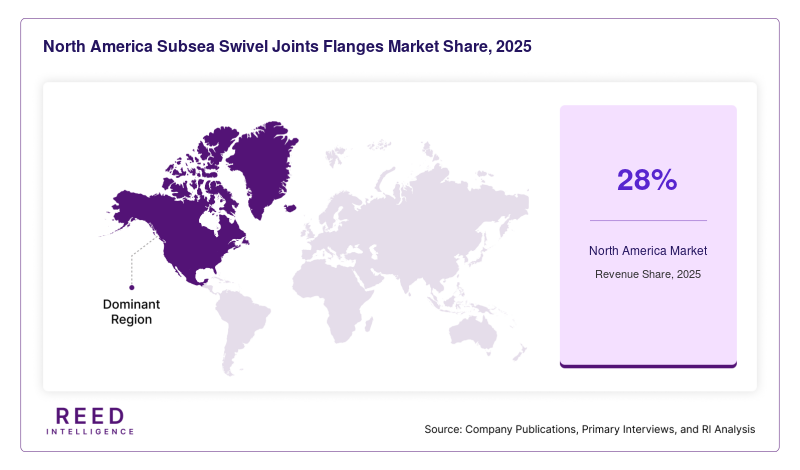
North America accounted for a significant share of the subsea swivel joints flanges market in 2025, contributing approximately 28% of the global revenue. The region is expected to maintain steady growth with a CAGR of around 5.5% during the forecast period. The presence of established offshore oil and gas infrastructure, particularly in the Gulf of Mexico, supports market expansion. Additionally, ongoing investments in deepwater exploration projects are driving demand for advanced subsea equipment.
The United States dominates the regional market due to its extensive offshore operations and technological advancements. A key growth factor in this region is the increasing adoption of enhanced oil recovery techniques, which require reliable subsea systems. This trend is encouraging operators to invest in high-performance swivel joints flanges.
Europe
Europe held a market share of approximately 22% in 2025 and is projected to grow at a CAGR of 5.2% through 2034. The region’s focus on offshore energy projects, including both oil and gas and renewable energy, is contributing to market growth. Countries such as Norway and the United Kingdom are key contributors due to their established offshore industries.
Norway leads the regional market, supported by its strong offshore exploration activities and advanced technological capabilities. A unique growth factor in Europe is the increasing integration of renewable energy projects, particularly offshore wind farms, which require subsea infrastructure solutions.
Asia Pacific
Asia Pacific is expected to witness the fastest growth, with a CAGR of 6.5% during the forecast period, and accounted for around 20% of the market share in 2025. The region’s growing energy demand and increasing offshore exploration activities are key drivers. Countries such as China, India, and Australia are investing heavily in offshore projects.
China dominates the regional market due to its expanding offshore exploration and production activities. A significant growth factor is government support for energy security initiatives, which is driving investments in subsea infrastructure and boosting demand for swivel joints flanges.
Middle East & Africa
The Middle East & Africa region held a market share of approximately 18% in 2025 and is expected to grow at a CAGR of 5.8%. The region’s abundant offshore oil reserves and ongoing exploration activities are supporting market growth. Countries such as Saudi Arabia and Nigeria are key contributors.
Nigeria stands out as a dominant market in the region, driven by its extensive offshore oil operations. A unique growth factor is the increasing development of deepwater projects, which require advanced subsea systems capable of operating in challenging conditions.
Latin America
Latin America accounted for around 12% of the market share in 2025 and is projected to grow at a CAGR of 6.2% through 2034. The region’s offshore oil and gas industry, particularly in Brazil, is a major driver of market growth. Increasing investments in deepwater exploration are further supporting demand.
Brazil leads the regional market due to its significant offshore reserves and ongoing exploration projects. A key growth factor is the development of pre-salt oil fields, which require advanced subsea equipment, including swivel joints flanges, to ensure efficient operations.
Competitive Landscape
The subsea swivel joints flanges market is moderately consolidated, with several key players competing on the basis of product quality, technological innovation, and global presence. Leading companies are focusing on developing advanced materials and integrating digital technologies to enhance product performance. Strategic partnerships and collaborations are also common, enabling companies to expand their market reach and strengthen their product portfolios.
One of the leading players in the market is TechnipFMC, known for its comprehensive range of subsea solutions and strong global presence. The company has recently introduced advanced swivel joint systems designed for deepwater applications, enhancing operational efficiency and reliability. Other major players are also investing in research and development to improve product durability and reduce maintenance costs. The competitive landscape is expected to remain dynamic, with companies focusing on innovation and strategic expansion to maintain their market positions.
Key Players List
- TechnipFMC
- Schlumberger Limited
- Baker Hughes Company
- Halliburton Company
- Aker Solutions
- National Oilwell Varco
- Oceaneering International
- Subsea 7
- Dril-Quip Inc.
- FMC Technologies
- Wood Group
- Saipem S.p.A.
- Tenaris S.A.
- Vallourec S.A.
- Prysmian Group
Recent Developments
- In 2024, TechnipFMC launched a new line of high-pressure swivel joints designed for ultra-deepwater applications, improving operational efficiency.
- In 2023, Aker Solutions expanded its subsea product portfolio with advanced corrosion-resistant swivel joint systems.
- In 2024, Baker Hughes announced a strategic partnership to develop digital monitoring solutions for subsea equipment, including swivel joints flanges.
Subsea Swivel Joints Flanges Market Segments
Type
- Flanged Swivel Joints
- Clamp-Type Swivel Joints
Application
- FPSO Systems
- Subsea Pipeline Systems
End-Use
- Oil and Gas
- Renewable Energy
By Region
- North America
- Europe
- APAC
- Middle East and Africa
- LATAM