Suction Excavator Market Size, Share & Demand Report By Product Type (Trailer-Mounted Suction Excavators, Truck-Mounted Suction Excavators), By Power Source (Diesel-Powered Systems), By Application (Utility Maintenance), By End Use (Construction Contractors, Municipal Authorities, Utility Companies), By Distribution Channel (Direct Sales, Equipment Distributors, Rental Service Providers) By Region & Segment Forecasts, 2026–2034
USD 3950
Market Overview
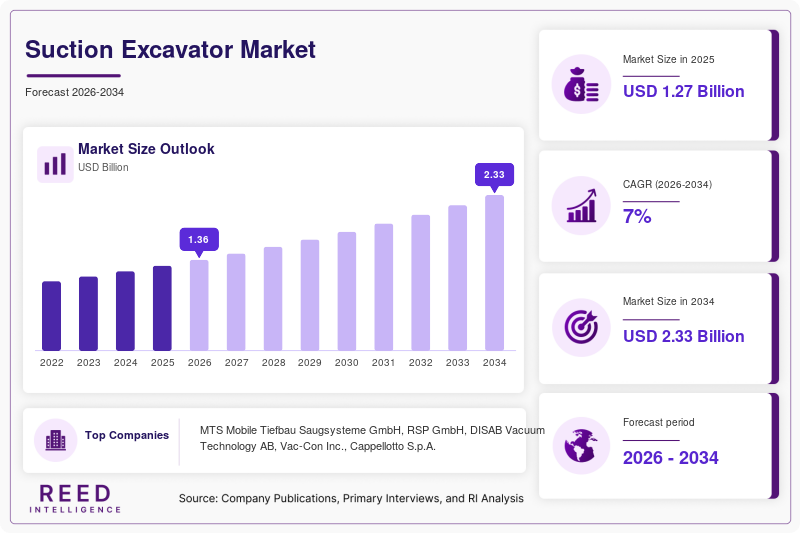
The Suction Excavator Market size was valued at USD 1.27 billion in 2026 and is projected to reach USD 2.18 billion by 2034, expanding at a CAGR of 7.0% during the forecast period from 2026 to 2034. The global Suction Excavator Market growth has been supported by the increasing demand for non-destructive excavation methods across utility maintenance, urban construction, and infrastructure rehabilitation projects. Governments and private contractors are increasingly adopting suction excavation equipment to minimize damage to underground utilities and improve operational safety during excavation activities.
The Suction Excavator Market has witnessed consistent expansion due to rising investments in smart city infrastructure and underground utility networks. Suction excavators are widely used for safe excavation around gas pipelines, electrical cables, telecommunications lines, and water distribution systems. These machines use high-powered vacuum systems to remove soil and debris while reducing the risk of damaging buried infrastructure.
Key Highlights
- Europe accounted for 37.2% of the global Suction Excavator Market share in 2025, while Asia Pacific is projected to register the fastest CAGR of 8.1% during the forecast period.
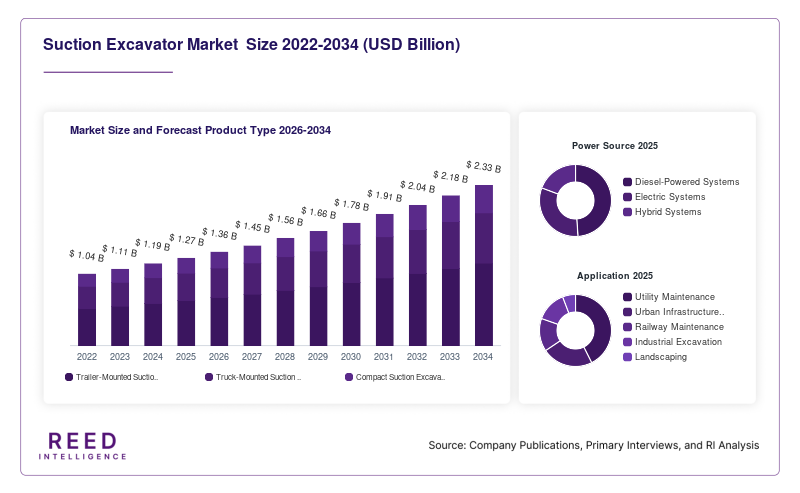
- By product type, trailer-mounted suction excavators held the leading market share of 42.6% in 2025, whereas truck-mounted suction excavators are anticipated to expand at a CAGR of 7.8% through 2034.
- By power source, diesel-powered systems dominated with 71.5% share in 2025, while electric and hybrid systems are forecast to grow at a CAGR of 8.6%.
- By application, utility maintenance accounted for 46.8% of the Suction Excavator Market share in 2025, whereas urban infrastructure development is expected to grow at a CAGR of 8.0%.
- By end use, construction contractors represented 49.7% of the market share in 2025, while municipal authorities are projected to register a CAGR of 7.9% during the study period.
- The Germany Suction Excavator Market was valued at USD 146.3 million in 2024 and increased to USD 156.8 million in 2025 due to growing underground utility rehabilitation projects.
Market Trends
Increasing Adoption of Compact Urban Excavation Equipment
One of the major trends shaping the Suction Excavator Market is the increasing adoption of compact excavation equipment designed for urban environments. Contractors and municipalities are seeking maneuverable suction excavators capable of operating in congested city areas with limited workspace. Compact systems reduce road blockage and improve operational efficiency during utility maintenance projects.
Manufacturers are introducing lightweight and high-capacity compact models equipped with advanced vacuum systems and improved debris storage features. The demand for flexible excavation equipment is expected to rise further as urban infrastructure projects continue to expand across major cities worldwide.
Integration of Digital Monitoring and Automation Features
Another important trend influencing the Suction Excavator Market is the integration of digital monitoring and automation technologies. Equipment manufacturers are incorporating telematics systems, real-time operational tracking, and predictive maintenance software into modern suction excavators.
Fleet operators are increasingly using digital platforms to optimize fuel consumption, monitor equipment performance, and reduce downtime. These advanced technologies improve project management efficiency and support preventive maintenance practices, making suction excavation equipment more attractive for large-scale contractors and municipal service providers.
Market Drivers
Rising Demand for Non-Destructive Excavation Techniques
The increasing demand for non-destructive excavation methods has become a major driver for the Suction Excavator Market. Conventional excavation equipment can damage underground utilities, leading to project delays, repair costs, and safety risks. Suction excavators offer precise excavation capabilities that reduce the likelihood of accidental utility strikes.
Utility operators and contractors are increasingly prioritizing excavation methods that improve worker safety and protect critical infrastructure. Growing awareness regarding damage prevention and operational efficiency has accelerated the adoption of suction excavation systems across utility maintenance and urban construction projects.
Expansion of Underground Utility Infrastructure
The expansion of underground utility infrastructure has significantly contributed to Suction Excavator Market growth. Governments and municipalities are investing in the modernization of water pipelines, gas distribution systems, electrical networks, and fiber optic infrastructure. These projects require accurate and low-impact excavation solutions.
The increasing deployment of telecommunications and broadband infrastructure has also strengthened demand for suction excavation equipment. Contractors prefer vacuum excavation systems for cable installation projects because they minimize disruption to existing underground networks.
Market Restraint
High Equipment Acquisition and Operating Costs
High acquisition and operating costs remain a major restraint for the Suction Excavator Market. Suction excavation systems involve advanced vacuum technology and specialized components, resulting in higher purchase prices compared to conventional excavation machinery.
In addition, maintenance costs, fuel consumption, and operator training requirements may create financial challenges for small contractors. These cost-related concerns can limit equipment adoption among budget-sensitive end users.
Market Opportunities
Growing Smart City and Urban Redevelopment Projects
The increasing number of smart city and urban redevelopment projects presents a strong opportunity for the Suction Excavator Market. Cities are investing in underground infrastructure modernization, transportation upgrades, and utility network expansion to support growing urban populations.
Suction excavators are expected to play an important role in these projects because they enable precise excavation with minimal environmental disruption. The growing emphasis on sustainable urban development is likely to support long-term equipment demand.
Expansion of Rental Equipment Services
The expansion of construction equipment rental services offers significant opportunities for the Suction Excavator Market. Many contractors and municipal operators prefer renting suction excavation equipment to reduce upfront capital expenditure.
Rental companies are expanding their fleets with technologically advanced suction excavators to meet growing demand from infrastructure and utility projects. This trend is expected to improve market accessibility for small and medium-sized contractors.
Segmental Analysis
By Product Type
Based on product type, the Suction Excavator Market is segmented into trailer-mounted suction excavators, truck-mounted suction excavators, and compact suction excavators.
Trailer-mounted suction excavators dominated the market with a 42.6% share in 2025 due to their operational flexibility and lower acquisition costs. Contractors widely preferred these systems for utility maintenance and medium-scale excavation projects.
Truck-mounted suction excavators are projected to witness the fastest CAGR of 7.8% during the forecast period. Their higher debris storage capacity and improved mobility are expected to strengthen adoption across large infrastructure and urban redevelopment projects.
By Power Source
Based on power source, the Suction Excavator Market is categorized into diesel-powered systems, electric systems, and hybrid systems.
Diesel-powered systems held the largest market share of 71.5% in 2025 because they provide high suction performance and operational reliability in heavy-duty excavation applications.
Electric and hybrid systems are expected to grow at a CAGR of 8.6% through 2034. Rising environmental regulations and increasing demand for low-emission construction equipment are anticipated to drive segment growth.
By Application
Based on application, the Suction Excavator Market is segmented into utility maintenance, urban infrastructure development, railway maintenance, industrial excavation, and landscaping.
Utility maintenance accounted for the highest market share of 46.8% in 2025 due to increasing repair and replacement activities across underground utility networks.
Urban infrastructure development is forecast to register the fastest CAGR of 8.0% during the study period. Expanding smart city projects and transportation infrastructure modernization initiatives are expected to accelerate segment growth.
By End Use
Based on end use, the Suction Excavator Market is segmented into construction contractors, municipal authorities, utility companies, and industrial operators.
Construction contractors dominated the market with a 49.7% share in 2025 because large infrastructure projects require precise excavation methods to reduce operational risks and project delays.
Municipal authorities are projected to expand at a CAGR of 7.9% through 2034. Increasing investments in underground utility maintenance and urban redevelopment programs are expected to support segment growth.
By Distribution Channel
Based on distribution channel, the Suction Excavator Market is segmented into direct sales, equipment distributors, and rental service providers.
Equipment distributors accounted for the leading market share of 45.4% in 2025 due to their extensive regional supply networks and strong after-sales support capabilities.
Rental service providers are expected to witness the fastest CAGR of 8.3% during the forecast period. Growing preference for short-term equipment leasing and flexible procurement models is likely to drive segment growth.
Regional Analysis
Europe
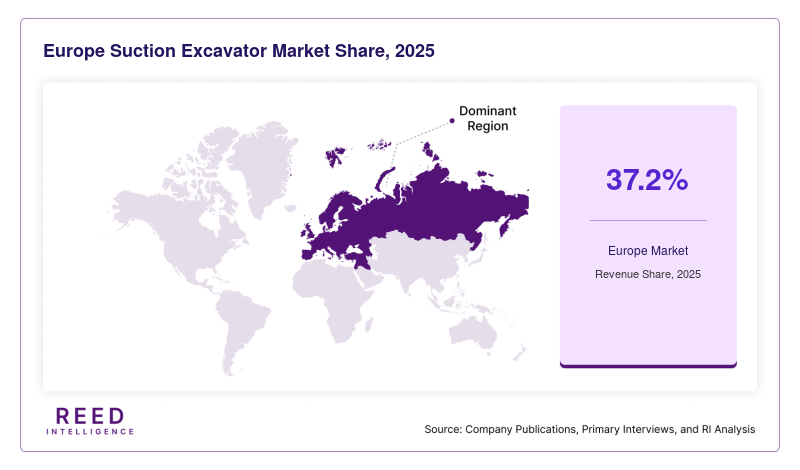
Europe accounted for 37.2% of the Suction Excavator Market share in 2025 and is projected to grow at a CAGR of 6.5% during the forecast period. The region maintained a dominant market position due to strict workplace safety regulations and increasing investments in underground utility modernization projects.
Germany represented the leading country within the regional market. The country experienced rising demand for precision excavation equipment because of large-scale transportation infrastructure rehabilitation and utility replacement activities.
North America
North America held 26.4% of the global Suction Excavator Market share in 2025 and is expected to expand at a CAGR of 6.8% through 2034. The regional market benefited from increasing utility maintenance activities and growing adoption of safe excavation technologies.
The United States emerged as the dominant country within North America due to rising investments in broadband infrastructure expansion and aging water pipeline replacement programs. Municipal utility projects also supported demand for advanced excavation equipment.
Asia Pacific
Asia Pacific accounted for 22.8% of the Suction Excavator Market share in 2025 and is forecast to register the fastest CAGR of 8.1% during the study period. The regional market benefited from rapid urbanization, transportation infrastructure projects, and increasing utility network expansion activities.
China represented the dominant country in the regional market due to large-scale smart city projects and expanding underground transportation systems. Rising government investments in urban infrastructure development also supported equipment procurement.
Middle East & Africa
The Middle East & Africa region represented 7.2% of the Suction Excavator Market share in 2025 and is anticipated to grow at a CAGR of 7.1% during the forecast period. The market growth was supported by increasing commercial construction activities and utility infrastructure projects.
Saudi Arabia dominated the regional market due to ongoing urban development initiatives and rising investments in underground utility systems. Large infrastructure projects associated with economic diversification programs contributed to equipment demand.
Latin America
Latin America accounted for 6.4% of the Suction Excavator Market share in 2025 and is projected to grow at a CAGR of 6.9% through 2034. The regional market expanded because of increasing transportation infrastructure upgrades and municipal utility modernization projects.
Brazil emerged as the leading country within the region due to growing urban redevelopment activities and expanding water distribution infrastructure. The increasing focus on public utility maintenance also supported demand for suction excavation systems.
Competitive Landscape
The Suction Excavator Market remains moderately competitive, with global and regional manufacturers focusing on product innovation, equipment efficiency, and geographic expansion strategies. Companies are investing in advanced vacuum systems, low-emission engines, and digital fleet management technologies to strengthen their market positions.
MTS Mobile Tiefbau Saugsysteme GmbH maintained a leading position in the market due to its broad product portfolio and strong presence across European infrastructure projects. The company recently introduced a next-generation truck-mounted suction excavator equipped with digital performance monitoring and enhanced debris filtration technology.
RSP GmbH continued to strengthen its international distribution network through partnerships with utility contractors and municipal service providers. DISAB Vacuum Technology AB focused on expanding industrial vacuum excavation solutions for urban utility maintenance applications.
Vac-Con Inc. increased investments in compact suction excavation systems targeting municipal infrastructure projects. Cappellotto S.p.A. expanded its manufacturing operations to support rising demand for high-capacity suction excavation equipment across emerging markets.
Key Players List
- MTS Mobile Tiefbau Saugsysteme GmbH
- RSP GmbH
- DISAB Vacuum Technology AB
- Vac-Con Inc.
- Cappellotto S.p.A.
- Ditch Witch
- Ring-O-Matic Inc.
- Vermeer Corporation
- Amphitec BV
- Keith Huber Corporation
- Sewer Equipment Co. of America
- Hi-Vac Corporation
- GapVax Inc.
- KOKS Group BV
- Fulongma Group Co., Ltd.
Recent Developments
- In February 2026, MTS Mobile Tiefbau Saugsysteme GmbH launched a truck-mounted suction excavator with enhanced digital monitoring and debris filtration capabilities.
- In May 2026, Vac-Con Inc. introduced a compact suction excavation system designed for urban infrastructure maintenance projects.
- In August 2025, RSP GmbH expanded its distribution partnership network across North America to strengthen regional equipment availability.
- In October 2025, DISAB Vacuum Technology AB developed upgraded industrial vacuum excavation systems for underground utility maintenance operations.
- In January 2026, Cappellotto S.p.A. increased manufacturing capacity for high-capacity suction excavation vehicles targeting infrastructure contractors in Asia Pacific.
Suction Excavator Market Segments
Product Type
- Trailer-Mounted Suction Excavators
- Truck-Mounted Suction Excavators
- Compact Suction Excavators
Power Source
- Diesel-Powered Systems
- Electric Systems
- Hybrid Systems
Application
- Utility Maintenance
- Urban Infrastructure Development
- Railway Maintenance
- Industrial Excavation
- Landscaping
End Use
- Construction Contractors
- Municipal Authorities
- Utility Companies
- Industrial Operators
Distribution Channel
- Direct Sales
- Equipment Distributors
- Rental Service Providers
By Region
- North America
- Europe
- APAC
- Middle East and Africa
- LATAM