Sugarcane Bottle Market Size, Share & Demand Report By Type (Bio-based Polyethylene, Biodegradable Polymers), By Application (Beverage Packaging, Personal Care Packaging, Food Packaging, Others), By End-Use (Food & Beverage, Personal Care & Cosmetics, Pharmaceuticals & Healthcare, Others), By Region & Segment Forecasts, 2025–2034
USD 3950
Market Overview
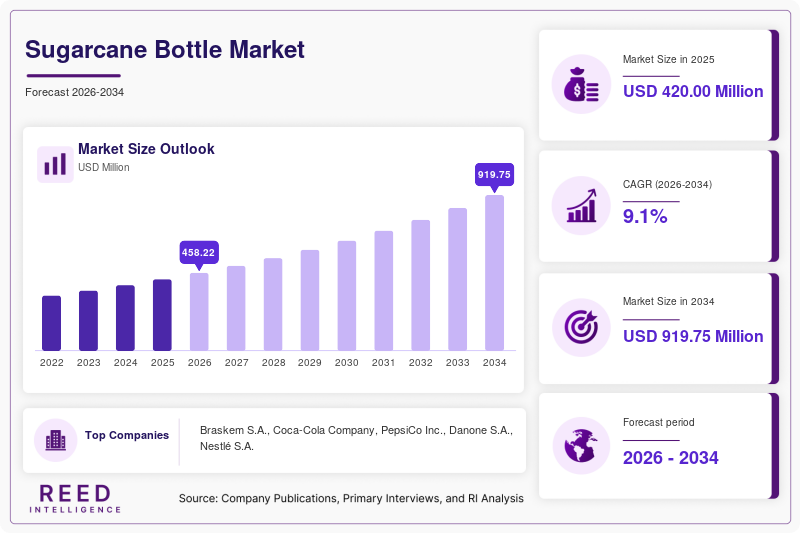
The Sugarcane Bottle Market size is estimated at USD 420 million and is projected to reach approximately USD 465 million in 2026. Over the forecast period from 2025 to 2034, the market is expected to grow significantly, reaching USD 1020 million by 2034, registering a CAGR of 9.1%. This growth reflects increasing awareness about plastic pollution and the rising demand for biodegradable and renewable packaging materials across multiple industries.
Sugarcane bottles, primarily made from bio-based polyethylene derived from sugarcane ethanol, offer a lower carbon footprint compared to conventional petroleum-based plastics. Their recyclability and compatibility with existing plastic recycling systems make them attractive to manufacturers and consumers alike. The market is gaining traction across beverage, personal care, and food packaging sectors, where sustainability is becoming a core requirement rather than an optional feature.
Key Highlights
- Market size is estimated at USD 420 million in 2025 and is expected to reach USD 465 million in 2026.
This growth reflects increasing adoption of eco-friendly packaging across multiple industries. - The market is projected to reach USD 1.02 billion by 2034, registering a CAGR of 9.1%.
Steady expansion is supported by long-term sustainability initiatives and rising investments. - Rising demand for sustainable and bio-based packaging solutions is driving market growth.
Consumers and brands are increasingly shifting toward environmentally responsible alternatives. - Increasing regulatory pressure to reduce plastic waste is accelerating market adoption.
Governments worldwide are implementing strict policies to encourage bio-based materials.
Market Trends
Shift Toward Bio-Based Packaging Materials
A prominent trend in the Sugarcane Bottle Market is the increasing shift toward bio-based packaging materials as companies seek to reduce their environmental impact. Manufacturers are transitioning from fossil fuel-based plastics to renewable resources such as sugarcane to meet sustainability goals. This trend is supported by consumer awareness and demand for eco-conscious products, especially in developed markets. Brands are actively promoting their use of plant-based packaging as part of their sustainability strategies, which is influencing purchasing decisions. Additionally, advancements in material science are improving the durability and functionality of sugarcane bottles, making them suitable for a wider range of applications.
Integration of Circular Economy Practices
Another key trend is the integration of circular economy principles within the packaging industry. Companies are focusing on designing sugarcane bottles that are fully recyclable and compatible with existing recycling streams. This approach minimizes waste and maximizes resource efficiency. Many organizations are also investing in closed-loop systems where used bottles are collected, recycled, and reused in new products. This trend is gaining traction as businesses aim to reduce their carbon footprint and comply with sustainability regulations. The alignment of sugarcane bottle production with circular economy models is expected to drive long-term growth and innovation in the market.
Market Drivers
Increasing Environmental Regulations
The implementation of strict environmental regulations is a major driver of the Sugarcane Bottle Market. Governments across regions are enforcing policies aimed at reducing plastic waste and promoting sustainable alternatives. These regulations include bans on single-use plastics, mandatory recycling targets, and incentives for using bio-based materials. As a result, manufacturers are compelled to adopt eco-friendly packaging solutions such as sugarcane bottles. Compliance with these regulations not only helps companies avoid penalties but also enhances their brand image. This regulatory pressure is expected to continue driving demand for sustainable packaging solutions over the forecast period.
Growing Consumer Preference for Sustainable Products
Consumer behavior is evolving rapidly, with a growing preference for environmentally friendly products. This shift is significantly influencing the Sugarcane Bottle Market, as consumers are increasingly willing to pay a premium for sustainable packaging. Brands are responding by incorporating sugarcane bottles into their product lines to attract eco-conscious customers. The trend is particularly strong among younger demographics, who prioritize sustainability in their purchasing decisions. This growing demand is encouraging companies to invest in bio-based packaging technologies and expand their product offerings, thereby driving market growth.
Market Restraint
High Production Costs Compared to Conventional Plastics
One of the primary restraints in the Sugarcane Bottle Market is the relatively high production cost associated with bio-based materials. The process of converting sugarcane into ethanol and subsequently into polyethylene involves advanced technologies and significant capital investment. As a result, sugarcane bottles are often more expensive than traditional plastic bottles, limiting their adoption among cost-sensitive industries. This price disparity poses a challenge, particularly in emerging markets where affordability is a key factor in purchasing decisions.
The high cost also impacts small and medium-sized enterprises that may lack the resources to transition to sustainable packaging solutions. For example, local beverage manufacturers may continue to rely on cheaper plastic alternatives to maintain competitive pricing. Additionally, fluctuations in raw material availability and agricultural conditions can further influence production costs. While technological advancements are expected to reduce costs over time, this restraint remains a significant barrier to widespread adoption in the short term.
Market Opportunities
Expansion in Emerging Markets
Emerging economies present significant growth opportunities for the Sugarcane Bottle Market. Rapid urbanization, increasing disposable incomes, and rising environmental awareness are driving demand for sustainable packaging solutions in these regions. Governments in countries across Asia Pacific and Latin America are also introducing policies to reduce plastic waste, creating a favorable environment for bio-based packaging adoption. Companies entering these markets can benefit from early adoption advantages and establish strong brand presence. Additionally, local production facilities can help reduce costs and improve supply chain efficiency, further supporting market expansion.
Innovation in Bio-Polymer Technologies
Technological innovation in bio-polymer production offers another major opportunity for the market. Advances in processing techniques are improving the quality, strength, and versatility of sugarcane-based plastics. These innovations are enabling the development of bottles with enhanced properties such as improved barrier resistance and longer shelf life. As technology continues to evolve, production costs are expected to decrease, making sugarcane bottles more competitive with conventional plastics. This will encourage broader adoption across various industries, including food, beverages, and personal care, thereby driving market growth.
Segmental Analysis
By Type
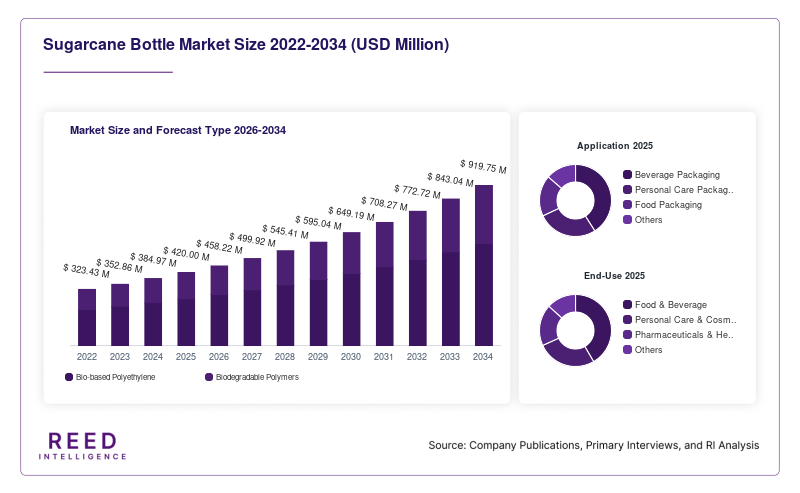
The bio-based polyethylene segment dominated the Sugarcane Bottle Market in 2024, accounting for approximately 62% of the total market share. This dominance is attributed to its compatibility with existing plastic manufacturing and recycling systems. Manufacturers prefer this type due to its durability, flexibility, and ability to maintain product integrity. Additionally, bio-based polyethylene derived from sugarcane offers a lower carbon footprint compared to conventional plastics, making it a preferred choice for companies aiming to meet sustainability targets. Its widespread application across beverage and personal care industries further strengthens its leading position in the market.
The biodegradable polymer segment is expected to be the fastest-growing, registering a CAGR of 10.5% during the forecast period. This growth is driven by increasing demand for fully compostable packaging solutions that go beyond recyclability. These materials decompose naturally, reducing environmental impact and landfill waste. Innovations in biodegradable polymer technology are improving product performance and cost efficiency, encouraging adoption. As regulations become stricter regarding plastic waste, the demand for biodegradable sugarcane bottles is expected to rise significantly.
By Application
The beverage packaging segment held the largest market share in 2024, accounting for around 55%. This dominance is driven by the high demand for sustainable packaging solutions in the beverage industry. Companies are increasingly adopting sugarcane bottles to reduce their environmental footprint and meet consumer expectations. The segment benefits from strong brand initiatives focused on sustainability, as well as regulatory pressures to reduce plastic waste. The compatibility of sugarcane bottles with existing filling and distribution systems further supports their widespread adoption in this segment.
The personal care packaging segment is projected to grow at the fastest CAGR of 9.8%. This growth is driven by increasing consumer demand for eco-friendly products in the cosmetics and personal care industry. Brands are incorporating sustainable packaging to enhance their product appeal and align with environmental values. The use of sugarcane bottles in this segment is expanding due to their aesthetic appeal and functional properties, making them suitable for a wide range of products.
By End-Use
The food and beverage industry dominated the market in 2024, holding a share of approximately 60%. This dominance is attributed to the high consumption of packaged food and beverages, which drives demand for sustainable packaging solutions. Companies in this sector are adopting sugarcane bottles to meet regulatory requirements and consumer expectations. The shift toward eco-friendly packaging is particularly strong in this industry, supporting the growth of sugarcane bottle adoption.
The pharmaceutical and healthcare sector is expected to be the fastest-growing segment, with a CAGR of 9.6%. This growth is driven by increasing demand for safe and sustainable packaging solutions in the healthcare industry. Sugarcane bottles offer advantages such as chemical resistance and durability, making them suitable for pharmaceutical applications. As sustainability becomes a priority in healthcare, the adoption of sugarcane bottles is expected to increase.
Regional Analysis
North America
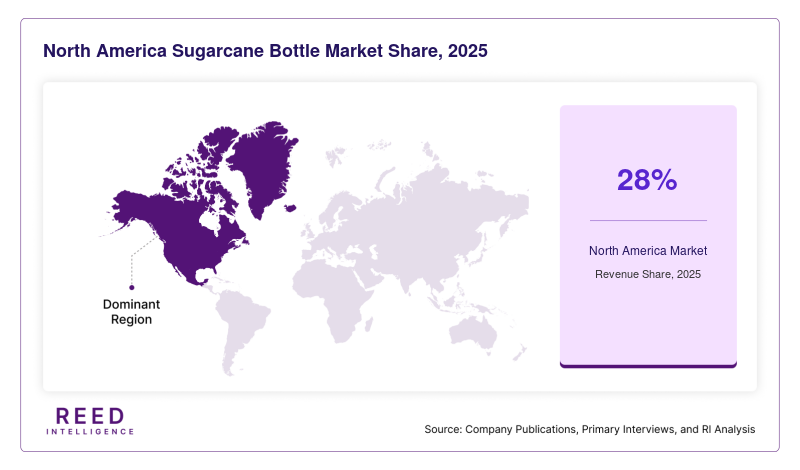
North America accounted for approximately 28% of the Sugarcane Bottle Market share in 2025 and is projected to grow at a CAGR of 8.5% during the forecast period. The region’s growth is driven by strong regulatory frameworks and increasing consumer awareness regarding sustainable packaging. Companies are actively adopting bio-based materials to align with environmental standards and corporate sustainability goals, contributing to steady market expansion.
The United States dominates the regional market due to its advanced packaging industry and strong focus on innovation. A key growth factor is the increasing investment in sustainable packaging technologies by major consumer goods companies. These investments are enabling the development of cost-effective sugarcane bottles, supporting wider adoption across industries.
Europe
Europe held around 26% market share in 2025 and is expected to grow at a CAGR of 8.8%. The region’s emphasis on reducing plastic waste and achieving carbon neutrality is driving demand for sugarcane bottles. Regulatory initiatives such as plastic reduction targets and recycling mandates are encouraging manufacturers to adopt bio-based packaging solutions.
Germany leads the European market, supported by its strong manufacturing base and commitment to sustainability. A unique growth factor is the integration of renewable materials in packaging supply chains, which is being actively promoted by both government and private sector initiatives, enhancing market growth.
Asia Pacific
Asia Pacific accounted for approximately 30% of the market share in 2025 and is projected to grow at the fastest CAGR of 10.2%. The region’s growth is fueled by rapid industrialization, increasing environmental concerns, and expanding consumer markets. Governments are implementing policies to reduce plastic usage, creating opportunities for sugarcane bottle manufacturers.
China dominates the region due to its large manufacturing capacity and growing demand for sustainable packaging. A key growth factor is the availability of raw materials such as sugarcane, which supports cost-effective production and encourages the adoption of bio-based packaging solutions.
Middle East & Africa
The Middle East & Africa region held around 8% market share in 2025 and is expected to grow at a CAGR of 7.9%. The market is gradually gaining traction as awareness of environmental issues increases. Governments are beginning to introduce policies aimed at reducing plastic waste, supporting the adoption of sustainable packaging.
South Africa is a leading market within the region, driven by increasing environmental awareness and regulatory initiatives. A unique growth factor is the rising demand for sustainable packaging in the food and beverage sector, which is encouraging companies to adopt sugarcane bottles.
Latin America
Latin America accounted for approximately 8% of the market share in 2025 and is projected to grow at a CAGR of 9.0%. The region benefits from abundant sugarcane resources, which support the production of bio-based materials. Increasing environmental awareness and government initiatives are driving market growth.
Brazil dominates the regional market due to its strong sugarcane industry and established bioethanol production capabilities. A key growth factor is the integration of sugarcane-based materials into the packaging industry, supported by government policies promoting renewable resources.
Competitive Landscape
The Sugarcane Bottle Market is moderately fragmented, with several global and regional players competing based on innovation, sustainability, and pricing strategies. Leading companies are focusing on expanding their product portfolios and investing in research and development to enhance the performance of bio-based packaging materials. Strategic collaborations and partnerships are also common, enabling companies to strengthen their market presence and improve supply chain efficiency.
Braskem S.A. is considered a market leader due to its strong expertise in bio-based polyethylene production. The company has recently expanded its production capacity to meet growing demand for sustainable packaging materials. Other key players are also investing in technological advancements and exploring new applications for sugarcane-based plastics, contributing to the competitive dynamics of the market.
Key Players List
- Braskem S.A.
- Coca-Cola Company
- PepsiCo Inc.
- Danone S.A.
- Nestlé S.A.
- Tetra Pak International S.A.
- Amcor Plc
- Berry Global Inc.
- Plastipak Holdings Inc.
- Alpla Group
- Dow Inc.
- TotalEnergies SE
- Corbion N.V.
- NatureWorks LLC
- FKuR Kunststoff GmbH
Recent Developments
- Braskem announced an expansion of its bio-based polyethylene production capacity to support growing global demand.
- A leading beverage company introduced a new product line packaged entirely in sugarcane-based bottles.
- Amcor Plc partnered with a bio-material technology firm to develop advanced sugarcane-based packaging solutions.
Sugarcane Bottle Market Segments
Type
- Bio-based Polyethylene
- Biodegradable Polymers
Application
- Beverage Packaging
- Personal Care Packaging
- Food Packaging
- Others
End-Use
- Food & Beverage
- Personal Care & Cosmetics
- Pharmaceuticals & Healthcare
- Others
By Region
- North America
- Europe
- APAC
- Middle East and Africa
- LATAM