Sulphur Recovery Market Size, Share & Demand Report By Technology (Claus Process, Tail Gas Treating, Acid Gas Enrichment), By Application (Oil & Gas, Refining, Chemical Processing, Power Generation) By Region & Segment Forecasts, 2026–2034
USD 3950
Sulphur Recovery Market Size
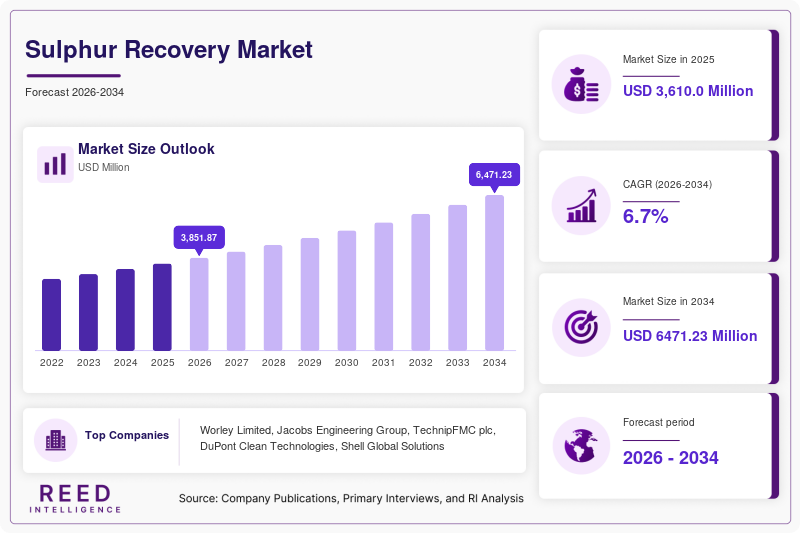
The sulphur recovery market size is projected at USD 3,850.0 million in 2026 and is expected to hit USD 6,471.23 million by 2034 with a CAGR of 6.7% during the forecast period. The increasing stringency of environmental regulations on sulphur emissions, the growing demand for sulphur recovery in oil and gas processing, and the rising need for efficient acid gas treatment solutions underpin market expansion. This report delivers a comprehensive analysis of the sulphur recovery market , including segmentation by technology and application, competitive dynamics, and regional growth patterns, equipping stakeholders with critical intelligence to navigate this essential environmental compliance and industrial processing landscape.
Sulphur Recovery Market Key Takeaways
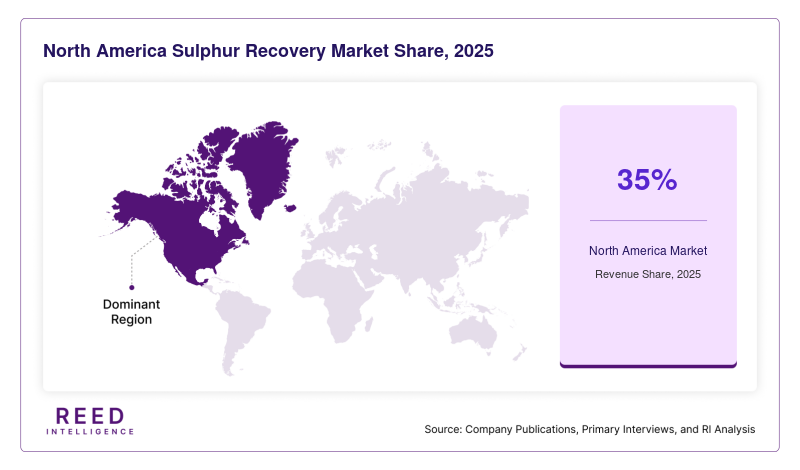
- Dominant Region: North America leads the sulphur recovery market with a 35% share, while Asia-Pacific is the fastest-growing region with a projected CAGR of 8.5% through 2034.
- Dominant Segment: The Claus Process technology dominates the market with a 65% share, while the Oil & Gas application is the leading segment with a 45% share.
- Emerging Country: China is projected to reach USD 850.0 million by 2034, expanding at a CAGR of 9.2%.
- Key Drivers: The increasing strictness of sulphur emission regulations, the growing sour gas processing requirements, and the rising demand for elemental sulphur are driving market growth.
The sulphur recovery market encompasses a range of technologies and services designed to recover elemental sulphur from acid gas streams generated during oil and gas processing, refining, and chemical production. These processes are essential for meeting environmental regulations, reducing sulphur dioxide emissions, and producing valuable elemental sulphur as a byproduct. Globally, the production of recovered sulphur has grown substantially, with an estimated 85 million metric tons produced annually across processing facilities worldwide. In 2025, the Claus Process accounted for roughly 65% of the total market revenue, driven by its widespread use as the primary sulphur recovery method, while Tail Gas Treating followed with 25% share, particularly utilized to meet stringent emission standards. The market is further characterized by a penetration rate exceeding 90% in large-scale oil and gas processing facilities, whereas smaller operations represent a growing adoption frontier due to increasing regulatory pressure. The development of Acid Gas Enrichment, representing 10% of the market, is gaining traction for processing low-quality acid gas streams and enhancing overall recovery efficiency.
Sulphur Recovery Market Trends
Advancements in Oxygen-Enriched and Novel Process Technologies
The sulphur recovery market is witnessing a significant trend toward the adoption of oxygen-enriched Claus processes and novel technologies that enhance recovery efficiency and capacity. This shift is driven by the need to process increasingly sour gas streams and meet higher recovery requirements. Manufacturers are developing advanced oxygen-enrichment systems that can increase capacity by up to 100% without major equipment modifications. The development of novel catalysts and process configurations is improving sulphur recovery rates to over 99.9%. The integration of advanced process control and automation is gaining momentum, enabling real-time optimization and reduced energy consumption. This trend is supported by the growing need to maximize sulphur recovery from challenging feedstocks and minimize environmental impact.
Growing Focus on Small-Scale and Remote Sulphur Recovery Solutions
The increasing focus on small-scale and remote sulphur recovery solutions is a major trend shaping the sulphur recovery market . The development of compact, modular units for small-scale gas processing and remote locations is gaining traction, driven by the need for cost-effective and environmentally compliant solutions. The emergence of micro-Claus and biological sulphur recovery technologies is particularly prominent in niche applications. This trend is supported by the growing number of small gas fields and the need for decentralized processing. The availability of standardized, skid-mounted units is enabling faster deployment and lower capital costs for small-scale operators.
Sulphur Recovery Market Drivers
The sulphur recovery market 's expansion is primarily driven by the increasing stringency of environmental regulations on sulphur emissions globally, with many jurisdictions mandating sulphur recovery efficiencies exceeding 99.9%. The growing demand for sour gas processing has been a major driver, with global natural gas production increasingly coming from sour fields requiring sulphur recovery. The rising demand for elemental sulphur in fertilizer production and other industrial applications has further fueled market demand. The increasing complexity of refinery operations and the need for compliance with clean fuel regulations have also supported market growth. Additionally, the growing investment in oil and gas infrastructure in developing regions has expanded the market opportunity.
Sulphur Recovery Market Restraints
Despite favorable growth prospects, the sulphur recovery market faces significant constraints, primarily related to the high capital and operating costs associated with advanced sulphur recovery units. The technical complexity of achieving ultra-high recovery rates and the need for specialized expertise can also limit adoption. The market's growth is further tempered by the volatility in sulphur prices and the potential for reduced demand for recovered sulphur. Additionally, the competition from alternative gas treatment technologies and the challenges of managing emissions from the recovery process itself can create barriers to market expansion.
Sulphur Recovery Market Opportunities
The sulphur recovery market presents significant opportunities in the rapidly expanding segment of small-scale and modular recovery units for remote and decentralized applications. The development of advanced oxygen-enrichment technologies for debottlenecking existing units represents another promising avenue. Emerging opportunities also exist in the application of biological and other novel sulphur recovery processes for niche applications. Furthermore, the increasing focus on reducing carbon footprints and improving energy efficiency in sulphur recovery operations offers potential for technology differentiation and market growth.
Challenges in Sulphur Recovery Market
The sulphur recovery market grapples with persistent challenges related to the need for continuous innovation to improve recovery efficiency, reduce costs, and meet increasingly stringent environmental standards. The complexity of managing the highly toxic and corrosive nature of acid gas streams presents ongoing safety and operational challenges. The market is also contending with the challenge of adapting to changing feedstock compositions and the need for flexible process designs. Moreover, the need for effective management of sulphur product quality and logistics poses challenges for producers and operators.
Sulphur Recovery Market Segmentation Analysis
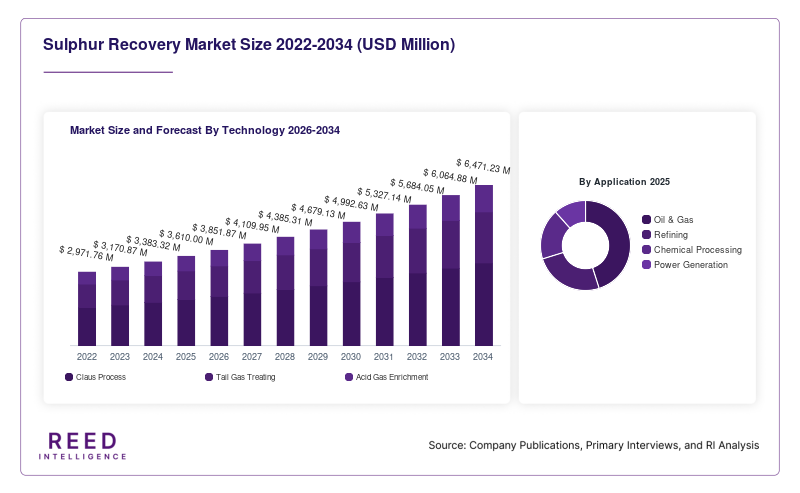
The sulphur recovery market is segmented by Technology and Application to provide a comprehensive market perspective. By Technology, the Claus Process dominates with a 65% market share, driven by its widespread use. The Application segment is led by Oil & Gas, which accounts for 45% of the market, followed by Refining at 30%, Chemical Processing at 15%, and Power Generation at 10%.
By Technology
The Claus Process represents the largest segment in the sulphur recovery market , commanding a 65% share, with revenue exceeding USD 2,503 million in 2025. This process involves the partial combustion of hydrogen sulfide to produce elemental sulphur. Technical specifications include recovery efficiency, capacity, and catalyst type. The market's Claus Process segment is driven by its use as the primary sulphur recovery method in oil and gas processing and refining.
Tail Gas Treating captures a 25% share of the sulphur recovery market , with revenue of USD 963 million in 2025. These technologies further treat the tail gas from Claus units to achieve ultra-high sulphur recovery rates. Technical specifications include recovery efficiency, emissions compliance, and integration capabilities. The market's Tail Gas Treating segment is driven by the need to meet stringent emission regulations and maximize sulphur recovery.
Acid Gas Enrichment represents 10% of the market, with revenue of USD 385 million in 2025, characterized by processes that enhance the hydrogen sulfide content of acid gas streams. Technical specifications include enrichment capability, selectivity, and energy consumption. The market's Acid Gas Enrichment segment is driven by its use in processing low-quality acid gas streams and improving overall recovery efficiency.
By Application
Oil & Gas dominates the sulphur recovery market , accounting for 45% of sales, representing USD 1,733 million in 2025. This segment includes the recovery of sulphur from natural gas processing and associated gas streams. Usage penetration exceeds 90% in large-scale gas processing facilities. The market's Oil & Gas segment is characterized by its focus on compliance, reliability, and high recovery efficiency.
Refining accounts for 30% of the sulphur recovery market , with revenue of USD 1,155 million in 2025. This segment encompasses the recovery of sulphur from refinery off-gases and hydrodesulfurization processes. The segment is growing at a steady rate, driven by the increasing need to process heavier and sourer crude oils. The market's Refining segment is characterized by its focus on environmental compliance and integration with refinery operations.
Chemical Processing represents 15% of the market, with revenue of USD 578 million in 2025, involving the recovery of sulphur from chemical production processes. The segment's growth is fueled by the increasing demand for sulphur-based chemicals. The market's Chemical Processing segment is characterized by its focus on product quality and process efficiency.
Power Generation accounts for 10% of the market, with revenue of USD 385 million in 2025, encompassing the recovery of sulphur from flue gas desulfurization and other power plant processes. The market's Power Generation segment is driven by the need to meet emission regulations and produce marketable sulphur products.
Sulphur Recovery Market Regional Analysis
North America Sulphur Recovery Market
Leads the sulphur recovery market , commanding a 35% share, with revenue of USD 1,348 million in 2025. The United States is the primary driver, accounting for 85% of regional demand, driven by extensive oil and gas processing activities, stringent environmental regulations, and a large number of sour gas fields. The North American market is characterized by its focus on technological innovation and environmental compliance.
Europe Sulphur Recovery Market
Represents the second-largest market, capturing a 28% share with revenue of USD 1,078 million in 2025. Germany, Norway, and the United Kingdom are the primary drivers, together accounting for 55% of regional demand, driven by mature oil and gas industries and stringent emission standards. The European market is projected to grow at a steady CAGR, supported by continuous innovation and environmental regulations.
Asia-Pacific Sulphur Recovery Market
Accounts for 25% of the global sulphur recovery market , with revenue of USD 963 million in 2025. China, India, and Australia are the primary drivers, accounting for 65% of regional demand, fueled by rapidly expanding oil and gas processing capacity, increasing environmental regulations, and growing industrial demand. The Asia-Pacific market is projected to grow at the fastest CAGR of 8.5% through 2034, driven by infrastructure development and regulatory enforcement.
Latin America and Middle East & Africa Sulphur Recovery Market
Together account for the remaining 12% of the sulphur recovery market , with Brazil and Saudi Arabia leading their respective regions. Both regions are projected to grow at CAGRs exceeding 7%, driven by significant oil and gas reserves, expanding processing capacity, and increasing focus on environmental compliance.
Top players in Sulphur Recovery Market
- Worley Limited
- Jacobs Engineering Group
- TechnipFMC plc
- DuPont Clean Technologies
- Shell Global Solutions
- ExxonMobil Catalysts and Licensing
- BASF SE
- Honeywell UOP
- Amec Foster Wheeler (Wood plc)
- Linde Engineering
- Merichem Company
- Prosernat (IFPEN)
- Sulzer Chemtech
- GTC Technology (Koch Industries)
- Bechtel Corporation
Recent Developments in Sulphur Recovery Market
- April 2026 – Worley Limited announced the successful commissioning of a new sulphur recovery unit with advanced oxygen enrichment technology for a major Middle Eastern gas processing facility.
- June 2025 – DuPont Clean Technologies launched a new generation of tail gas treating catalysts with improved activity and longer service life.
- August 2025 – TechnipFMC introduced a new modular sulphur recovery unit design for remote and small-scale gas processing applications.
- February 2026 – Shell Global Solutions announced a new process technology for enhancing sulphur recovery efficiency in existing Claus units.
- October 2025 – BASF SE introduced a new catalyst for acid gas enrichment applications with enhanced selectivity and stability.
Sulphur Recovery Market Segments
By Technology
- Claus Process
- Tail Gas Treating
- Acid Gas Enrichment
By Application
- Oil & Gas
- Refining
- Chemical Processing
- Power Generation
By Region
- North America
- Europe
- APAC
- Middle East and Africa
- LATAM