Super Hi Vision Market Size, Share & Demand Report By Component (Display Systems, Cameras, Storage Systems, Processing Units), By Application (Broadcasting, Healthcare Imaging, Surveillance, Simulation and Training), By End-Use (Media and Entertainment, Healthcare, Defense, Industrial), By Region & Segment Forecasts, 2026–2034
USD 3950
Market Overview
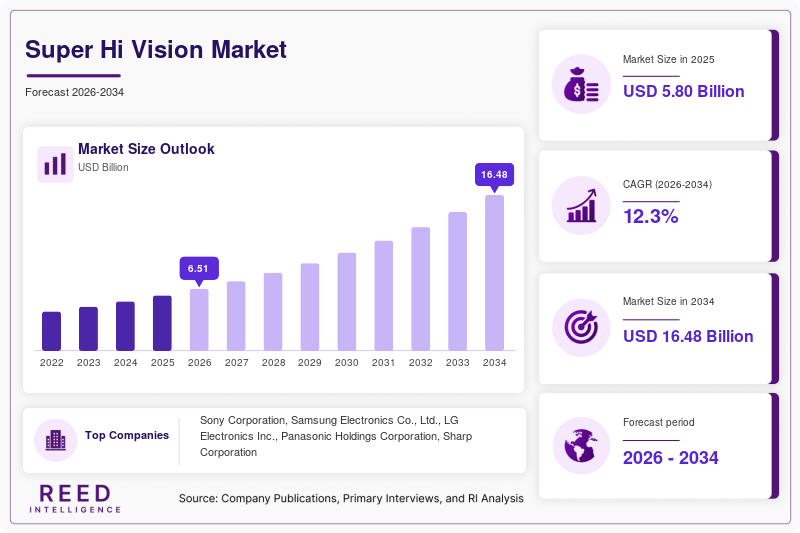
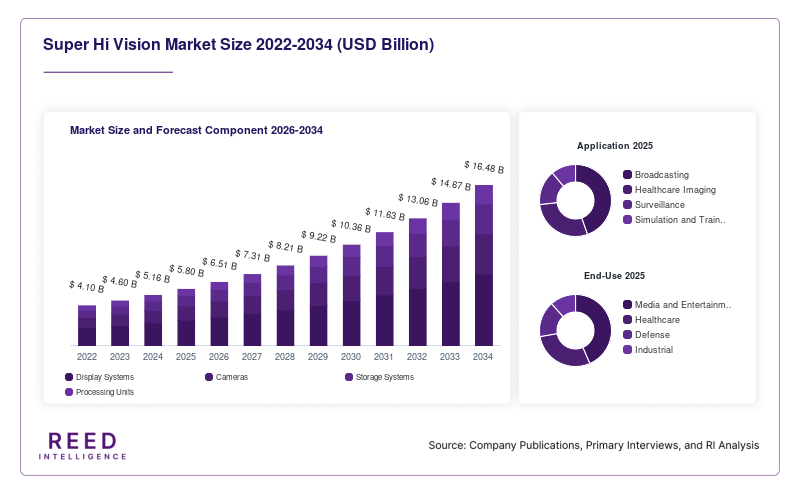
The Super Hi Vision Market size was valued at approximately USD 5.8 billion in 2026 and is projected to reach USD 14.6 billion by 2034, expanding at a compound annual growth rate (CAGR) of 12.3% during the forecast period from 2026 to 2034. This growth trajectory reflects rising demand for ultra-high-definition (UHD) broadcasting technologies, particularly 8K resolution systems that deliver enhanced clarity, immersive viewing, and improved color depth. The increasing adoption of advanced display technologies across broadcasting, healthcare imaging, simulation, and entertainment sectors has contributed significantly to the market’s expansion.
A major global factor supporting market growth is the accelerating digital transformation across media and entertainment industries. Broadcasters and content providers are investing in next-generation infrastructure to meet consumer expectations for high-quality visual experiences. The proliferation of high-speed internet, expansion of 5G networks, and advancements in compression technologies have made it feasible to transmit large volumes of ultra-high-definition content efficiently. These developments are enabling wider deployment of Super Hi Vision systems in both developed and emerging markets.
Key Highlights
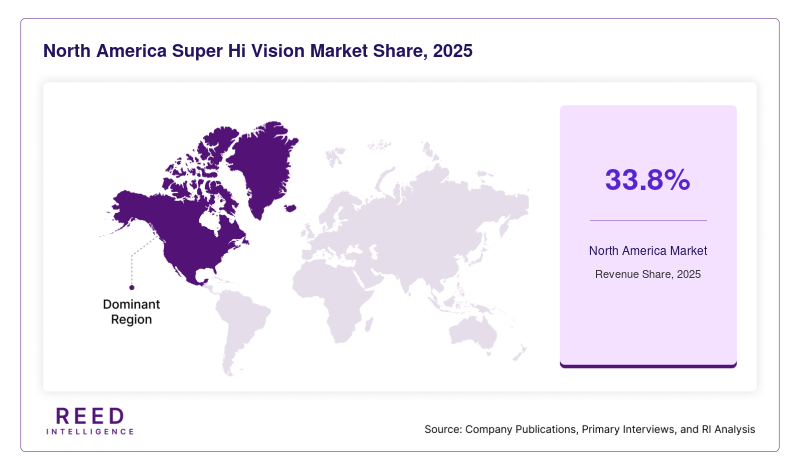
- North America dominated the market with a 33.8% share in 2025.
- Asia Pacific is expected to grow at the fastest CAGR of 13.1% during 2026–2034.
- By component, display systems accounted for the largest share of 36.9%.
- while processing units are projected to grow at a CAGR of 13.4%.
- By application, broadcasting led with a 42.5% share, whereas healthcare imaging is expected to expand at a CAGR of 12.9%.
- The United States remained the dominant country, with market values of USD 1.2 billion in 2024 and USD 1.35 billion in 2025.
Market Trends
Expansion of 8K Broadcasting and Content Ecosystems
The Super Hi Vision Market is witnessing strong momentum due to the rapid expansion of 8K broadcasting and content ecosystems. Broadcasters are increasingly transitioning from high-definition and 4K formats to 8K resolution to deliver improved viewer engagement and visual fidelity. This transition is supported by advancements in camera technology, display panels, and video compression algorithms that allow seamless capture and transmission of ultra-high-resolution content. Content creators are also investing in native 8K production, particularly for sports, live events, and cinematic applications, where image quality plays a critical role in audience experience.
In addition, global sporting events and entertainment productions are acting as catalysts for 8K adoption. These events often serve as testing grounds for next-generation broadcasting technologies, driving infrastructure upgrades among broadcasters and network operators. The integration of artificial intelligence in video processing further enhances image clarity and reduces bandwidth requirements. As consumer demand for immersive viewing continues to rise, the expansion of 8K ecosystems is expected to remain a key trend shaping the market landscape.
Integration of Super Hi Vision in Non-Entertainment Applications
Another notable trend is the growing integration of Super Hi Vision technology in non-entertainment sectors such as healthcare, defense, and industrial simulation. In healthcare, ultra-high-definition imaging systems are being utilized for surgical procedures, diagnostics, and medical training, enabling greater precision and improved patient outcomes. Similarly, defense organizations are leveraging Super Hi Vision systems for surveillance, reconnaissance, and simulation-based training, where image clarity and detail are essential.
Industrial sectors are also adopting these technologies for applications such as quality inspection, remote monitoring, and digital twin simulations. The ability to capture and analyze high-resolution data enhances operational efficiency and decision-making processes. Furthermore, advancements in virtual and augmented reality platforms are driving demand for high-resolution displays and imaging systems. This trend indicates that the market is expanding beyond traditional broadcasting applications, creating diversified revenue streams and long-term growth opportunities.
Market Drivers
Rising Consumer Demand for Enhanced Viewing Experiences
The increasing consumer preference for high-quality visual experiences is a primary driver of the Super Hi Vision Market. As audiences become accustomed to high-definition and 4K content, expectations for even higher resolution and immersive viewing continue to rise. Super Hi Vision technology, with its 8K resolution and advanced audio capabilities, offers a superior experience that aligns with these evolving preferences.
The proliferation of large-screen televisions and home entertainment systems further amplifies this demand. Consumers are investing in premium devices that support ultra-high-definition content, encouraging manufacturers to develop compatible technologies. Streaming platforms are also contributing to this trend by offering high-resolution content libraries, prompting viewers to upgrade their viewing infrastructure. As a result, the demand for Super Hi Vision systems is expected to grow steadily, driven by consumer expectations for enhanced visual quality and realism.
Technological Advancements in Display and Transmission Infrastructure
Continuous advancements in display technologies and transmission infrastructure are significantly driving market growth. Innovations in panel manufacturing, such as improved pixel density and energy efficiency, have made 8K displays more accessible and cost-effective. At the same time, advancements in video compression standards and high-speed connectivity solutions are enabling efficient transmission of large data volumes associated with ultra-high-definition content.
The deployment of 5G networks plays a crucial role in supporting real-time streaming of high-resolution content, reducing latency and enhancing user experience. Additionally, cloud-based broadcasting solutions and edge computing technologies are facilitating scalable and flexible content delivery. These technological developments are lowering barriers to adoption and encouraging industries to invest in Super Hi Vision systems. As infrastructure continues to evolve, the market is expected to benefit from increased accessibility and improved performance capabilities.
Market Restraint
High Implementation Costs and Infrastructure Requirements
One of the key challenges limiting the growth of the Super Hi Vision Market is the high cost associated with implementation and infrastructure development. Deploying 8K broadcasting systems requires significant investment in cameras, displays, storage, and transmission equipment. Additionally, upgrading existing infrastructure to support ultra-high-definition content involves substantial capital expenditure, which can be a barrier for small and medium-sized enterprises.
The high bandwidth requirements of Super Hi Vision content also pose challenges for network operators, particularly in regions with limited connectivity infrastructure. While advancements in compression technologies have reduced data loads, the transmission of 8K content still demands robust network capabilities. This can lead to increased operational costs and limit adoption in certain markets. For example, smaller broadcasters may delay transitioning to 8K due to financial constraints and uncertain return on investment. These factors collectively restrain market growth, especially in developing regions where infrastructure development is still in progress.
Market Opportunities
Growing Adoption in Healthcare Imaging and Diagnostics
The healthcare sector presents significant growth opportunities for the Super Hi Vision Market, particularly in imaging and diagnostics. Ultra-high-definition imaging systems enable healthcare professionals to visualize intricate details with greater accuracy, improving diagnostic outcomes and surgical precision. The adoption of these technologies is increasing in areas such as minimally invasive surgery, radiology, and telemedicine.
Hospitals and research institutions are investing in advanced imaging solutions to enhance patient care and support medical innovation. The integration of Super Hi Vision systems with artificial intelligence and machine learning algorithms further enhances their capabilities, enabling automated analysis and real-time decision-making. As healthcare infrastructure continues to modernize, the demand for high-resolution imaging technologies is expected to grow, creating new opportunities for market expansion.
Expansion of Smart Cities and Digital Infrastructure
The development of smart cities and digital infrastructure is another key opportunity for the Super Hi Vision Market. Governments and urban planners are investing in advanced surveillance, monitoring, and communication systems to improve public safety and urban management. Super Hi Vision technology plays a critical role in these applications by providing high-resolution imaging for real-time monitoring and data analysis.
In addition, the integration of these systems with Internet of Things (IoT) platforms enables seamless connectivity and data sharing across urban networks. Smart transportation systems, public safety initiatives, and infrastructure monitoring projects are increasingly utilizing high-resolution imaging solutions. As urbanization continues to accelerate, the demand for advanced visual technologies is expected to rise, providing a strong growth avenue for the market.
Segmental Analysis
By Component
The display systems segment dominated the Super Hi Vision Market, accounting for approximately 36.9% of the market share in 2024. This dominance is attributed to the increasing demand for high-resolution screens capable of delivering 8K content with enhanced clarity and color accuracy. Manufacturers are focusing on developing advanced display technologies, including OLED and microLED panels, to meet evolving consumer expectations. The growing adoption of large-screen televisions and digital signage solutions further drives the demand for display systems.
In addition, the integration of advanced features such as high dynamic range (HDR) and wide color gamut enhances the overall viewing experience. The use of display systems in commercial applications, including retail, healthcare, and corporate environments, also contributes to their market leadership. As industries continue to prioritize visual quality, the demand for high-performance display systems is expected to remain strong.
The processing units segment is projected to grow at the fastest CAGR of 13.4% during the forecast period. This growth is driven by the increasing need for efficient data processing and real-time rendering of ultra-high-resolution content. Processing units play a critical role in managing large volumes of data generated by Super Hi Vision systems, ensuring smooth playback and transmission.
Advancements in semiconductor technologies and the integration of artificial intelligence are enhancing the capabilities of processing units, enabling faster and more efficient data handling. The growing adoption of cloud-based solutions and edge computing further supports the demand for advanced processing units. As the complexity of Super Hi Vision systems increases, the need for high-performance processing solutions is expected to drive significant growth in this segment.
By Application
The broadcasting segment held the largest market share of 42.5% in 2024, driven by the increasing adoption of 8K broadcasting technologies. Broadcasters are investing in advanced infrastructure to deliver high-quality content and meet consumer demand for immersive viewing experiences. The transition from traditional broadcasting formats to ultra-high-definition systems is a key factor contributing to the segment’s dominance.
In addition, the growing popularity of live events and sports broadcasting in 8K resolution is driving demand for Super Hi Vision systems. Broadcasters are leveraging these technologies to enhance viewer engagement and differentiate their offerings in a competitive market. The integration of advanced audio systems further enhances the overall viewing experience, supporting the segment’s continued growth.
The healthcare imaging segment is expected to grow at the fastest CAGR of 12.9% during the forecast period. This growth is driven by the increasing adoption of high-resolution imaging technologies in medical applications. Super Hi Vision systems enable healthcare professionals to visualize detailed anatomical structures, improving diagnostic accuracy and treatment outcomes.
The integration of these systems with advanced technologies such as artificial intelligence and machine learning enhances their capabilities, enabling automated analysis and real-time decision-making. The growing focus on minimally invasive procedures and telemedicine further supports the demand for high-resolution imaging solutions. As healthcare providers continue to invest in advanced technologies, the healthcare imaging segment is expected to witness significant growth.
By End-Use
The media and entertainment segment dominated the market, accounting for 45.2% of the market share in 2024. This dominance is driven by the increasing demand for high-quality content and immersive viewing experiences. Content creators and distributors are investing in Super Hi Vision technologies to enhance production quality and meet consumer expectations.
The growth of streaming platforms and digital media services further supports the adoption of ultra-high-definition systems. These platforms are offering a wide range of high-resolution content, encouraging consumers to upgrade their viewing infrastructure. The integration of advanced technologies such as virtual reality and augmented reality also contributes to the segment’s growth.
The healthcare sector is projected to grow at the fastest CAGR of 12.7% during the forecast period. This growth is driven by the increasing adoption of advanced imaging technologies and the growing focus on improving patient outcomes. Super Hi Vision systems enable healthcare providers to deliver precise and accurate diagnoses, supporting better treatment planning.
The expansion of healthcare infrastructure and the increasing adoption of telemedicine further contribute to the segment’s growth. Governments and private organizations are investing in advanced medical technologies to enhance healthcare services. As the demand for high-quality imaging solutions continues to rise, the healthcare sector is expected to become a key growth area for the market.
Regional Analysis
North America
North America accounted for approximately 33.8% of the Super Hi Vision Market share in 2025 and is expected to grow at a CAGR of 11.8% during the forecast period. The region’s strong market position is attributed to early adoption of advanced broadcasting technologies and significant investments in digital infrastructure. The presence of major technology companies and content providers further supports market growth, enabling continuous innovation and development of high-resolution imaging systems.
The United States remains the dominant country in this region, driven by high consumer demand for premium entertainment experiences and advanced healthcare infrastructure. A key growth factor is the rapid expansion of streaming platforms offering ultra-high-definition content, which encourages adoption of Super Hi Vision technologies across households and enterprises.
Europe
Europe held a market share of around 24.6% in 2025 and is projected to grow at a CAGR of 11.5% through 2034. The region benefits from strong regulatory support for digital broadcasting and increasing investments in media and entertainment infrastructure. Countries across Europe are focusing on upgrading their broadcasting systems to support higher resolution formats, contributing to steady market growth.
Germany is a leading country in the European market, supported by its advanced manufacturing capabilities and strong focus on technological innovation. A unique growth factor is the increasing use of Super Hi Vision systems in industrial applications, including automotive design and quality inspection, which enhances operational efficiency and product development processes.
Asia Pacific
Asia Pacific is expected to witness the fastest growth, with a CAGR of 13.1% during the forecast period, and accounted for 22.9% of the market share in 2025. The region’s growth is driven by rapid urbanization, increasing disposable income, and strong demand for advanced consumer electronics. Governments and private organizations are investing heavily in digital infrastructure, further supporting market expansion.
Japan dominates the Asia Pacific market, owing to its leadership in 8K broadcasting technology and early adoption of Super Hi Vision systems. A key growth factor is the country’s continuous innovation in display technologies and its strong presence in global electronics manufacturing, which drives widespread adoption of ultra-high-definition solutions.
Middle East & Africa
The Middle East & Africa region held a market share of 9.8% in 2025 and is expected to grow at a CAGR of 10.9% during the forecast period. The market is driven by increasing investments in digital transformation and smart city initiatives across the region. Governments are focusing on enhancing communication infrastructure and adopting advanced technologies to improve public services.
The United Arab Emirates leads the market in this region, supported by its ambitious smart city projects and strong focus on technological innovation. A unique growth factor is the integration of Super Hi Vision systems in surveillance and security applications, which enhances monitoring capabilities and supports urban development initiatives.
Latin America
Latin America accounted for 8.9% of the market share in 2025 and is projected to grow at a CAGR of 10.7% through 2034. The region’s growth is supported by increasing adoption of digital broadcasting technologies and rising consumer demand for high-quality entertainment. Investments in telecommunications infrastructure are also contributing to market expansion.
Brazil is the dominant country in Latin America, driven by its large consumer base and growing media industry. A key growth factor is the increasing penetration of high-speed internet services, which enables efficient streaming of ultra-high-definition content and supports the adoption of Super Hi Vision technologies.
Competitive Landscape
The Super Hi Vision Market is characterized by the presence of several global and regional players focusing on technological innovation and strategic collaborations. Companies are investing in research and development to enhance product performance and expand their market presence. The competitive landscape is shaped by continuous advancements in display technologies, processing capabilities, and content delivery solutions.
One of the leading companies in the market is Sony Corporation, which has been at the forefront of developing advanced 8K display and imaging technologies. The company recently introduced a new range of professional 8K cameras designed for broadcasting and cinematic applications, strengthening its position in the market. Other key players are also focusing on partnerships and product launches to gain a competitive edge.
Key Players List
- Sony Corporation
- Samsung Electronics Co., Ltd.
- LG Electronics Inc.
- Panasonic Holdings Corporation
- Sharp Corporation
- Canon Inc.
- Nikon Corporation
- Blackmagic Design Pty. Ltd.
- Red Digital Cinema Camera Company
- Hitachi Ltd.
- BOE Technology Group Co., Ltd.
- AU Optronics Corp.
- TCL Technology Group Corporation
- Hisense Group
- JVCKENWOOD Corporation
Recent Developments
- Sony Corporation launched an advanced 8K broadcasting camera series to enhance live event production capabilities.
- Samsung Electronics introduced a new line of 8K smart televisions with improved AI-based upscaling technology.
- LG Electronics expanded its portfolio of OLED 8K displays targeting commercial and healthcare applications.
Super Hi Vision Market Segments
Component
- Display Systems
- Cameras
- Storage Systems
- Processing Units
Application
- Broadcasting
- Healthcare Imaging
- Surveillance
- Simulation and Training
End-Use
- Media and Entertainment
- Healthcare
- Defense
- Industrial
By Region
- North America
- Europe
- APAC
- Middle East and Africa
- LATAM