Supercritical Fluid Chromatography Market Size, Share & Demand Report By Component (Instruments, Consumables), By Application (Pharmaceutical Analysis, Environmental Testing, Food & Beverage Testing, Chemical Analysis), By End-User (Pharmaceutical & Biotechnology Companies, Academic & Research Institutes, Contract Research Organizations), By Technology Type (Analytical SFC, Preparative SFC), By Region & Segment Forecasts, 2025–2034
USD 3950
Market Overview
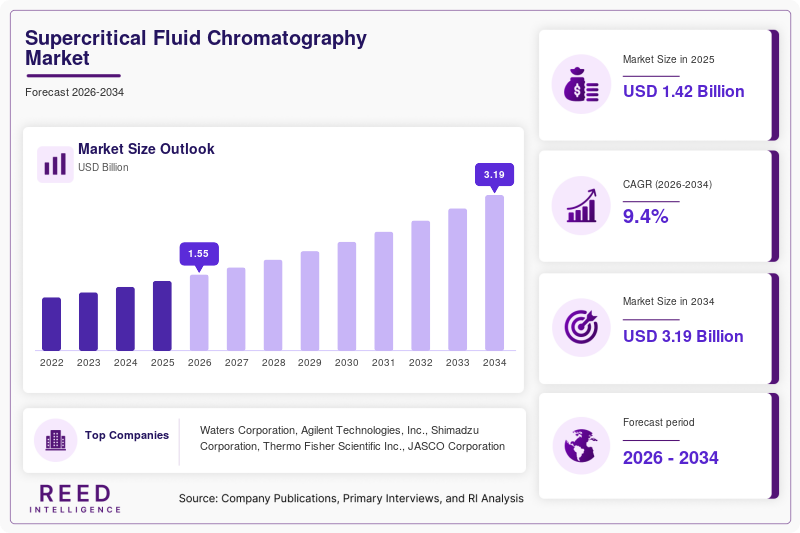
The Supercritical Fluid Chromatography Market size was valued at USD 1.42 billion in 2025 and is projected to reach USD 3.18 billion by 2034, expanding at a CAGR of 9.4% during 2025–2034. The market is experiencing steady expansion as analytical laboratories increasingly adopt advanced separation techniques that offer faster processing times, reduced solvent consumption, and improved environmental performance compared to traditional chromatography methods.
A major global factor supporting the growth of the Supercritical Fluid Chromatography Market is the rising emphasis on green analytical chemistry. Regulatory bodies and research institutions are encouraging sustainable laboratory practices, which has accelerated the adoption of supercritical fluid chromatography (SFC) systems due to their lower reliance on organic solvents and reduced environmental footprint.
Key Highlights
- North America dominated the market with a 38.6% share in 2025, while Asia Pacific is projected to grow at the fastest CAGR of 11.2% through 2034.
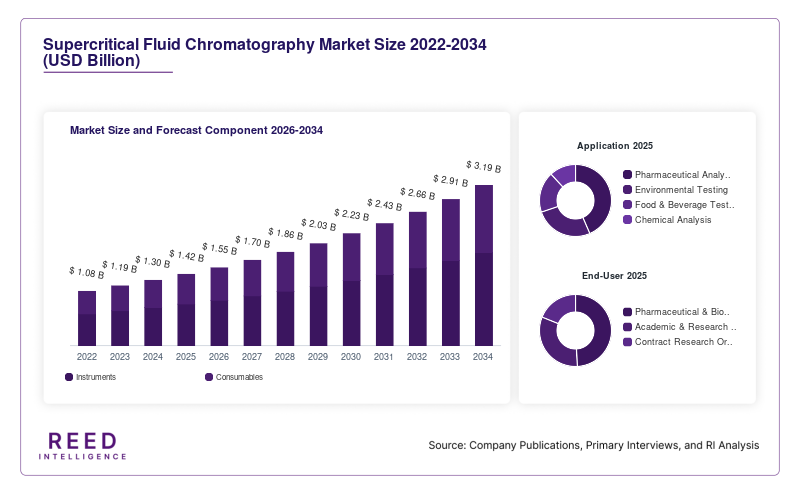
- Instruments emerged as the leading segment with a 54.3% share, while consumables are expected to grow at a CAGR of 10.1%.
- Within applications, pharmaceutical analysis dominated with 41.8% share, while environmental testing is projected to grow at 10.8% CAGR.
- The United States led globally, with market values of USD 420 million in 2025 and USD 455 million in 2026.
Market Trends
Integration of Automation and AI in Chromatography Systems
Automation is becoming a defining trend in the Supercritical Fluid Chromatography Market. Laboratories are increasingly integrating automated sample handling, data processing, and system optimization tools to enhance workflow efficiency. Artificial intelligence-based software is enabling predictive maintenance, method development optimization, and improved accuracy in analytical results. This trend is reducing manual intervention and increasing throughput, particularly in high-volume pharmaceutical laboratories.
Expansion of SFC Applications Beyond Pharmaceuticals
While pharmaceuticals remain the dominant application area, the use of SFC is expanding into food safety, cosmetics, and environmental monitoring. The technique is being increasingly used for pesticide residue analysis, nutraceutical compound separation, and flavor profiling. This diversification is broadening the scope of the Supercritical Fluid Chromatography Market and creating new revenue streams. Industries are recognizing the technique’s efficiency in handling complex matrices, which is driving adoption across non-traditional sectors.
Market Drivers
Rising Demand for Efficient Chiral Separation Techniques
Chiral separation plays a critical role in drug development, as enantiomers often exhibit different biological activities. Supercritical fluid chromatography offers superior resolution and faster separation of chiral compounds compared to conventional methods. The growing pipeline of complex pharmaceutical molecules is increasing demand for high-performance analytical tools, thereby driving the Supercritical Fluid Chromatography Market.
Increasing Adoption of Eco-Friendly Analytical Methods
Environmental concerns and stringent regulations on solvent usage are pushing laboratories to adopt greener technologies. SFC systems use carbon dioxide as the primary mobile phase, significantly reducing hazardous solvent waste. This aligns with global sustainability goals and corporate environmental strategies, making SFC an attractive alternative. As organizations prioritize sustainable operations, the adoption of SFC technologies is expected to accelerate across industries.
Market Restraint
High Initial Investment and Operational Complexity
One of the major challenges limiting the growth of the Supercritical Fluid Chromatography Market is the high initial cost associated with system installation and setup. SFC instruments require specialized components, including high-pressure pumps and temperature control systems, which increase capital expenditure.
Additionally, the technique demands skilled personnel for method development and system maintenance. The lack of trained professionals in emerging economies further restricts widespread adoption. Smaller laboratories and academic institutions often find it difficult to justify the investment, especially when conventional chromatography methods are already in place.
Operational complexity also presents a barrier, as optimizing parameters such as pressure, temperature, and co-solvent ratios can be technically demanding. These challenges collectively slow down the penetration of SFC systems, particularly in cost-sensitive markets.
Market Opportunities
Growth in Biopharmaceutical and Personalized Medicine Research
The expansion of biopharmaceutical research and personalized medicine is creating significant opportunities in the Supercritical Fluid Chromatography Market. Advanced therapies require precise analytical techniques for compound separation and validation. SFC offers high efficiency and accuracy, making it suitable for analyzing complex biological samples. As research in biologics and gene-based therapies continues to grow, demand for SFC systems is expected to increase.
Emerging Markets and Laboratory Infrastructure Development
Developing economies are investing heavily in healthcare and research infrastructure, creating new growth avenues. Countries in Asia Pacific, Latin America, and the Middle East are expanding their laboratory capabilities to support pharmaceutical manufacturing and quality control. This expansion is expected to drive demand for advanced analytical instruments, including SFC systems. Market players are focusing on these regions to capitalize on untapped opportunities and expand their global footprint.
Segmental Analysis
By Component
The instruments segment dominated the Supercritical Fluid Chromatography Market with a 54.3% share in 2025. High demand for advanced chromatography systems in pharmaceutical and research laboratories contributed to this dominance.
The consumables segment is expected to grow at a CAGR of 10.1%, driven by recurring demand for columns, solvents, and accessories. Increasing sample testing volumes will continue to support this growth.
By Application
Pharmaceutical analysis held the largest share at 41.8% in 2025, driven by the need for efficient drug development and quality control processes.
Environmental testing is projected to grow at a CAGR of 10.8%, supported by increasing regulations on pollution monitoring and chemical analysis.
By End-User
Pharmaceutical and biotechnology companies dominated the market with a 46.2% share in 2025. These organizations require high-performance analytical tools for research and development.
Academic and research institutes are expected to grow at a CAGR of 9.9%, driven by increased funding for scientific research and innovation.
By Technology Type
Analytical SFC systems accounted for the largest share of 63.5% in 2025, as they are widely used for compound identification and quantification.
Preparative SFC systems are expected to grow at a CAGR of 10.5%, driven by increasing demand for large-scale purification processes in pharmaceutical manufacturing.
Regional Analysis
North America
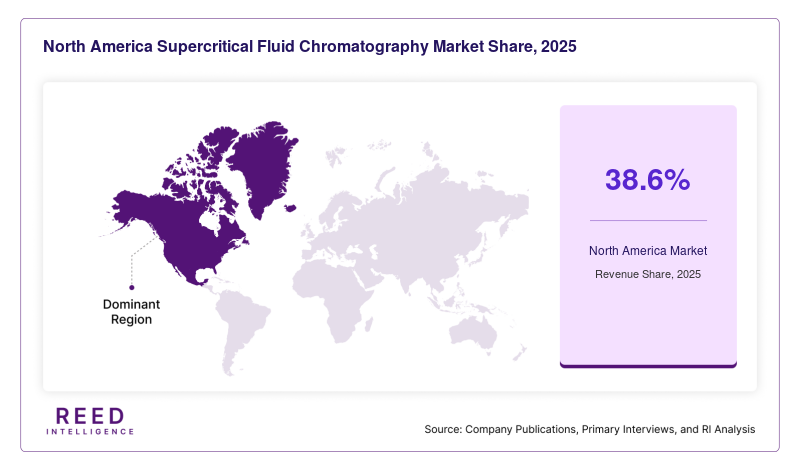
North America accounted for 38.6% of the Supercritical Fluid Chromatography Market share in 2025 and is expected to grow at a CAGR of 8.7% through 2034. The region’s growth is supported by advanced research infrastructure and widespread adoption of innovative analytical technologies.
The United States dominated the regional market due to strong investments in pharmaceutical research. The presence of major drug manufacturers and contract research organizations has driven demand for high-precision chromatography systems.
Europe
Europe held 27.4% market share in 2025 and is projected to grow at a CAGR of 8.9% during the forecast period. The region benefits from strict environmental regulations that encourage the adoption of sustainable analytical methods.
Germany led the European market, supported by its robust chemical and pharmaceutical industries. The country’s focus on sustainable manufacturing practices has accelerated the adoption of SFC technologies.
Asia Pacific
Asia Pacific represented 21.8% of the Supercritical Fluid Chromatography Market in 2025 and is anticipated to grow at the fastest CAGR of 11.2% through 2034. Rapid industrialization and increasing investments in research infrastructure are driving market expansion.
China emerged as the dominant country due to its expanding pharmaceutical manufacturing base. Government initiatives to strengthen domestic drug production and quality standards are boosting demand for advanced analytical instruments.
Middle East & Africa
The Middle East & Africa accounted for 6.5% market share in 2025 and is expected to grow at a CAGR of 9.1%. Growth is driven by improving healthcare infrastructure and increasing focus on quality control in food and pharmaceuticals.
Saudi Arabia led the region due to investments in laboratory modernization and regulatory improvements aimed at enhancing product quality and safety.
Latin America
Latin America held 5.7% share of the Supercritical Fluid Chromatography Market in 2025 and is projected to grow at a CAGR of 9.3%. The region is witnessing increased adoption of advanced analytical tools in food safety and environmental monitoring.
Brazil dominated the regional market, supported by expanding research activities and growing pharmaceutical production capabilities.
Competitive Landscape
The Supercritical Fluid Chromatography Market is moderately competitive, with several global and regional players focusing on product innovation and strategic collaborations. Leading companies are investing in research and development to enhance system performance and expand application areas.
The market leader, Waters Corporation, continues to strengthen its position through continuous innovation and product launches. The company recently introduced an advanced SFC system with improved automation capabilities, enhancing efficiency and throughput.
Other prominent players are focusing on expanding their global presence through partnerships and acquisitions. Companies are also investing in emerging markets to tap into growing demand for analytical technologies.
Key Players
- Waters Corporation
- Agilent Technologies, Inc.
- Shimadzu Corporation
- Thermo Fisher Scientific Inc.
- JASCO Corporation
- PerkinElmer, Inc.
- Merck KGaA
- Danaher Corporation
- Restek Corporation
- Selerity Technologies
- Gilson, Inc.
- Knauer Wissenschaftliche Geräte GmbH
- Trajan Scientific and Medical
- Bruker Corporation
- Hitachi High-Tech Corporation
Recent Developments
- In 2024, Waters Corporation launched a next-generation SFC system with enhanced automation features.
- Agilent Technologies expanded its chromatography portfolio with improved SFC compatibility modules.
- Shimadzu Corporation introduced a hybrid chromatography system integrating SFC and LC capabilities.
- Thermo Fisher Scientific invested in expanding its analytical instrument manufacturing facilities.
- Merck KGaA developed advanced consumables tailored for SFC applications.
Supercritical Fluid Chromatography Market Segments
Component
- Instruments
- Consumables
Application
- Pharmaceutical Analysis
- Environmental Testing
- Food & Beverage Testing
- Chemical Analysis
End-User
- Pharmaceutical & Biotechnology Companies
- Academic & Research Institutes
- Contract Research Organizations
Technology Type
- Analytical SFC
- Preparative SFC
By Region
- North America
- Europe
- APAC
- Middle East and Africa
- LATAM