Suppository Packaging Market Size, Share & Demand Report By Material Type (Plastic Films, Aluminum Laminates, Paper-Based Materials, Composite Materials), By Packaging Format (Blister Packs, Strip Packaging, Sachets, Tubes and Containers), By End Use (Pharmaceutical Manufacturers, Contract Packaging Organizations, Hospital Pharmacies, Retail Pharmacies), By Region & Segment Forecasts, 2026–2034
USD 3950
Market Overview
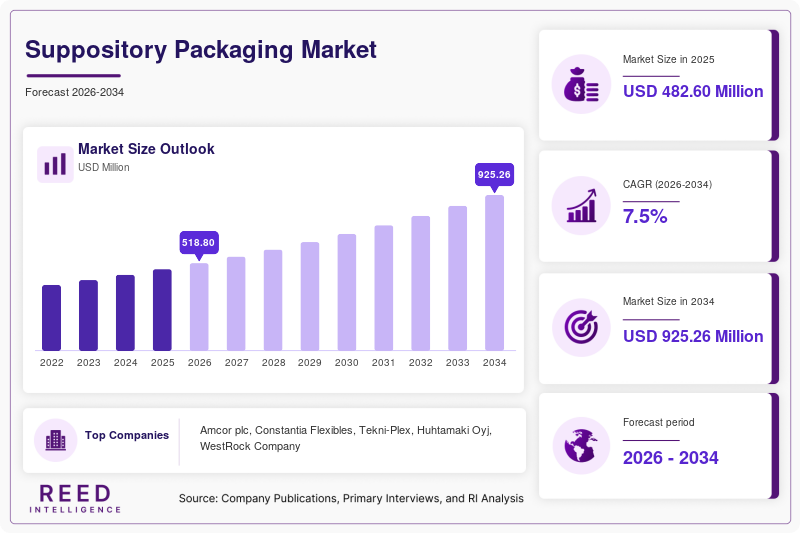
The global Suppository Packaging Market size was valued at USD 482.6 million in 2026 and is projected to reach USD 864.3 million by 2034, expanding at a CAGR of 7.5% during the forecast period from 2026 to 2034. The market is experiencing steady growth due to the rising demand for pharmaceutical dosage forms that offer targeted drug delivery and improved patient compliance. Suppository packaging solutions are widely used to protect rectal and vaginal dosage forms from moisture, contamination, temperature fluctuations, and physical deformation during transportation and storage. Pharmaceutical companies are increasingly focusing on advanced packaging materials that can improve shelf life and maintain product stability across different climatic conditions.
One of the major global factors supporting market expansion is the growth of the pharmaceutical industry in emerging economies. Increasing healthcare expenditure, wider access to over-the-counter medications, and rising production of generic drugs have accelerated the demand for cost-effective and protective pharmaceutical packaging formats. In addition, the growing prevalence of gastrointestinal disorders, gynecological conditions, and pediatric treatments has contributed to higher consumption of suppository-based medications. Manufacturers are also investing in recyclable blister films, aluminum laminates, and thermoformed packaging solutions to comply with sustainability targets and pharmaceutical safety regulations.
Key Highlights
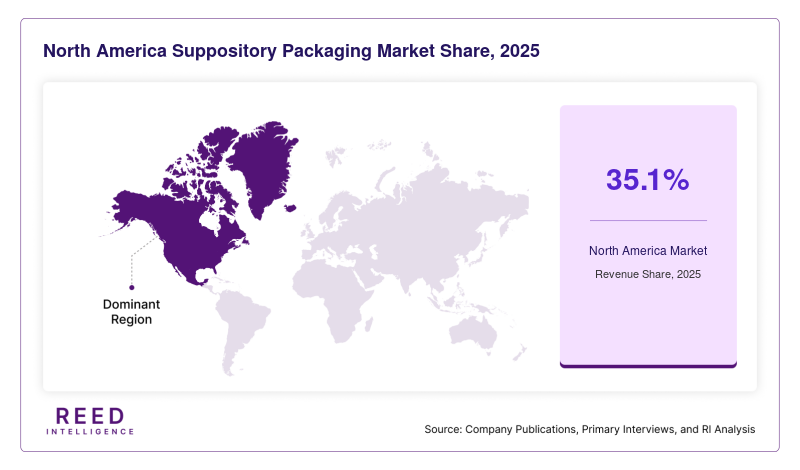
- North America dominated the market with a 35.1% share in 2025.
- Asia Pacific is expected to grow at the fastest CAGR of 9.4% during 2026–2034.
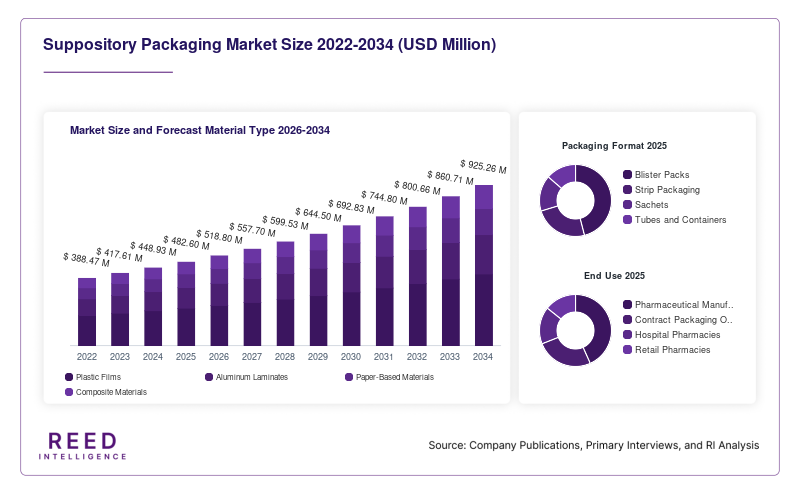
- By material type, plastic films accounted for the largest share of 42.8%, while aluminum laminate packaging is projected to grow at a CAGR of 8.7%.
- By packaging format, blister packs led with a 47.3% share, whereas strip packaging is expected to expand at a CAGR of 8.9%.
- By end use, pharmaceutical manufacturers held the leading share of 58.4%, while contract packaging organizations are projected to grow at a CAGR of 9.1%.
- The United States remained the dominant country, with market values of USD 121 million in 2024 and USD 132 million in 2025.
Market Trends
Rising Adoption of Sustainable Pharmaceutical Packaging Materials
Sustainability has become an important trend in the Suppository Packaging Market as pharmaceutical companies increasingly seek environmentally responsible packaging alternatives. Manufacturers are gradually replacing conventional multilayer plastic packaging with recyclable films, biodegradable polymers, and lightweight aluminum laminates to reduce packaging waste and improve environmental performance. Regulatory authorities in Europe and North America are also encouraging pharmaceutical companies to lower plastic consumption and improve recycling practices across the healthcare supply chain. This trend has encouraged packaging suppliers to develop mono-material blister structures that offer both moisture resistance and easier recyclability. Companies are also investing in thinner packaging films that reduce material usage without compromising product protection. Growing consumer awareness regarding sustainable healthcare products is expected to strengthen the adoption of eco-friendly suppository packaging solutions during the forecast period.
Expansion of Automated and Smart Packaging Technologies
The increasing use of automated production technologies is reshaping the global Suppository Packaging Market. Pharmaceutical manufacturers are adopting high-speed filling, sealing, and inspection systems to improve production efficiency and reduce operational errors. Automated packaging lines support accurate dosing, contamination control, and consistent sealing quality, which are essential for suppository-based medications. In addition, smart packaging technologies such as serialization, QR code integration, and track-and-trace systems are becoming more common due to stricter pharmaceutical safety regulations. These technologies help improve supply chain transparency and reduce the risk of counterfeit products entering the market. Packaging companies are also introducing digital monitoring systems that track temperature and storage conditions during transportation. The growing integration of Industry 4.0 technologies into pharmaceutical packaging operations is expected to support long-term market development.
Market Drivers
Increasing Demand for Targeted Drug Delivery Systems
The growing preference for targeted drug delivery systems is a major factor driving the Suppository Packaging Market. Suppositories provide localized treatment and bypass the digestive system, making them suitable for patients who experience difficulty swallowing oral medications. Healthcare providers are increasingly recommending suppository formulations for pediatric, geriatric, and postoperative patients because they improve therapeutic effectiveness and reduce gastrointestinal side effects. This trend has increased the production of rectal and vaginal dosage forms across pharmaceutical companies worldwide. As demand for these medications rises, manufacturers require high-quality packaging solutions that can preserve product integrity and maintain sterility throughout distribution. Packaging materials with strong barrier properties are becoming essential to prevent moisture absorption and deformation. The growing application of suppositories in pain management, fever reduction, and gynecological treatments continues to support the expansion of the market.
Growth of Generic Pharmaceutical Manufacturing in Emerging Economies
The rapid expansion of generic drug manufacturing in emerging economies is contributing significantly to market growth. Countries such as India, China, Brazil, and Indonesia are increasing pharmaceutical production capacity to meet rising domestic and export demand. Generic drug manufacturers are focusing on affordable packaging solutions that comply with international pharmaceutical standards while maintaining cost efficiency. Suppository packaging suppliers are benefiting from increased production volumes, especially in regions with expanding healthcare infrastructure and supportive government initiatives. Rising investments in pharmaceutical manufacturing facilities and contract packaging operations are also increasing demand for automated blister and strip packaging systems. Additionally, the expansion of retail pharmacy chains and e-commerce pharmaceutical distribution has created greater demand for secure and tamper-evident packaging formats. These developments are expected to maintain strong demand for suppository packaging products during the forecast period.
Market Restraint
High Regulatory Compliance Requirements for Pharmaceutical Packaging
Strict regulatory requirements associated with pharmaceutical packaging continue to restrain the growth of the Suppository Packaging Market. Packaging manufacturers must comply with multiple international standards related to material safety, sterility, labeling accuracy, and child-resistant packaging features. Regulatory authorities in the United States, Europe, and Japan require extensive testing and documentation to ensure that packaging materials do not interact negatively with suppository formulations. Compliance processes often increase manufacturing costs and lengthen product approval timelines for packaging suppliers. Smaller companies may face challenges in meeting evolving standards because of limited investment capacity and technical expertise. In addition, frequent updates to environmental and pharmaceutical safety regulations require manufacturers to redesign packaging structures and production processes. For example, several European pharmaceutical packaging companies have invested heavily in recyclable blister technologies to meet regional sustainability mandates. These regulatory pressures can reduce profit margins and delay product launches, particularly for small and medium-sized packaging manufacturers operating in highly competitive markets.
Market Opportunities
Increasing Pharmaceutical Outsourcing and Contract Packaging Services
The growth of pharmaceutical outsourcing is creating strong opportunities for the Suppository Packaging Market. Pharmaceutical companies are increasingly collaborating with contract packaging organizations to reduce operational costs and improve manufacturing flexibility. Contract packaging providers offer specialized expertise in filling, sealing, labeling, and compliance management for sensitive dosage forms such as suppositories. This trend is particularly strong among small and mid-sized pharmaceutical firms that lack advanced packaging infrastructure. Outsourcing allows drug manufacturers to focus on research and product development while relying on third-party specialists for packaging operations. Contract packaging companies are investing in automated blister and strip packaging lines to accommodate increasing production demand. Rising demand for customized packaging, shorter production cycles, and international pharmaceutical distribution is expected to create additional revenue opportunities for suppliers offering integrated packaging solutions.
Growing Demand for Temperature-Resistant Packaging Solutions
The increasing global distribution of pharmaceutical products has created rising demand for temperature-resistant packaging in the suppository segment. Suppositories are highly sensitive to heat and moisture, making protective packaging essential for maintaining product quality during transportation and storage. Pharmaceutical companies are therefore seeking advanced packaging materials that can provide thermal stability and improved barrier protection across varying climatic conditions. This trend is particularly important in tropical and developing regions where high temperatures can affect product consistency. Packaging manufacturers are developing multilayer films, insulated secondary packaging, and advanced aluminum laminate structures that help preserve suppository integrity throughout the supply chain. The expansion of online pharmaceutical sales and cross-border drug exports is also encouraging demand for durable and secure packaging formats. These developments are expected to generate long-term growth opportunities for companies specializing in pharmaceutical barrier packaging technologies.
Segmental Analysis
By Material Type
Plastic films accounted for the largest share of the Suppository Packaging Market in 2024, representing 42.8% of total revenue. The dominance of this subsegment is attributed to the flexibility, lightweight properties, and cost efficiency offered by plastic-based packaging materials. Pharmaceutical manufacturers widely use polyvinyl chloride, polyethylene, and polypropylene films because they provide effective moisture protection and support high-speed thermoforming operations. Plastic films are also compatible with automated filling and sealing equipment, making them suitable for large-scale pharmaceutical production environments. In addition, the availability of transparent packaging structures allows easy product inspection and improves patient convenience. The growing demand for unit-dose packaging in hospitals and retail pharmacies has further strengthened the use of plastic films across the pharmaceutical packaging industry. Manufacturers continue to focus on improving film durability and barrier performance to enhance product stability and shelf life.
Aluminum laminate packaging is projected to register the fastest CAGR of 8.7% during the forecast period due to rising demand for high-barrier pharmaceutical packaging solutions. Aluminum laminates provide superior protection against moisture, oxygen, and temperature fluctuations, making them particularly suitable for heat-sensitive suppository products. Pharmaceutical companies are increasingly adopting aluminum-based structures to improve product integrity during international transportation and long-term storage. The segment is also benefiting from rising sustainability initiatives because aluminum materials can support recyclable packaging designs. In addition, regulatory agencies are encouraging the use of packaging materials that maintain consistent pharmaceutical quality across different environmental conditions. Packaging manufacturers are investing in advanced laminate technologies that combine aluminum layers with lightweight polymer coatings to improve flexibility and reduce overall packaging weight. These developments are expected to support continued growth within the segment.
By Packaging Format
Blister packs held the leading position in the Suppository Packaging Market in 2024 with a revenue share of 47.3%. The widespread use of blister packaging is primarily driven by its ability to provide individual cavity protection, tamper evidence, and convenient product dispensing. Pharmaceutical companies prefer blister packs because they reduce contamination risks and improve medication safety throughout the distribution process. The format also supports accurate dosage management and extends product shelf life through enhanced barrier protection. Hospitals, retail pharmacies, and healthcare institutions increasingly favor blister-packed suppositories because of improved handling efficiency and patient convenience. In addition, advancements in thermoforming and cold-forming technologies have enabled manufacturers to develop customized blister cavity designs suitable for different suppository shapes and sizes. The growing adoption of automated packaging systems has further strengthened the demand for blister packaging formats in pharmaceutical manufacturing facilities worldwide.
Strip packaging is expected to witness the fastest growth at a CAGR of 8.9% during the forecast period. The segment is expanding because strip packaging offers cost-effective production and reduced material consumption compared to traditional blister formats. Pharmaceutical companies are increasingly using strip packaging for high-volume generic drug production and over-the-counter suppository products. The format is particularly popular in emerging economies where affordability and efficient distribution remain critical market factors. Strip packaging also supports compact product design, which reduces storage and transportation costs for pharmaceutical suppliers. Packaging manufacturers are introducing multilayer strip materials with enhanced sealing performance and moisture resistance to improve product protection. In addition, the rising demand for portable and easy-to-open pharmaceutical packaging among elderly consumers is contributing to the rapid adoption of strip packaging solutions across both developed and developing healthcare markets.
By End Use
Pharmaceutical manufacturers represented the dominant end-use segment in the Suppository Packaging Market in 2024, accounting for 58.4% of overall revenue. The segment’s leading position is supported by increasing production of prescription and over-the-counter suppository medications for gastrointestinal, gynecological, and pain management applications. Pharmaceutical companies require highly reliable packaging systems that can maintain product sterility, stability, and compliance with international healthcare regulations. Manufacturers are investing heavily in automated packaging lines to improve operational efficiency and reduce contamination risks during production. In addition, growing demand for customized dosage forms and patient-specific medications has increased the need for flexible packaging solutions capable of supporting different product configurations. The expansion of pharmaceutical manufacturing capacity across emerging economies has also contributed significantly to higher demand for blister packs, strip packaging, and aluminum laminate structures used in suppository packaging applications.
Contract packaging organizations are projected to expand at the fastest CAGR of 9.1% during the forecast period due to the increasing outsourcing of pharmaceutical packaging operations. Drug manufacturers are collaborating with third-party packaging specialists to reduce capital expenditure and improve supply chain flexibility. Contract packaging companies provide expertise in packaging design, labeling, serialization, and regulatory compliance, making them valuable partners for pharmaceutical firms seeking operational efficiency. The segment is also benefiting from rising demand for short production cycles and customized packaging solutions tailored to regional market requirements. Many contract packaging providers are investing in advanced automation systems and quality inspection technologies to meet growing pharmaceutical industry standards. Furthermore, smaller pharmaceutical companies are increasingly relying on outsourcing partners because of the high costs associated with establishing in-house packaging infrastructure. These factors are expected to accelerate growth within the contract packaging segment over the coming years.
Regional Analysis
North America
North America accounted for 35.1% of the global Suppository Packaging Market in 2025 and maintained its leading position due to the strong presence of pharmaceutical manufacturers and advanced healthcare infrastructure. The region is projected to expand at a CAGR of 6.8% during the forecast period. High adoption of unit-dose pharmaceutical packaging and growing demand for child-resistant packaging solutions continue to support regional growth. Pharmaceutical companies in the United States and Canada are increasingly investing in automated blister packaging technologies to improve production efficiency and maintain regulatory compliance. Rising healthcare spending and strong demand for prescription medications also contribute to stable market expansion across the region.
The United States remained the dominant country in North America due to its extensive pharmaceutical manufacturing sector and advanced packaging technology capabilities. One unique growth factor in the country is the increasing use of specialized suppository formulations for pain management and palliative care treatments. Hospitals and long-term care facilities are expanding the use of rectal dosage forms for elderly patients who require alternative drug administration methods. In addition, pharmaceutical packaging companies in the United States are actively investing in recyclable blister packaging materials to meet sustainability targets and reduce environmental impact across healthcare supply chains.
Europe
Europe represented 27.4% of the global Suppository Packaging Market in 2025 and is expected to register a CAGR of 6.9% between 2026 and 2034. The regional market benefits from strict pharmaceutical quality standards and growing demand for sustainable packaging materials. Countries across Western Europe are increasingly adopting recyclable aluminum laminates and mono-material blister films to comply with environmental regulations. Pharmaceutical manufacturers are also focusing on high-barrier packaging technologies to preserve drug stability and improve product shelf life. The region’s well-established pharmaceutical sector and strong contract manufacturing industry continue to support steady demand for suppository packaging products.
Germany emerged as the dominant country in Europe due to its strong pharmaceutical production capacity and advanced packaging machinery industry. A major growth factor supporting the German market is the increasing integration of smart packaging technologies into pharmaceutical supply chains. Manufacturers are adopting serialization systems and digital tracking features to improve product authentication and regulatory compliance. In addition, the country’s emphasis on precision engineering has encouraged the development of highly efficient thermoforming and sealing systems used for suppository packaging production. These factors continue to strengthen Germany’s position within the regional market.
Asia Pacific
Asia Pacific held 22.6% of the global Suppository Packaging Market in 2025 and is anticipated to grow at the fastest CAGR of 9.4% during the forecast period. Rapid pharmaceutical industry expansion, increasing healthcare expenditure, and rising generic drug production are supporting regional market growth. Countries such as China, India, and South Korea are investing heavily in pharmaceutical manufacturing infrastructure to meet growing domestic and export demand. The increasing availability of affordable healthcare products and wider distribution of over-the-counter medications have also accelerated the demand for suppository packaging solutions. Packaging manufacturers in the region are adopting automated filling and sealing systems to improve production efficiency and reduce operational costs.
China remained the leading country in the Asia Pacific market because of its large pharmaceutical manufacturing base and expanding export activities. One unique growth factor driving the Chinese market is the government’s continued support for domestic pharmaceutical self-sufficiency and industrial modernization. Packaging manufacturers are receiving incentives to upgrade production facilities and implement advanced packaging technologies. In addition, the rapid growth of e-commerce pharmaceutical distribution in China has increased demand for durable and tamper-evident packaging solutions capable of protecting temperature-sensitive suppository products during long-distance transportation and storage.
Middle East & Africa
The Middle East & Africa accounted for 7.3% of the global Suppository Packaging Market in 2025 and is projected to grow at a CAGR of 7.1% through 2034. The regional market is benefiting from improvements in healthcare infrastructure and rising pharmaceutical imports. Governments across the Gulf Cooperation Council countries are investing in local pharmaceutical manufacturing facilities to reduce dependency on imported medicines. Demand for high-quality pharmaceutical packaging has increased as healthcare providers focus on product safety and regulatory compliance. In addition, the growing prevalence of chronic illnesses and gastrointestinal disorders has contributed to higher consumption of suppository-based medications across several countries in the region.
Saudi Arabia emerged as the dominant country within the Middle East & Africa market due to rising healthcare investments and pharmaceutical sector diversification initiatives. One significant growth factor supporting the country’s market is the expansion of domestic pharmaceutical production under national industrial development programs. Local drug manufacturers are increasing investments in modern packaging technologies to improve product quality and reduce reliance on imported packaging materials. The growing establishment of hospital networks and retail pharmacy chains across Saudi Arabia is also encouraging greater demand for secure and temperature-resistant suppository packaging solutions.
Latin America
Latin America captured 7.6% of the global Suppository Packaging Market in 2025 and is expected to expand at a CAGR of 7.3% during the forecast period. The market is supported by improving healthcare accessibility, rising pharmaceutical manufacturing activity, and increasing demand for affordable generic medications. Countries across the region are witnessing greater adoption of unit-dose pharmaceutical packaging formats due to enhanced medication safety requirements. Pharmaceutical companies are also expanding regional production capabilities to reduce import dependency and improve supply chain efficiency. Growing awareness regarding pharmaceutical product stability and packaging quality has encouraged higher investment in advanced blister and strip packaging systems.
Brazil remained the dominant country in the Latin American market because of its large pharmaceutical industry and expanding healthcare infrastructure. A unique growth factor in Brazil is the increasing government support for local generic drug production and public healthcare programs. Pharmaceutical manufacturers are expanding production of rectal and vaginal dosage forms to address rising healthcare demand among pediatric and elderly populations. In addition, local packaging companies are investing in cost-effective thermoformed packaging technologies that can improve product protection while supporting large-scale pharmaceutical distribution across urban and rural healthcare networks.
Competitive Landscape
The global Suppository Packaging Market is moderately fragmented, with several international and regional packaging manufacturers competing through product innovation, material development, and strategic partnerships. Leading companies are focusing on advanced barrier materials, automated packaging technologies, and sustainable packaging solutions to strengthen their market positions. Competition is increasing as pharmaceutical manufacturers seek packaging suppliers capable of meeting strict regulatory standards while supporting cost-effective production.
Amcor plc remains one of the leading companies in the market due to its broad pharmaceutical packaging portfolio and global manufacturing network. The company continues to invest in recyclable packaging technologies and high-barrier film solutions for temperature-sensitive pharmaceutical products. Constantia Flexibles, Huhtamaki Oyj, WestRock Company, and Tekni-Plex are also expanding their pharmaceutical packaging operations through product development and capacity expansion initiatives.
Key Players
- Amcor plc
- Constantia Flexibles
- Tekni-Plex
- Huhtamaki Oyj
- WestRock Company
- Bilcare Limited
- Sonoco Products Company
- Klöckner Pentaplast
- Winpak Ltd.
- UFlex Limited
- AptarGroup, Inc.
- Gerresheimer AG
- Berry Global Inc.
- SGD Pharma
- ACG Pharmapack
Recent Developments
- Amcor plc expanded its recyclable pharmaceutical blister packaging portfolio in 2025 to support sustainable healthcare packaging initiatives across North America and Europe.
- Constantia Flexibles introduced advanced aluminum laminate structures with improved moisture barrier performance for heat-sensitive suppository medications in 2024.
- Tekni-Plex launched upgraded thermoformed blister packaging materials designed to improve production efficiency and product protection for pharmaceutical manufacturers in 2025.
- Huhtamaki Oyj invested in additional pharmaceutical packaging production capacity in Asia Pacific to meet rising regional demand for unit-dose healthcare packaging solutions.
Suppository Packaging Market Segments
Material Type
- Plastic Films
- Aluminum Laminates
- Paper-Based Materials
- Composite Materials
Packaging Format
- Blister Packs
- Strip Packaging
- Sachets
- Tubes and Containers
End Use
- Pharmaceutical Manufacturers
- Contract Packaging Organizations
- Hospital Pharmacies
- Retail Pharmacies
By Region
- North America
- Europe
- APAC
- Middle East and Africa
- LATAM