Surfactant EOR Market Size, Share Demand Report By Product Type (Anionic, Non-Ionic, Cationic, Amphoteric), By Application (Onshore, Offshore), By Reservoir Type (Carbonate Reservoirs, Sandstone Reservoirs) & Segment Forecasts, 2026–2034
USD 3950
Surfactant EOR Market Size
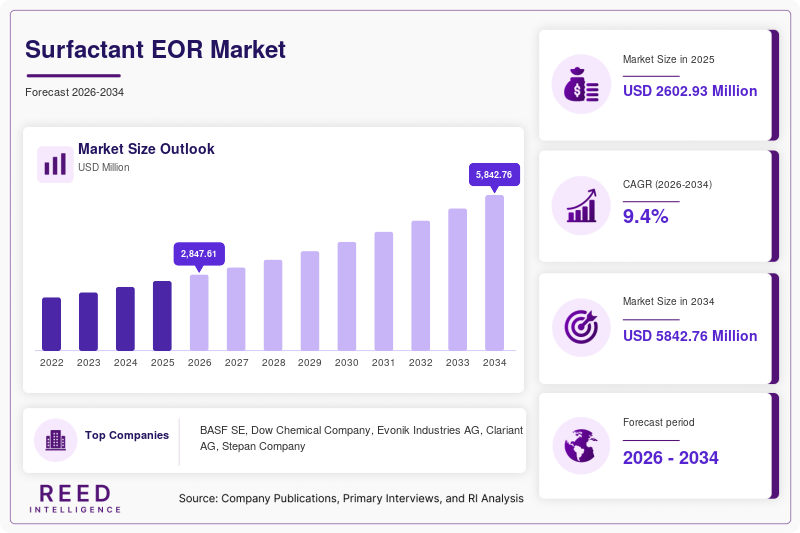
Surfactant EOR market size is projected at USD 2,847.6 million in 2026 and is expected to hit USD 5,847.5 million by 2034 with a CAGR of 9.4% during the forecast period. The increasing need to enhance oil recovery from mature fields and the growing adoption of chemical EOR methods to improve reservoir performance, coupled with the rising global energy demand, underpins market expansion. This report delivers a comprehensive analysis of the Surfactant EOR market, including segmentation by type and application, competitive dynamics, and regional growth patterns, equipping stakeholders with critical intelligence. The Surfactant EOR market continues to demonstrate strong growth potential, fueled by the global push for maximizing production from existing assets, the increasing complexity of oil reservoirs, and continuous innovation in surfactant chemistry and formulation.
Surfactant Enhanced Oil Recovery (EOR) involves the injection of surfactants into oil reservoirs to reduce interfacial tension between oil and water, mobilize trapped oil, and improve sweep efficiency. This chemical EOR method is used to recover oil that cannot be produced by primary or secondary methods. The global consumption of surfactants for EOR applications exceeded 350,000 metric tons in 2025, reflecting a 9% increase from 2023, driven by the need to increase recovery factors from mature oil fields. Adoption patterns reveal that the Anionic type dominates the market, accounting for 48% of total demand, followed by Non-Ionic at 28%, Cationic at 16%, and Amphoteric at 8%. The Surfactant EOR market's trajectory is closely linked to the growth of the global EOR market, which is projected to reach USD 80 billion by 2028, and the increasing focus on maximizing recovery from existing oil resources.
Surfactant EOR Market Trends
Development of Novel and High-Performance Surfactant Formulations
The Surfactant EOR market is witnessing a significant trend toward the development of novel and high-performance surfactant formulations, driven by the need to address challenging reservoir conditions, such as high salinity and high temperature. The revenue from advanced surfactant formulations grew to USD 950 million in 2025, a year-on-year increase of 16%, as 40% of new projects in 2025 specified custom-designed surfactant blends. Adoption rates of novel surfactants in high-temperature reservoirs reached 30%, with this figure projected to exceed 55% by 2030. The Surfactant EOR market's trend toward advanced formulations is reinforced by the need for higher oil recovery, the increasing complexity of reservoir conditions, and the continuous innovation in surfactant chemistry and nano-technology.
Growing Focus on Environmentally Sustainable and Bio-Based Surfactants
The increasing focus on environmentally sustainable and bio-based surfactants is a major trend shaping the Surfactant EOR market, with the development of products with lower toxicity and higher biodegradability. The market has seen a 20% increase in the demand for green surfactants since 2022, with 25% of new product developments in 2025 featuring bio-based or eco-friendly formulations. The use of surfactants derived from renewable sources has also gained significant traction. The Surfactant EOR market's trend toward sustainability is reinforced by the need to reduce environmental impact, the increasing regulatory pressure on chemical usage, and the continuous innovation in green chemistry and biotechnology.
Surfactant EOR Market Drivers
The Surfactant EOR market's expansion is primarily driven by the increasing global demand for energy and the need to enhance oil recovery from mature fields, with the global EOR market valued at USD 60 billion in 2025 and growing at a steady pace. The need to improve recovery factors and maximize production from existing assets has been a major driver, with surfactant EOR offering a proven method. The rising adoption of chemical EOR techniques and the continuous advancements in surfactant chemistry have also fueled market growth. Additionally, the increasing oil prices have spurred investment in EOR projects. The Surfactant EOR market's growth is further reinforced by the continuous improvement in surfactant formulations, leading to better performance and cost-effectiveness.
Surfactant EOR Market Restraints
Despite favorable growth prospects, the Surfactant EOR market faces significant constraints, primarily related to the high cost of surfactants and the complexity of their application, which can make projects economically challenging. The sensitivity of surfactants to reservoir conditions, such as temperature and salinity, can also be a limitation. The Surfactant EOR market's growth is also tempered by the long lead times for project development and the need for extensive pilot testing.
Surfactant EOR Market Opportunities
The Surfactant EOR market presents significant opportunities in the rapidly expanding market for enhanced oil recovery in offshore and deepwater fields, where specialized surfactant formulations are needed. The development of cost-effective and high-performance surfactants for challenging reservoir conditions is expected to grow at a CAGR of 12% through 2034. Emerging opportunities also exist in the integration of surfactants with other EOR methods, such as polymer flooding. The Surfactant EOR market's opportunity profile is further enhanced by the growing trend of digitalization and AI in reservoir management.
Challenges in Surfactant EOR Market
The Surfactant EOR market faces persistent challenges related to the need for continuous innovation to develop surfactants that are effective in a wide range of reservoir conditions. The complexity of surfactant loss due to adsorption and precipitation can also be a challenge. The market is also contending with the challenge of reducing the cost of surfactant production and deployment. Additionally, the Surfactant EOR market is challenged by the need to demonstrate the long-term economic viability of projects.
Surfactant EOR Market Segmentation
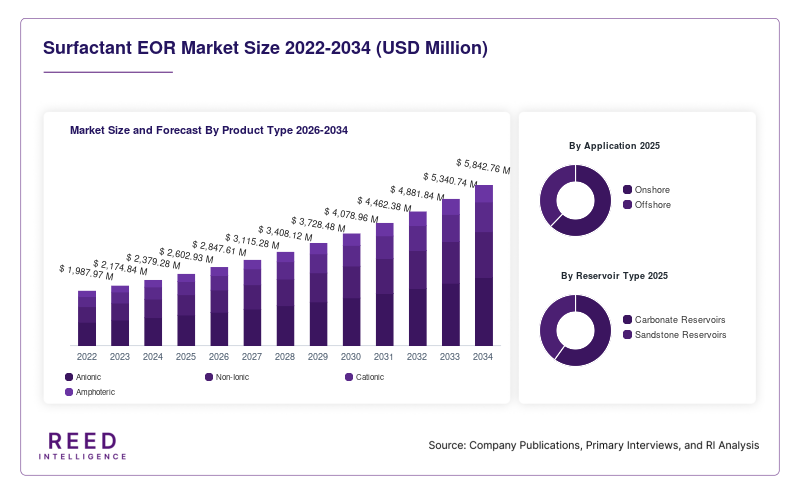
The Surfactant EOR market is segmented by Type and Application to provide a comprehensive market perspective. By Type, Anionic dominates with a 48% market share, driven by its cost-effectiveness and wide applicability. The Application segment is led by Onshore, which accounts for 72% of the market, followed by Offshore at 28%.
By Type
Anionic represent the largest segment in the Surfactant EOR market, commanding a 48% share, with consumption exceeding 168,000 metric tons in 2025. These are characterized by their use in reducing interfacial tension and their cost-effectiveness. Technical specifications include charge type, critical micelle concentration, and tolerance to salinity. The Surfactant EOR market's Anionic segment is driven by its use in onshore reservoirs.
Non-Ionic capture a 28% share of the Surfactant EOR market, with consumption of 98,000 metric tons in 2025. These are characterized by their lower sensitivity to salinity and hardness, making them suitable for a wider range of conditions. Technical specifications include cloud point, hydrophilic-lipophilic balance (HLB), and temperature stability. The Surfactant EOR market's Non-Ionic segment is driven by its use in offshore and high-salinity reservoirs.
Cationic represent 16% of the Surfactant EOR market, with consumption of 56,000 metric tons in 2025. These are characterized by their use in specific applications, often in combination with other surfactants. Technical specifications include charge type and compatibility. The Surfactant EOR market's Cationic segment is driven by its use in niche and specialized applications.
Amphoteric comprise the remainder of the Surfactant EOR market, accounting for 8% of total consumption, with 28,000 metric tons in 2025. These are characterized by their versatile charge behavior and stability. The Surfactant EOR market's Amphoteric segment is driven by its use in specialized and emerging applications.
By Application
Onshore dominates the Surfactant EOR market, accounting for 72% of consumption, representing 252,000 metric tons in 2025. This segment includes use in mature fields and land-based reservoirs. Usage penetration exceeds 15% in the sector. The Surfactant EOR market's Onshore segment is characterized by its focus on large-scale, cost-effective applications.
Offshore accounts for 28% of the Surfactant EOR market, with consumption of 98,000 metric tons in 2025. This segment encompasses use in offshore fields and deepwater reservoirs. The segment is growing at a robust CAGR, driven by offshore development. The Surfactant EOR market's Offshore segment is characterized by its focus on specialized formulations and logistics.
Surfactant EOR Market Regional Outlook
North America Surfactant EOR Market
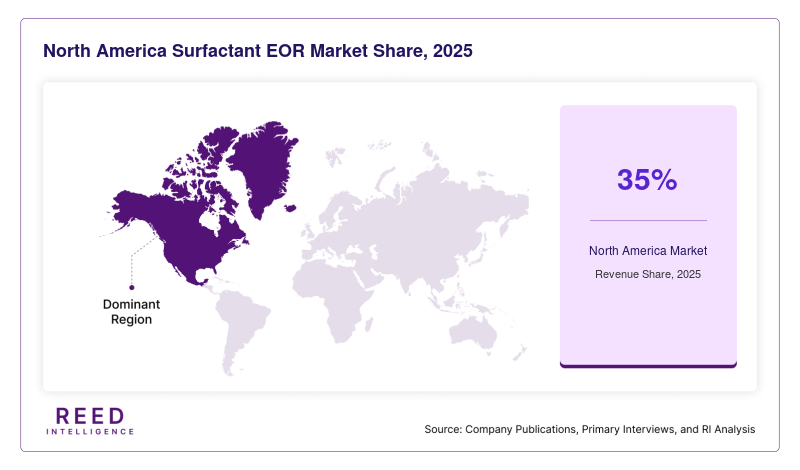
Leads the Surfactant EOR market, commanding a 35% share, with a revenue of USD 996.7 million in 2025. The United States is the primary driver, accounting for 85% of regional demand, driven by the large number of mature fields, strong oil and gas industry, and high adoption of EOR techniques. The North American Surfactant EOR market is characterized by its focus on innovation and high-performance products.
Middle East & Africa Surfactant EOR Market
Represents the second-largest market, capturing a 28% share with a revenue of USD 797.3 million in 2025. The UAE and Saudi Arabia are the primary drivers, collectively accounting for 65% of regional demand, driven by the vast oil reserves and national oil company initiatives to enhance recovery. The Middle East Surfactant EOR market is characterized by its focus on large-scale and high-value projects.
Asia-Pacific Surfactant EOR Market
Accounts for 22% of the global Surfactant EOR market, with a revenue of USD 626.5 million in 2025. China, India, and Indonesia are the primary drivers, together accounting for 70% of regional demand, driven by increasing energy demand and growing EOR activities. The Asia-Pacific Surfactant EOR market is projected to grow at the fastest CAGR of 11% through 2034.
Europe and Latin America Surfactant EOR Market
Together account for the remaining 15% of the Surfactant EOR market, with the UK leading the European market and Brazil leading the Latin American market. Both regions are projected to grow at CAGRs exceeding 8%, driven by oil and gas development.
Top players in Surfactant EOR Market
- BASF SE
- Dow Chemical Company
- Evonik Industries AG
- Clariant AG
- Stepan Company
- Huntsman Corporation
- Solvay S.A.
- Nouryon
- Kao Corporation
- Croda International Plc
- Oxiteno S.A.
- Pilot Chemical Company
- Sasol Limited
- Shell Chemicals
- Chevron Phillips Chemical
BASF SE
BASF SE holds a dominant position in the Surfactant EOR market, with an estimated 16% global market share, particularly strong in the development of high-performance surfactant formulations. The company's portfolio of EOR surfactants is widely recognized for its quality, innovation, and effectiveness. BASF's market leadership is reinforced by its significant R&D investment, its extensive chemical expertise, and its strong relationships with oil and gas companies. BASF commands over 18% of the North American market and 15% of the European market, positioning it as a key player in the Surfactant EOR market.
Dow Chemical Company
Dow Chemical Company is a leading player in the Surfactant EOR market, commanding approximately 14% of the global market share through its comprehensive portfolio of specialty chemicals and surfactants. The company's expertise in chemical engineering and its focus on innovation have solidified its position. Dow's EOR surfactants are known for their performance, reliability, and adaptability. The company's commitment to sustainability and its strong presence in the North American and Middle Eastern markets have enhanced its competitive advantage.
Evonik Industries AG holds a significant 10% market share, with particular strength in the specialty surfactant segment. Clariant AG is a major player in the global surfactant market, holding an 8% share.
Recent Developments in Surfactant EOR Market
- 2025: BASF launched a new line of high-temperature, high-salinity resistant surfactants for deepwater and challenging reservoir applications.
- 2025: Dow Chemical Company introduced a new bio-based surfactant for EOR, targeting the growing demand for sustainable chemical solutions.
Surfactant EOR Market Segments
By Product Type
- Anionic
- Non-Ionic
- Cationic
- Amphoteric
By Application
- Onshore
- Offshore
By Reservoir Type
- Carbonate Reservoirs
- Sandstone Reservoirs
By Region
- North America
- Europe
- APAC
- Middle East and Africa
- LATAM