Surgical Rasp Market Size, Share, Demand Report By Product Type (Stainless Steel Surgical Rasps, Titanium-Coated Surgical Rasps, Disposable Composite Rasps, Modular Surgical Rasps), By Application (Orthopedic Surgery, Dental & Maxillofacial Surgery, Trauma Surgery, Spinal Surgery), By End Use (Hospitals, Ambulatory Surgical Centers, Specialty Orthopedic Clinics, Academic & Research Institutes) By Region & Segment Forecasts, 2026–2034
USD 3950
Market Overview
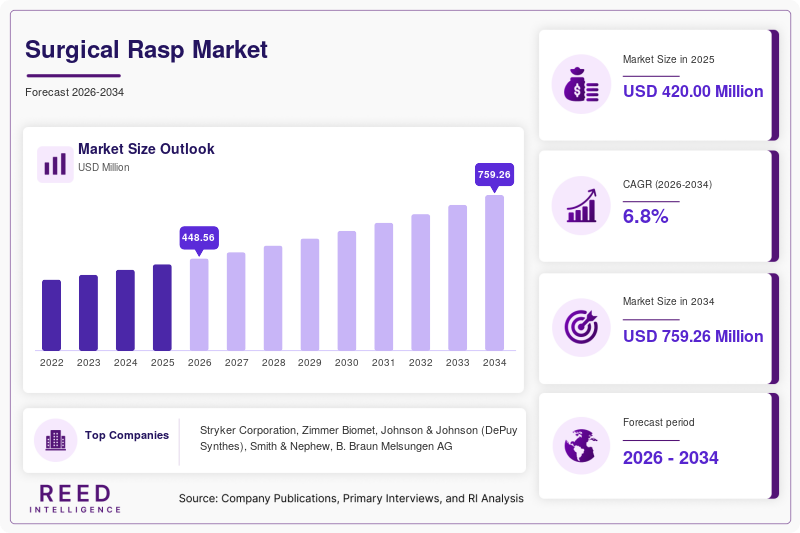
The global Surgical Rasp Market is valued at approximately USD 420 million in 2026 and is projected to reach USD 720 million by 2034, expanding at a CAGR of 6.8% during 2026–2034. Surgical rasps are essential orthopedic and reconstructive instruments used for bone shaping, surface smoothing, and implant preparation in procedures such as joint reconstruction, trauma surgery, and spinal operations. Growth in the market is primarily supported by the increasing volume of orthopedic surgeries driven by aging populations, rising sports injuries, and expanding access to advanced surgical care in emerging economies.
A key global factor influencing market expansion is the rapid shift toward minimally invasive orthopedic procedures, which require precision instruments like modular and ergonomically designed surgical rasps. Improvements in surgical tool manufacturing, including titanium coatings and disposable rasp systems, have further enhanced procedural efficiency and reduced infection risks, contributing to broader adoption across hospitals and ambulatory surgical centers.
Key Highlights
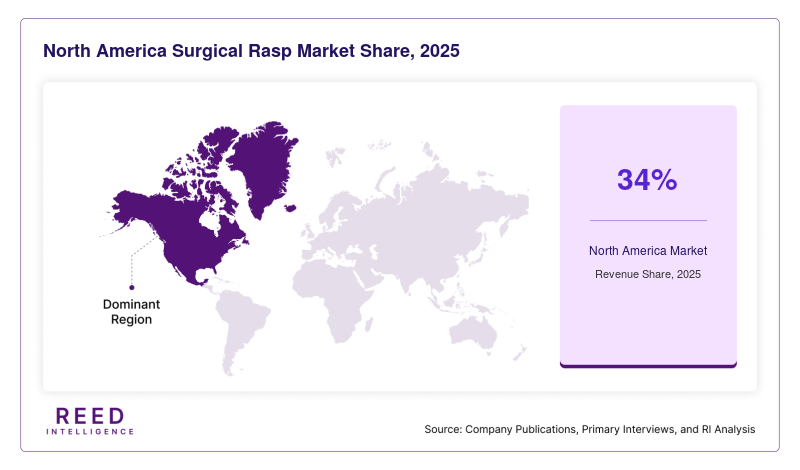
North America dominated the market with a 34.5% share in 2025.
Asia Pacific is expected to grow at the fastest CAGR of 11.6% during 2026–2034.
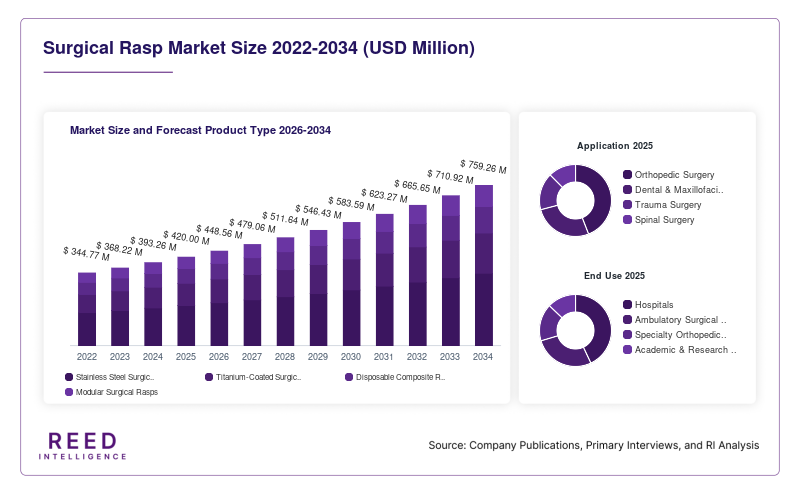
By product type, stainless steel surgical rasps accounted for the largest share of 46.2%.
while disposable composite rasps are projected to grow at a CAGR of 12.1%.
By application, orthopedic surgery led with a 44.8% share, whereas dental and maxillofacial surgery applications are expected to expand at a CAGR of 10.9%.
The United States remained the dominant country, with market values of USD 165 million in 2024 and USD 178 million in 2025.
Market Trends
Shift Toward Disposable and Single-Use Surgical Rasps
The adoption of disposable surgical rasps is increasing across hospitals and surgical centers due to rising concerns over cross-contamination and hospital-acquired infections. Single-use rasps eliminate the need for sterilization cycles, thereby reducing operational workload and ensuring consistent instrument performance. This trend is particularly evident in high-volume orthopedic departments where workflow efficiency is critical. Manufacturers are investing in cost-effective polymer-based and composite material rasps that maintain adequate strength while remaining safe for single use. In addition, regulatory pressure on infection control protocols is further encouraging healthcare providers to transition away from reusable metal instruments. The growing acceptance of value-based healthcare models is also influencing procurement decisions, where infection prevention outcomes are prioritized alongside procedural costs. Over time, this trend is expected to reshape procurement strategies in hospitals, especially in developed markets with strict clinical compliance standards.
Integration of Ergonomic and Precision-Engineered Instrument Designs
Another significant trend shaping the Surgical Rasp Market is the development of ergonomically optimized and precision-engineered instruments. Surgeons increasingly demand tools that offer improved grip, reduced hand fatigue, and enhanced control during complex orthopedic procedures. As surgical procedures become more minimally invasive, the requirement for precision has intensified, pushing manufacturers to design rasps with advanced handle geometries, modular attachments, and refined cutting edges. Computer-aided design and additive manufacturing technologies are being used to develop customized rasps tailored for specific anatomical requirements. Additionally, surface coating technologies such as titanium nitride and diamond-like carbon are improving durability and cutting efficiency. These innovations are helping reduce surgical time and improve patient outcomes, making ergonomic surgical rasps an integral part of modern operating rooms.
Market Drivers
Rising Incidence of Orthopedic Disorders and Aging Population
The growing prevalence of orthopedic conditions such as osteoarthritis, rheumatoid arthritis, and osteoporosis is a primary driver of the surgical rasp market. As the global population ages, the demand for joint replacement and reconstructive surgeries continues to rise significantly. Surgical rasps play a critical role in preparing bone surfaces for implants, making them indispensable in these procedures. Additionally, the increasing incidence of sports-related injuries and road accidents is contributing to higher surgical volumes globally. Emerging economies are witnessing improved access to orthopedic care, further expanding procedural demand. Governments and healthcare organizations are also investing in infrastructure development, enabling more surgeries in both urban and semi-urban regions. This rising procedural burden directly translates into higher consumption of surgical instruments, including rasps, across hospitals and specialty clinics.
Technological Advancements in Surgical Instrumentation
Technological progress in surgical instrument design and materials is another major growth driver for the market. Manufacturers are introducing advanced alloys, corrosion-resistant coatings, and lightweight composite materials that enhance instrument durability and usability. Innovations in precision engineering allow for better bone shaping accuracy, reducing surgical complications and improving implant fit. Integration of digital surgical planning tools and computer-assisted surgery systems has also increased the need for highly specialized rasps compatible with modern workflows. Furthermore, improved sterilization compatibility and enhanced lifecycle performance are encouraging hospitals to upgrade their existing instrument sets. These advancements are not only improving surgical efficiency but also supporting the adoption of next-generation orthopedic procedures globally.
Market Restraint
Single-Use Instrument Cost Pressure and Reprocessing Limitations
One of the major restraints in the Surgical Rasp Market is the cost burden associated with disposable instruments and the operational complexities of reusable instrument sterilization. While disposable rasps reduce infection risks, they significantly increase recurring procurement costs for hospitals, particularly in cost-sensitive regions. On the other hand, reusable rasps require strict sterilization protocols, which add to operational expenses, labor requirements, and equipment maintenance costs. In developing countries, limited healthcare budgets often restrict the adoption of advanced surgical instruments, leading to continued use of conventional, lower-cost tools. Additionally, inconsistent reimbursement frameworks for orthopedic procedures in some regions further limit investment in premium surgical instruments. Hospitals must balance cost efficiency with patient safety, creating hesitation in large-scale adoption of high-end or single-use rasp systems. This cost-performance trade-off remains a key challenge for manufacturers aiming to expand their global footprint.
Market Opportunities
Expansion of Ambulatory Surgical Centers and Outpatient Surgeries
The rapid growth of ambulatory surgical centers (ASCs) presents a significant opportunity for the surgical rasp market. ASCs are increasingly performing orthopedic and minor reconstructive procedures due to lower costs, reduced hospital stays, and faster patient recovery times. These facilities require efficient, easy-to-use, and often disposable surgical instruments, creating strong demand for modern rasp systems. As healthcare systems shift toward outpatient care models, instrument manufacturers can benefit by offering compact, single-use, and procedure-specific rasp kits. Additionally, ASCs prioritize workflow efficiency and infection control, making them an ideal segment for advanced disposable surgical tools. The increasing establishment of ASCs in emerging economies further broadens market potential.
Growth in Emerging Markets and Healthcare Infrastructure Development
Emerging economies in Asia Pacific, Latin America, and parts of the Middle East are witnessing rapid healthcare infrastructure development, creating strong growth opportunities for surgical instrument manufacturers. Rising medical tourism, increasing government healthcare expenditure, and expanding insurance coverage are driving surgical volumes in these regions. Local hospitals are gradually adopting advanced orthopedic procedures, increasing demand for precision surgical tools like rasps. Additionally, partnerships between global manufacturers and regional distributors are improving product accessibility. The growing presence of private hospitals and specialty orthopedic clinics is further accelerating market penetration, especially for mid-range and cost-effective surgical rasp solutions.
Segmental Analysis
By Product Type
Stainless steel surgical rasps dominated the market with a 46.2% share in 2024, driven by their durability, cost-effectiveness, and widespread availability in hospitals. These instruments remain the standard choice for orthopedic and reconstructive procedures due to their reliability and compatibility with sterilization processes. Their extensive use in developed healthcare systems reinforces their leading position across global markets. Hospitals prefer stainless steel variants for high-volume surgeries, where repeated use and longevity are critical.
Disposable composite rasps are expected to grow at a CAGR of 12.1%, supported by rising concerns over infection control and operational efficiency. These rasps are gaining traction in ambulatory surgical centers and outpatient facilities, where single-use instruments reduce sterilization costs and turnaround time. Increasing regulatory focus on hospital-acquired infection prevention and the shift toward value-based healthcare models are accelerating adoption. Technological improvements in polymer composites are also enhancing performance, making disposable rasps more competitive.
By Application
Orthopedic surgery accounted for the dominant share of 44.8% in 2024, driven by high volumes of joint replacement and reconstructive procedures. Surgical rasps are critical in shaping bone surfaces for implants, making them essential tools in orthopedic operating rooms. Rising geriatric populations and increasing musculoskeletal disorders are key contributors to this segment’s dominance. Hospitals continue to invest heavily in orthopedic surgical infrastructure, reinforcing steady demand.
Dental and maxillofacial surgery applications are expected to grow at a CAGR of 10.9%, driven by increasing cosmetic dentistry procedures and facial reconstruction surgeries. The demand for precision bone shaping tools in dental implantology is expanding significantly. Advancements in dental surgical techniques and growing awareness of aesthetic procedures are further supporting growth. Clinics are increasingly adopting specialized rasps designed for fine anatomical work.
By End Use
Hospitals held the largest share of 52.5% in 2024, as they remain the primary centers for complex orthopedic and trauma surgeries. Their access to advanced surgical infrastructure and skilled professionals ensures consistent usage of surgical rasps across procedures. Hospitals also maintain large instrument inventories, supporting steady procurement cycles.
Ambulatory surgical centers are expected to grow at a CAGR of 11.8%, driven by the shift toward outpatient surgeries and cost-efficient healthcare delivery. These centers prefer disposable and easy-to-handle surgical rasps that reduce sterilization requirements. Increasing patient preference for same-day discharge procedures is also contributing to growth.
Regional Analysis
North America
North America holds the largest share of the global Surgical Rasp Market, accounting for approximately 34%–40% of total revenue in 2025, supported by a mature healthcare ecosystem and high procedural volumes. The region is expected to grow at a CAGR of around 6.2% during 2026–2034, driven by continuous adoption of advanced surgical instruments and the shift toward minimally invasive orthopedic procedures. Strong reimbursement frameworks and widespread use of ambulatory surgical centers further contribute to steady demand across hospitals and outpatient facilities.
The United States dominates the regional market, owing to its large patient pool undergoing orthopedic surgeries and high healthcare expenditure. A key growth factor is the rapid expansion of ambulatory surgical centers, which are increasingly adopting disposable and precision-based surgical rasps to improve efficiency and reduce infection risks. Additionally, regulatory support for advanced surgical tools and increasing integration of robotic-assisted surgery systems are accelerating market penetration across healthcare facilities.
Europe
Europe represents the second-largest market, accounting for approximately 27%–30% share in 2025, and is projected to expand at a CAGR of around 5.8%–6.0% during the forecast period. Growth in this region is supported by an aging population and increasing demand for orthopedic and reconstructive procedures. Well-established public healthcare systems and strong regulatory frameworks ensure consistent adoption of high-quality surgical instruments, including reusable and modular rasp systems.
Germany leads the European market due to its advanced medical device manufacturing sector and high surgical standards. A unique growth factor in this region is the increasing adoption of patient-specific and 3D-printed surgical instruments, including customized rasps used in complex orthopedic and craniofacial procedures. Furthermore, regional regulations promoting sterilization standards and traceability are encouraging the use of premium-quality surgical instruments across hospitals.
Asia Pacific
Asia Pacific accounted for approximately 23%–25% of the global market share in 2025 and is expected to grow at the fastest CAGR of 9%–11% during 2026–2034. The region’s rapid expansion is driven by increasing healthcare investments, rising disposable incomes, and a growing burden of orthopedic conditions. Expanding hospital infrastructure and improved access to surgical care in developing economies are further fueling demand for surgical rasps.
China is the dominant country in the region, supported by large-scale healthcare reforms and strong domestic manufacturing capabilities. A key growth factor is the government’s focus on expanding healthcare access in tier-2 and tier-3 cities, which is increasing the volume of orthopedic and trauma surgeries. Additionally, rising medical tourism in countries like India and Thailand is contributing to increased adoption of advanced surgical instruments, including disposable and precision-engineered rasps.
Middle East & Africa
The Middle East & Africa region holds a relatively smaller share of approximately 7%–8% in 2025, but is projected to grow at a CAGR of around 7% during the forecast period. Growth is supported by increasing investments in healthcare infrastructure and rising awareness of advanced surgical procedures. Governments across the region are prioritizing the development of specialized healthcare facilities, which is gradually improving access to orthopedic and reconstructive surgeries.
Saudi Arabia leads the regional market due to significant investments in healthcare modernization and the expansion of private hospital networks. A unique growth factor is the increasing focus on medical tourism and specialty care centers, particularly for orthopedic and cosmetic procedures. These developments are driving demand for advanced surgical instruments, including high-precision and disposable rasp systems, across the region’s healthcare facilities.
Latin America
Latin America accounted for approximately 6%–7% of the global market share in 2025, with an expected CAGR of around 6.5% during 2026–2034. The region is experiencing steady growth due to improving healthcare access and increasing surgical volumes, particularly in orthopedic and trauma care. Government initiatives aimed at expanding healthcare coverage and upgrading hospital infrastructure are contributing to gradual market expansion.
Brazil dominates the Latin American market, driven by a large patient population and increasing demand for orthopedic procedures. A key growth factor is the rising incidence of sports injuries and road accidents, which is boosting surgical volumes across the country. Additionally, the gradual adoption of modern surgical instruments and increasing presence of private healthcare providers are supporting market growth in the region.
Competitive Landscape
The Surgical Rasp Market is moderately consolidated, with several global and regional players competing based on product quality, material innovation, and pricing strategies. Leading companies include Stryker Corporation, Zimmer Biomet, Johnson & Johnson (DePuy Synthes), Smith & Nephew, and B. Braun Melsungen AG. Among these, Stryker Corporation remains a leading player due to its extensive orthopedic instrument portfolio and continuous product innovation in surgical tools. Companies are focusing on ergonomic design improvements, corrosion-resistant coatings, and disposable instrument development to strengthen market positioning. Recent developments include product line expansions targeting minimally invasive procedures and partnerships with hospitals to supply customized surgical instrument kits. Competitive intensity is increasing as manufacturers expand into emerging markets and invest in cost-effective product lines.
Key Players List
- Stryker Corporation
- Zimmer Biomet
- Johnson & Johnson (DePuy Synthes)
- Smith & Nephew
- B. Braun Melsungen AG
- Medtronic
- Conmed Corporation
- Arthrex Inc.
- Karl Storz SE & Co. KG
- Medline Industries
- Integra LifeSciences
- Sklar Surgical Instruments
- Thompson Surgical Instruments
- Richard Wolf GmbH
- KLS Martin Group
Recent Developments
- In 2025, several manufacturers introduced titanium-coated rasp systems designed to improve cutting efficiency and reduce wear during orthopedic procedures.
- A major orthopedic device company expanded its disposable instrument portfolio in 2024, targeting ambulatory surgical centers in North America and Europe.
- In early 2026, strategic partnerships between surgical instrument manufacturers and hospital networks were announced to supply customized orthopedic toolkits for high-volume surgery centers.
Surgical Rasp Market Segments
Product Type
- Stainless Steel Surgical Rasps
- Titanium-Coated Surgical Rasps
- Disposable Composite Rasps
- Modular Surgical Rasps
Application
- Orthopedic Surgery
- Dental & Maxillofacial Surgery
- Trauma Surgery
- Spinal Surgery
End Use
- Hospitals
- Ambulatory Surgical Centers
- Specialty Orthopedic Clinics
- Academic & Research Institutes
By Region
- North America
- Europe
- APAC
- Middle East and Africa
- LATAM