Suspended Scaffolding Market Size, Share Demand Report By Type (Manual Suspended Scaffolding, Electric Suspended Scaffolding, Modular Suspended Scaffolding), By Material (Steel, Aluminum), By Application (Construction, Facade Maintenance, Window Cleaning, Inspection & Repair), By End-Use (Residential, Commercial, Industrial) & Segment Forecasts, 2026–2034
USD 3950
Market Overview
The global Suspended Scaffolding Market size was valued at approximately USD 2.8 billion in 2026 and is projected to reach USD 4.6 billion by 2034, expanding at a CAGR of 6.4% during the forecast period (2026–2034). The market growth is primarily driven by the increasing demand for efficient and flexible access systems in high-rise construction and maintenance activities. Suspended scaffolding systems offer enhanced safety, mobility, and cost-effectiveness, making them a preferred choice across commercial, industrial, and residential infrastructure projects.
A major global factor supporting the growth of the Suspended Scaffolding Market is the rapid urbanization and vertical construction trend across emerging and developed economies. As cities expand upward due to space constraints, the need for advanced scaffolding solutions that can access difficult building exteriors has surged significantly.
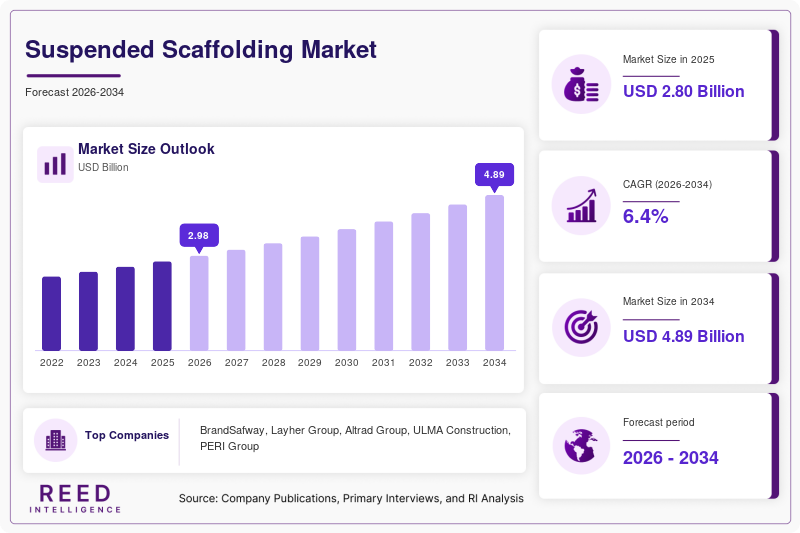
Key Highlights:
- Asia Pacific dominated the market with a 38% share in 2025, while the Middle East & Africa is expected to register the fastest CAGR of 7.8% during the forecast period.
- By type, electric suspended scaffolding held the largest share of 52% in 2025, whereas modular suspended scaffolding is projected to grow at a CAGR of 7.5%.
- By end-use, the construction sector led with a 61% share, while industrial maintenance is anticipated to grow at a CAGR of 7.2%.
- China, the dominant country, recorded market values of USD 620 million in 2024 and USD 660 million in 2025.
Market Trends
Integration of Smart Safety Technologies
One of the key trends shaping the Suspended Scaffolding Market is the integration of advanced safety technologies into scaffolding systems. Manufacturers are increasingly incorporating features such as anti-tilt mechanisms, overload sensors, automated braking systems, and remote monitoring capabilities. These enhancements aim to reduce workplace accidents and comply with evolving safety regulations across industries. Digitalization is also playing a role, with IoT-enabled scaffolding systems allowing real-time performance tracking and predictive maintenance. This trend is particularly relevant in developed regions where safety standards are stringent, encouraging contractors to adopt technologically advanced systems.
Growing Preference for Modular and Lightweight Systems
Another significant trend in the Suspended Scaffolding Market is the shift toward modular and lightweight scaffolding solutions. These systems are designed for quick assembly, easy transportation, and adaptability to different building structures. Lightweight materials such as aluminum alloys are increasingly being used to improve portability without compromising strength. The modular design enables customization based on project requirements, reducing installation time and labor costs. This trend is gaining traction among contractors managing multiple projects simultaneously, as it enhances operational efficiency and cost control. The demand for such systems is expected to grow steadily across both developed and emerging markets.
Market Drivers
Expansion of High-Rise Construction Projects
The rapid expansion of high-rise construction projects globally is a primary driver of the Suspended Scaffolding Market. Urban population growth and land scarcity have led to increased vertical development, especially in metropolitan areas. Suspended scaffolding systems provide efficient access to tall structures for construction, maintenance, and repair work. Their ability to reach complex building facades safely and efficiently makes them indispensable in modern construction practices. As governments and private developers continue to invest in skyscrapers, residential towers, and commercial complexes, the demand for suspended scaffolding solutions is expected to rise steadily.
Rising Demand for Building Maintenance and Renovation
Another significant driver is the growing demand for building maintenance, repair, and renovation activities. Aging infrastructure in developed regions requires regular inspection and refurbishment, driving the need for reliable access equipment. Suspended scaffolding offers a cost-effective and flexible solution for façade cleaning, painting, and structural repairs. Additionally, increasing awareness regarding building aesthetics and safety standards has encouraged property owners to undertake periodic maintenance activities. This trend is contributing to consistent demand for suspended scaffolding systems across both residential and commercial sectors.
Market Restraint
High Initial Setup and Maintenance Costs
A major restraint affecting the Suspended Scaffolding Market is the high initial investment and maintenance costs associated with these systems. Advanced suspended scaffolding solutions, particularly motorized and modular variants, require significant capital expenditure. The cost of installation, regular inspection, and compliance with safety regulations adds to the overall financial burden for contractors and end-users. Small and medium-sized enterprises may find it challenging to invest in such systems, limiting market penetration in certain regions.
Additionally, the need for skilled labor to install and operate suspended scaffolding further increases operational costs. Improper handling or lack of training can lead to safety risks, necessitating additional investment in workforce training programs. Maintenance requirements, including periodic inspection of cables, motors, and safety components, also contribute to ongoing expenses.
These cost-related challenges can hinder market growth, particularly in price-sensitive markets. However, the availability of rental services and leasing options is gradually mitigating this restraint by providing cost-effective alternatives for end-users.
Market Opportunities
Growth in Infrastructure Development Projects
The increasing number of infrastructure development projects presents a significant opportunity for the Suspended Scaffolding Market. Governments worldwide are investing heavily in transportation networks, smart cities, and public infrastructure. These projects require advanced access solutions for construction and maintenance activities. Suspended scaffolding systems are well-suited for large-scale infrastructure projects, including bridges, highways, and high-rise public buildings. The rising demand for efficient and safe construction equipment is expected to create new growth avenues for market players.
Expansion of Rental and Leasing Services
The expansion of rental and leasing services offers another promising opportunity in the Suspended Scaffolding Market. Many contractors prefer renting scaffolding equipment to reduce upfront costs and avoid long-term maintenance responsibilities. Rental services provide flexibility and access to advanced systems without significant capital investment. This trend is particularly beneficial for small and medium-sized enterprises operating in cost-sensitive markets. As rental service providers expand their fleets and geographic presence, the accessibility of suspended scaffolding systems is expected to improve, driving market growth.
Segmental Analysis
By Type
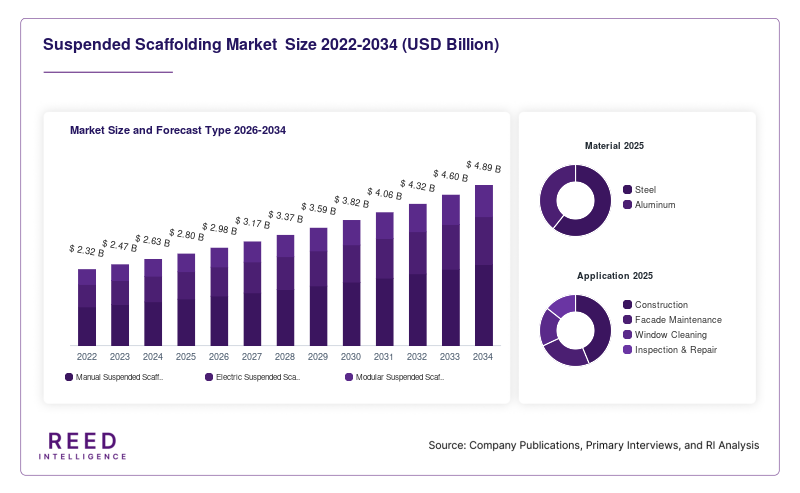
Electric suspended scaffolding dominated the market with a 52% share in 2025 due to its efficiency and ease of operation. These systems are widely used in high-rise construction projects where manual operation is less feasible. Their ability to provide consistent performance and reduce labor effort contributed to their dominance.
Modular suspended scaffolding is expected to grow at the fastest CAGR of 7.5% during the forecast period. The flexibility and adaptability of modular systems will drive their adoption. Their capability to be customized for different project requirements will make them increasingly popular among contractors.
By Material
Steel-based suspended scaffolding held the largest share of 58% in 2025 due to its durability and strength. Steel scaffolding systems are widely used in heavy-duty applications where load-bearing capacity is critical.
Aluminum scaffolding is projected to grow at a CAGR of 7.3% due to its lightweight properties. The ease of transportation and installation will drive its adoption, particularly in projects requiring mobility and quick setup.
By End-Use
The construction sector dominated the Suspended Scaffolding Market with a 61% share in 2025. The widespread use of scaffolding systems in residential, commercial, and industrial construction projects contributed to this dominance.
Industrial maintenance is expected to grow at a CAGR of 7.2% during the forecast period. Increasing demand for inspection and maintenance of industrial facilities will drive growth in this segment.
By Application
Facade maintenance accounted for the largest share of 47% in 2025 due to the growing need for cleaning and repair of building exteriors. Suspended scaffolding systems provide efficient access for such activities.
Window cleaning applications are projected to grow at a CAGR of 6.8%. The increasing number of high-rise buildings will drive demand for specialized scaffolding systems designed for cleaning operations.
Regional Analysis
North America
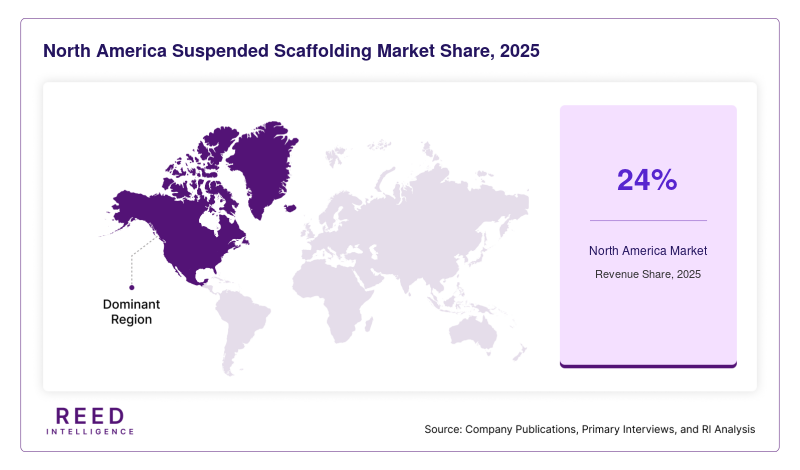
North America accounted for approximately 24% of the Suspended Scaffolding Market share in 2025 and is expected to grow at a CAGR of 5.8% during the forecast period. The region’s growth will be supported by increasing investments in commercial construction and infrastructure modernization projects.
The United States dominated the regional market due to its strong focus on workplace safety standards. Strict regulatory frameworks and the adoption of advanced construction technologies have encouraged the use of suspended scaffolding systems. The presence of established construction firms and ongoing renovation activities will continue to drive demand.
Europe
Europe held around 21% of the market share in 2025 and is projected to expand at a CAGR of 5.6% through 2034. The region’s growth will be influenced by the renovation of historical buildings and infrastructure upgrades.
Germany emerged as the dominant country, driven by its robust construction sector and emphasis on engineering precision. The country’s focus on sustainable construction practices and modernization of urban infrastructure has increased the adoption of efficient scaffolding solutions.
Asia Pacific
Asia Pacific led the Suspended Scaffolding Market with a 38% share in 2025 and is expected to grow at a CAGR of 6.9% during the forecast period. Rapid urbanization and industrialization will continue to drive market growth in this region.
China dominated the market due to large-scale construction activities and government investments in infrastructure development. The country’s expanding urban population and increasing number of high-rise projects have significantly boosted the demand for suspended scaffolding systems.
Middle East & Africa
The Middle East & Africa region accounted for 10% of the market share in 2025 and is projected to register the fastest CAGR of 7.8% during the forecast period. Growth will be driven by large-scale construction projects and urban development initiatives.
The United Arab Emirates led the regional market, supported by ongoing development of commercial and residential projects. The region’s focus on modern architecture and skyscrapers has increased the need for advanced scaffolding solutions.
Latin America
Latin America held approximately 7% of the Suspended Scaffolding Market share in 2025 and is expected to grow at a CAGR of 6.1% during the forecast period. Increasing infrastructure investments and urban development projects will support market growth.
Brazil dominated the regional market due to its expanding construction industry. Government initiatives to improve infrastructure and housing have driven the demand for suspended scaffolding systems in the country.
Competitive Landscape
The Suspended Scaffolding Market is characterized by the presence of several global and regional players focusing on product innovation and strategic partnerships. Key companies are investing in advanced technologies to enhance safety and operational efficiency.
The market leader, BrandSafway, has strengthened its position through continuous product development and expansion of its service portfolio. The company recently introduced advanced motorized scaffolding systems designed for high-rise construction projects.
Other major players are focusing on expanding their geographic presence and offering rental services to attract a broader customer base. Competitive strategies include mergers, acquisitions, and collaborations aimed at improving market share and technological capabilities.
Key Players List
- BrandSafway
- Layher Group
- Altrad Group
- ULMA Construction
- PERI Group
- Safway Group Holding LLC
- Spider (BrandSafway)
- Waco International
- Instant UpRight
- MJ-Gerüst GmbH
- KHK Scaffolding & Formwork LLC
- Sunshine Enterprise
- Changli XMWY Formwork Scaffolding Co. Ltd.
- Tianjin Gowe Holding Group Co. Ltd.
- Rizhao Fenghua Scaffoldings Co. Ltd.
Recent Developments
- In 2025, BrandSafway launched a new range of smart suspended scaffolding systems equipped with IoT-enabled monitoring features.
- In 2024, PERI Group expanded its rental services portfolio to include advanced suspended scaffolding solutions.
- In 2025, Altrad Group acquired a regional scaffolding company to strengthen its market presence in Europe.
- In 2024, ULMA Construction introduced lightweight aluminum scaffolding systems for improved mobility.
- In 2025, Layher Group invested in research and development to enhance safety features in suspended scaffolding systems.
Suspended Scaffolding Market Segments
Type
- Manual Suspended Scaffolding
- Electric Suspended Scaffolding
- Modular Suspended Scaffolding
Material
- Steel
- Aluminum
Application
- Construction
- Facade Maintenance
- Window Cleaning
- Inspection & Repair
End-Use
- Residential
- Commercial
- Industrial
By Region
- North America
- Europe
- APAC
- Middle East and Africa
- LATAM