Swiss Turn Market Size, Share & Trends Analysis Report By Type, By Material, By Application, and By Region (North America, Europe, Asia Pacific, Latin America, Middle East & Africa) Forecasts, 2026–2034
USD 3950
Swiss Turn Market Size
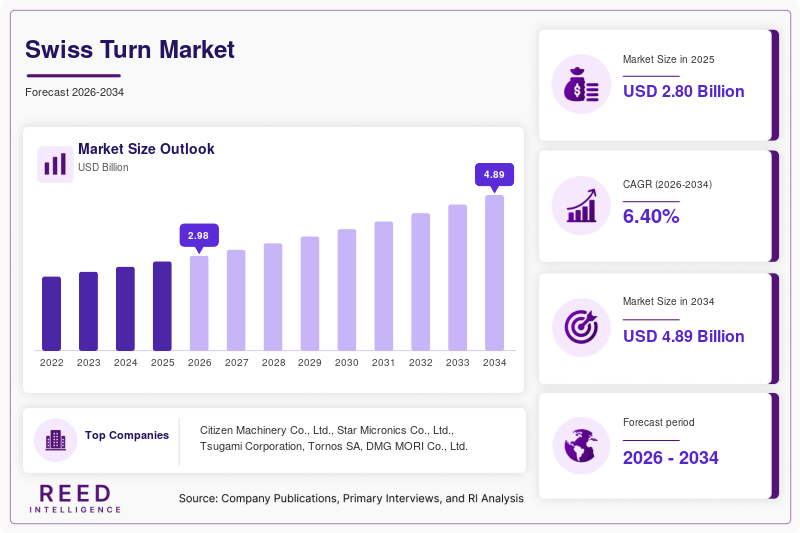
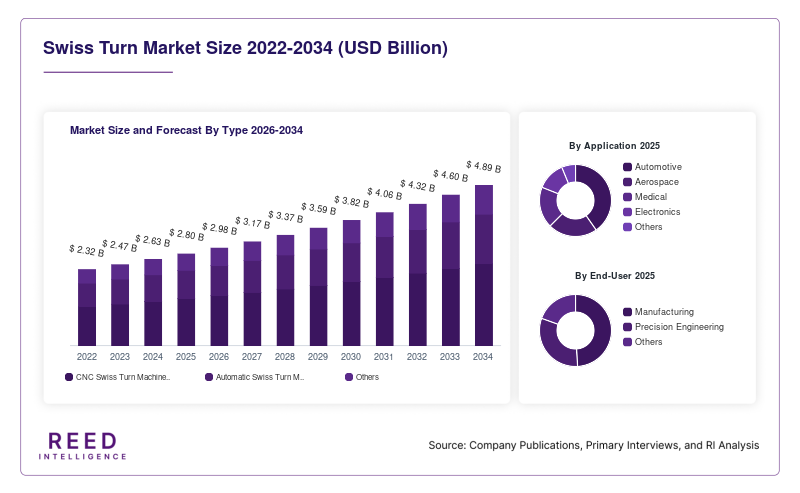
The global swiss turn market size was valued at USD 2.80 billion in 2025 and is projected to grow from USD 2.98 billion in 2026 to USD 4.89 billion by 2034, registering a CAGR of 6.40% during the forecast period from 2026 to 2034.
The swiss turn market encompasses precision-machined components manufactured using Swiss-type turning machines, also known as Swiss screw machines or sliding-headstock lathes. These machines are designed to produce small, intricate, and high-precision cylindrical components, particularly those requiring tight dimensional tolerances, complex geometries, and consistent surface finishes. The technology is widely used in medical devices, automotive systems, aerospace components, electronics, telecommunications, industrial machinery, and other precision-engineering applications.
Swiss Turn Market Drivers
Increasing Demand for Precision Components
The growing use of compact, complex components across medical devices, automotive systems, electronics, aerospace, and industrial equipment is supporting the adoption of Swiss turning technology. These applications often require consistent dimensional accuracy, fine surface finishes, and reliable repeatability. Swiss-type machines are suited to producing slender and intricate parts because the workpiece is supported near the cutting zone, helping control deflection during machining.
Expansion of Medical Device Manufacturing
Medical-device production creates demand for precision components used in surgical instruments, implants, dental devices, and minimally invasive procedures. Manufacturers require controlled machining processes to meet product specifications and applicable quality requirements. Swiss turning supports the production of small, complex components from suitable metals and other machinable materials. Continued investment in medical manufacturing and specialized contract machining can create opportunities for machine builders and precision-component suppliers.
Adoption of CNC Automation
Manufacturers are investing in CNC Swiss-type turning systems to improve repeatability, reduce setup changes, and increase production efficiency. Multi-axis machining, automatic bar feeding, integrated tooling, and robotic handling can reduce manual operations and enable continuous production. Automation is particularly relevant where manufacturers face labour shortages, need consistent output, or produce large quantities of precision components with demanding quality specifications.
Swiss Turn Market Restraints
High Equipment and Maintenance Costs
Swiss-type CNC machines can require substantial capital investment, particularly when equipped with multiple axes, advanced tooling, automation, and specialized software. Operating costs also include cutting tools, maintenance, programming, machine setup, and operator training. These expenses can be challenging for small and medium-sized manufacturers, especially when production volumes are uncertain or machine utilization is low.
Shortage of Skilled Operators and Programmers
Swiss turning requires knowledge of CNC programming, tooling selection, material behaviour, machining sequences, and process optimization. Multi-axis systems can be difficult to program and troubleshoot without specialized experience. A shortage of qualified machinists and engineers may delay machine commissioning, increase training expenditure, and limit the productivity benefits of advanced equipment. Manufacturers may also face challenges transferring process knowledge when experienced workers leave.
Swiss Turn Market Opportunities
Medical, Aerospace, and High-Value Component Production
The expansion of specialized medical devices, aerospace systems, and high-performance industrial equipment creates opportunities for Swiss turning providers. These industries require precision components with stringent specifications and consistent manufacturing quality. Suppliers capable of meeting traceability, inspection, and process-control requirements can pursue specialized contracts and develop long-term relationships with original equipment manufacturers and precision-engineering businesses.
Smart Factories and Integrated Machining Solutions
The development of connected manufacturing facilities creates opportunities for machine builders to combine Swiss turning equipment with robotics, automatic loading, tool monitoring, and production software. Integrated systems can reduce manual handling, improve production visibility, and support more flexible manufacturing. Retrofitting and modernization of existing machine fleets also offer opportunities for automation providers, tooling suppliers, and machine-service businesses.
Swiss Turn Market Segmental Analysis
By Type
CNC Swiss Turn Machines: Dominant segment, accounting for approximately 62.5% of the market share in 2025. Demand is supported by programmability, multi-axis machining, repeatability, and the ability to manufacture complex components with fewer secondary operations.
Automatic Swiss Turn Machines: Used in high-volume production of components with relatively stable designs and repeatable machining requirements. Their continued use is supported by established production lines and applications where dedicated high-throughput equipment is economically suitable.
Others: Includes specialized or alternative Swiss-type turning configurations designed for particular component geometries, production requirements, and manufacturing environments.
By Application
Automotive: Supports production of precision shafts, pins, connectors, fuel-system components, sensors, and other small mechanical parts.
Aerospace: Requires precision-machined components that meet demanding dimensional, material, and quality specifications.
Medical: One of the fastest-growing applications, with a projected CAGR of 7.8% according to the matching market estimate. Demand is associated with surgical instruments, implants, dental components, and miniature medical devices.
Electronics: Includes connectors, contacts, terminals, miniature housings, and other precision parts used in electronic equipment.
Others: Includes industrial machinery, telecommunications, watchmaking, and specialized engineering applications.
By End-User
Manufacturing: Uses Swiss turning systems to produce precision parts for original equipment manufacturers and component suppliers across multiple industries.
Precision Engineering: Includes specialized machining companies and contract manufacturers producing intricate components to customer-specific tolerances and specifications.
Others: Covers additional industrial users and specialized production facilities that require small, accurate, and repeatable turned components.
Swiss Turn Market Regional Analysis
North America Swiss Turn Market
North America is an important market for Swiss turning technology, supported by precision manufacturing, medical-device production, aerospace engineering, automotive component manufacturing, and advanced electronics. The United States represents a major source of demand because of its contract-manufacturing base and industrial investment. Canada and Mexico contribute through aerospace, automotive, electronics, and cross-border manufacturing supply chains. The exact 2025 global market-share percentage for North America under the supplied swiss turn market definition could not be independently verified.
Regional demand is supported by investment in CNC automation, reshoring of selected precision-manufacturing activities, and requirements for specialized components. Medical-device and aerospace suppliers require repeatable machining processes and close dimensional control, while automotive and electronics manufacturers need reliable production of small, intricate parts. Adoption is influenced by equipment costs, access to skilled programmers, machine-tool distribution networks, and demand from specialized contract manufacturers.
Europe Swiss Turn Market
Europe has an established precision-engineering industry, supported by automotive manufacturing, industrial machinery, medical technology, aerospace, and micromechanical component production. Germany, Switzerland, Italy, and France contribute to demand for advanced turning systems, while Switzerland retains particular relevance through its precision-machining and machine-tool heritage. The exact 2025 global market-share percentage for Europe under the supplied swiss turn market definition could not be independently verified.
The regional market is influenced by demand for multi-axis CNC equipment, manufacturing automation, and high-quality components for export-oriented industries. Automotive suppliers use precision turning for selected mechanical and fluid-system parts, while medical and aerospace manufacturers require close process control and traceability. Machine replacement cycles, energy efficiency, skilled-labour availability, and investment in connected manufacturing systems are important considerations for regional adoption.
Asia Pacific Swiss Turn Market
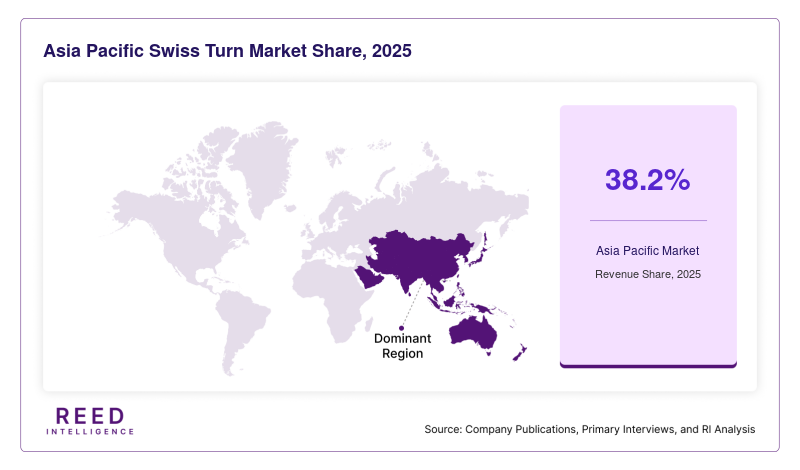
Asia Pacific is the dominant region, accounting for 38.2% of global swiss turn market revenue in 2025, according to a market report matching the supplied USD 2.80 billion 2025 valuation and USD 4.89 billion 2034 forecast. Japan, China, and South Korea support regional demand through their precision-machining, automotive, electronics, and machine-tool industries. India and other Southeast Asian economies also contribute through expanding manufacturing capacity and investment in industrial automation.
Regional growth is supported by the concentration of component suppliers, increasing use of CNC equipment, and demand for precision parts across electronics, medical devices, automotive systems, and industrial machinery. Japanese machine builders have an established presence in Swiss-type turning technology, while manufacturers across China, South Korea, and India are investing in production capacity and automation. The region's development will depend on manufacturing investment, technology adoption, skilled-worker availability, and demand from export-oriented industries.
Latin America Swiss Turn Market
Latin America's swiss turn market is supported by automotive manufacturing, industrial machinery, medical products, electronics, and precision-component production. Brazil and Mexico are relevant manufacturing centres, with Mexico benefiting from its integration into North American automotive and industrial supply chains. Other countries contribute through specialized engineering and industrial production. The exact 2025 global market-share percentage for Latin America under the supplied market definition could not be independently verified.
Demand for Swiss turning equipment depends on capital investment, the development of local component suppliers, and the adoption of more advanced CNC machining capabilities. Manufacturers may invest in Swiss-type machines when conventional turning equipment cannot meet required tolerances or component geometries efficiently. Equipment acquisition costs, imported machinery and tooling expenses, financing conditions, and access to trained operators can affect adoption across the region.
Middle East & Africa Swiss Turn Market
The Middle East & Africa market is associated with industrial diversification, aerospace and defence-related manufacturing, medical-device demand, automotive components, and broader investment in precision engineering. Countries developing advanced manufacturing capabilities may require Swiss-type turning systems to produce small, complex components for industrial equipment and specialized applications. The exact 2025 global market-share percentage for this region under the supplied swiss turn market definition could not be independently verified.
Regional opportunities depend on the expansion of manufacturing ecosystems, investment in industrial technology, and the development of local machining and maintenance capabilities. Adoption can be constrained by limited specialist expertise, equipment-import costs, and a smaller installed base of advanced precision-turning systems in some markets. Partnerships with international machine builders, technical training, and investment in CNC automation can support wider adoption.
Swiss Turn Market Competitive Landscape
The swiss turn market includes established machine-tool manufacturers that compete through machining accuracy, machine configuration, multi-axis capability, automation, reliability, technical support, and application engineering. Japanese and European companies have a notable presence in Swiss-type turning technology, while other manufacturers serve specialized applications and regional customer segments.
Competition is shaped by demand for CNC platforms, shorter production cycles, reduced secondary machining, and improved production consistency. Manufacturers differentiate their equipment through spindle configurations, tooling flexibility, bar-feeding systems, software, and integration with factory automation. After-sales support, spare-parts availability, operator training, and the ability to optimize machining processes also influence purchasing decisions.
Key Market Players
- Citizen Machinery Co., Ltd.
- Star Micronics Co., Ltd.
- Tsugami Corporation
- Tornos SA
- DMG MORI Co., Ltd.
- Hanwha Corporation
- Nexturn Co., Ltd.
- Nakamura-Tome Precision Industry Co., Ltd.
- Takisawa Machine Tool Co., Ltd.
- Maier Machine Tool Co., Ltd.
- Marubeni Citizen-Cincom Inc.
Recent Market Developments in the Swiss Turn Market
- September 2026 – Star Micronics: Star Micronics announced the SB-12RII Swiss-type automatic lathe, designed for small-diameter precision components used in medical devices, connectors, and humanoid robots. The updated machine features enhanced driven-tool performance, a more powerful sub-spindle motor, improved rear-end machining, and a footprint approximately 10% smaller than its predecessor. Sales are scheduled to begin in Japan and overseas markets from spring 2027.
- September 2026 – Mazak Corporation: Mazak showcased its SYNCREX 32/8 eight-axis Swiss-type production turning machine at IMTS 2026. Designed for high-speed, high-volume machining, the machine accommodates bar stock up to 32 mm and features main and counter spindles capable of 8,000 rpm, CNC controls, and chip-control options. The announcement reflects continued product development focused on productivity and machining flexibility.
Swiss Turn Market Segments
By Type
- CNC Swiss Turn Machines
- Automatic Swiss Turn Machines
- Others
By Application
- Automotive
- Aerospace
- Medical
- Electronics
- Others
By End-User
- Manufacturing
- Precision Engineering
- Others
By Region
- North America
- Europe
- APAC
- Middle East and Africa
- LATAM