Synthetic and Bio-Based Polypropylene Market Size, Share Demand Report By Product Type (Synthetic PP, Bio-Based PP), By Application (Packaging, Automotive, Textiles, Medical, Others), By Grade (Homopolymer, Copolymer, Impact Copolymer) & Segment Forecasts, 2026–2034
USD 3950
Synthetic and Bio-Based Polypropylene Market Size
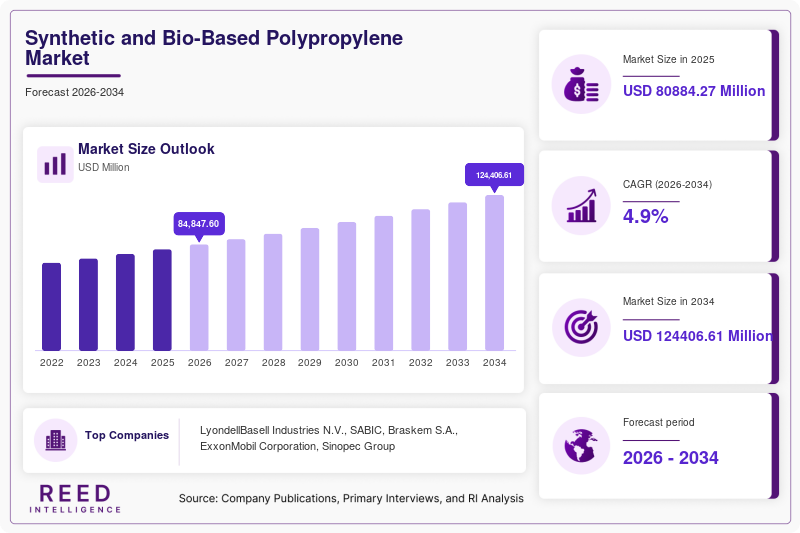
Synthetic and Bio-Based Polypropylene market size is projected at USD 84,847.6 million in 2026 and is expected to hit USD 124,847.5 million by 2034 with a CAGR of 4.9% during the forecast period. The increasing demand for lightweight, durable, and versatile plastic materials in packaging, automotive, and textile industries, coupled with the growing focus on sustainable and bio-based alternatives, underpins market expansion. This report delivers a comprehensive analysis of the Synthetic and Bio-Based Polypropylene market, including segmentation by type and application, competitive dynamics, and regional growth patterns, equipping stakeholders with critical intelligence. The Synthetic and Bio-Based Polypropylene market continues to demonstrate steady growth potential, fueled by the global expansion of the packaging industry, the increasing demand for lightweight automotive components, and continuous innovation in polypropylene production and applications.
Polypropylene (PP) is a versatile thermoplastic polymer used in a wide range of applications, from packaging and automotive components to textiles and medical devices. The market for polypropylene includes both synthetic PP, derived from fossil fuels, and bio-based PP, produced from renewable resources. The global production volume of polypropylene exceeded 80 million metric tons in 2025, reflecting a 5% increase from 2023, driven by the growing demand from various end-use industries. Adoption patterns reveal that the Synthetic PP type dominates the market, accounting for 95% of total demand, with Bio-Based PP at 5% and growing rapidly. The Synthetic and Bio-Based Polypropylene market's trajectory is closely linked to the growth of the global plastics market, which is projected to reach USD 700 billion by 2028, and the increasing focus on sustainability and circular economy principles.
Synthetic and Bio-Based Polypropylene Market Trends
Growing Demand for Bio-Based and Sustainable Polypropylene
The Synthetic and Bio-Based Polypropylene market is witnessing a significant trend toward the growing demand for bio-based and sustainable polypropylene, driven by the need to reduce carbon footprint and reliance on fossil fuels. The revenue from bio-based PP grew to USD 2.8 billion in 2025, a year-on-year increase of 22%, as 15% of new product developments in 2025 specified bio-based or sustainable content. Adoption rates of bio-based PP in packaging and automotive applications reached 10%, with this figure projected to exceed 25% by 2030. The Synthetic and Bio-Based Polypropylene market's trend toward sustainability is reinforced by the need for environmentally friendly materials, the increasing regulatory pressure for sustainable plastics, and the continuous innovation in bio-based feedstocks and production technologies.
Increasing Focus on Lightweighting and High-Performance Applications
The increasing focus on lightweighting and high-performance applications is a major trend shaping the Synthetic and Bio-Based Polypropylene market, with the development of advanced PP grades for automotive, aerospace, and medical applications. The market has seen a 10% increase in the demand for high-performance PP grades since 2022, with 20% of new product developments in 2025 featuring enhanced mechanical and thermal properties. The use of PP composites and copolymers for structural applications has also gained significant traction. The Synthetic and Bio-Based Polypropylene market's trend toward high-performance is reinforced by the need for weight reduction, the increasing demand for durable materials, and the continuous innovation in polymer chemistry and compounding technologies.
Synthetic and Bio-Based Polypropylene Market Drivers
The Synthetic and Bio-Based Polypropylene market's expansion is primarily driven by the increasing demand from the packaging industry, with the global packaging market valued at USD 1 trillion in 2025 and growing at a steady pace. The need for lightweight, durable, and cost-effective packaging solutions has been a major driver, with polypropylene being a key material. The growth of the automotive and textile industries has also fueled market growth. Additionally, the increasing demand for medical-grade polypropylene has spurred demand. The Synthetic and Bio-Based Polypropylene market's growth is further reinforced by the continuous improvement in production technology, leading to better quality and lower costs.
Synthetic and Bio-Based Polypropylene Market Restraints
Despite favorable growth prospects, the Synthetic and Bio-Based Polypropylene market faces significant constraints, primarily related to the volatility of crude oil and propylene prices, which can impact production costs. The environmental concerns over plastic waste and the increasing regulatory pressure on single-use plastics can also be a limitation. The Synthetic and Bio-Based Polypropylene market's growth is also tempered by the challenge of scaling up bio-based PP production and the competition from other polymers and alternative materials.
Synthetic and Bio-Based Polypropylene Market Opportunities
The Synthetic and Bio-Based Polypropylene market presents significant opportunities in the rapidly expanding market for sustainable packaging and circular economy solutions, where bio-based and recycled PP are in high demand. The development of advanced PP grades for 3D printing and additive manufacturing is expected to grow at a CAGR of 12% through 2034. Emerging opportunities also exist in the use of PP for new energy applications, such as battery components and solar panels. The Synthetic and Bio-Based Polypropylene market's opportunity profile is further enhanced by the growing trend of lightweighting in the automotive and aerospace industries.
Challenges in Synthetic and Bio-Based Polypropylene Market
The Synthetic and Bio-Based Polypropylene market faces persistent challenges related to the need for continuous innovation to develop more sustainable and high-performance materials. The complexity of managing the supply chain for bio-based feedstocks and ensuring their sustainability can also be a challenge. The market is also contending with the challenge of recycling and end-of-life management for PP products. Additionally, the Synthetic and Bio-Based Polypropylene market is challenged by the need to balance performance, cost, and sustainability.
Synthetic and Bio-Based Polypropylene Market Segmentation
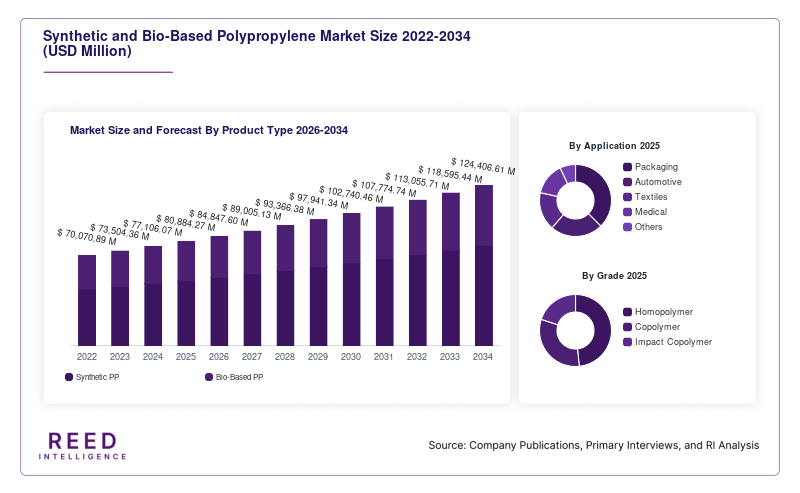
The Synthetic and Bio-Based Polypropylene market is segmented by Type and Application to provide a comprehensive market perspective. By Type, Synthetic PP dominates with a 95% market share, driven by its established production and cost-effectiveness. The Application segment is led by Packaging, which accounts for 45% of the market, followed by Automotive at 20%, Textiles at 15%, Medical at 10%, and Others at 10%.
By Type
Synthetic PP represent the largest segment in the Synthetic and Bio-Based Polypropylene market, commanding a 95% share, with production exceeding 76 million metric tons in 2025. These are characterized by their production from fossil fuel-based propylene, offering versatility and cost-effectiveness. Technical specifications include melt flow index, density, and tensile strength. The Synthetic and Bio-Based Polypropylene market's Synthetic segment is driven by its use in packaging, automotive, and textiles.
Bio-Based PP capture a 5% share of the Synthetic and Bio-Based Polypropylene market, with production of 4 million metric tons in 2025. These are characterized by their production from renewable resources, offering a lower carbon footprint. Technical specifications include bio-based content, performance characteristics, and sustainability certifications. The Synthetic and Bio-Based Polypropylene market's Bio-Based segment is driven by its use in sustainable packaging and consumer goods.
By Application
Packaging dominates the Synthetic and Bio-Based Polypropylene market, accounting for 45% of sales, representing 36 million metric tons in 2025. This segment includes use in flexible packaging, rigid containers, and films. Usage penetration exceeds 30% in the sector. The Synthetic and Bio-Based Polypropylene market's Packaging segment is characterized by its focus on versatility and cost-effectiveness.
Automotive accounts for 20% of the Synthetic and Bio-Based Polypropylene market, with sales of 16 million metric tons in 2025. This segment encompasses use in interior and exterior components, bumpers, and under-the-hood parts. The segment is growing at a steady CAGR, driven by lightweighting trends. The Synthetic and Bio-Based Polypropylene market's Automotive segment is characterized by its focus on durability and performance.
Textiles represents 15% of the Synthetic and Bio-Based Polypropylene market, with sales of 12 million metric tons in 2025. This segment includes use in non-woven fabrics, carpets, and apparel. The segment is growing at a moderate rate. The Synthetic and Bio-Based Polypropylene market's Textiles segment is characterized by its focus on softness and durability.
Medical accounts for 10% of the Synthetic and Bio-Based Polypropylene market, with sales of 8 million metric tons in 2025. This segment includes use in syringes, medical devices, and packaging. The segment is growing at a robust pace. The Synthetic and Bio-Based Polypropylene market's Medical segment is characterized by its focus on purity and biocompatibility.
Others comprises the remainder of the Synthetic and Bio-Based Polypropylene market, accounting for 10% of total sales, with 8 million metric tons in 2025. This includes use in consumer goods, electronics, and other niche applications. The segment is projected to grow at a steady CAGR through 2034. The Synthetic and Bio-Based Polypropylene market's Others segment is characterized by its diverse and evolving applications.
Synthetic and Bio-Based Polypropylene Market Regional Outlook
Asia-Pacific Synthetic and Bio-Based Polypropylene Market
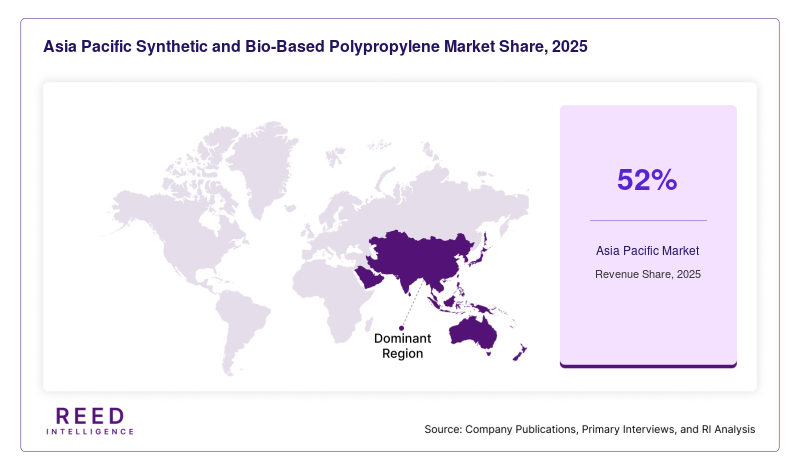
Leads the Synthetic and Bio-Based Polypropylene market, commanding a 52% share, with a revenue of USD 44,120.7 million in 2025. China is the primary driver, accounting for 65% of regional demand, driven by its massive manufacturing base, large packaging industry, and growing automotive sector. The Asia-Pacific Synthetic and Bio-Based Polypropylene market is characterized by its focus on high-volume production and cost-effective solutions.
North America Synthetic and Bio-Based Polypropylene Market
Represents the second-largest market, capturing a 20% share with a revenue of USD 16,969.5 million in 2025. The United States is the primary driver, accounting for 85% of regional demand, driven by the mature packaging, automotive, and medical industries. The North American Synthetic and Bio-Based Polypropylene market is characterized by its focus on innovation and high-performance products.
Europe Synthetic and Bio-Based Polypropylene Market
Accounts for 18% of the global Synthetic and Bio-Based Polypropylene market, with a revenue of USD 15,272.6 million in 2025. Germany, France, and the UK are the primary drivers, collectively accounting for 60% of regional demand, driven by the strong automotive and packaging sectors, and a focus on sustainability. The European Synthetic and Bio-Based Polypropylene market is projected to grow at a CAGR of 4% through 2034.
Middle East & Africa and Latin America Synthetic and Bio-Based Polypropylene Market
Together account for the remaining 10% of the Synthetic and Bio-Based Polypropylene market, with the UAE leading the Middle East market and Brazil leading the Latin American market. Both regions are projected to grow at CAGRs exceeding 6%, driven by infrastructure development and industrial growth.
Top players in Synthetic and Bio-Based Polypropylene Market
- LyondellBasell Industries N.V.
- SABIC
- Braskem S.A.
- ExxonMobil Corporation
- Sinopec Group
- Borealis AG
- TotalEnergies SE
- INEOS Group
- Mitsubishi Chemical Corporation
- Sumitomo Chemical Co., Ltd.
- Dow Chemical Company
- PPG Industries, Inc.
- Reliance Industries Limited
- Formosa Plastics Corporation
- LG Chem Ltd.
LyondellBasell Industries N.V.
LyondellBasell Industries holds a dominant position in the Synthetic and Bio-Based Polypropylene market, with an estimated 16% global market share, particularly strong in the packaging and automotive segments. The company's portfolio of polypropylene products is widely recognized for its quality, versatility, and innovation. LyondellBasell's market leadership is reinforced by its significant R&D investment, its global production network, and its strong relationships with industrial customers. LyondellBasell commands over 18% of the North American market and 14% of the European market, positioning it as a key player in the Synthetic and Bio-Based Polypropylene market.
SABIC
SABIC is a leading player in the Synthetic and Bio-Based Polypropylene market, commanding approximately 14% of the global market share through its comprehensive portfolio of polymer solutions. The company's expertise in petrochemicals and its focus on sustainability have solidified its position. SABIC's polypropylene products are known for their quality, consistency, and performance. The company's commitment to circular economy and its strong presence in the Asian and European markets have enhanced its competitive advantage.
Braskem S.A. holds a significant 10% market share, with particular strength in the bio-based PP segment. ExxonMobil Corporation is a major player in the North American and global market, holding an 8% share.
Recent Developments in Synthetic and Bio-Based Polypropylene Market
- 2025: LyondellBasell launched a new line of bio-based polypropylene with certified renewable content, targeting the sustainable packaging market.
- 2025: SABIC announced a new investment to expand its production capacity for high-performance polypropylene grades for automotive applications.
Synthetic and Bio-Based Polypropylene Market Segments
By Product Type
- Synthetic PP
- Bio-Based PP
By Application
- Packaging
- Automotive
- Textiles
- Medical
- Others
By Grade
- Homopolymer
- Copolymer
- Impact Copolymer
By Region
- North America
- Europe
- APAC
- Middle East and Africa
- LATAM