Synthetic Aperture Radar In Space Sector Market Size, Share Demand Report By Frequency Band (X-band, C-band, L-band, Other Bands), By Platform Type (Satellite-Based, High-Altitude Platforms), By Application (Defense & Intelligence, Environmental Monitoring, Commercial Earth Observation, Disaster Management), By End-Use (Government, Commercial) By Region & Segment Forecasts, 2026–2034
USD 3950
Market Overview
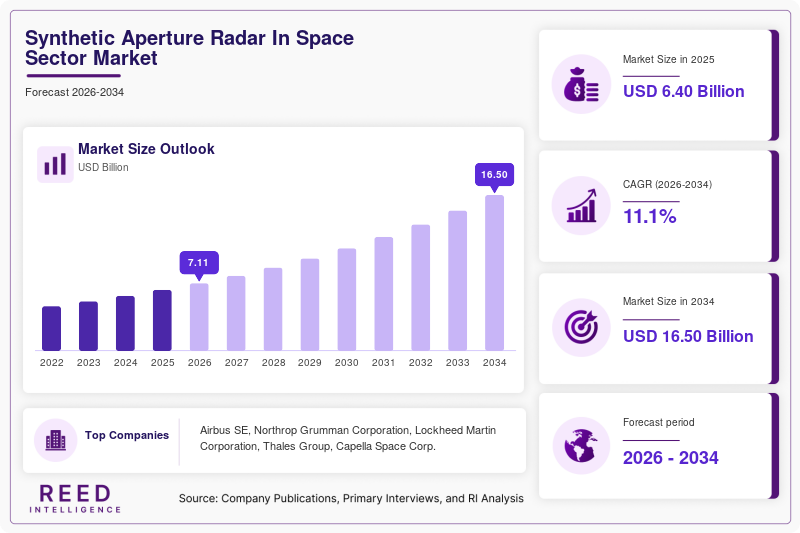
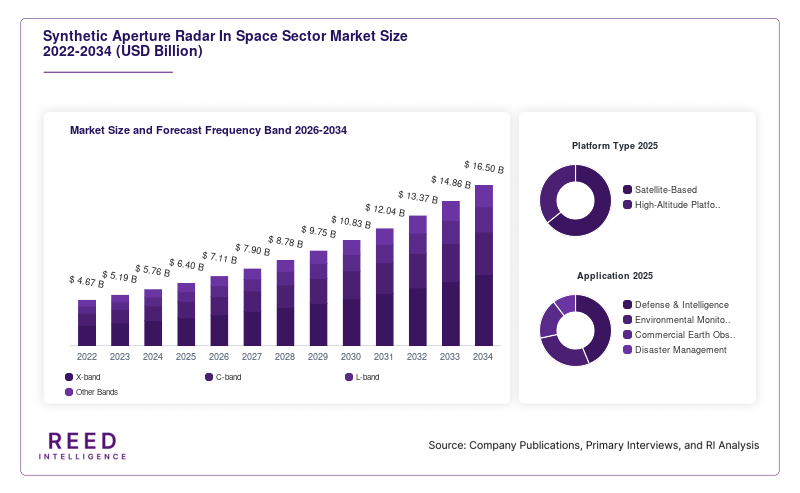
The Synthetic Aperture Radar In Space Sector Market size was valued at USD 6.4 billion in 2026 and is projected to reach USD 14.9 billion by 2034, expanding at a CAGR of 11.1% during the forecast period (2026–2034). The market growth is primarily supported by increasing global reliance on earth observation data for climate monitoring, defense intelligence, and disaster management. Synthetic aperture radar (SAR) systems deployed in space enable high-resolution imaging irrespective of weather conditions and time of day, which continues to drive demand across both government and commercial sectors.
A key global factor contributing to the expansion of the Synthetic Aperture Radar In Space Sector Market is the rising investment in satellite constellations. Governments and private space companies are launching clusters of SAR-enabled satellites to ensure continuous and real-time earth monitoring capabilities. This shift toward multi-satellite constellations is reshaping the industry outlook and expanding the commercial viability of SAR technologies.
Key Highlights:
- North America dominated the market with a 38.2% share in 2025, while Asia Pacific is projected to register the fastest CAGR of 12.8% during 2026–2034.
- By frequency band, the X-band segment held the largest share of 34.6% in 2025, while L-band is anticipated to grow at the fastest CAGR of 12.5%.
- By application, defense & intelligence led with a 41.3% share in 2025, whereas commercial earth observation is expected to grow at a CAGR of 13.2%.
- The United States remained the dominant country, with market values of USD 2.1 billion in 2024 and USD 2.4 billion in 2025.
Market Trends
Proliferation of Small Satellite Constellations
The Synthetic Aperture Radar In Space Sector Market is witnessing a transition toward small satellite constellations. Companies are increasingly deploying compact SAR satellites that reduce launch costs and improve revisit times. This trend is reshaping operational models by enabling near real-time data acquisition and expanding accessibility for commercial users.
Integration of AI and Cloud-Based Data Analytics
Another key trend shaping the Synthetic Aperture Radar In Space Sector Market is the integration of artificial intelligence and cloud computing in SAR data processing. AI-driven analytics allow faster interpretation of complex radar images, supporting applications such as agriculture monitoring, maritime surveillance, and urban planning. Cloud-based platforms further enhance scalability and data distribution efficiency.
Market Drivers
Rising Demand for All-Weather Imaging Capabilities
The Synthetic Aperture Radar In Space Sector Market is significantly driven by the need for reliable imaging under all weather conditions. Unlike optical imaging systems, SAR technology can penetrate clouds and operate during night, making it essential for continuous monitoring applications such as disaster response and border surveillance.
Increasing Defense and Security Investments
Global defense budgets are expanding, with a growing focus on advanced surveillance technologies. SAR-equipped satellites provide strategic intelligence, reconnaissance, and target tracking capabilities. This increased demand from defense agencies is a major driver supporting the long-term growth of the Synthetic Aperture Radar In Space Sector Market.
Market Restraint
High Development and Deployment Costs
One of the primary restraints affecting the Synthetic Aperture Radar In Space Sector Market is the high cost associated with satellite development, launch, and maintenance. Despite declining launch costs, SAR systems require advanced components and complex engineering, which limits entry for smaller players and slows adoption in cost-sensitive regions.
Market Opportunities
Expansion of Commercial Earth Observation Services
The Synthetic Aperture Radar In Space Sector Market presents strong opportunities in commercial earth observation. Industries such as agriculture, oil & gas, and insurance are increasingly adopting SAR data for operational insights. This expansion is expected to open new revenue streams for satellite operators.
Growth in Climate Monitoring and Environmental Applications
Environmental monitoring is emerging as a critical opportunity area. SAR technology supports applications such as glacier tracking, deforestation monitoring, and flood mapping. Growing global emphasis on sustainability and climate change mitigation will further drive demand in the Synthetic Aperture Radar In Space Sector Market.
Segmental Analysis
By Frequency Band
The X-band segment dominated the Synthetic Aperture Radar In Space Sector Market with a 34.6% share in 2025 due to its high-resolution imaging capabilities and widespread use in defense applications. The L-band segment is projected to grow at the fastest CAGR of 12.5%, driven by its ability to penetrate vegetation and soil, making it suitable for environmental monitoring.
By Platform Type
Satellite-based platforms held the largest share of 79.2% in 2025, as space-based SAR systems are essential for global coverage and large-scale monitoring. High-altitude pseudo-satellites (HAPS) are expected to witness the fastest growth at a CAGR of 13.1%, supported by their flexibility and lower deployment costs.
By Application
Defense & intelligence accounted for 41.3% of the Synthetic Aperture Radar In Space Sector Market in 2025 due to increasing surveillance requirements. The commercial earth observation segment is anticipated to grow at the fastest CAGR of 13.2%, driven by rising demand from industries such as agriculture and energy.
By End-Use
Government agencies dominated the market with a 58.7% share in 2025 due to large-scale investments in space programs. The commercial sector is projected to grow at the fastest CAGR of 13.5%, supported by expanding use cases and growing availability of SAR data services.
Regional Analysis
North America
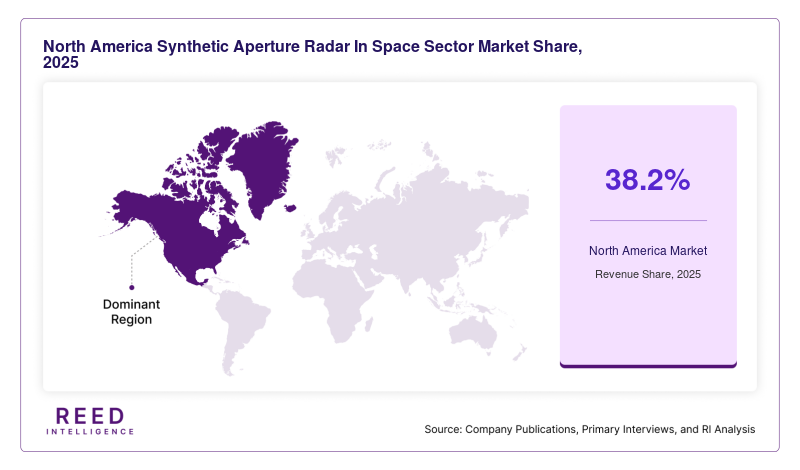
North America accounted for 38.2% of the Synthetic Aperture Radar In Space Sector Market share in 2025 and is expected to grow at a CAGR of 10.4% during the forecast period. The United States dominated the region due to strong government funding for space-based surveillance programs. The presence of major space technology companies and advanced satellite infrastructure supported sustained growth.
Europe
Europe held a 24.6% share of the Synthetic Aperture Radar In Space Sector Market in 2025 and will expand at a CAGR of 10.8% through 2034. Germany led the region, supported by collaborative space initiatives and increasing investment in earth observation missions. The region benefits from strong regulatory frameworks and cross-border cooperation in satellite programs.
Asia Pacific
Asia Pacific captured 21.3% of the Synthetic Aperture Radar In Space Sector Market in 2025 and is projected to grow at the fastest CAGR of 12.8%. China dominated the region, driven by rapid expansion of satellite constellations and increasing focus on space-based intelligence. Rising government initiatives and growing private sector participation are key growth factors.
Middle East & Africa
The Middle East & Africa held a 7.4% share of the Synthetic Aperture Radar In Space Sector Market in 2025 and is anticipated to grow at a CAGR of 9.7%. The United Arab Emirates emerged as the leading country, supported by investments in space exploration and satellite-based monitoring systems. The region is gradually adopting SAR technology for environmental and security applications.
Latin America
Latin America accounted for 8.5% of the Synthetic Aperture Radar In Space Sector Market in 2025 and is expected to grow at a CAGR of 9.9%. Brazil dominated the region, driven by the need for environmental
Competitive Landscape
The Synthetic Aperture Radar In Space Sector Market is characterized by a mix of established aerospace companies and emerging private players. Key companies include Airbus SE, Northrop Grumman Corporation, Lockheed Martin Corporation, Thales Group, and Capella Space Corp. Airbus SE remains a leading player, leveraging its expertise in satellite manufacturing and earth observation systems.
The company recently expanded its SAR satellite portfolio with enhanced imaging capabilities to support defense and commercial applications. Northrop Grumman and Lockheed Martin continue to focus on defense contracts and advanced radar technologies. Thales Group is strengthening its presence through partnerships and integrated space solutions. Meanwhile, Capella Space is gaining traction with its small satellite constellation approach, offering high-frequency revisit capabilities. The competitive environment is evolving with increasing participation from private companies, which are driving innovation and cost efficiency across the Synthetic Aperture Radar In Space Sector Market.
Key Players List
- Airbus SE
- Northrop Grumman Corporation
- Lockheed Martin Corporation
- Thales Group
- Capella Space Corp.
- ICEYE Oy
- MDA Ltd.
- L3Harris Technologies, Inc.
- Israel Aerospace Industries Ltd.
- Raytheon Technologies Corporation
- OHB SE
- BlackSky Technology Inc.
- Synspective Inc.
- Umbra Lab Inc.
- Leonardo S.p.A.
Recent Developments
- In 2025, Capella Space launched a new SAR satellite with improved imaging resolution to support real-time monitoring applications.
- In 2024, ICEYE expanded its satellite constellation to enhance revisit frequency and global coverage.
- In 2025, Airbus SE introduced an upgraded SAR payload with enhanced data processing capabilities.
- In 2024, Synspective Inc. secured funding to accelerate the deployment of its SAR satellite network.
- In 2025, Umbra Lab Inc. announced advancements in high-resolution SAR imaging technology for commercial use.
Synthetic Aperture Radar In Space Sector Market Segments
Frequency Band
- X-band
- C-band
- L-band
- Other Bands
Platform Type
- Satellite-Based
- High-Altitude Platforms (HAPS)
Application
- Defense & Intelligence
- Environmental Monitoring
- Commercial Earth Observation
- Disaster Management
End-Use
- Government
- Commercial
By Region
- North America
- Europe
- APAC
- Middle East and Africa
- LATAM