Synthetic Camphor Market Size, Share & Demand Report By Product Type (Powder Synthetic Camphor, Tablet Synthetic Camphor, Oil Synthetic Camphor, Granule Synthetic Camphor), By Application (Pharmaceuticals, Personal Care and Cosmetics, Fragrances and Aromatherapy, Chemical Intermediates, Religious and Household Uses), By Distribution Channel (Direct Industrial Sales, Distributors and Wholesalers, Retail Stores, Online Distribution), By Region & Segment Forecasts, 2026–2034
USD 3950
Market Overview
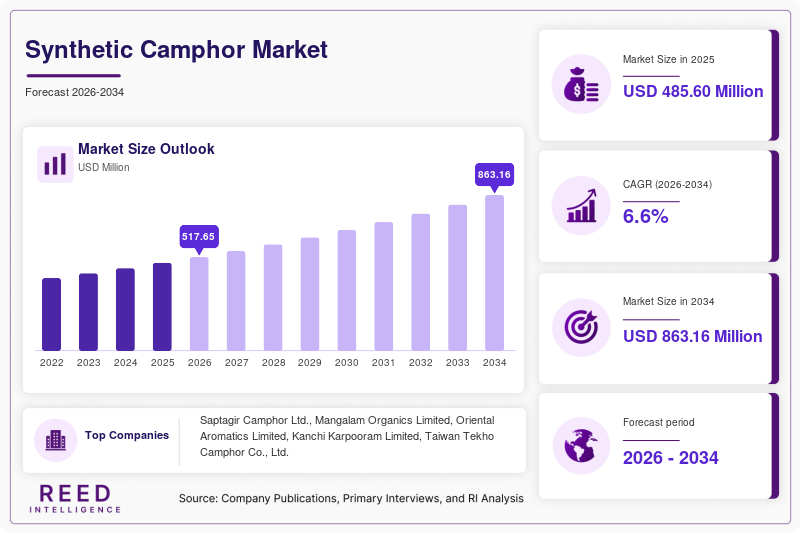
The global Synthetic Camphor Market size was valued at USD 485.6 million in 2026 and is projected to reach USD 812.4 million by 2034, expanding at a CAGR of 6.6% during the forecast period. Synthetic camphor is widely used in pharmaceuticals, personal care products, plastics, chemical intermediates, and religious applications due to its aromatic properties and functional performance. The market continues to gain traction as manufacturers focus on stable supply chains and scalable chemical synthesis processes that support large-volume industrial production. Demand from pharmaceutical formulations such as topical pain relief products, decongestants, and medicated ointments remains a major contributor to overall market expansion.
A key global factor supporting market growth is the increasing consumption of over-the-counter healthcare products across emerging and developed economies. Synthetic camphor is used extensively in vapor rubs, balms, liniments, and inhalation products because of its cooling and aromatic characteristics. Rising consumer awareness regarding self-care products, combined with expanding retail distribution networks, has strengthened the adoption of camphor-based healthcare and wellness products. In addition, industrial users are increasingly preferring synthetic variants over natural alternatives due to consistent purity levels, cost efficiency, and reduced dependency on fluctuating raw material availability.
Key Highlights
- North America dominated the market with a 33.8% share in 2025.
- Asia Pacific is expected to grow at the fastest CAGR of 7.8% during 2026–2034.
- By product type, powder synthetic camphor accounted for the largest share of 41.6%.
- while tablet synthetic camphor is projected to grow at a CAGR of 7.5%.
- By application, pharmaceuticals led with a 39.8% share.
- whereas personal care and cosmetics are expected to expand at a CAGR of 7.3%.
- By distribution channel, direct industrial sales dominated with a 46.4% share, while online distribution is anticipated to register a CAGR of 8.1%.
- The United States remained the dominant country, with market values of USD 122 million in 2024 and USD 131 million in 2025.
Market Trends
Expansion of Pharmaceutical and Wellness Applications
The increasing use of synthetic camphor in pharmaceutical and wellness products is emerging as a significant market trend. Manufacturers are incorporating synthetic camphor into topical analgesics, inhalation products, antiseptic creams, and medicated oils due to its cooling and aromatic properties. Consumer preference for convenient over-the-counter healthcare products has increased the production of vapor rubs and pain relief formulations across several regions. The trend is particularly visible in urban markets where consumers seek products that support quick relief from congestion, muscle discomfort, and minor skin irritation. Pharmaceutical companies are also focusing on higher-purity synthetic camphor grades that provide stable composition and improved shelf life. In addition, wellness brands are using camphor-based ingredients in aromatherapy products and therapeutic oils, which is broadening the commercial scope of the market.
Rising Adoption of Synthetic Alternatives in Industrial Manufacturing
Industrial manufacturers are increasingly shifting toward synthetic camphor instead of natural variants because synthetic production offers consistent quality and scalable manufacturing. This trend is strengthening across plastics, chemical intermediates, and fragrance manufacturing industries where standardized chemical composition is important for operational efficiency. Synthetic camphor provides advantages related to stable supply, lower production volatility, and predictable pricing structures. Companies involved in industrial processing are adopting synthetic grades to minimize procurement risks associated with natural raw materials. The trend is also supported by advancements in chemical synthesis technologies that improve output efficiency and reduce impurities during manufacturing. In several developing economies, industrial users are entering long-term supply agreements with synthetic camphor producers to secure cost-effective sourcing for high-volume production applications.
Market Drivers
Increasing Demand for Over-the-Counter Healthcare Products
The growing demand for over-the-counter healthcare products is a major driver supporting the Synthetic Camphor Market. Consumers are increasingly purchasing topical medications, inhalers, and vapor-based therapeutic products without prescription requirements. Synthetic camphor is widely used in these formulations because it delivers cooling sensations and aromatic effects that support symptom relief. Rising healthcare awareness and expanding self-medication practices in both developed and emerging economies are encouraging pharmaceutical manufacturers to increase production capacity for camphor-based products. Retail pharmacies and e-commerce platforms are also improving accessibility to these healthcare solutions. Furthermore, aging populations in several countries are contributing to higher demand for pain relief products, creating sustained growth opportunities for synthetic camphor suppliers operating in pharmaceutical distribution networks.
Growth of Personal Care and Fragrance Manufacturing
The rapid expansion of personal care and fragrance manufacturing industries is another important driver influencing market growth. Synthetic camphor is increasingly utilized in creams, lotions, perfumes, and aromatic products because of its distinctive fragrance profile and cooling properties. Beauty and skincare companies are incorporating camphor-based ingredients into formulations targeted at consumers seeking refreshing and therapeutic skincare experiences. Demand for herbal-inspired cosmetics and wellness-focused beauty products has also increased the use of synthetic camphor in personal care manufacturing. In addition, fragrance producers prefer synthetic variants because they provide consistent aromatic characteristics and scalable industrial supply. Expanding middle-class populations, rising disposable income levels, and increasing spending on grooming and wellness products are collectively strengthening demand across global personal care markets.
Market Restraint
Volatility in Raw Material Pricing and Regulatory Compliance Challenges
Fluctuations in raw material pricing and strict regulatory compliance requirements continue to restrain the growth of the Synthetic Camphor Market. The production of synthetic camphor depends on chemical feedstocks that are influenced by changes in crude oil prices and broader petrochemical market conditions. Sudden increases in raw material costs can affect manufacturing margins, particularly for small and medium-sized producers operating in price-sensitive regions. In addition, manufacturers are required to comply with stringent regulations related to chemical handling, labeling, purity standards, and environmental safety. Regulatory agencies in North America and Europe have introduced stricter monitoring systems for industrial chemical production, increasing operational costs for producers. Companies also face challenges in obtaining certifications and maintaining documentation for export-oriented trade. These factors can delay production expansion plans and reduce profitability in highly competitive market environments.
Market Opportunities
Expansion of E-Commerce Distribution for Consumer Healthcare Products
The rapid growth of e-commerce platforms is creating substantial opportunities for synthetic camphor manufacturers and distributors. Online retail channels have improved product visibility and accessibility for healthcare, wellness, and personal care products containing synthetic camphor. Consumers are increasingly purchasing vapor rubs, balms, aromatic oils, and therapeutic products through digital marketplaces due to convenience and competitive pricing. Small and regional brands are also entering the market through online distribution channels without depending heavily on traditional retail networks. This transition is helping manufacturers expand into untapped geographic regions and reach younger consumer demographics. In addition, digital marketing campaigns and health-focused online content are increasing awareness regarding camphor-based applications, encouraging repeat purchases and higher product penetration across urban and semi-urban markets.
Growing Industrial Demand in Emerging Asian Economies
Emerging Asian economies are presenting strong opportunities for the Synthetic Camphor Market due to rising industrialization and pharmaceutical manufacturing activities. Countries such as India, China, Indonesia, and Vietnam are witnessing increased investments in chemical processing, cosmetics production, and healthcare manufacturing. Synthetic camphor producers are establishing regional production facilities and distribution partnerships to capitalize on expanding industrial demand. The availability of lower manufacturing costs and favorable export conditions is supporting production scalability across Asia Pacific. Governments in several countries are also encouraging domestic pharmaceutical and specialty chemical manufacturing through policy support and infrastructure development. As industrial output increases, demand for synthetic camphor in fragrances, chemical intermediates, and pharmaceutical formulations is expected to strengthen steadily during the forecast period.
Segmental Analysis
By Product Type
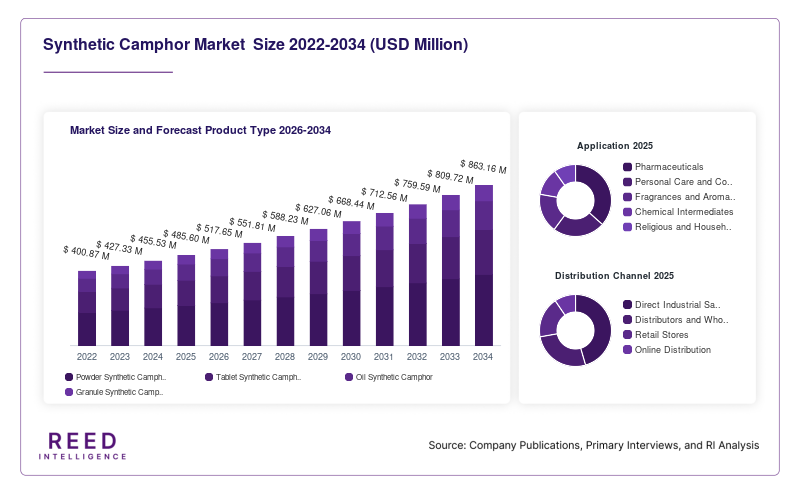
Powder synthetic camphor accounted for the largest share of the global market in 2024, representing 41.6% of total revenue. The segment continues to dominate because powder formulations are widely used across pharmaceutical, industrial, and fragrance applications. Powder synthetic camphor provides advantages related to ease of storage, blending efficiency, and stable chemical composition. Pharmaceutical manufacturers utilize powder variants extensively in the production of ointments, vapor rubs, and topical analgesics. Industrial users also prefer powder forms for chemical processing and fragrance manufacturing because they can be incorporated efficiently into large-scale production systems. In addition, the availability of different purity grades and standardized packaging formats supports the broad commercial adoption of powder synthetic camphor across multiple industries.
By Application
The pharmaceutical segment held the dominant share of 39.8% in 2024 and remained the leading application area for synthetic camphor. The segment benefits from extensive use of synthetic camphor in topical medications, inhalers, cough remedies, and therapeutic formulations. Pharmaceutical companies prefer synthetic variants because they offer consistent purity, reliable supply, and compliance with standardized manufacturing requirements. Increasing consumer demand for non-prescription healthcare products is encouraging greater production of camphor-based medicines across global markets. In addition, aging populations and rising incidence of respiratory discomfort and muscle pain are supporting demand for medicated products containing synthetic camphor. Strong retail distribution through pharmacies and healthcare stores further contributes to the dominant position of the pharmaceutical application segment.
By Distribution Channel
Direct industrial sales represented the largest share of 46.4% in 2024 and remained the leading distribution channel for synthetic camphor products. Large pharmaceutical, chemical, and fragrance manufacturers prefer direct procurement arrangements because they provide stable supply agreements and competitive pricing structures. Bulk purchasing through industrial sales channels also supports efficient inventory management and long-term sourcing stability. Producers often establish direct contractual relationships with industrial buyers to secure predictable revenue streams and reduce distribution complexity. In addition, direct sales models enable manufacturers to customize product grades, packaging formats, and logistics solutions according to specific industrial requirements. These operational advantages continue to strengthen the dominance of direct industrial sales across the global market.
Regional Analysis
North America
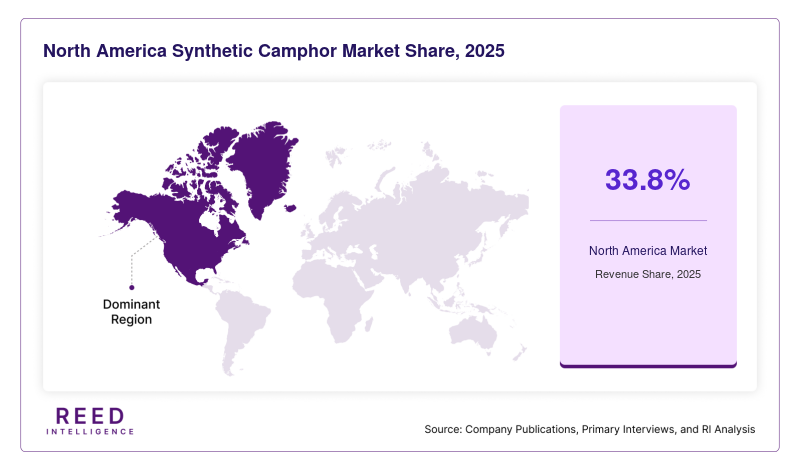
North America accounted for 33.8% of the global Synthetic Camphor Market in 2025 and is expected to maintain steady growth at a CAGR of 5.9% during the forecast period. The region benefits from a mature pharmaceutical industry and high consumption of over-the-counter healthcare products. Increasing demand for vapor rubs, pain relief creams, and aromatic wellness products continues to support market expansion. In addition, established regulatory frameworks and strong distribution infrastructure enable efficient commercialization of synthetic camphor-based formulations across the United States and Canada.
Europe
Europe represented 26.1% of the global Synthetic Camphor Market in 2025 and is projected to expand at a CAGR of 5.7% through 2034. The region benefits from strong demand for cosmetic, fragrance, and pharmaceutical products that utilize synthetic camphor in manufacturing processes. European consumers increasingly prefer wellness-oriented personal care products with aromatic and cooling ingredients, supporting steady product adoption. In addition, the presence of established chemical manufacturers and research-focused pharmaceutical companies contributes to stable market development across the region.
Asia Pacific
Asia Pacific held 24.9% of the global Synthetic Camphor Market in 2025 and is anticipated to register the fastest CAGR of 7.8% during the forecast period. The region is experiencing rapid industrialization, expanding pharmaceutical production, and rising demand for personal care products. Increasing urban populations and improving healthcare accessibility are contributing to stronger consumption of camphor-based products. In addition, manufacturers across China, India, and Southeast Asia are increasing production capacities to support both domestic demand and export activities.
Middle East & Africa
The Middle East & Africa region accounted for 8.3% of the global Synthetic Camphor Market in 2025 and is expected to grow at a CAGR of 5.4% during the forecast period. Demand for synthetic camphor is increasing gradually due to expanding pharmaceutical imports, rising consumer awareness regarding wellness products, and improving retail distribution networks. Countries in the Gulf region are witnessing greater demand for aromatic and medicinal products, particularly in urban healthcare markets. Industrial diversification initiatives are also supporting growth in specialty chemical manufacturing activities.
Latin America
Latin America captured 6.9% of the global Synthetic Camphor Market in 2025 and is projected to expand at a CAGR of 5.2% during the forecast period. The region is benefiting from rising healthcare expenditure and increasing consumption of topical healthcare formulations. Consumers are showing greater interest in aromatic wellness products, pain relief balms, and medicated creams that incorporate synthetic camphor. Expanding pharmaceutical distribution networks and improving retail penetration are also supporting market development across several Latin American countries.
Competitive Landscape
The Synthetic Camphor Market is characterized by the presence of regional manufacturers and global specialty chemical companies competing through product quality, pricing strategies, and distribution expansion. Market participants are focusing on production efficiency, supply chain optimization, and long-term partnerships with pharmaceutical and industrial buyers. Companies are also investing in research and development activities to improve product purity levels and support customized industrial applications. Strategic collaborations with distributors and online retail platforms are becoming increasingly important for expanding customer reach.
Saptagir Camphor Ltd. remained one of the leading companies in the market due to its strong production capabilities and broad product portfolio serving pharmaceutical, religious, and industrial applications. The company recently expanded its manufacturing capacity in Asia to address rising export demand from North America and Europe. Other major players are emphasizing regional expansion strategies and sustainable manufacturing practices to strengthen market positioning. Competitive intensity is expected to increase further as demand rises across healthcare, personal care, and specialty chemical industries.
Key Players
- Saptagir Camphor Ltd.
- Mangalam Organics Limited
- Oriental Aromatics Limited
- Kanchi Karpooram Limited
- Taiwan Tekho Camphor Co., Ltd.
- Fujian Green Pine Co., Ltd.
- Hiya India Biotech Pvt. Ltd.
- Camphor & Allied Products Ltd.
- Suzhou Youhe Science and Technology Co., Ltd.
- Spectrum Chemical Manufacturing Corp.
- Merck KGaA
- Alfa Aesar
- Apt Exim
Recent Developments
- In February 2026, Mangalam Organics Limited announced the expansion of its synthetic camphor production facility to improve supply capacity for pharmaceutical customers in Asia Pacific.
- In August 2025, Saptagir Camphor Ltd. introduced a new high-purity synthetic camphor product line designed for premium healthcare and aromatherapy applications.
- In November 2025, Oriental Aromatics Limited entered a strategic distribution partnership with regional wellness product manufacturers to strengthen market presence in the Middle East.
- In January 2026, Fujian Green Pine Co., Ltd. invested in upgraded chemical processing technologies aimed at improving manufacturing efficiency and reducing operational waste.
Synthetic Camphor Market Segments
Product Type
- Powder Synthetic Camphor
- Tablet Synthetic Camphor
- Oil Synthetic Camphor
- Granule Synthetic Camphor
Application
- Pharmaceuticals
- Personal Care and Cosmetics
- Fragrances and Aromatherapy
- Chemical Intermediates
- Religious and Household Uses
Distribution Channel
- Direct Industrial Sales
- Distributors and Wholesalers
- Retail Stores
- Online Distribution
By Region
- North America
- Europe
- APAC
- Middle East and Africa
- LATAM