Syphilis Testing Market Size, Share & Demand Report By Type (Laboratory-Based Testing, Point-of-Care Testing), By Application (Diagnostic Testing, Screening), By End-Use (Hospitals and Clinics, Diagnostic Laboratories, Home Care Settings), By Region & Segment Forecasts, 2025–2034
USD 3950
Market Overview
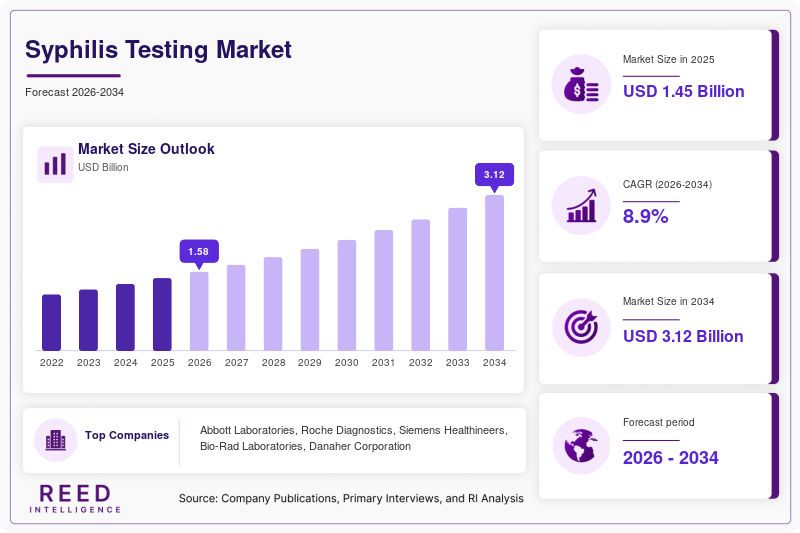
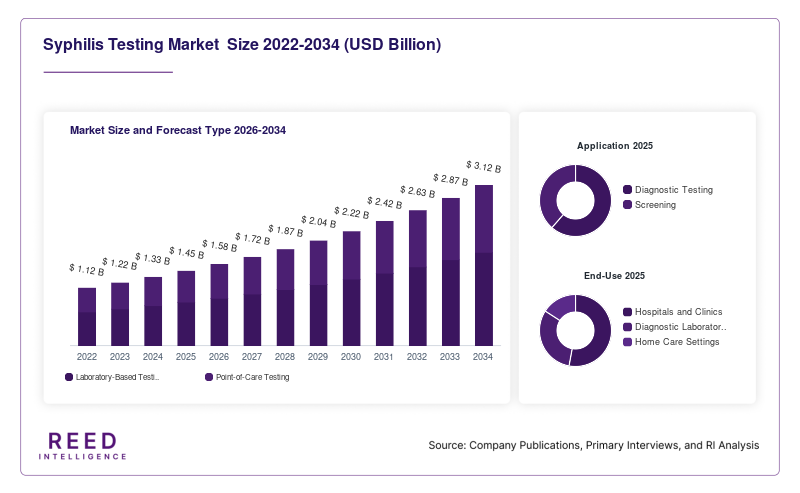
The Syphilis Testing Market size was valued at approximately USD 1.45 billion in 2025 and is projected to reach USD 1.58 billion in 2026. With growing public health concerns and expanded testing programs, the market is forecast to reach USD 3.12 billion by 2034, registering a compound annual growth rate (CAGR) of 8.9% from 2025 to 2034.
The growth trajectory of the syphilis testing industry is supported by multiple factors. First, the increasing prevalence of syphilis infections across both developed and developing regions is driving demand for early diagnostic solutions. Public health organizations are investing in routine screening campaigns, particularly among high-risk populations. Second, the expansion of point-of-care testing technologies is enabling faster and more accessible diagnosis, especially in remote and resource-limited settings. These rapid diagnostic tools reduce turnaround time and support immediate clinical decisions. Third, rising investments in healthcare infrastructure and laboratory capabilities are enhancing the availability of advanced testing platforms, including automated immunoassays and molecular diagnostics.
Key Highlights
- Market size reached USD 1.45 billion in 2025 and is estimated to grow to USD 1.58 billion in 2026. This reflects steady expansion driven by increasing diagnostic demand and improved testing accessibility across healthcare systems.
- The market is projected to reach USD 3.12 billion by 2034, registering a CAGR of 8.9% during 2025–2034. Sustained growth is supported by rising investments in healthcare infrastructure and expanding screening programs worldwide.
- The rising prevalence of syphilis remains a key growth driver, with increasing infection rates observed in both developed and developing regions. This has intensified the need for early diagnosis and routine screening initiatives.
- Point-of-care testing is significantly expanding access to syphilis diagnosis, especially in underserved and remote regions. These rapid tests enable quicker clinical decisions and improve patient management outcomes.
Market Trends
Growing Adoption of Point-of-Care Testing
The increasing adoption of point-of-care (POC) testing is a significant trend in the Syphilis Testing Market. These diagnostic solutions provide rapid results, often within minutes, allowing healthcare providers to initiate treatment immediately. This is particularly important in reducing transmission rates and preventing complications. POC tests are gaining traction in low-resource settings due to their ease of use, minimal infrastructure requirements, and cost efficiency. Governments and global health organizations are promoting these solutions in rural and underserved areas, where laboratory-based testing may not be feasible.
Additionally, technological advancements are enhancing the sensitivity and specificity of POC tests, making them more reliable for clinical use. The integration of mobile health platforms with POC devices is also improving data collection and patient tracking. This trend is expected to continue as healthcare systems prioritize decentralized testing models to improve accessibility and reduce diagnostic delays.
Integration of Multiplex Testing Platforms
Another notable trend is the integration of multiplex testing platforms that can simultaneously detect multiple sexually transmitted infections, including syphilis, HIV, and hepatitis. These platforms are becoming increasingly popular in clinical and diagnostic laboratories due to their efficiency and cost-effectiveness. By combining multiple tests into a single assay, healthcare providers can streamline workflows and improve patient outcomes.
Multiplex testing also supports comprehensive screening programs, particularly in high-risk populations. The growing demand for integrated diagnostic solutions is encouraging manufacturers to develop advanced assays with improved accuracy and reduced turnaround time. This trend is further supported by the increasing adoption of automated laboratory systems, which enhance throughput and reduce human error. As a result, multiplex testing is expected to play a key role in shaping the future of the syphilis testing market.
Market Drivers
Rising Prevalence of Syphilis Globally
The increasing incidence of syphilis infections worldwide is a primary driver of market growth. Many countries are reporting a resurgence of syphilis cases due to changing sexual behaviors, limited awareness, and inadequate screening programs. This rise in prevalence is creating a strong demand for effective diagnostic solutions. Public health authorities are emphasizing early detection and treatment to prevent complications such as neurological damage and congenital infections.
Moreover, the growing burden of syphilis among pregnant women is driving the adoption of prenatal screening programs. Early diagnosis during pregnancy is critical to preventing transmission to newborns. Governments and healthcare organizations are implementing mandatory screening policies, which are contributing to the expansion of the syphilis testing market.
Expansion of Government and Public Health Initiatives
Government initiatives and public health campaigns are significantly boosting the demand for syphilis testing. Many countries are investing in awareness programs, free testing services, and community outreach initiatives to control the spread of STIs. These efforts are increasing testing rates and improving early diagnosis.
In addition, international organizations are supporting large-scale screening programs in developing regions. Funding and technical assistance are being provided to strengthen healthcare infrastructure and improve access to diagnostic tools. The implementation of national guidelines for STI screening is also encouraging healthcare providers to adopt standardized testing protocols. This driver is expected to sustain market growth over the forecast period.
Market Restraint
Social Stigma and Underdiagnosis
One of the key restraints in the Syphilis Testing Market is the persistent social stigma associated with sexually transmitted infections. This stigma discourages individuals from seeking testing and treatment, leading to underdiagnosis and delayed care. In many regions, cultural and societal barriers prevent open discussions about sexual health, which limits awareness and reduces testing rates.
The impact of this restraint is significant, as undiagnosed cases contribute to continued transmission and increased disease burden. Healthcare providers may also face challenges in reaching high-risk populations due to privacy concerns and fear of discrimination. For example, individuals in conservative communities may avoid testing centers, even when symptoms are present.
This restraint affects not only market growth but also public health outcomes. To address this issue, governments and organizations are focusing on awareness campaigns and confidential testing services. However, overcoming stigma remains a complex challenge that requires long-term efforts and community engagement.
Market Opportunities
Expansion in Emerging Markets
Emerging markets present a substantial opportunity for the syphilis testing industry. Countries in Asia, Africa, and Latin America are experiencing increasing demand for diagnostic services due to rising infection rates and improving healthcare access. Investments in healthcare infrastructure are enabling the adoption of advanced testing technologies.
Additionally, international funding and partnerships are supporting the deployment of affordable diagnostic solutions in these regions. The growing focus on maternal and child health is also driving the adoption of prenatal screening programs. As awareness increases and healthcare systems evolve, emerging markets are expected to offer significant growth potential for industry players.
Technological Advancements in Diagnostic Solutions
Technological innovation is creating new opportunities in the syphilis testing market. The development of highly sensitive and specific assays is improving diagnostic accuracy and reliability. Advances in molecular diagnostics and immunoassays are enabling early detection of infections, even in asymptomatic cases.
Furthermore, the integration of digital health technologies is enhancing data management and patient monitoring. Remote testing solutions and telemedicine platforms are expanding access to diagnostic services. These innovations are not only improving patient outcomes but also creating new revenue streams for market participants. As research and development efforts continue, technological advancements are expected to drive market expansion.
Segmental Analysis
By Type
The laboratory-based testing segment dominated the market in 2024, accounting for approximately 62% of the total share. These tests offer high accuracy and are widely used in hospitals and diagnostic laboratories. Advanced technologies such as enzyme immunoassays and chemiluminescence assays are commonly employed.
The point-of-care testing segment is expected to be the fastest-growing, with a CAGR of 10.5%. Growth is driven by the increasing demand for rapid and accessible diagnostic solutions, particularly in remote areas.
By Application
The diagnostic testing segment held the largest share in 2024, accounting for around 68%. This segment includes routine screening and confirmatory testing in clinical settings.
The screening segment is projected to grow at the fastest rate, with a CAGR of 9.8%. Growth is driven by expanding public health initiatives and increased awareness programs.
By End-Use
Hospitals and clinics dominated the market in 2024, with a share of approximately 55%. These facilities have access to advanced diagnostic equipment and trained professionals.
Diagnostic laboratories are expected to be the fastest-growing segment, with a CAGR of 9.6%. Growth is driven by increasing outsourcing of testing services and advancements in laboratory automation.
Regional Analysis
North America
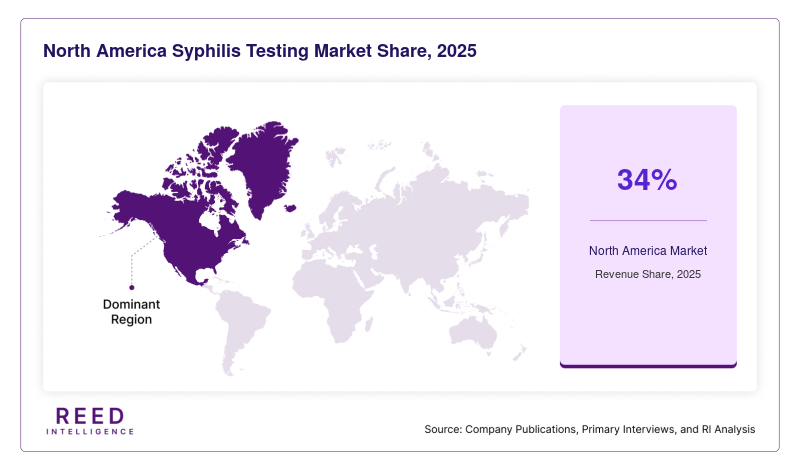
North America held a significant share of the syphilis testing market in 2025, accounting for approximately 34% of global revenue. The region is expected to grow at a CAGR of 7.8% during the forecast period. High awareness levels, advanced healthcare infrastructure, and strong government initiatives contribute to market growth.
The United States dominates the regional market due to extensive screening programs and rising infection rates. A unique growth factor is the widespread adoption of digital health systems that improve disease surveillance and testing efficiency.
Europe
Europe accounted for around 26% of the market share in 2025 and is projected to grow at a CAGR of 7.2%. The region benefits from well-established healthcare systems and comprehensive STI prevention programs.
Germany leads the market, driven by strong laboratory infrastructure and government-supported screening initiatives. A unique growth factor is the integration of multiplex diagnostic platforms in clinical settings.
Asia Pacific
Asia Pacific represented approximately 22% of the market in 2025 and is expected to register the highest CAGR of 10.2%. Rapid urbanization and increasing healthcare investments are driving market growth.
China dominates the region due to its large population and expanding healthcare infrastructure. A unique growth factor is the increasing focus on maternal health programs and prenatal screening.
Middle East & Africa
The Middle East & Africa region held about 10% of the market share in 2025 and is projected to grow at a CAGR of 8.5%. Limited healthcare access in some areas is offset by growing international support.
South Africa leads the market, supported by government initiatives and global health funding. A unique growth factor is the expansion of community-based testing programs in rural areas.
Latin America
Latin America accounted for nearly 8% of the market share in 2025 and is expected to grow at a CAGR of 8.1%. Increasing awareness and improving healthcare access are driving growth.
Brazil dominates the regional market due to strong public health campaigns. A unique growth factor is the implementation of nationwide STI screening programs.
Competitive Landscape
The syphilis testing market is moderately competitive, with several global and regional players focusing on product innovation and strategic partnerships. Leading companies are investing in research and development to enhance the accuracy and efficiency of diagnostic solutions. The market leader is Abbott Laboratories, which has a strong portfolio of diagnostic products and a wide global presence.
Recent developments include the introduction of advanced point-of-care testing kits and multiplex assays. Companies are also expanding their distribution networks to reach emerging markets. Collaborations with public health organizations are further strengthening market positions. Competitive strategies such as mergers, acquisitions, and product launches are shaping the industry landscape.
Key Players
- Abbott Laboratories
- Roche Diagnostics
- Siemens Healthineers
- Bio-Rad Laboratories
- Danaher Corporation
- Thermo Fisher Scientific
- Becton, Dickinson and Company
- Trinity Biotech
- OraSure Technologies
- Chembio Diagnostics
- Hologic Inc.
- PerkinElmer Inc.
- Fujirebio
- Sysmex Corporation
- Quidel Corporation
Recent Developments
- In 2024, Abbott Laboratories launched a new rapid syphilis test with improved sensitivity.
- In 2023, Roche Diagnostics introduced a multiplex assay for simultaneous detection of multiple STIs.
- In 2024, Siemens Healthineers expanded its diagnostic portfolio with advanced immunoassay systems.
Syphilis Testing Market Segments
Type
- Laboratory-Based Testing
- Point-of-Care Testing
Application
- Diagnostic Testing
- Screening
End-Use
- Hospitals and Clinics
- Diagnostic Laboratories
- Home Care Settings
By Region
- North America
- Europe
- APAC
- Middle East and Africa
- LATAM