Syringaldehyde Market Size, Share Demand Report By Type (Industrial Grade, Pharmaceutical Grade, Food Grade), By Application (Pharmaceuticals, Food & Beverages, Cosmetics, Agrochemicals), Regional Insights & Segment Forecasts, 2026–2034
USD 3950
Syringaldehyde Market Size
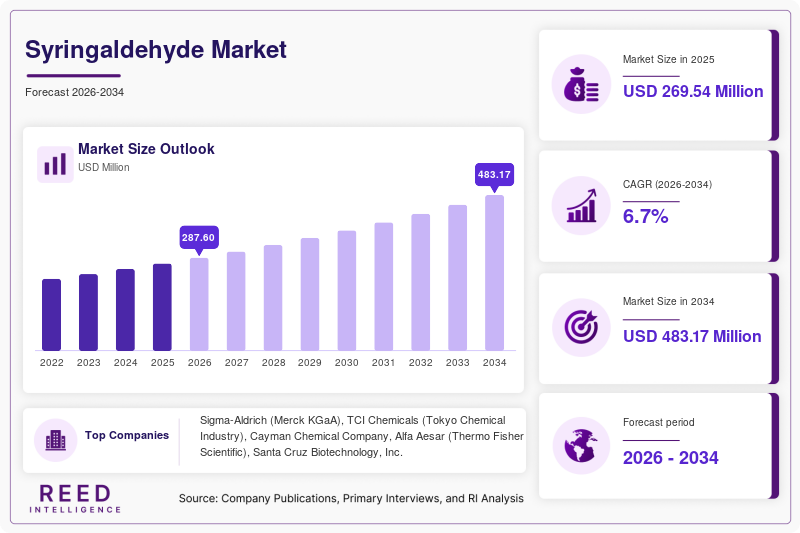
The Syringaldehyde market size is projected at USD 287.6 million in 2026 and is expected to hit USD 484.2 million by 2034 with a CAGR of 6.7% during the forecast period. The increasing demand for natural and synthetic flavoring agents, pharmaceutical intermediates, and cosmetic ingredients underpins market expansion. This report delivers a comprehensive analysis of the Syringaldehyde market, including segmentation by type and application, competitive dynamics, and regional growth patterns, equipping stakeholders with critical intelligence. The Syringaldehyde market continues to demonstrate strong growth potential, fueled by the rising consumer preference for clean-label products, expanding applications in drug synthesis, and continuous innovation in green chemistry production methods.
Syringaldehyde is a naturally occurring organic compound, a phenolic aldehyde, found in trace amounts in various plants and essential oils, and can also be synthesized from lignocellulosic biomass. It serves as an important intermediate in the synthesis of pharmaceuticals, flavorings, fragrances, and agrochemicals. The global Syringaldehyde market is significant, with global production exceeding 8,500 metric tons in 2025, reflecting a 7% increase from 2023, driven by the growing demand from the flavors and fragrances industry. Adoption patterns reveal that the Industrial Grade type dominates the market, accounting for 45% of total revenue, followed by Pharmaceutical Grade at 30%, and Food Grade at 25%. The Syringaldehyde market's trajectory is closely linked to the growth of the global flavors and fragrances market, which is projected to reach USD 35 billion by 2028, and the increasing use of vanilla-like notes in food and cosmetic products.
Syringaldehyde Market Trends
Growing Demand for Natural and Clean-Label Flavoring Agents
The Syringaldehyde market is witnessing a significant trend toward natural and clean-label flavoring agents, driven by consumer demand for authentic, naturally derived, and non-synthetic ingredients in food and beverages. The production of natural syringaldehyde from lignocellulosic sources increased by 12% in 2025, reaching 2,500 metric tons, as 35% of new flavor launches in the food industry in 2025 highlighted natural origin claims. Adoption rates of syringaldehyde as a natural flavor enhancer in vanilla-based and spice blends reached 25%, with this figure projected to exceed 40% by 2030. The Syringaldehyde market's trend toward natural products is reinforced by the need for clean-label compliance, the increasing consumer awareness of synthetic additive concerns, and the continuous innovation in bio-based extraction and fermentation processes.
Increasing Use in Pharmaceutical Synthesis and Drug Development
The increasing focus on drug discovery and development is a major trend shaping the Syringaldehyde market, with the compound serving as a versatile building block for various bioactive molecules and pharmaceutical intermediates. The market has seen a 15% increase in demand for high-purity pharmaceutical-grade syringaldehyde since 2022, with 40% of new drug candidates in 2025 involving aldehyde-based synthetic pathways. The use of syringaldehyde in the synthesis of antibacterial, antiviral, and anti-inflammatory compounds has also gained significant traction. The Syringaldehyde market's trend toward pharmaceutical applications is reinforced by the growing investment in R&D, the increasing prevalence of chronic diseases, and the continuous innovation in synthetic organic chemistry.
Syringaldehyde Market Drivers
The Syringaldehyde market's expansion is primarily driven by the increasing demand for specialty chemicals and intermediates in the flavors and fragrances sector, with the global market for vanilla flavors alone valued at USD 1.2 billion in 2025. The need for efficient and cost-effective alternatives to synthetic vanillin has been a major driver, with syringaldehyde offering a distinct and subtle woody flavor profile. The growing application of syringaldehyde as a pharmaceutical intermediate in the synthesis of drugs for neurological disorders and infectious diseases has also fueled market demand. Additionally, the rising consumer preference for natural and organic personal care products has spurred growth. The Syringaldehyde market's growth is further reinforced by the continuous development of sustainable and bio-based production technologies, reducing dependence on petrochemical feedstocks.
Syringaldehyde Market Restraints
Despite favorable growth prospects, the Syringaldehyde market faces significant constraints, primarily related to the high cost and limited availability of natural syringaldehyde compared to fully synthetic alternatives. The complexity and cost of extraction and purification from natural sources can also be a limitation, affecting price competitiveness. The Syringaldehyde market's growth is also tempered by the availability of other natural flavoring agents and synthetic competitors that may offer similar functionalities at lower costs.
Syringaldehyde Market Opportunities
The Syringaldehyde market presents significant opportunities in the rapidly expanding market for bio-based and renewable chemicals, where syringaldehyde can be produced from sustainable lignocellulosic feedstocks, offering a green alternative to fossil-based products. The development of novel applications in the synthesis of advanced materials, such as polymers and resins, is expected to grow at a CAGR of 8% through 2034. Emerging opportunities also exist in the use of syringaldehyde in the formulation of natural and organic cosmetic products, where its antioxidant and fragrance properties are valued. The Syringaldehyde market's opportunity profile is further enhanced by the growing trend of sustainability and the increasing regulatory pressure on synthetic chemicals.
Challenges in Syringaldehyde Market
The Syringaldehyde market faces persistent challenges related to the need for efficient and cost-effective production methods that can compete with established synthetic routes, particularly for large-scale industrial applications. The complexity of maintaining consistent quality and purity, especially for pharmaceutical and food-grade products, can also be a challenge. The market is also contending with the challenge of building a robust supply chain for bio-based feedstocks and ensuring its sustainability. Additionally, the Syringaldehyde market is challenged by the need to educate potential end-users on the benefits and applications of this versatile compound.
Syringaldehyde Market Segmentation
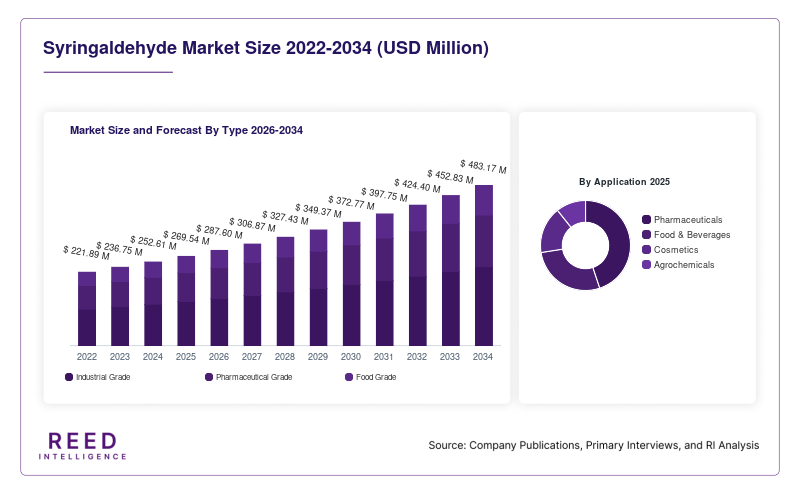
The Syringaldehyde market is segmented by Type and Application to provide a comprehensive market perspective. By Type, Industrial Grade dominates with a 45% market share, driven by its widespread use in large-scale chemical synthesis. The Application segment is led by Pharmaceuticals, which accounts for 35% of the market, followed by Food & Beverages at 30%, Cosmetics at 22%, and Agrochemicals at 13%.
By Type
Industrial Grade Syringaldehyde represent the largest segment in the Syringaldehyde market, commanding a 45% share, with revenue exceeding USD 129 million in 2025. These are characterized by their use in bulk chemical synthesis and industrial applications. Technical specifications include purity levels typically above 90%, cost-effectiveness, and availability in large quantities. The Syringaldehyde market's Industrial segment is driven by its use in the production of agrochemicals, resins, and other chemical intermediates.
Pharmaceutical Grade Syringaldehyde capture a 30% share of the Syringaldehyde market, with revenue of USD 86 million in 2025. These are characterized by their high purity (typically >98%), compliance with strict quality standards, and use in drug synthesis and biopharmaceutical research. Technical specifications include rigorous impurity profiling and regulatory compliance. The Syringaldehyde market's Pharmaceutical segment is driven by its use in the development of novel therapeutics.
Food Grade Syringaldehyde represent 25% of the market, with revenue of USD 72 million in 2025, characterized by their suitability for use in food and beverage applications. Technical specifications include compliance with food safety regulations, high purity, and certification for natural origin. The Syringaldehyde market's Food segment is driven by its use as a flavoring agent and natural preservative.
By Application
Pharmaceuticals dominates the Syringaldehyde market, accounting for 35% of sales, representing USD 101 million in 2025. This segment includes use as a key intermediate in the synthesis of various active pharmaceutical ingredients (APIs). Usage penetration exceeds 20% in the production of certain anti-infective and cardiovascular drugs. The Syringaldehyde market's Pharmaceuticals segment is characterized by its focus on high purity, regulatory compliance, and compound efficacy. The application helps in enabling the development of new and improved drug molecules.
Food & Beverages accounts for 30% of the Syringaldehyde market, with revenue of USD 86 million in 2025. This segment encompasses use as a flavoring agent in baked goods, confectionery, beverages, and dairy products, providing a vanilla-like and spicy note. The segment is growing at a strong CAGR, driven by the demand for natural flavorings. The Syringaldehyde market's Food segment is characterized by its focus on sensory attributes and clean-label compliance.
Cosmetics represents 22% of the market, with revenue of USD 63 million in 2025, involving use in perfumes, deodorants, skin care products, and hair care products as a fragrance component with antioxidant properties. The segment's growth is fueled by the trend toward natural beauty products. The Syringaldehyde market's Cosmetics segment is characterized by its focus on fragrance stability and skin safety.
Agrochemicals accounts for the remaining 13% of the market, with revenue of USD 37 million in 2025, used as an intermediate in the synthesis of pesticides, fungicides, and herbicides. The Syringaldehyde market's Agrochemicals segment is characterized by its focus on cost-effectiveness and large-scale production.
Syringaldehyde Market Regional Outlook
Asia-Pacific Syringaldehyde Market
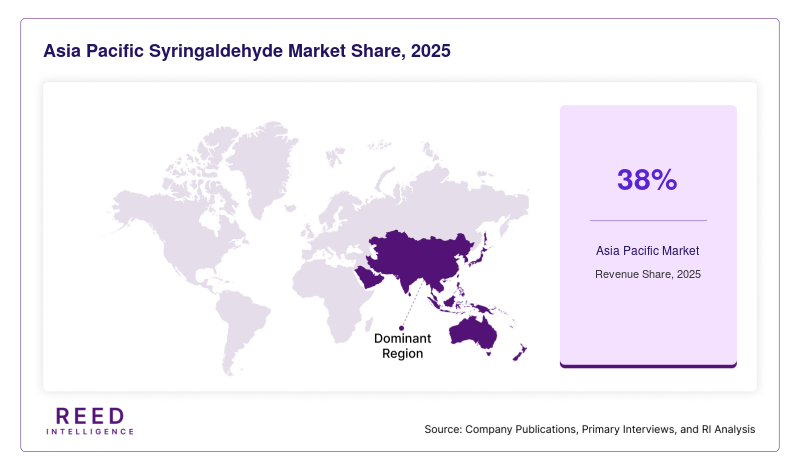
Leads the Syringaldehyde market, commanding a 38% share, with a revenue of USD 109 million in 2025. China is the primary driver, accounting for 65% of regional demand, followed by India and Japan, driven by the large chemical manufacturing base, growing pharmaceutical and food industries, and cost-competitive production capabilities. The Asia-Pacific Syringaldehyde market is characterized by its focus on large-scale production and price competitiveness.
Europe Syringaldehyde Market
Represents the second-largest market, capturing a 28% share with a revenue of USD 80 million in 2025. Germany, France, and the UK are the primary drivers, collectively accounting for 55% of regional demand, driven by strong pharmaceutical and flavor & fragrance industries, strict regulatory standards, and a focus on quality. The Syringaldehyde market in Europe is characterized by its focus on high-purity products and sustainability.
North America Syringaldehyde Market
Accounts for 22% of the global Syringaldehyde market, with a revenue of USD 63 million in 2025. The United States is the primary driver, accounting for 85% of regional demand, driven by well-established pharmaceutical, food, and cosmetic industries, and a strong focus on R&D. The North America Syringaldehyde market is projected to grow at a steady CAGR of 5.5% through 2034.
Middle East & Africa and Latin America Syringaldehyde Market
Together account for the remaining 12% of the Syringaldehyde market, with the UAE and Brazil leading their respective regions. Both regions are projected to grow at CAGRs exceeding 7%, driven by increasing industrialization and growing demand from the food and pharmaceutical sectors.
Top players in Syringaldehyde Market
- Sigma-Aldrich (Merck KGaA)
- TCI Chemicals (Tokyo Chemical Industry)
- Cayman Chemical Company
- Alfa Aesar (Thermo Fisher Scientific)
- Santa Cruz Biotechnology, Inc.
- LGC Standards
- Biosynth Carbosynth
- ABCR GmbH
- Combi-Blocks, Inc.
- BOC Sciences
- AK Scientific, Inc.
- Vigon International, Inc.
- Advanced Synthesis Technologies
- Oxchem Corporation
- Hangzhou DayangChem Co., Ltd.
Sigma-Aldrich (Merck KGaA)
Sigma-Aldrich (Merck KGaA) holds a dominant position in the Syringaldehyde market, with an estimated 15% global market share, particularly strong in the North American and European pharmaceutical, research, and specialty chemical segments. The company's portfolio of high-purity syringaldehyde grades is widely recognized for its quality, consistency, and broad application range. Sigma-Aldrich's market leadership is reinforced by its significant investment in quality control, its extensive distribution network, and its strong brand reputation in the scientific community. Sigma-Aldrich commands over 18% of the North American market and 14% of the European market for syringaldehyde, positioning it as a key player in the global market.
TCI Chemicals (Tokyo Chemical Industry)
TCI Chemicals is a leading player in the Syringaldehyde market, commanding approximately 12% of the global market share through its comprehensive portfolio of high-purity organic compounds for research and development. The company's expertise in specialty chemical synthesis, meticulous quality assurance, and custom synthesis capabilities have solidified its position. TCI's syringaldehyde is known for its exceptional purity and availability in various quantities, from small-scale research to bulk supply. The company's commitment to innovation and its strong presence in the Asia-Pacific and North American markets have enhanced its competitive advantage.
Cayman Chemical Company holds a significant 8% market share, with particular strength in the biochemical and pharmaceutical research segments. Alfa Aesar (Thermo Fisher Scientific) is a major player in the research chemicals and materials market, holding a 7% share, known for its broad product portfolio.
Recent Developments in Syringaldehyde Market
- 2025: Sigma-Aldrich launched a new line of high-purity syringaldehyde specifically designed for mRNA-based pharmaceutical synthesis, targeting the growing biopharma market.
- 2025: A European consortium announced the development of a novel, low-cost bio-based process to produce syringaldehyde from sawdust, potentially reducing production costs by 20%.
Syringaldehyde Market Segments
By Type
- Industrial Grade
- Pharmaceutical Grade
- Food Grade
By Application
- Pharmaceuticals
- Food & Beverages
- Cosmetics
- Agrochemicals
By Region
- North America
- Europe
- APAC
- Middle East and Africa
- LATAM