Tempeh Market Size, Share & Demand Report By Product Type (Soy Tempeh, Multi-Grain Tempeh, Black Bean Tempeh, Chickpea Tempeh, Other Specialty Tempeh), By Nature (Organic Tempeh, Conventional Tempeh), By Distribution Channel (Supermarkets & Hypermarkets, Convenience Stores, Specialty Health Food Stores, Online Retail, Foodservice & Institutional Sales), By End User (Households, Restaurants & Cafés, Food Processing Companies, Institutional Buyers), By Region & Segment Forecasts, 2026–2034
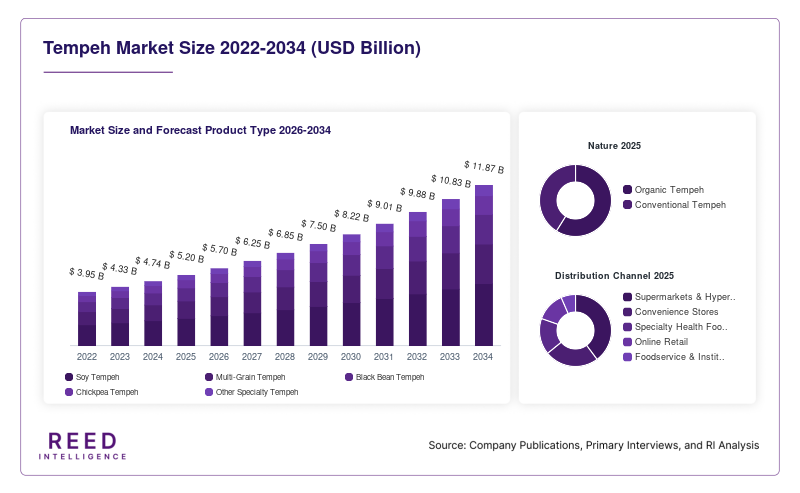
USD 3950
Market Overview
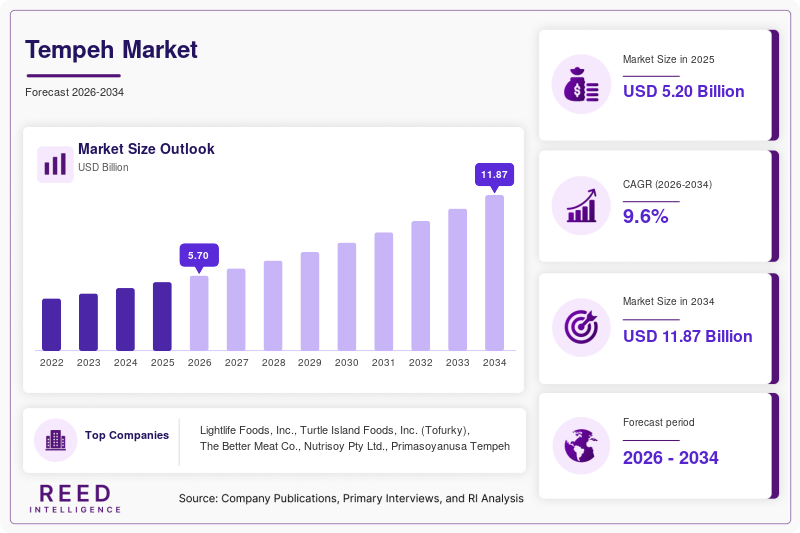
The Tempeh Market size was valued at USD 5.2 billion in 2026 and is projected to reach USD 10.8 billion by 2034, expanding at a CAGR of 9.6% during 2026–2034. The market is witnessing steady expansion as consumers increasingly seek nutrient-dense, plant-based protein alternatives that align with health, sustainability, and ethical consumption preferences. Tempeh, a traditional fermented soybean product, has gained significant recognition beyond its Southeast Asian origins and is now widely incorporated into vegetarian, vegan, and flexitarian diets worldwide.
A major global factor supporting the growth of the Tempeh Market has been the rising shift toward plant-based nutrition. Consumers are actively reducing animal protein consumption and adopting alternative protein sources that offer high nutritional value while reducing environmental impact. Tempeh provides a favorable combination of protein, dietary fiber, probiotics, vitamins, and minerals, making it attractive to health-conscious consumers and food manufacturers alike.
Key Highlights
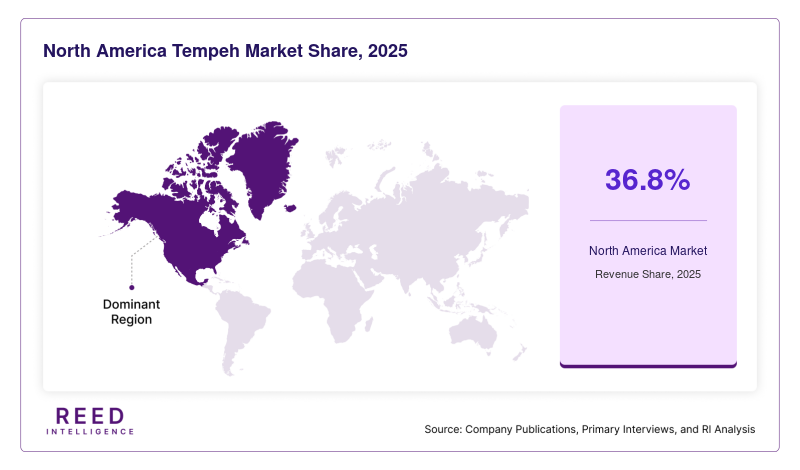
- North America dominated the Tempeh Market with 36.8% share in 2025, while Asia Pacific is projected to register the fastest CAGR of 11.4% during 2026–2034.
- By Product Type, Soy Tempeh accounted for the largest market share of 62.5% in 2025, while Chickpea Tempeh is expected to witness the fastest CAGR of 12.1%.
- By Nature, Conventional Tempeh held 68.2% market share in 2025, whereas Organic Tempeh is forecast to expand at 11.8% CAGR.
- By Distribution Channel, Supermarkets & Hypermarkets represented 41.7% share in 2025, while Online Retail is projected to grow at 13.2% CAGR.
- By End User, Households captured 54.6% market share in 2025, while Food Processing Companies are anticipated to expand at 11.6% CAGR.
- The United States remained the dominant country market, valued at USD 1.48 billion in 2024 and USD 1.61 billion in 2025.
Market Trends
Expansion of Ready-to-Eat and Convenience Tempeh Products
Consumers increasingly demand convenient food products that require minimal preparation. Manufacturers are responding by launching ready-to-eat tempeh meals, marinated tempeh portions, frozen tempeh products, and snack-based formulations. This trend is expanding consumption beyond traditional vegetarian households and attracting busy professionals seeking nutritious meal solutions. Convenience-focused innovation continues to improve product accessibility and strengthen retail visibility.
Growing Integration of Tempeh into Functional Food Portfolios
Food companies are increasingly incorporating tempeh into functional food categories due to its fermentation-derived nutritional benefits. Product developers are using tempeh in protein bowls, meal kits, plant-based burgers, wraps, salads, and health-focused packaged foods. The growing emphasis on gut health, digestive wellness, and protein enrichment is encouraging manufacturers to position tempeh as a multifunctional ingredient rather than solely a meat alternative.
Market Drivers
Rising Adoption of Flexitarian Dietary Patterns
The growing popularity of flexitarian lifestyles is creating favorable conditions for the Tempeh Market. Consumers who do not fully eliminate animal products are increasingly incorporating plant-based proteins into their diets. Tempeh offers a versatile texture, balanced nutritional profile, and adaptability across cuisines, making it attractive for individuals seeking dietary variety while reducing meat consumption.
Increasing Investments in Plant-Based Food Innovation
Food manufacturers and investors are allocating substantial resources toward alternative protein development. Product innovation, improved fermentation technologies, enhanced packaging formats, and expanded retail partnerships are supporting broader commercialization of tempeh products. These investments are increasing consumer awareness and accelerating market growth across multiple geographic regions.
Market Restraint
Limited Consumer Familiarity in Emerging Markets
Despite increasing popularity in developed economies, consumer awareness of tempeh remains relatively limited in several emerging markets. Many consumers remain unfamiliar with preparation methods, nutritional benefits, and culinary applications. This awareness gap can slow adoption rates and restrict market penetration in certain regions.
Market Opportunities
Development of Non-Soy Tempeh Variants
Growing interest in dietary diversity is creating opportunities for manufacturers to develop tempeh using chickpeas, lentils, peas, black beans, and mixed grains. These alternatives appeal to consumers seeking product variety while addressing concerns related to soy allergies or dietary preferences. The diversification of raw materials is expected to broaden the consumer base significantly.
Expansion of Tempeh-Based Food Ingredients
Food processors are increasingly exploring tempeh as an ingredient for prepared foods, protein snacks, frozen meals, and nutritional supplements. The integration of tempeh into mainstream food manufacturing creates opportunities for suppliers to establish long-term partnerships with packaged food companies and institutional food providers.
Segmental Analysis
By Product Type
The Tempeh Market is segmented into Soy Tempeh, Multi-Grain Tempeh, Black Bean Tempeh, Chickpea Tempeh, and Other Specialty Tempeh.
Soy Tempeh dominated the market with 62.5% share in 2025. Its leadership position was supported by established consumer familiarity, strong protein content, efficient production economics, and widespread availability across retail channels.
Chickpea Tempeh is projected to expand at the fastest CAGR of 12.1% during the forecast period. Growth will be driven by increasing demand for soy-free protein alternatives and growing consumer interest in diverse plant-based food formulations.
By Nature
The market is categorized into Organic Tempeh and Conventional Tempeh.
Conventional Tempeh accounted for 68.2% of market revenue in 2025. The segment benefited from broad product availability, competitive pricing, and large-scale manufacturing capabilities that supported consistent supply across retail networks.
Organic Tempeh is expected to witness a CAGR of 11.8% through 2034. Growth will be supported by increasing consumer preference for clean-label foods produced without synthetic agricultural inputs and chemical treatments.
By Distribution Channel
The market is segmented into Supermarkets & Hypermarkets, Convenience Stores, Specialty Health Food Stores, Online Retail, and Foodservice & Institutional Sales.
Supermarkets & Hypermarkets held the largest share of 41.7% in 2025. Their extensive product assortments and strong consumer foot traffic contributed significantly to sales volume and product visibility.
Online Retail is forecast to expand at a CAGR of 13.2% during the study period. Growth will be supported by subscription-based grocery services, direct-to-consumer brand strategies, and expanding digital food commerce ecosystems.
By End User
The market includes Households, Restaurants & Cafés, Food Processing Companies, and Institutional Buyers.
Households represented 54.6% of total revenue in 2025. Home consumption remained dominant due to increasing interest in healthy meal preparation and growing familiarity with plant-based cooking practices.
Food Processing Companies are expected to register a CAGR of 11.6% through 2034. Growth will be supported by the increasing incorporation of tempeh ingredients into packaged meals, frozen foods, snacks, and protein-enhanced product formulations.
Regional Analysis
North America
North America accounted for 36.8% of the global Tempeh Market share in 2025. The region benefited from widespread consumer adoption of plant-based diets and strong retail availability of alternative protein products. Market growth will reach a CAGR of 8.9% through 2034.
The United States remained the dominant country within the region. Growth was supported by the increasing incorporation of fermented protein products into mainstream grocery assortments. Retailers expanded shelf space dedicated to plant-based foods, encouraging greater consumer exposure and product trial.
Europe
Europe represented 28.4% of market revenue in 2025. Consumer demand for sustainable food products and ethical sourcing practices supported market expansion throughout the region. The market is expected to grow at a CAGR of 9.1% during the forecast period.
Germany emerged as the leading country market. Growth was supported by increasing adoption of environmentally conscious food purchasing behaviors. Consumers demonstrated strong interest in products with lower carbon footprints, creating favorable demand conditions for fermented plant-based proteins.
Asia Pacific
Asia Pacific held 22.7% market share in 2025 and is expected to register the fastest regional CAGR of 11.4% from 2026 to 2034. The region continues to benefit from expanding urban populations and growing consumer interest in nutritious convenience foods.
Indonesia remained the dominant country market. Growth was supported by strong cultural familiarity with tempeh consumption and increasing commercialization of packaged tempeh products. Local manufacturers expanded production capacity while introducing modern retail formats that improved product accessibility.
Middle East & Africa
The Middle East & Africa accounted for 6.1% market share in 2025. Market development was supported by increasing interest in health-oriented food products and diversification of dietary choices among urban consumers. The regional market will expand at a CAGR of 8.5% through 2034.
The United Arab Emirates led regional demand. Growth was supported by expanding premium food retail infrastructure and rising demand for internationally inspired health food products among expatriate and local populations.
Latin America
Latin America captured 6.0% of global market revenue in 2025. Growing awareness of plant-based nutrition and expanding specialty food retail networks supported market growth across several countries. The market is forecast to grow at a CAGR of 8.8% during 2026–2034.
Brazil represented the largest country market. Growth was driven by increasing consumer interest in protein-rich vegetarian foods and the availability of locally produced soybean-based ingredients suitable for tempeh manufacturing.
Competitive Landscape
The Tempeh Market remains moderately fragmented, with both regional producers and international plant-based food manufacturers competing across multiple distribution channels. Companies focus on product innovation, capacity expansion, ingredient diversification, and strategic partnerships to strengthen their market positions.
Lightlife Foods, Inc. maintained a leading position through extensive retail distribution, product innovation, and strong brand recognition within the plant-based food segment. The company recently expanded its tempeh product portfolio with flavored and ready-to-cook varieties designed to improve convenience and consumer appeal.
Turtle Island Foods (Tofurky) continues to strengthen its presence through diversified plant-based protein offerings and expanded retail penetration.
The Better Meat Co. focuses on fermentation-based protein solutions and ingredient innovation targeting foodservice and manufacturing customers.
Nutrisoy Pty Ltd. emphasizes premium-quality tempeh products while expanding distribution across health-focused retail channels.
Primasoyanusa Tempeh remains an important participant due to its extensive manufacturing expertise and strong presence within traditional tempeh-producing regions.
Key Players List
- Lightlife Foods, Inc.
- Turtle Island Foods, Inc. (Tofurky)
- The Better Meat Co.
- Nutrisoy Pty Ltd.
- Primasoyanusa Tempeh
- Tempeh Today LLC
- Healthy Food Tempeh
- Quorn Foods Ltd.
- Danone S.A.
- The Hain Celestial Group, Inc.
- Impulse Foods Pty Ltd.
- Tempeh Manufactory
- Plant Power Foods
- Better Nature Ltd.
- Noble Bean Tempeh
- Schouten Europe B.V.
Tempeh Market Segments
Product Type
- Soy Tempeh
- Multi-Grain Tempeh
- Black Bean Tempeh
- Chickpea Tempeh
- Other Specialty Tempeh
Nature
- Organic Tempeh
- Conventional Tempeh
Distribution Channel
- Supermarkets & Hypermarkets
- Convenience Stores
- Specialty Health Food Stores
- Online Retail
- Foodservice & Institutional Sales
End User
- Households
- Restaurants & Cafés
- Food Processing Companies
- Institutional Buyers
By Region
- North America
- Europe
- APAC
- Middle East and Africa
- LATAM