Temperature Detection Screen Market Size, Share Demand Report By Type (Fixed Temperature Detection Screens), By Technology (Infrared Thermal Imaging Systems, AI-Based Detection Systems), By End Use (Healthcare, Transportation, Commercial Buildings, Industrial Facilities), By Application (Entry Screening Systems, Crowd Monitoring Systems, Security Checkpoints), By Region & Segment Forecasts, 2026–2034
USD 3950
Market Overview
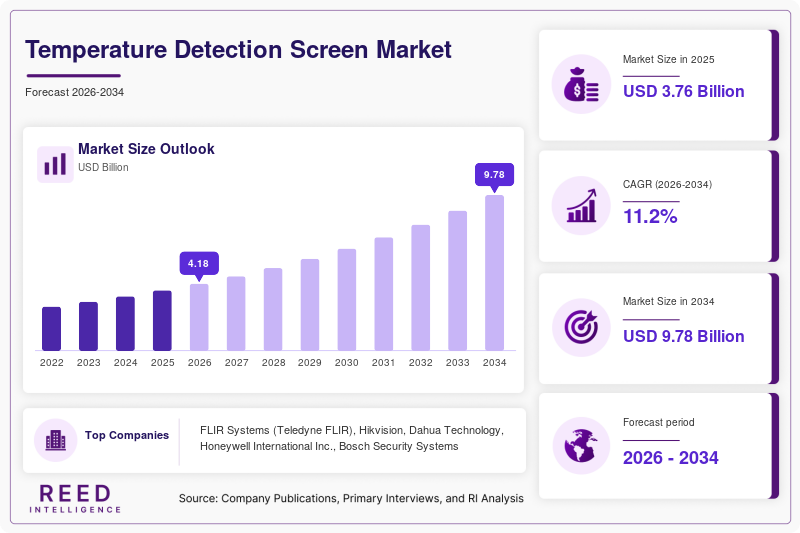
The global Temperature Detection Screen Market size is estimated at USD 4.18 billion and is projected to reach USD 9.76 billion by 2034, registering a CAGR of 11.2% during the forecast period (2026–2034). Growth is primarily supported by rising global emphasis on preventive health monitoring and enhanced security screening protocols across high-traffic environments.
A key global factor supporting the Temperature Detection Screen Market growth is the accelerated adoption of automated health screening systems in response to heightened awareness of infectious disease control. Governments and private institutions are increasingly integrating AI-enabled thermal screening technologies into entry checkpoints to reduce manual intervention and improve operational efficiency.
Key Highlights:
- Dominant region share (2025): Asia Pacific accounted for 38% of the Temperature Detection Screen Market
- Fastest-growing region CAGR (2026–2034): Middle East & Africa at 12.4%
- Leading subsegment (Type): Fixed temperature detection screens dominated in 2025
- Fastest-growing subsegment: AI-based detection systems are expected to expand at 13.1% CAGR
- Dominant country market value: United States valued at USD 0.92 billion in 2024 and USD 1.03 billion in 2025
Market Trends
AI Integration with Thermal Imaging Systems
The Temperature Detection Screen Market is increasingly shaped by the integration of artificial intelligence with thermal imaging technologies. AI algorithms enhance temperature measurement accuracy by minimizing false readings caused by environmental variations and non-human heat sources. These systems are being widely deployed in airports, hospitals, and corporate facilities where high precision and real-time alerts are essential. Machine learning capabilities allow continuous system improvement through data-driven calibration, enabling smarter decision-making and automated health risk identification. The convergence of AI and thermal sensing is transforming traditional screening devices into intelligent monitoring platforms that support predictive analytics and centralized health data management.
Expansion of Contactless Entry and Smart Infrastructure Systems
Another major trend influencing the Temperature Detection Screen Market is the increasing adoption of contactless entry systems integrated into smart infrastructure projects. Organizations are combining thermal screening with biometric authentication, access control, and surveillance systems to create seamless entry ecosystems. This trend is particularly strong in smart cities, modern transportation hubs, and corporate campuses where hygiene and operational efficiency are prioritized. Demand is also rising for portable and mobile screening units used in temporary setups such as events and emergency response zones. Advancements in infrared sensor performance are further enhancing speed and reliability, supporting broader deployment across diverse environments.
Market Drivers
Rising Global Focus on Public Health and Safety Infrastructure
The Temperature Detection Screen Market is significantly driven by heightened global awareness of public health safety and infectious disease prevention. Governments, healthcare providers, and private organizations are increasingly investing in automated screening systems to detect abnormal body temperatures at entry points of public spaces. This proactive approach helps reduce transmission risks while ensuring compliance with health safety protocols. Airports, hospitals, and educational institutions are among the largest adopters of these systems, contributing to sustained demand across both developed and emerging economies.
Technological Advancements in AI and Infrared Sensing Systems
Continuous advancements in infrared sensor technology and artificial intelligence are another major driver of the Temperature Detection Screen Market. Modern systems now provide high-precision thermal readings, real-time analytics, and integration with cloud-based monitoring platforms. These innovations improve operational efficiency while reducing dependency on manual screening personnel. The incorporation of facial recognition and behavioral analytics further enhances system capabilities, making them suitable for large-scale deployment in security-sensitive environments such as transportation terminals and corporate facilities.
Market Restraints
High Cost of Advanced Thermal Screening Systems
The Temperature Detection Screen Market faces a notable challenge due to the high installation and maintenance costs associated with advanced AI-integrated thermal screening systems. While basic devices are relatively affordable, high-end systems equipped with cloud connectivity, biometric integration, and advanced analytics require substantial investment. This limits adoption among small and medium enterprises and budget-constrained public facilities. In addition, ongoing maintenance requirements such as calibration, software upgrades, and sensor replacements increase the total cost of ownership, which can slow down widespread adoption in price-sensitive regions.
Market Opportunities
Expansion of Smart City Infrastructure and Digital Transformation Projects
The Temperature Detection Screen Market presents strong opportunities through the expansion of smart city initiatives and digital transformation programs. Governments across Asia Pacific, the Middle East, and Latin America are investing heavily in intelligent infrastructure that integrates health monitoring, security, and surveillance systems. Temperature detection systems are increasingly being incorporated into these frameworks, enabling real-time public health monitoring across transportation systems, government buildings, and urban entry points.
Growth in Portable and Flexible Screening Solutions
Another significant opportunity in the Temperature Detection Screen Market lies in the increasing demand for portable and flexible screening systems. These devices are gaining traction in temporary setups such as construction sites, outdoor events, disaster management zones, and remote healthcare camps. Their ease of deployment, mobility, and cost efficiency make them suitable for non-traditional applications. Continuous improvements in battery performance and compact sensor design are expected to further accelerate adoption in emerging use cases.
Segmental Analysis
By Type
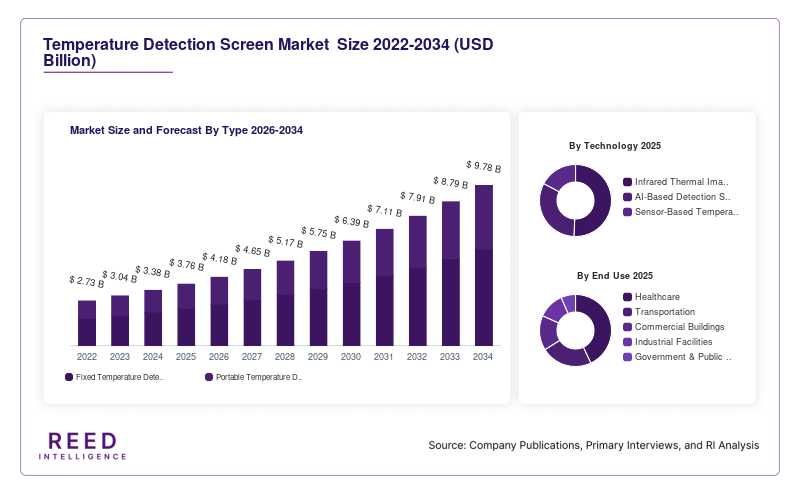
Fixed systems dominated the Temperature Detection Screen Market with a 61% share in 2025 due to their widespread use in airports, hospitals, and commercial buildings where continuous monitoring is required. These systems are preferred for high-traffic environments as they offer stable installation and integration with access control systems. Portable systems are expected to grow at a CAGR of 12.8% during the forecast period due to increasing demand for flexible deployment in temporary locations such as events, construction sites, and emergency response zones. Rising need for mobility and quick installation is supporting adoption across diverse applications.
By Technology
Infrared-based systems held the largest share of 54% in 2025 in the Temperature Detection Screen Market due to cost efficiency and reliable performance in detecting body temperature variations. AI-based systems are projected to grow at a CAGR of 13.1% due to their ability to enhance accuracy, reduce false readings, and enable predictive analytics. Increasing integration of facial recognition and cloud-based monitoring capabilities is further accelerating adoption of advanced systems across security-sensitive environments.
By End Use
Healthcare dominated the Temperature Detection Screen Market with a 46% share in 2025 due to widespread deployment in hospitals, clinics, and diagnostic centers. Transportation is expected to grow at a CAGR of 12.5% during the forecast period due to rising passenger traffic and increasing adoption of automated screening systems in airports and railway stations. Commercial and industrial sectors are also expanding steadily with growing emphasis on workplace safety and automated entry screening systems.
Regional Analysis
North America
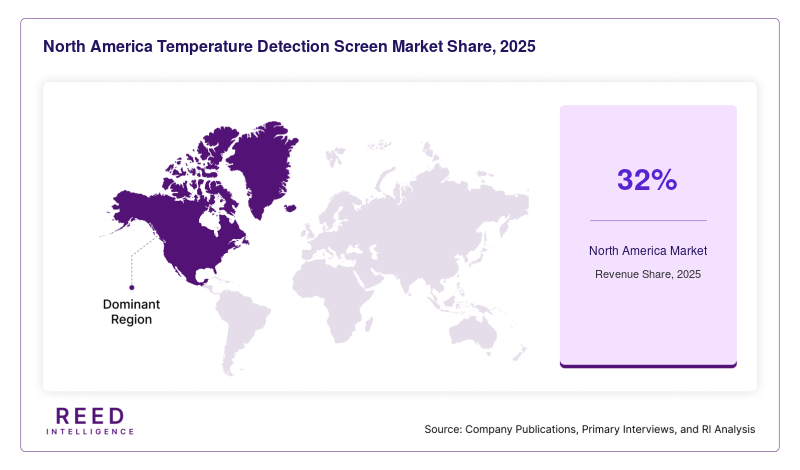
North America accounted for 32% share of the Temperature Detection Screen Market in 2025 and is expected to grow at a CAGR of 10.6% from 2026 to 2034. Growth in this region is driven by strong adoption of advanced healthcare infrastructure, high security standards, and widespread deployment of automated screening technologies across public and private facilities. The United States dominates the regional market due to large-scale integration of AI-based screening systems in airports, corporate offices, and healthcare institutions. A major growth factor is the increasing emphasis on smart building infrastructure that integrates thermal screening with access control and security systems.
Europe
Europe held 27% share of the Temperature Detection Screen Market in 2025 and is projected to expand at a CAGR of 10.2% during the forecast period. Growth is supported by strict workplace safety regulations and strong focus on public health monitoring systems. Germany leads the region due to its advanced industrial automation ecosystem and rapid deployment of smart infrastructure technologies. The integration of thermal screening systems in manufacturing plants, transportation networks, and public buildings is a key factor supporting market expansion.
Asia Pacific
Asia Pacific dominated the Temperature Detection Screen Market with 38% share in 2025 and is expected to grow at a CAGR of 12.1% during the forecast period. Rapid urbanization, large population density, and increasing investments in smart city projects are key growth drivers. China leads the region due to large-scale government-led deployment of AI-enabled surveillance and thermal screening systems across public infrastructure. Expansion of transportation networks and healthcare modernization programs further strengthen market demand.
Middle East & Africa
Middle East & Africa accounted for 8% share of the Temperature Detection Screen Market in 2025 and is projected to grow at the highest CAGR of 12.4% from 2026 to 2034. Growth is driven by rising investments in airports, healthcare facilities, and smart city developments. The United Arab Emirates leads the region due to strong adoption of advanced security systems and integration of intelligent screening technologies in public infrastructure. Increasing tourism and infrastructure modernization are further supporting demand.
Latin America
Latin America held 5% share of the Temperature Detection Screen Market in 2025 and is expected to grow at a CAGR of 10.8% during the forecast period. Growth is supported by gradual modernization of healthcare systems and increasing adoption of automated screening technologies in urban areas. Brazil dominates the regional market due to expansion of public healthcare infrastructure and rising investment in smart surveillance systems across transportation and commercial facilities.
Competitive Landscape
The Temperature Detection Screen Market is moderately competitive with the presence of global technology providers and specialized thermal imaging companies. Key players include FLIR Systems (Teledyne FLIR), Hikvision, Dahua Technology, Honeywell International, and Bosch Security Systems. FLIR Systems leads the market due to its advanced thermal imaging portfolio and continuous innovation in AI-integrated screening solutions.
The company has recently expanded its cloud-enabled temperature screening systems to enhance real-time monitoring and centralized data management. Hikvision and Dahua Technology focus on large-scale deployments in public infrastructure projects, particularly in Asia Pacific. Honeywell International emphasizes integrated enterprise security solutions combining access control and thermal detection, while Bosch Security Systems focuses on modular and scalable screening solutions for commercial and industrial applications.
Key Players List
- FLIR Systems (Teledyne FLIR)
- Hikvision
- Dahua Technology
- Honeywell International
- Bosch Security Systems
- Axis Communications
- OMRON Corporation
- Seek Thermal
- Infrared Cameras Inc.
- Thermoteknix Systems
- Raytek Corporation
- NEC Corporation
- Panasonic Holdings Corporation
- Zebra Technologies
- Mobotix AG
Temperature Detection Screen Market Segments
By Type
- Fixed Temperature Detection Screens
- Portable Temperature Detection Screens
By Technology
- Infrared Thermal Imaging Systems
- AI-Based Detection Systems
- Sensor-Based Temperature Detection Systems
By End Use
- Healthcare
- Transportation
- Commercial Buildings
- Industrial Facilities
- Government & Public Infrastructure
By Application
- Entry Screening Systems
- Crowd Monitoring Systems
- Security Checkpoints
- Public Health Surveillance Systems
By Region
- North America
- Europe
- APAC
- Middle East and Africa
- LATAM