Temperature Sensor in the Aerospace Defense Market Size, Share & Demand Report By Sensor Type (Thermocouples, Resistance Temperature Detectors (RTDs)), By Platform (Commercial Aircraft, Military Aircraft, Unmanned Aerial Vehicles (UAVs)), By Application (Engine Monitoring Systems, Avionics Thermal Management), By End User (Aerospace OEMs, Defense Organizations, Maintenance), By Region & Segment Forecasts, 2026–2034
USD 3950
Market Overview
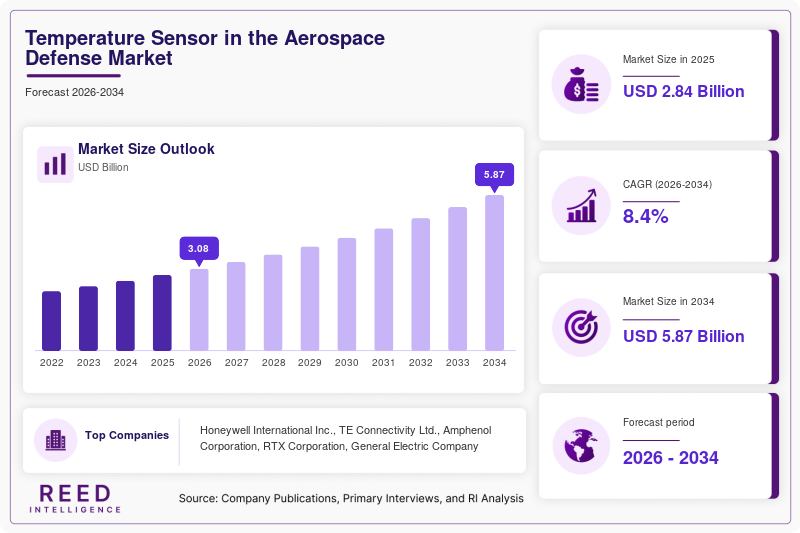
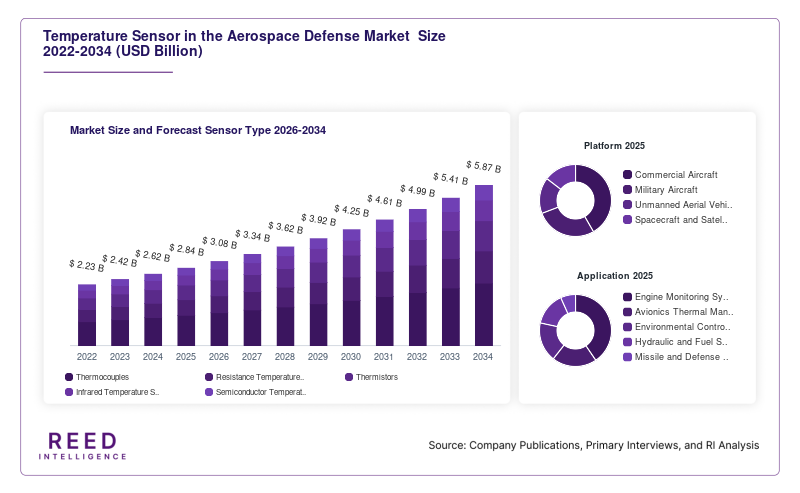
The Temperature Sensor in the Aerospace Defense Market was valued at USD 2.84 billion in 2026 and is projected to reach USD 5.41 billion by 2034, expanding at a CAGR of 8.4% during the forecast period from 2026 to 2034. The global Temperature Sensor in the Aerospace Defense Market growth has been supported by rising investments in advanced aircraft systems, defense modernization programs, and increasing adoption of predictive maintenance technologies across aerospace platforms. Temperature sensors have become essential components in aircraft engines, avionics, hydraulic systems, environmental control units, and missile guidance systems due to their ability to ensure operational safety and thermal efficiency.
The growing demand for commercial aircraft and military fleet expansion has significantly accelerated the adoption of advanced sensing technologies. Aerospace manufacturers are increasingly integrating high-performance temperature sensors to monitor system performance under extreme operating conditions. These sensors help improve fuel efficiency, reduce maintenance downtime, and support real-time diagnostics in aerospace and defense applications.
Key Highlights
- North America accounted for 38.7% of the global Temperature Sensor in the Aerospace Defense Market share in 2025, while Asia Pacific is projected to register the fastest CAGR of 9.1% during 2026–2034.
- By sensor type, thermocouples dominated the market with a 34.5% share in 2025, while infrared temperature sensors are projected to grow at a CAGR of 9.6%.
- By platform, commercial aircraft represented the leading segment with 41.2% market share in 2025, whereas unmanned aerial vehicles (UAVs) are forecast to expand at a CAGR of 10.2%.
- By application, engine monitoring systems held 36.8% of the market share in 2025, while avionics thermal management systems are expected to grow at a CAGR of 9.4%.
- The United States remained the dominant country market, valued at USD 846 million in 2024 and USD 912 million in 2025.
Market Trends
Integration of Smart Sensor Technologies
The integration of smart sensing technologies has emerged as a major trend shaping the Temperature Sensor in the Aerospace Defense Market. Aerospace manufacturers are increasingly deploying intelligent temperature sensors equipped with wireless communication, self-diagnostic capabilities, and real-time monitoring functions.
These advanced systems enable predictive maintenance and improve operational efficiency across aircraft fleets. Airlines and defense operators are using smart sensor networks to detect thermal abnormalities early and minimize system failures.
Growing Adoption of Infrared Temperature Sensors
Infrared temperature sensors are witnessing increasing adoption across aerospace and defense applications. These non-contact sensors are suitable for monitoring high-temperature engine components, turbine systems, and missile guidance units without direct physical interaction.
The growing focus on thermal efficiency and equipment protection is supporting the use of infrared sensing technologies in advanced aerospace platforms.
Market Drivers
Expansion of Aircraft Production and Fleet Modernization
The rising production of commercial aircraft and modernization of military fleets are key drivers supporting the Temperature Sensor in the Aerospace Defense Market. Aircraft manufacturers are integrating advanced sensing systems to improve thermal management, flight safety, and equipment reliability.
Defense agencies are also upgrading aging military aircraft with modern avionics and monitoring technologies, which is increasing demand for high-performance temperature sensors.
Increasing Demand for Predictive Maintenance Systems
Predictive maintenance systems have become essential within aerospace and defense operations. Temperature sensors play a critical role in monitoring engine health, hydraulic systems, and electronic components to prevent unexpected failures.
The growing emphasis on reducing maintenance costs and improving operational uptime is accelerating sensor deployment across aerospace platforms.
Market Restraint
High Certification and Compliance Requirements
The Temperature Sensor in the Aerospace Defense Market faces challenges associated with strict aerospace certification standards and regulatory compliance requirements. Sensor manufacturers must meet rigorous testing and qualification procedures, which can increase production costs and extend product development timelines.
Market Opportunities
Rising Investments in Space Exploration Programs
The increasing number of satellite launches and space exploration initiatives is creating new opportunities for the Temperature Sensor in the Aerospace Defense Market. Spacecraft and satellite systems require highly reliable temperature sensors capable of operating under extreme environmental conditions.
Growing government and private sector investments in space technologies are expected to support market expansion.
Expansion of Electric and Hybrid Aircraft Development
The development of electric and hybrid aircraft presents emerging opportunities for advanced thermal monitoring systems. These aircraft platforms require highly accurate temperature sensors to manage battery systems, power electronics, and electric propulsion components.
As sustainable aviation technologies continue to evolve, demand for advanced temperature sensing solutions is expected to increase substantially.
Segmental Analysis
By Sensor Type
Thermocouples Dominated the Market
Thermocouples accounted for 34.5% of the Temperature Sensor in the Aerospace Defense Market share in 2025 due to their wide operating temperature range and high reliability in harsh aerospace environments.
These sensors were widely utilized in turbine engines, exhaust systems, and propulsion monitoring applications because of their durability and fast response times.
Infrared Temperature Sensors to Witness Fastest Growth
Infrared temperature sensors are projected to grow at a CAGR of 9.6% through 2034. Growth will be driven by increasing demand for non-contact thermal monitoring systems across advanced aircraft and missile platforms.
The ability to monitor extreme temperatures remotely will support their adoption in critical aerospace applications.
By Platform
Commercial Aircraft Held the Largest Share
Commercial aircraft represented 41.2% of the Temperature Sensor in the Aerospace Defense Market share in 2025 because of rising global air passenger traffic and increasing aircraft production volumes.
Temperature sensors were extensively integrated into environmental control systems, engines, avionics, and cabin monitoring systems.
UAVs to Expand Rapidly
Unmanned aerial vehicles (UAVs) are forecast to expand at a CAGR of 10.2% during the forecast period. Growth will be supported by increasing military surveillance applications and expanding commercial drone operations.
By Application
Engine Monitoring Systems Led the Market
Engine monitoring systems held 36.8% of the Temperature Sensor in the Aerospace Defense Market share in 2025 due to the critical requirement for thermal management and engine performance optimization.
Temperature sensors played a major role in detecting overheating conditions and improving aircraft operational reliability.
Avionics Thermal Management Systems to Register Strong Growth
Avionics thermal management systems are expected to grow at a CAGR of 9.4% during 2026–2034. Growth will be supported by increasing integration of advanced electronic systems and connected avionics technologies in modern aircraft.
By End User
Aerospace OEMs Dominated the Market
Aerospace OEMs accounted for 44.6% of the Temperature Sensor in the Aerospace Defense Market share in 2025 because of growing production of commercial and military aircraft.
OEMs increasingly integrated advanced sensing systems into new-generation aircraft platforms to improve operational safety and system reliability.
Defense Organizations to Grow Significantly
Defense organizations are projected to expand at a CAGR of 8.8% during the forecast period. Growth will be driven by rising investments in defense modernization and advanced military aviation systems.
Regional Analysis
North America
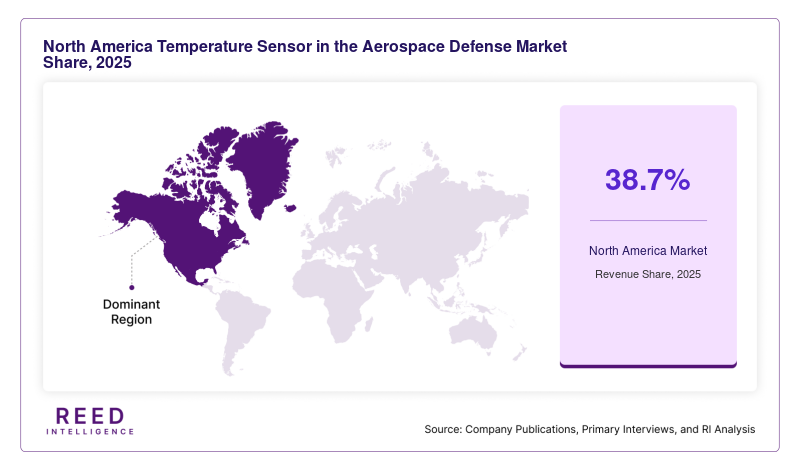
North America held 38.7% of the global Temperature Sensor in the Aerospace Defense Market share in 2025 and will grow at a CAGR of 8.3% during the forecast period. The regional market expanded due to strong aerospace manufacturing capabilities and rising defense modernization programs.
The United States dominated the region because of increasing investments in next-generation military aircraft, commercial aviation, and space exploration projects.
Europe
Europe accounted for 27.1% of the Temperature Sensor in the Aerospace Defense Market share in 2025 and will register a CAGR of 7.8% through 2034. The market experienced steady growth because of expanding aircraft production activities and strong aerospace engineering capabilities.
Germany emerged as the dominant country due to increasing aerospace component manufacturing and growing adoption of industrial automation technologies.
Asia Pacific
Asia Pacific represented 22.8% of the global Temperature Sensor in the Aerospace Defense Market share in 2025 and is projected to witness the fastest CAGR of 9.1% during 2026–2034. Rising aircraft procurement activities and expanding aerospace infrastructure supported regional market growth.
China led the regional market because of increasing investments in domestic aircraft manufacturing and defense technology development.
Middle East & Africa
Middle East & Africa captured 6.2% of the Temperature Sensor in the Aerospace Defense Market share in 2025 and will grow at a CAGR of 7.2% during the forecast period. The market expanded because of rising defense spending and increasing aircraft fleet expansion initiatives.
Saudi Arabia dominated the region due to ongoing investments in military aviation infrastructure and aerospace modernization programs.
Latin America
Latin America accounted for 5.2% of the global Temperature Sensor in the Aerospace Defense Market share in 2025 and will register a CAGR of 6.9% through 2034. Regional growth was supported by increasing commercial aviation activities and gradual defense sector upgrades.
Brazil remained the leading country because of growing aerospace manufacturing activities and rising investments in aviation infrastructure.
Competitive Landscape
The Temperature Sensor in the Aerospace Defense Market is characterized by strong competition among aerospace component manufacturers and sensor technology providers. Companies are focusing on product innovation, miniaturization technologies, and advanced thermal sensing capabilities to strengthen their market position.
Honeywell International Inc. remained one of the leading participants in the Temperature Sensor in the Aerospace Defense Market due to its broad aerospace sensor portfolio and advanced avionics technologies. The company recently expanded its aerospace sensing solutions for next-generation aircraft thermal monitoring applications.
Major companies are also emphasizing strategic partnerships with aircraft manufacturers and defense contractors to enhance product integration capabilities and expand their global footprint.
Key Players List
- Honeywell International Inc.
- TE Connectivity Ltd.
- Amphenol Corporation
- RTX Corporation
- General Electric Company
- Safran S.A.
- BAE Systems plc
- Emerson Electric Co.
- Sensata Technologies Holding plc
- Meggitt PLC
- Curtiss-Wright Corporation
- TT Electronics plc
- Thales Group
- Omega Engineering Inc.
- PCB Piezotronics, Inc.
Temperature Sensor in the Aerospace Defense Market Segments
Sensor Type
- Thermocouples
- Resistance Temperature Detectors (RTDs)
- Thermistors
- Infrared Temperature Sensors
- Semiconductor Temperature Sensors
Platform
- Commercial Aircraft
- Military Aircraft
- Unmanned Aerial Vehicles (UAVs)
- Spacecraft and Satellites
Application
- Engine Monitoring Systems
- Avionics Thermal Management
- Environmental Control Systems
- Hydraulic and Fuel Systems
- Missile and Defense Systems
End User
- Aerospace OEMs
- Defense Organizations
- Maintenance, Repair & Overhaul (MRO) Providers
- Space Agencies
By Region
- North America
- Europe
- APAC
- Middle East and Africa
- LATAM